

Every great writer from Hemingway to your favorite blogger relies on one thing above all else: sentence structure. Your writing feels choppy, robotic, or confusing. Get it right and your words flow so naturally that readers don’t even notice the craft behind them.
This guide breaks down simple and compound sentences from the ground up. You’ll learn what they are, how to build them, when to use each one and just as importantly when not to. Whether you’re a student, a professional writer, or someone who just wants to communicate more clearly, this is the foundation everything else builds on.
Why Sentence Structure Actually Matters
Therefore, think about the last time you struggled to read something. Chances are the sentences were all the same length, or the ideas felt disconnected, or the writing just felt flat. That’s a sentence structure problem.
What is sentence structure?
Simply put, it’s how you arrange words and clauses to form a complete thought. Strong sentence structure keeps readers engaged. It controls rhythm, clarity, and even emotion. Vary it well and your writing breathes. Ignore it and your writing suffocates.
Moreover, there are four main sentence structure types: simple, compound, complex, and compound complex. This post focuses on the first two simple and compound because they’re the foundation everything else is built on.
Start With the Basics What Is a Clause?
Before you can understand sentence types, you need to know what a clause is. It’s simpler than it sounds.
A clause is a group of words that contains a subject and a verb. There are two kinds:
- Independent clause: expresses complete thought and can stand alone.
Example: She reads every night.
- Dependent clauses: have a subject and verb but can’t stand alone because it doesn’t express a complete thought.
Example: Because she loves stories.
Every sentence you write is built from one or more of these clauses. Think of them as LEGO bricks the type and number you snap together determines what kind of sentence you get.
What Is a Simple Sentence?
The Definition
A sentence which contains one independent clause is known as simple sentence. That’s the whole definition. One subject, one verb, one complete thought.
“The dog barked.”
Done. That’s a simple sentence.
Simple Doesn’t Mean Short
Here’s a myth worth busting simple sentences aren’t weak or early. The most powerful sentences ever written are simple. Hemingway built an entire literary career on them.
“The old man fished alone in a skiff in the Gulf Stream.” Ernest Hemingway, The Old Man and the Sea
That sentence is 16 words long. It’s still simple. It has one independent clause, one subject (the old man), and one verb (fished). Length doesn’t determine sentence type clause count does.
Simple Sentence Structure Examples
Here are several simple sentence structure examples with their parts labeled:
| Sentence | Subject | Verb | Object/Complement |
| Dogs bark. | Dogs | bark | — |
| She runs every morning. | She | runs | every morning |
| The team won the championship. | The team | won | the championship |
| My brother cooks incredible pasta. | My brother | cooks | incredible pasta |
| The storm destroyed the old barn. | The storm | destroyed | the old barn |
Notice how each one delivers a clear, complete thought. No fluff. No confusion.
Common Mistakes with Simple Sentences
The biggest trap? Using too many simple sentences in a row. Like this:
She woke up.
She made coffee.
So, it’s technically correct. But it’s exhausting to read. It has no rhythm, no flow it sounds like a police report. The fix is to mix in other sentence types, which we’ll get to shortly.
What Is a Compound Sentence?
The Definition
The sentence which contains two or more independent clauses joined together is known as compound sentence. Each clause could stand alone as its own sentence but linking them shows a relationship between the ideas.
“She loves coffee, but she can’t stand tea.”
Both sides work independently. Joining them creates contrast and flow.
You might be interested in Phrases About Time
The Three Ways to Build a Compound Sentence
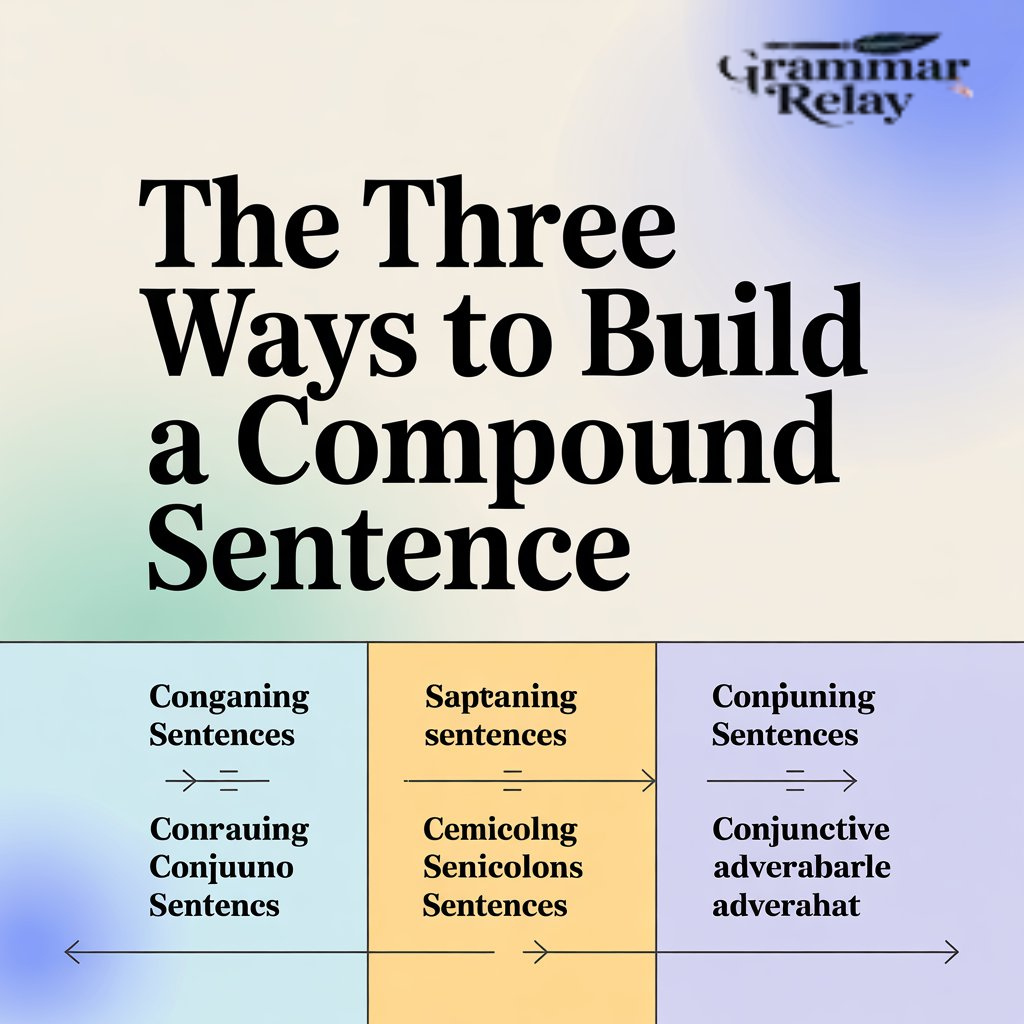
This is where simple sentence structure expands into something richer. You have three tools at your disposal.
Coordinating Conjunctions (FANBOYS)
The most common method. FANBOYS stands for:
For, And, Nor, But, Or, Yet, So
Place a comma before the conjunction when joining two independent clauses:
- She studied hard and she passed the exam.
- He wanted to stay but the rain started.
- You can call me or you can send an email.
- They didn’t quit nor did they slow down.
- She was tired so she went to bed early.
- The plan was risky, yet they moved forward.
- He skipped breakfast because he was running late.
Each conjunction signals a different relationship addition, contrast, choice, consequence. Choosing the right one sharpens your meaning considerably.
Semicolons
A semicolon joins two closely related independent clauses without a conjunction. It’s a stronger pause than a comma but a softer stop than a period.
“The deadline is tomorrow; we need to finish tonight.”
Use it when the relationship between clauses is obvious and you don’t need a conjunction to spell it out. It also adds a slightly more formal tone.
Conjunctive Adverbs
Words like however, therefore, meanwhile, consequently, and nevertheless can join independent clauses. The punctuation rule here trips people up constantly:
Semicolon before + comma after
“She trained for months; however, the injury forced her out of the race.”
“The data was incomplete; therefore, the results were inconclusive.”
Get that punctuation right and you’ll immediately sound more polished.
Compound Sentence Examples in Context
Here’s a practical look at simple, compound, and complex sentences examples starting with two simple sentences transformed into one compound sentence:
| Two Simple Sentences | Compound Sentence |
| It was raining. We stayed inside. | It was raining so we stayed inside. |
| She loves hiking. She hates camping. | She loves hiking but she hates camping. |
| He called twice. Nobody answered. | He called twice; nobody answered. |
| You can drive. You can take the train. | You can drive or you can take the train. |
Simple vs Compound A Side-by-Side Comparison
| Feature | Simple Sentence | Compound Sentence |
| Number of clauses | One | Two or more |
| Joining words needed | No | Yes (conjunction or semicolon) |
| Best used for | Emphasis, clarity, punch | Showing relationship between ideas |
| Common errors | Choppy writing when overused | Comma splices, run-ons |
| Rhythm effect | Short, decisive | Balanced, flowing |
How to Use Both Sentence Types Together
Here’s where it all clicks. When you understand simple, compound and complex sentences examples in real paragraphs, you start to see why mixing them is so essential.
Paragraph using only simple sentences:
The storm arrived fast. The wind picked up. Trees bent sideways. Power lines snapped. People ran for cover.
Technically fine. But it reads like a telegram.
Same paragraph with mixed structure:
The storm arrived fast. Wind tore through the streets and trees bent sideways like blades of grass. Power lines snapped; people barely had time to run.
That’s the same information just written with rhythm. Short sentences create impact. Compound sentences show cause and effect. Together, they pull the reader forward.
So, the goal isn’t to memorize rules. It’s to develop a feeling when your writing needs a quick punch (simple) versus when it needs to show connection (compound).
Quick Grammar Rules to Keep Handy
- Always place a comma before FANBOYS when joining two independent clauses
- Use a semicolon when two clauses are closely related and no conjunction is needed
- With conjunctive adverbs: semicolon before, comma after
- The simple sentence can have a compound predicate (She sings and dances) that’s still one clause, not two
- Never use a comma alone to join two independent clauses, that’s a comma splice
Practice Exercises
Identify Simple or Compound
Read each sentence and identify its type:
- The cat slept on the windowsill.
- I wanted pizza but she preferred sushi.
- Running every day keeps your energy high.
- He finished the book; he started another immediately.
- The kids played outside until dark.
Answers: 1-Simple, 2-Compound, 3-Simple, 4-Compound, 5-Simple
Frequently Asked Questions
Can a simple sentence be long?
Absolutely, a simple sentence can be if it needs to be if it has one independent clause. Length and sentence type are separate things.
What’s the difference between a compound sentence and a compound subject?
A compound subject (Tom and Jerry ran) is still a simple sentence it has one clause. On the other hand, a compound sentence has two or more independent clauses joined together.
Do compound sentences always need a comma?
Therefore, Only when you use a coordinating conjunction (FANBOYS). With a semicolon, no comma is needed.
What is a comma splice?
It’s joining two independent clauses with only a comma and no conjunction. This is one of the most common grammar errors in English writing and one of the easiest to fix.
Read more grammar lessons on GrammarRelay
Conclusion
As mastering simple and compound sentences isn’t about following rigid rules. It’s about giving yourself more tools. Simple sentences hit hard. Compound sentences connect ideas. So, use them together and your writing gains a rhythm that keeps readers engaged from the first word to the last.
Once these feel natural, you’re ready for the next level: complex and compound complex sentences where dependent clauses open up a whole new world of nuance and sophistication.
