

If you’ve ever said “I have seen him three days ago” and gotten a confused look in return this guide is for you. Time expressions are the backbone of clear communication. Get them right and you sound natural. Get them wrong and your meaning collapses entirely.
If you want to get more details about “time expression”, must read this article till the end!
What Are Time Expressions and Why Do They Matter?
A time expression is any word or phrase that tells us when something happens, how long it lasts, or how often it occurs. Think of them as timestamps for your sentences.
So, what is a time expression exactly? It’s broader than most people realize. “Yesterday,” “since 2010,” “every other Tuesday,” and “in the middle of the night” are all time expressions. They work alongside verb tenses to anchor your meaning in time.
Without them, sentences float. “She called” tells us nothing useful. “She called last night” now we’re talking.
“The single biggest problem in communication is the illusion that it has taken place.” George Bernard Shaw
Time expressions prevent that illusion. They make your message land.
The 6 Core Types of Time Expressions in English
Past Tense Time Expressions What Already Happened
Past tense time expressions signal that something is finished, done, and behind us. The most common ones include:
- Yesterday, last week, last year
- Ago (three days ago, a long time ago)
- In + a past year (in 1998, in the 1980s)
- The other day, back then, once, formerly, previously
The trickiest one here is “ago.” It always pairs with the past simple tense never the present perfect. So “I have visited Paris three years ago” is wrong. The correct form is “I visited Paris three years ago.” Simple rule, huge impact.
“Before” and “ago” also confuse a lot of learners. Here’s the difference: ago counts back from now. Before counts back from another point in time. “She left two hours ago” vs. “She had left two hours before I arrived.” Different anchors entirely.
You might be interested in Phrases About Time
Present Time Expressions What’s Happening Right Now
Present time expressions describe current states, habits, or ongoing actions. Common ones include:
- Now, currently, at the moment
- These days, nowadays, today
- Still, already, just
Here’s a subtle distinction worth knowing: “nowadays” and “these days” both describe general present trends but feel slightly different in register. Nowadays leans a touch more formal. These days feels more conversational.
“Still,” “yet,” and “already” are where learners stumble most. Quick breakdown:
| Word | Use | Example |
|---|---|---|
| Still | Ongoing situation (often surprising) | She’s still waiting. |
| Yet | Expected but not happened (negatives/questions) | Has he called yet? |
| Already | Sooner than expected | I’ve already eaten. |
Future Time Expressions Planning and Predicting
Future time phrases help you discuss what’s coming. The most useful ones:
- Tomorrow, next week, next month
- Soon, eventually, shortly, before long
- In two days, in a week’s time
- By Friday, by the end of the year
- From now on, from this point forward
Pay attention to “in” vs. “within.” In three days means exactly three days from now. Within three days means anytime between now and three days from now. A deadline sensitive distinction.
Also, the certainty level of your prediction often determines which structure you use:
- Will → predictions, spontaneous decisions (“It’ll rain tomorrow.”)
- Going to → plans, evidence-based predictions (“Look at those clouds it’s going to rain.”)
- Present continuous → fixed future arrangements (“I’m meeting her at noon.”)
Frequency Expressions How Often Things Happen
Frequency time expression examples tell us about repetition. The classic scale runs like this:
Always → Usually → Often → Sometimes → Rarely → Hardly ever → Never
Position matters here. Frequency adverbs sit before the main verb but after the verb “to be”:
- She always drinks coffee in the morning. ✅
- She is always late. ✅
- Always she drinks coffee. ❌
Longer frequency phrases once a week, every other day, twice a month typically go at the end of the sentence. “He goes to the gym three times a week.”
Duration Expressions How Long Something Lasts
This is where “for” and “since” become essential where most learners hit a wall.
For describes a length of time. Since describes a starting point.
- I’ve lived here for five years. (length)
- I’ve lived here since 2019. (starting point)
Memory trick: if you can replace the word with “a period of,” use for. If you can replace it with “starting from,” use since.
Other useful duration expressions include:
- During throughout a specific event or period (“during the meeting”)
- Throughout from beginning to end without interruption (“throughout the night”)
- Over across a span of time (“over the past decade”)
- All day / all week continuous duration
During vs. for: During tells you when (during the film). For tells you how long (for two hours). You can’t swap them. “I slept during two hours” sounds wrong because it is.
Read more about Simple and Compound Sentences
Sequence and Order Time Expressions Telling Events in Order
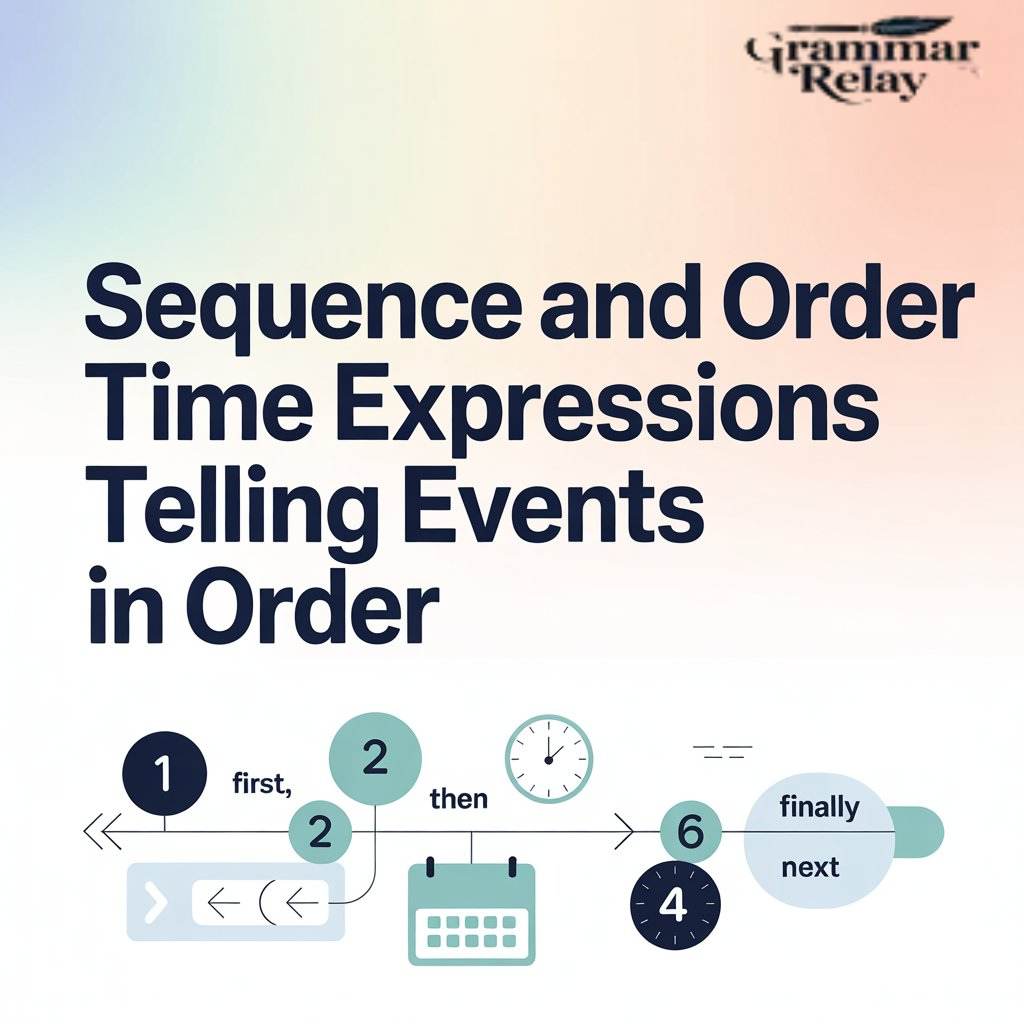
These time phrases keep your storytelling coherent. They show the audience what happened first, what came next, and how events relate to each other.
Common sequence expressions:
- Opening: First, to begin with, initially
- Middle: Then, next, after that, subsequently, meanwhile, at the same time
- Closing: Finally, eventually, in the end, at last
“Meanwhile” and “at the same time” both describe parallel events but feel different. Meanwhile is more dramatic and narrative-driven. At the same time is more neutral and informational.
One note on formality: words like subsequently and thereafter belong in formal writing. In everyday speech, then and after that do the job better.
Time Expressions and Verb Tenses The Complete Pairing Guide
This is the section that ties everything together. Here’s a quick reference table:
| Time Expression | Correct Tense | Example |
|---|---|---|
| Yesterday | Past Simple | She called yesterday. |
| Since 2015 | Present Perfect | He’s lived here since 2015. |
| At the moment | Present Continuous | They’re working at the moment. |
| By next Friday | Future Perfect | I’ll have finished by next Friday. |
| For three years | Present Perfect / Past Perfect | She’d studied for three years. |
| When I was young | Past Simple | We played outside every day. |
| Just | Present Perfect | I’ve just arrived. |
| Already | Present Perfect | He’s already left. |
| Tomorrow | Future (will / going to) | I’ll call you tomorrow. |
Prepositions in Time Expressions At, In, On, By, For, Since
Prepositions of time trip up even advanced learners. Here’s the no fluff breakdown:
At → specific clock times and set phrases
- At 9 o’clock, at noon, at midnight, at the weekend, at Christmas
In → months, years, seasons, longer periods
- In March, in 2024, in the summer, in the 19th century
On → specific days and dates
- On Monday, on July 4th, on New Year’s Eve
By → deadline (no later than)
- Submit it by Thursday. (Thursday is the latest possible moment.)
Until / Till → up to a point in time
- Wait until Thursday. (The action continues right up to Thursday.)
By vs. until is a distinction that changes everything in professional settings. By sets a deadline. Until sets an endpoint for an ongoing action. “Finish by noon” is not the same as “wait until noon.”
Zero preposition cases when no preposition is needed:
- Last week, next Monday, this morning, every day, yesterday
Don’t say “on last Monday” or “in next week.” No preposition needed.
The Most Common Mistakes with Time Expressions
Let’s cut straight to the errors people make most often and how to fix them.
| Mistake | Why It’s Wrong | Correction |
|---|---|---|
| I have seen him three days ago. | “Ago” requires past simple | I saw him three days ago. |
| She is working since morning. | “Since” needs present perfect | She has been working since morning. |
| In the end of the movie, he dies. | Wrong preposition | At the end of the movie, he dies. |
| I have finished already my work. | Wrong word order | I’ve already finished my work. |
| During two hours, we waited. | “During” needs a noun event | For two hours, we waited. |
“In the end” vs. “at the end” catches everyone at some point. At the end refers to the final part of something specific (“at the end of the chapter”). In the end means “eventually” or “after everything” (“In the end, she decided to stay”).
Time Expressions in Real Conversation How Native Speakers Actually Use Them
Native speakers use time expression examples that textbooks often skip. Here are some natural, informal time phrases you’ll hear constantly:
- Back in the day referring to the past nostalgically
- One of these days vague future intention
- Any minute now something expected very soon
- In a sec / in a bit informal for “shortly”
- At some point unspecified future or past
Spoken English also blends and shortens time expressions. “I’ll do it in a minute” often means “I’ll do it eventually.” Context matters as much as the words themselves.
Quick-Reference Summary Tables
Time Expressions by Category
| Category | Examples |
|---|---|
| Past | Yesterday, ago, last week, back then, formerly |
| Present | Now, currently, still, already, these days |
| Future | Tomorrow, soon, by Friday, eventually, next month |
| Frequency | Always, often, rarely, once a week, every day |
| Duration | For, since, during, throughout, all day |
| Sequence | First, then, meanwhile, finally, subsequently |
Prepositions of Time at a Glance
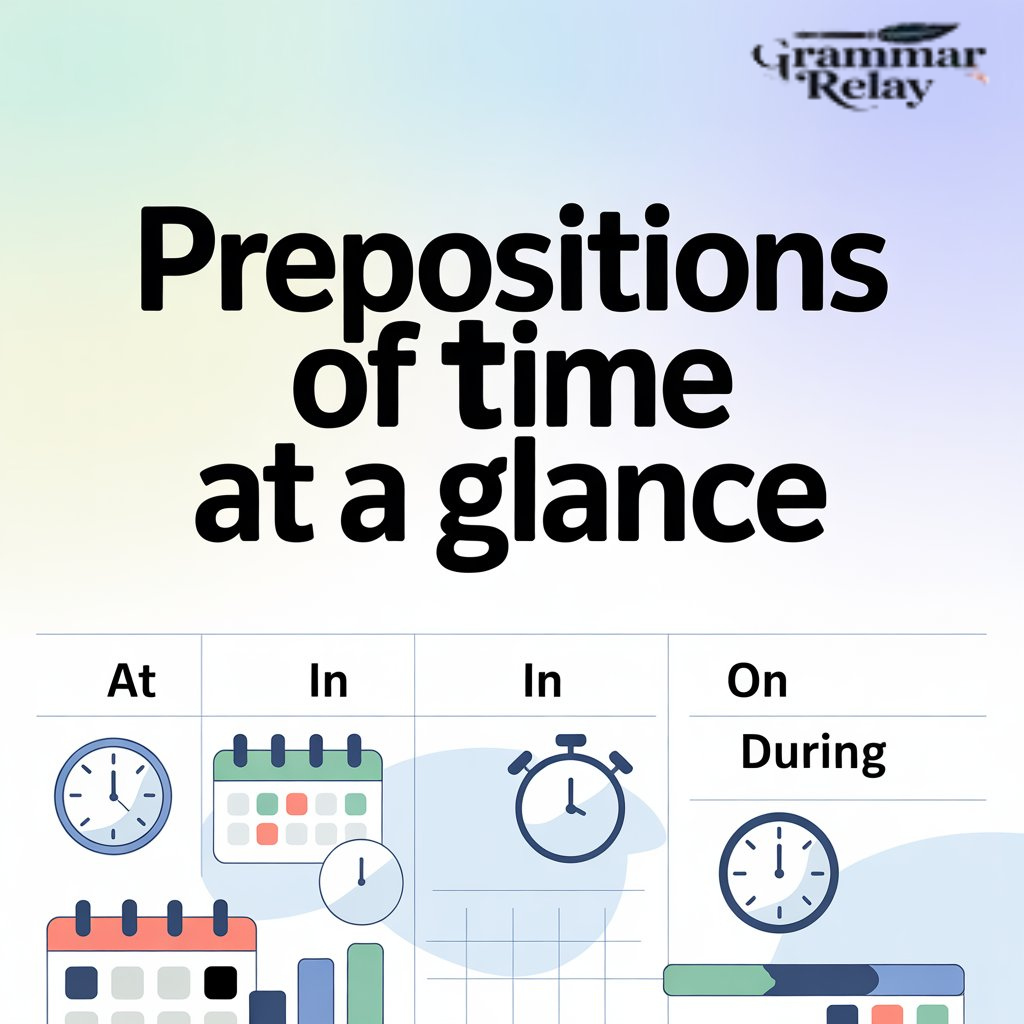
| Preposition | Used With | Example |
|---|---|---|
| At | Clock times, set phrases | At 6pm, at Christmas |
| In | Months, years, seasons | In April, in 2023 |
| On | Days, dates | On Friday, on March 5th |
| By | Deadlines | By tomorrow |
| Until | Endpoints of ongoing action | Until midnight |
| For | Length of time | For two hours |
| Since | Starting points | Since Monday |
Frequently Asked Questions About Time Expressions
What is a time expression in English?
A time expression is any word or phrase that tells you when something happens, how long it lasts, or how often it occurs. Words like “yesterday,” “since Monday,” and “every week” are all time expressions.
What are the most common time expression examples?
Some of the most frequently used ones include: yesterday, tomorrow, ago, since, for, already, yet, still, soon, currently, and eventually. Each one pairs with specific verb tenses to make your meaning clear.
What is the difference between “for” and “since”?
For describes a length of time “I’ve lived here for five years.” Since marks a starting point “I’ve lived here since 2019.” Simple rule: if you can say “a period of,” use for. If you can say “starting from,” use since.
Can time expressions be used with any tense?
Not freely. Each time expression tends to pair with specific tenses. “Yesterday” goes with past simple. “Since” pairs with present perfect. Using them with the wrong tense is one of the most common grammar mistakes in English.
What are present time expressions?
Present time expressions describe what’s happening now or in general. Common ones include: now, currently, at the moment, these days, nowadays, still, and already.
What does “time expressions ne dame” mean?
This is a Turkish phrase meaning “what do time expressions mean?” a common question among Turkish learners studying English grammar. The short answer: zaman fiddler angelize (time expressions in English) are words and phrases that show when or how long something happens.
What’s the difference between “at the end” and “in the end”?
At the end refers to the final part of something specific “at the end of the movie.” In the end means “eventually” or “after everything”. “In the end, she made the right choice.” They’re not interchangeable.
Why do past tense time expressions matter so much?
Because they tell your listener or reader when something happened and that changes meaning entirely. “I saw him” is vague. “I saw him last night” is clear, grounded, and easy to follow.
Read more grammar lessons on GrammarRelay
Conclusion
Mastering time expressions isn’t about memorizing lists. It’s about recognizing patterns noticing how native speakers anchor their sentences in time and then doing the same thing yourself.
Start small. Pick five time expression examples from this guide and use them deliberately in your next five conversations. Notice zaman ifadeleri ingilizce (time expressions in English) when you read articles or watch shows. The more you spot them in the wild, the more naturally you’ll reach for them yourself.
Time phrases are everywhere. Once you start seeing them, you can’t unsee them and that’s exactly when your English starts to sound genuinely fluent.
