

Few words in English work as hard as “like”. It’s a verb, a preposition, a conjunction, a noun, an adverb and somehow it still finds time to be a filler word in casual conversation. Whether you’re trying to nail the like definition for a grammar test or just curious about what part of speech is like, this guide covers everything.
What Does “Like” Actually Mean?
The short answer? It depends on how you use it.
Like has two completely separate Old English roots. One comes from gallic (meaning “similar in form”) and the other from Lycian (meaning “to please”). That’s why “I like pizza” and “She looks like her mother” feel so different they literally descend from different words.
Here’s a quick overview before we go deep:
| Grammatical Role | Core Meaning | Example |
|---|---|---|
| Verb | To enjoy or prefer | I like jazz |
| Noun | A preference or equal | Her likes and dislikes |
| Preposition | Similar to | He swims like a fish |
| Adjective | Of the same kind | They’re of like mind |
| Adverb | Approximately | It costs like $10 |
| Conjunction | In the way that | Do it like I showed you |
| Interjection | Filler/hedge | It was, like, amazing |
| Suffix | Resembling | Dreamlike, lifelike |
“Like” as a Verb Enjoyment, Preference, and Digital Approval
This is the like meaning most people reach for first.
As a transitive verb, “like” means to find something pleasant, agreeable, or satisfying. You always need an object you like something.
- I like strong coffee.
- She likes hiking on weekends.
- We liked the movie more than we expected.
There’s also a subtle but real distinction between “like” and “enjoy.” “Enjoy” tends to describe active, in the moment pleasure. “Like” is broader it covers ongoing preferences too. You can like a band you haven’t heard in years.
“Like” + infinitive vs. gerund is worth a quick note. Both are correct:
- I like to cook. (emphasizes choice)
- I like cooking. (emphasizes the activity itself)
British English often favors the gerund. American English uses both interchangeably.
Then there’s the social media verb. When you tap the heart on Instagram or give a thumbs up on Facebook, you’re “liking” something. This usage exploded after 2009 when Facebook formalized the Like button. Today, “like” as a digital action is understood globally it’s one of the fastest semantic shifts a word has ever undergone.
Read more about “Synonyms of Disappointed”
“Like” as a Noun : Two Different Animals
Likes and Dislikes (Preferences)
“Everyone has their likes and dislikes.”
Here, like functions as a countable noun meaning a personal preference or something you enjoy. It pairs naturally with “dislikes” and shows up constantly in personality profiles, job applications, and casual conversation.
“We’ll Never See His Like Again” (A Comparable Person or Thing)
This is the older, more formal sense. It means someone or something without equal a peer, a match, a comparable example.
- Musicians of his like don’t come along often.
- The world hasn’t seen the like of it since.
This usage is literary and slightly archaic but still alive in formal writing.
The Social Media Noun
- Her post got 20,000 likes overnight.
A “like” here is a measurable unit of digital approval. Brands track likes as performance metrics. Psychologists study how likes affect self esteem. It’s a cultural artifact now as much as a grammatical one.
“Like” as a Preposition : The Similarity Engine
When you define like as a preposition, you’re talking about similarity or resemblance. It introduces a noun or noun phrase not a full clause.
- She sings like an angel.
- He fought like a lion.
- This coffee tastes like cardboard.
Similes run on this usage. Nearly every simile in English uses “like” or “as” as its engine. From Shakespeare to Kendrick Lamar, “like” carries the weight of comparison.
One critical grammar rule: if a verb follows, you probably need “as” instead of “like.”
- ✓ She spoke like a professional. (noun phrase correct)
- ✗ She spoke like she knew everything. (clause follows technically “as if” is preferred)
Though in spoken English, the second version is everywhere and widely accepted.
“Like” as an Adjective : Similar, Comparable, Alike
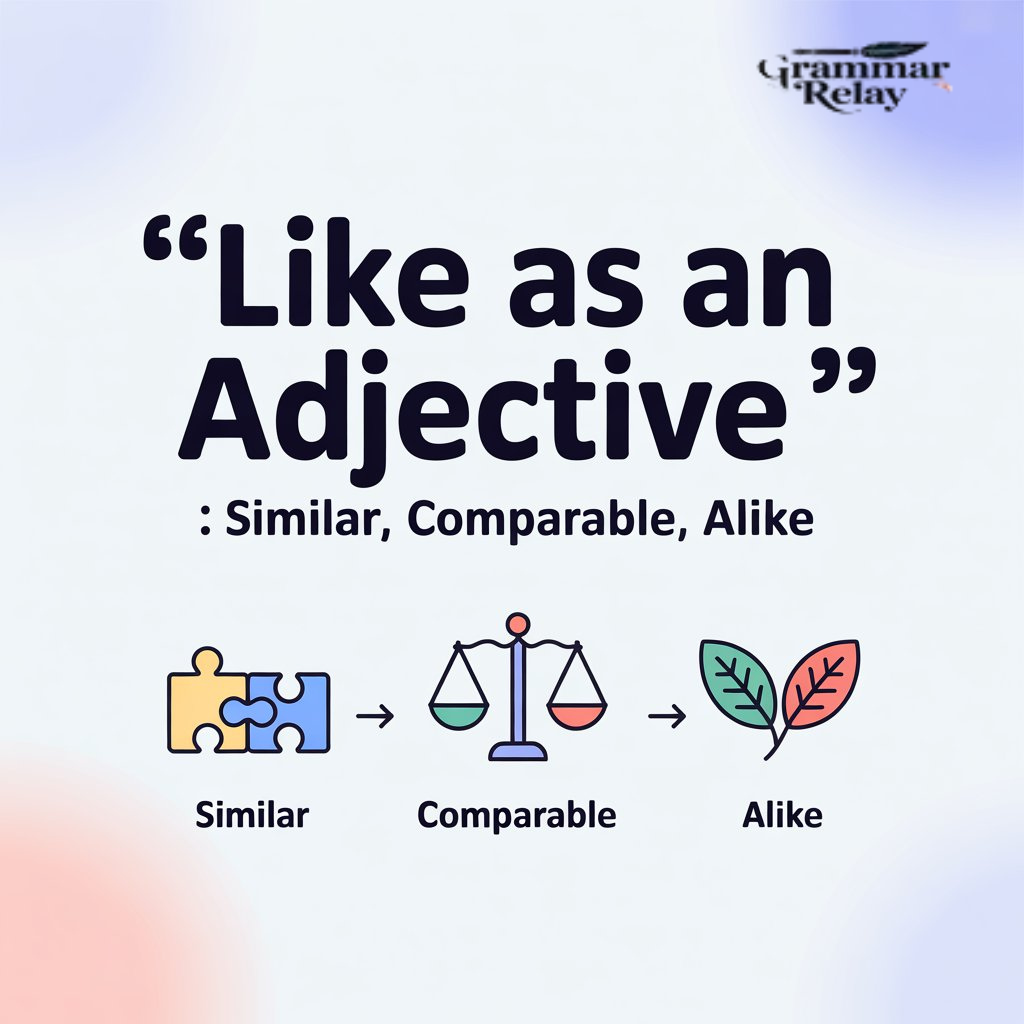
As an adjective, “like” means having similar qualities or characteristics. This is a more formal register.
- They approached the problem with like enthusiasm.
- Birds of like feather tend to flock together.
You’ll spot this more often in writing than in speech. “Like-minded” is a compound adjective built on this very sense people who think similarly.
“Like” as an Adverb : The Approximation Tool
This one’s informal but extremely common in American English.
- It was like midnight when we finally left.
- The package weighed like 50 pounds.
- There were like a hundred people there.
Here, like functions similarly to “approximately” or “roughly.” It hedges the number, signaling that precision isn’t the point. Don’t use this in formal writing but in casual speech, it’s perfectly natural.
“Like” as a Conjunction : The Grammar Debate
This is where things get spicy.
Using “like” as a conjunction meaning in the way that or as has been controversial for over a century. But here’s the thing: it’s been in use since the 1300s.
- Nobody understands her like I do.
- Do it like I showed you.
Major style guides have softened considerably. Merriam Webster now accepts conjunctive “like” in informal and conversational contexts. The Associated Press allows it in quoted speech. Most modern linguists consider the stigma more about class and prestige than actual grammar rules.
The “like” vs. “as” distinction in practice:
| Use “like” | Use “as” |
|---|---|
| Before a noun or pronoun | Before a clause with a verb |
| She looks like her mom | She did it as she was told |
| Informal and conversational | Formal and written |
“Like” as an Interjection : The Filler Everyone Uses
Ah, the famous “like” that drives grammar teachers up the wall.
- I was, like, so tired.
- And he was like, “No way.”
- It’s like, really complicated.
Linguists call this the discourse particle or quotative like (when it introduces speech). It originated in California surfer and Valley Girl culture in the 1970s–80s and spread globally through pop culture and TV.
But here’s what’s fascinating: it’s not meaningless. Research by linguist Alexandra D’Arcy and others shows that “like” as a filler serves real communicative functions:
- Hedging softening a statement (“It costs like $50”)
- Emphasis signaling something notable (“It was like, perfect”)
- Reported speech introducing what someone said or thought (“She was like, ‘I can’t believe it'”)
Younger speakers use it most, but it cuts across age groups now. It’s a feature of natural speech, not a flaw.
You might be interesting in Giving for Advice
“Like” as a Suffix : Building New Adjectives
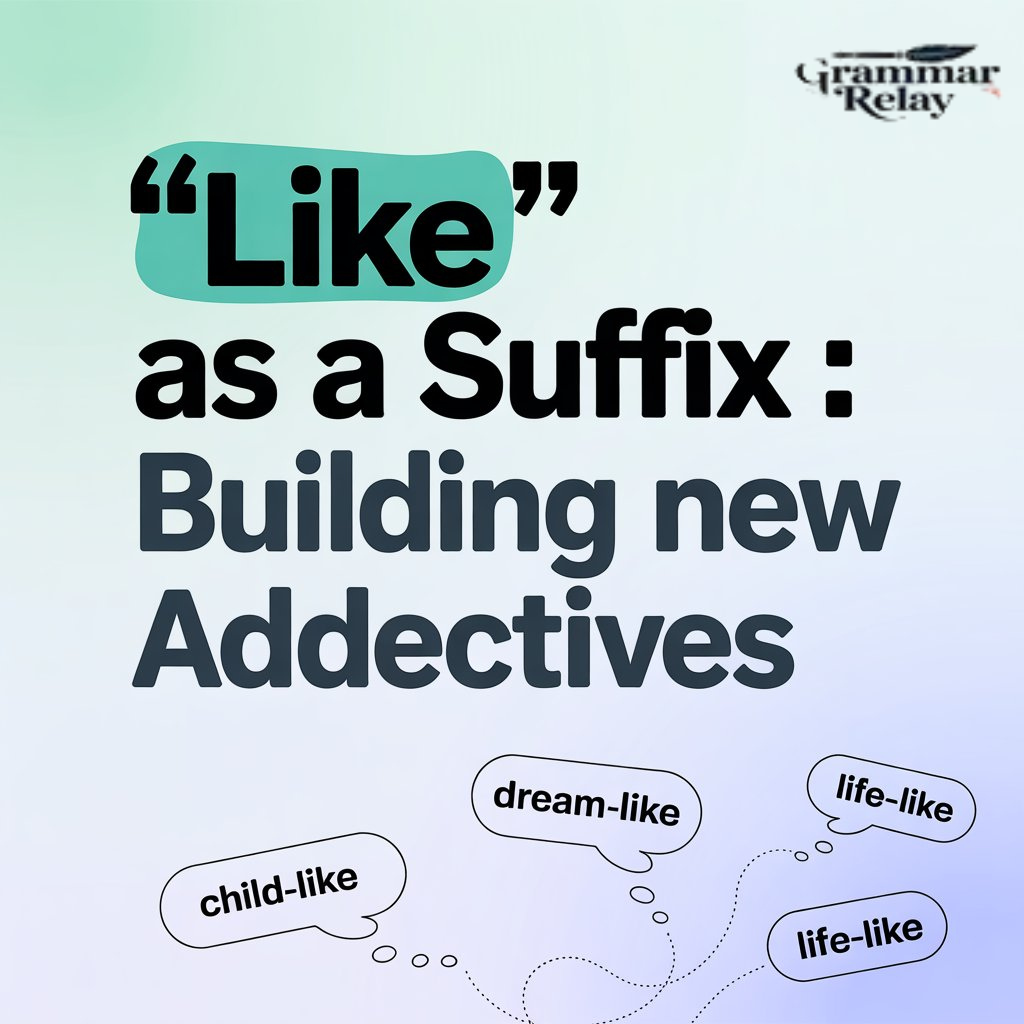
Attach like to almost any noun and you’ve got an adjective meaning “resembling” or “characteristic of.”
Common examples:
- Lifelike so realistic it seems alive
- Dreamlike having the quality of a dream
- Godlike resembling a god in power or perfection
- Childlike having the innocence of a child
- Businesslike efficient, practical, professional
Hyphen rule: Use a hyphen when the base word ends in l (bell-like, shell-like) or when the compound might look awkward without one (crab-like, skull-like). Otherwise, no hyphen needed.
Other Words for “Like” : Synonyms by Role
Looking for a like synonym? Here’s a role-by-role breakdown.
Verb Synonyms
- Enjoy, appreciate, relish, fancy, adore, savor
Preposition / Adjective Synonyms (Similarity)
- Similar to, akin to, resembling, comparable to, analogous to
Like Synonym Formal Options
- Akin to, analogous to, commensurate with, cognate with
I Like Synonym Options (Verb)
- I enjoy, I appreciate, I’m fond of, I’m partial to, I relish
“Like” vs. “As” vs. “Such As” Which One Do You Need?
| Word | Use When… | Example |
|---|---|---|
| Like | Comparing nouns/pronouns | He plays like a pro |
| As | Introducing a clause | Do as I say |
| Such as | Giving examples | Sports such as tennis and golf |
“Such as” is more precise than “like” when listing examples. Technically, “like” implies similarity while “such as” introduces actual instances. In formal academic and legal writing, this distinction matters.
Where Did “Like” Come From?
Like has a dual etymology two words that merged over centuries.
- “Like” (similarity) → Old English gallic, from gel- (together) + lice (body/form). Related to German Galich and Dutch gemlike.
- “Like” (enjoyment) → Old English lician, meaning “to please.” Related to Old Norse líka.
By Middle English, both forms had simplified to “like” and English speakers have been navigating the overlap ever since.
Common Mistakes With “Like” (And How to Fix Them)
| Mistake | Correction |
|---|---|
| It looks like it will rain (informal) | Fine in speech; use “as if” in formal writing |
| Do it like I told you | Use “as” in formal contexts |
| He’s, like, my boss | Avoid in professional and written communication |
| A dreamlike-quality | Drop the extra hyphen: a dreamlike quality |
How Do You Spell “Like”?
Straightforward: L-I-K-E. But since how do you spell like is a genuinely common search probably because it’s such a short, common word it’s worth confirming. No tricks, no silent letters. Just four letters, one syllable.
Key Takeaways
- “Like” descends from two separate Old English roots one meaning similarity, one meaning pleasure.
- It functions as a verb, noun, preposition, adjective, adverb, conjunction, interjection, and suffix.
- The “like vs. as” debate is real but overblown context and register determine which is right.
- Filler “like” isn’t lazy speech it serves genuine linguistic functions.
- When you need a like synonym formal alternative, reach for akin to, analogous to, or commensurate with.
- The word like is one of the most frequently used in the English language and for good reason. It’s irreplaceable.
Frequently Asked Questions
What part of speech is “like”?
“Like” can be a verb, noun, preposition, adjective, adverb, conjunction, interjection, and suffix. It’s one of the most grammatically flexible words in English.
What is the like definition as a verb?
As a verb, “like” means to enjoy, prefer, or find something pleasant. Example: I like strong coffee.
What are other words for “like”?
Common synonyms include enjoy, appreciate, and relish (verb). For similarity, try akin to, resembling, or comparable to.
What’s a like synonym for formal writing?
Try analogous to, akin to, or commensurate with when you need a formal alternative.
Is using “like” as a conjunction grammatically correct?
Yes. Though debated, most modern style guides accept it in conversational and informal contexts.
What’s the difference between “like” and “as”?
Use “like” before nouns and pronouns. Use “as” before clauses containing a verb.
How do you spell “like”?
Simply L-I-K-E. One syllable, no tricks.
What does “like” mean on social media?
It’s a verb and noun referring to digital approval tapping a button to show you enjoyed a post.
Read more grammar lessons on Grammar relay
Conclusion
“Like” is genuinely remarkable. No other word in English quietly shapeshifts across so many grammatical roles while staying completely natural in every one of them.
Think about it. You wake up, say you like your morning coffee, drink it like a champ, scroll through social media collecting likes, and describe your commute as like, really exhausting all before 9 AM. One word. Eight different jobs.
Understanding the like meaning across its many roles doesn’t just make you a better writer. It makes you a sharper communicator. You’ll know when to swap it for a like synonym formal alternative in professional writing. You’ll stop second guessing the “like vs. as” debate. And you’ll appreciate why that filler “like” in casual speech isn’t lazy it’s doing real linguistic work.
