


“Take care.” You’ve said it a thousand times. At the end of emails, after phone calls, when a friend walks out the door. It’s warm. It’s familiar. But say anything enough times and it starts to sound like furniture present but invisible.
The truth is, how you close a conversation matters just as much as how you open it. The right farewell sticks. It makes someone feel genuinely seen. The wrong one? It evaporates before they’ve even read it.
So whether you’re hunting for a take care synonym email sign-off, searching for sweet ways to say take care of yourself to someone going through a rough patch, or just tired of typing the same two words on repeat this guide covers everything.
Why “Take Care” Starts to Feel Empty Over Time
Here’s the uncomfortable truth about overused phrases: they stop registering.
When someone reads “take care” at the end of an email, their brain processes it the same way it processes “Best” or “Thanks.” It’s a signal that the message is over. Nothing more.
That’s a wasted opportunity. A closing phrase is your last impression. It’s the emotional punctuation on everything you just said. Used well, it reinforces warmth, professionalism, or genuine concern depending on what the moment calls for.
“The most important thing in communication is hearing what isn’t said.” Peter Drucker
What you choose to say last communicates a lot about how much you actually care.
What Does “Take Care” Really Mean: And When Should You Use It?
“Take care” pulls double duty. Sometimes it’s a genuine expression of concern “I worry about you, please look after yourself.” Other times it’s simply a polished way to say goodbye, closer in spirit to “see you later” than anything deeply emotional.
Neither use is wrong. But knowing which one you mean — and making sure the other person feels it is where most people drop the ball.
Quick rule of thumb:
- Use it as a genuine farewell when parting with colleagues, acquaintances, or in professional emails
- Use a deeper alternative when someone is sick, struggling, or going through something real
- Use a lighter alternative in casual texts where the full phrase feels stiff
Understanding how to say take care in different ways starts with reading the room first.
Read more about 30+ Good Afternoon Phrases
Professional Alternatives to “Take Care” (Emails, Letters & Meetings)
The professional world runs on sign-offs. And while take care as a sign off works fine in semi-formal emails, it doesn’t always fit every context. Here’s what does:
| Phrase | Formality Level | Best Used For |
|---|---|---|
| Best regards | Formal | Cold emails, first-time contact |
| Warm regards | Semi-formal | Existing clients, professional contacts |
| Kind regards | Semi-formal | General professional correspondence |
| Wishing you well | Semi-formal | Follow-up emails, check-ins |
| With appreciation | Formal | Thank-you emails, after receiving help |
| Stay well | Casual-professional | Colleagues, regular contacts |
| Take good care | Semi-formal | Clients you know personally |
| Wishing you continued success | Formal | End of project emails, farewells |
| Until next time | Casual-professional | Recurring meetings, ongoing relationships |
| Respectfully | Formal | Official correspondence, senior recipients |
Example in action:
“It was great connecting with you today. Wishing you continued success with the launch looking forward to staying in touch.”
That closing does three things: it references the conversation, expresses genuine goodwill, and signals future contact. Far more effective than a lone “take care.”
When you need a solid take care synonym email option that doesn’t sound robotic, “Wishing you well” and “Warm regards” are your safest bets professional enough for clients and warm enough for colleagues.
Casual Alternatives to “Take Care” (Texts, Calls & Everyday Conversations)
Casual farewells should feel effortless. These are your go-to options for friends, family, and low-stakes conversations:
- Stay safe: works especially well during travel or uncertain times
- Look after yourself: slightly warmer than “take care,” feels more personal
- Take it easy: relaxed, friendly, great for laid-back relationships
- Rest up: perfect after someone mentions they’re tired or overwhelmed
- Be well: simple and genuinely warm
- Don’t work too hard: lighthearted, great for colleagues on a Friday
- Be good: casual and affectionate, works with close friends
- Catch you later and take it easy: breezy but still caring
These give you plenty of room to say take care in different ways without overthinking it.
Heartfelt Alternatives for Someone Going Through a Hard Time
This is where word choice really matters. When someone’s grieving, burned out, sick, or struggling generic phrases land like a thud. You need something that actually carries weight.
Here’s how to tell someone to take care of themselves when they really need to hear it:
- “Be gentle with yourself right now.”
- “Please be kind to yourself, you’re doing the best you can.”
- “Go easy on yourself. Seriously.”
- “Guard your peace. Nothing else matters more right now.”
- “Take some real time for yourself, not just an hour. A real break.”
- “Your wellbeing comes first. Everything else can wait.”
- “Give yourself some grace through this.”
- “Make sure you’re actually okay, not just functioning.”
The difference between these and “take care”? Specificity and depth. They acknowledge that something hard is happening. They don’t rush past it.
“People don’t remember what you said. They remember how you made them feel.” Maya Angelou
That principle applies to farewells too. One thoughtful closing line can stay with someone for days.
Funny & Lighthearted Alternatives (When Humor Is the Right Move)
Sometimes the most caring thing you can do is make someone laugh. These work brilliantly with close friends or teammates who appreciate a lighter touch:
- “Don’t do anything I wouldn’t do.”
- “Try not to cause too much chaos while I’m gone.”
- “Stay out of trouble, mostly.”
- “Keep yourself in one piece, please.”
- “Don’t forget to eat, sleep, and hydrate. In that order.”
- “Take care and yes, that includes actual meals, not just coffee.”
Just know the room. Humor lands beautifully with the right person and falls flat or worse, feels dismissive with the wrong one.
Another Way to Say “Take Care of Yourself” Specifically
The full phrase “take care of yourself” carries more emotional weight than a simple “take care.” It’s direct. It’s personal. And when someone needs to hear it, a well-chosen another way to say take care of yourself hits harder than the default phrasing.
Try these instead:
- “Look after yourself properly, not just on the surface.”
- “Put yourself first for once.”
- “Make sure you’re actually okay.”
- “Don’t neglect yourself in all this.”
- “Be patient with yourself as you heal.”
- “Take good care of yourself, I mean that.”
- “Your health and peace matter more than any deadline.”
How to say take care of yourself in a way that actually resonates? Add one specific detail. Instead of “take care of yourself,” try “take care of yourself and please get some sleep this week.” That specificity is everything.
What to Reply When Someone Says “Take Care of Yourself”
So someone’s told you to take care now what? The take care reply in English doesn’t have to be complicated. But matching their warmth makes the exchange feel complete instead of one-sided.
Casual replies:
- “You too, thanks for thinking of me.”
- “Will do! You take care as well.”
- “Appreciate that, same to you!”
Warmer replies:
- “That genuinely means a lot. You take care too.”
- “Thank you, I really needed to hear that. Take care of yourself as well.”
Knowing what to reply when someone says take care of yourself is about matching sincerity with sincerity. Don’t brush it off with a quick “thanks” if they said it with real feeling.
Other Ways to Say “Take Care” Across Specific Situations
After a Job Interview or Business Meeting
Close with intention. Try:
- “Thank you, wishing you a wonderful rest of the week.”
- “It was a pleasure. I look forward to speaking again soon.”
To Someone Who Is Sick or Recovering
Skip the hollow phrases. Instead:
- “Rest up and let yourself actually heal, don’t rush it.”
- “Please take it easy. Your only job right now is to get better.”
To Someone Traveling or Moving Away
Safe travels is the classic. But also consider:
- “Travel safe and check in when you land.”
- “Godspeed, wishing you smooth roads ahead.”
In a Romantic Context
The take care salutation shifts significantly between partners. Try:
- “Take care of yourself, I worry about you.”
- “Please rest. I need you in one piece.”
- “Be gentle with yourself today. I love you.”
To a Colleague Leaving a Job
- “All the best in your next chapter, you’re going to do great things.”
- “Wishing you every success in what comes next. It’s been a privilege.”
How “Take Care” Translates Across Cultures
| Language | Phrase | Literal Meaning |
|---|---|---|
| Spanish | Cuídate | Take care of yourself |
| French | Prends soin de toi | Take care of yourself |
| German | Pass auf dich auf | Watch out for yourself |
| Japanese | Odaiji ni | Please take care (used when sick) |
| Arabic | Ala salama | Go in peace/safety |
| Italian | Prenditi cura di te | Take care of yourself |
| Portuguese | Cuida-se | Take care of yourself |
Interestingly, Japanese uses Odaiji ni almost exclusively when someone is unwell — it carries specific weight that the English “take care” doesn’t. Context is baked right into the language.
You might be interested in Gotta Definition
Phrases to Avoid: And What to Use Instead
| Awkward Phrase | Why It Misses | Better Alternative |
|---|---|---|
| “Take care now” | Sounds slightly sarcastic | “Please take good care of yourself” |
| “Best” (standalone) | Abrupt and cold | “All the best” or “Warm regards” |
| “Godspeed” in casual texts | Confusing and overly formal | “Safe travels” or “Travel safe” |
| “Stay safe” every single message | Loses meaning through repetition | Rotate with “rest up” or “be well” |
| “Take care of yourself, okay?” | Can feel patronizing | “Make sure you’re getting some rest” |
Other Ways to Say “Take Care” by Situation
| Situation | Best Phrase |
|---|---|
| Formal email sign-off | “Warm regards” / “Wishing you well” |
| Take care email to a client | “Take good care, looking forward to connecting again” |
| Colleague leaving a job | “All the best in your next chapter” |
| Friend going through hard times | “Be gentle with yourself” |
| Someone who is sick | “Rest up and take good care” |
| Casual text goodbye | “Take it easy” / “Stay safe” |
| Romantic farewell | “Take care of yourself, I mean it” |
| Someone traveling | “Safe travels” / “Godspeed” |
How to Make Any “Take Care” Alternative Feel Genuine
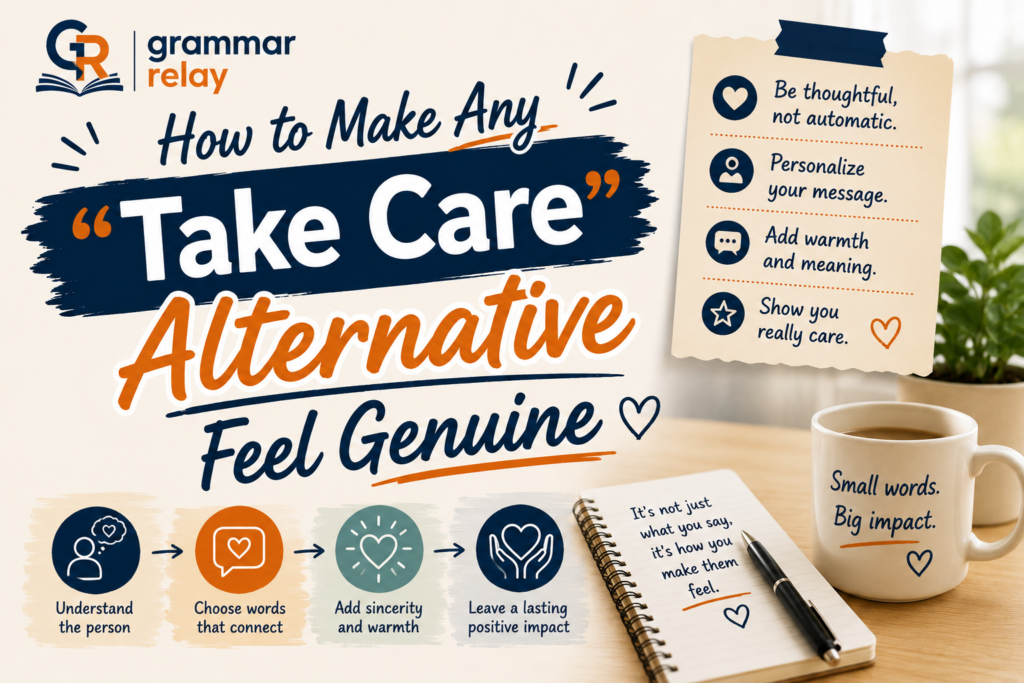
The phrase matters less than the intention behind it. Here’s how to make any closing land well:
- Add one specific detail: reference what they’re actually dealing with
- Don’t bury it: sometimes leading with care is more powerful than closing with it
- Match their energy: a heavy moment deserves a heavy phrase; a light one deserves lightness
- Follow it up: “Take care and seriously, call me if you need anything” hits differently than the phrase alone
- Mean it: readers and listeners feel the difference between a genuine close and a copy-paste sign-off
Frequently Asked Questions
Is “Take Care” appropriate in professional emails?
Yes, but context matters. It works well with colleagues or clients you already know. For formal first-time correspondence, “Warm regards” or “Wishing you well” lands more professionally.
What’s the most heartfelt alternative to “Take Care”?
“Be gentle with yourself” and “Give yourself some grace” carry the most emotional depth. They acknowledge what someone is going through rather than simply wrapping up a conversation.
What’s the best take care reply in English?
Match the warmth you received. “You too, that genuinely means a lot” works perfectly for sincere messages. For casual goodbyes, a simple “Will do! You take care as well” is more than enough.
What’s the difference between “Take Care” and “Take Care of Yourself”?
“Take care” functions mostly as a farewell. “Take care of yourself” is more personal and direct, it signals that you’re genuinely concerned about someone’s wellbeing, not just closing a conversation.
Which phrase works best when someone is going through a tough time?
Skip the generic options entirely. “Be patient with yourself” or “Your wellbeing comes first” acknowledges the difficulty without minimizing it. Specificity is what separates a meaningful phrase from a throwaway one.
Can these alternatives work in romantic messages too?
Absolutely. Phrases like “Take care of yourself, I mean it” or “Be gentle with yourself today” carry real tenderness without feeling over the top. Add one personal detail and they land even better.
Read more grammar lessons on Grammar Relay
Conclusion
Other ways to say take care aren’t just synonyms. They’re opportunities. Each one is a chance to make someone feel genuinely considered not just politely dismissed at the end of a message.
The right phrase at the right moment can turn a forgettable goodbye into something that actually stays with a person. That’s worth the extra two seconds it takes to choose well.
Pick one phrase from this list today. Use it in your next email, your next text, your next conversation. Notice what happens when your closing actually means something.
