

“According to.” You’ve typed it a hundred times. In essays, emails, reports, presentations. It works. It attributes. It’s grammatically sound. But here’s the uncomfortable truth when every citation in your writing starts the same way, your prose starts to feel like a conveyor belt. Functional. Mechanical. Forgettable.
Strong writers don’t just cite sources. They engage with them. And the language they use to do that the attribution phrase itself signals how deeply they’ve thought about what they’re referencing.
Whether you need another way to say according to in an academic essay, a business report, a news article, or everyday conversation, this guide covers every situation with real examples, practical frameworks, and phrases that actually elevate your writing.
Why “According To” Gets Overused: And What It Costs You
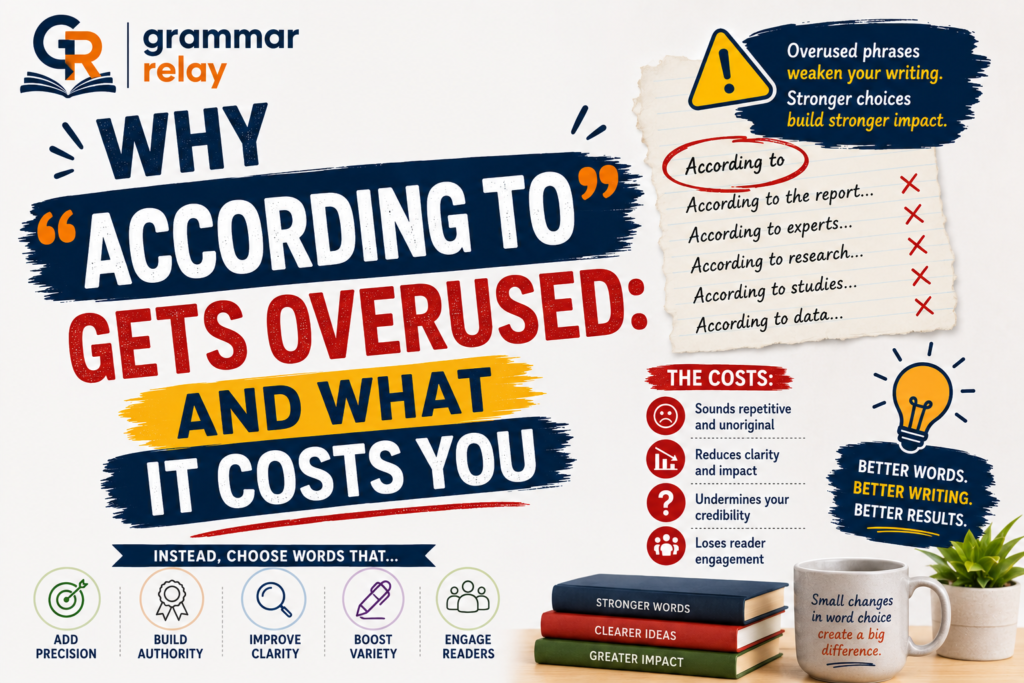
Here’s the problem with “according to” it’s almost too easy. It’s neutral, safe, and universally understood. So writers reach for it constantly without considering whether something better fits the moment.
Read any student essay and you’ll typically find “according to” appearing four, five, sometimes six times per page. Each instance chips away at the writing’s authority. By the third repetition, the reader stops processing the attribution and starts skimming past it entirely.
Worse still, overusing one attribution phrase signals something to your reader: that you’re citing sources but not necessarily thinking about them. Varying your attribution language demonstrates analytical engagement. It shows you understand the relationship between your argument and your source not just that the source exists.
What “According To” Actually Means: And When It Works
Before exploring what to say instead of according to, it’s worth understanding what the phrase actually does. At its core, “according to” attributes a claim, statement, or piece of information to a specific source a person, document, study, or institution.
It works perfectly when:
- The source is a document or report rather than a person
- Neutrality matters, you’re not endorsing or challenging the claim
- The attribution needs to be quick and unobtrusive
- You’re writing in a journalistic context referencing official documents
It starts failing when it appears repeatedly, when it’s used for both facts and opinions interchangeably, or when a more precise verb would better capture the relationship between the source and the claim.
The Five Categories of “According To” Alternatives
The smartest way to understand different ways to say according to is to organize them by function — not just treat them as interchangeable synonyms. Each category serves a distinct purpose:
- Direct attribution: crediting a specific person or named source
- Data & research citation: referencing studies, reports, and statistics
- Opinion & perspective framing: signaling a viewpoint rather than established fact
- Compliance & alignment: showing something follows a rule, standard, or guideline
- Analytical engagement: going beyond citation to interpretation and conclusion
Get this distinction right and your writing immediately becomes more precise, more credible, and more persuasive.
Read more about 40+ Other Ways to Say “I Agree”
Formal Alternatives to “According To” (For Essays & Academic Writing)
Academic writing demands the most nuanced attribution language. The according to the text synonym choices you make in an essay signal your relationship with your sources and professors notice.
| Phrase | Best Used For | Formality Level |
|---|---|---|
| As argued by | Scholarly debates, contested positions | Formal |
| As evidenced by | Supporting claims with proof | Formal |
| As established by | Well-accepted findings | Formal |
| As posited by | Theoretical frameworks | Formal |
| As contended by | Disagreements, debates | Formal |
| As demonstrated by | Experimental or empirical results | Formal |
| [X] maintains that | Ongoing scholarly positions | Formal |
| [X] asserts that | Strong declarative claims | Formal |
| Findings from [X] suggest | Research results | Formal |
| Drawing from | Borrowing a framework or concept | Semi-formal |
The key insight here? Verbs like “argues,” “maintains,” “contends,” and “asserts” do something “according to” never can they tell the reader how the source makes its claim. That’s enormously valuable in academic writing.
Example “weak”:
“According to Smith, social media affects mental health.”
Example “strong”:
“Smith contends that prolonged social media exposure measurably increases anxiety in adolescents, a position supported by longitudinal data spanning 2018–2023.”
Same source. Completely different level of engagement.
“The goal of academic writing is not merely to report what others have said but to situate their ideas within a larger conversation.” Gerald Graff & Cathy Birkenstein, They Say / I Say
Professional & Business Alternatives to “According To”
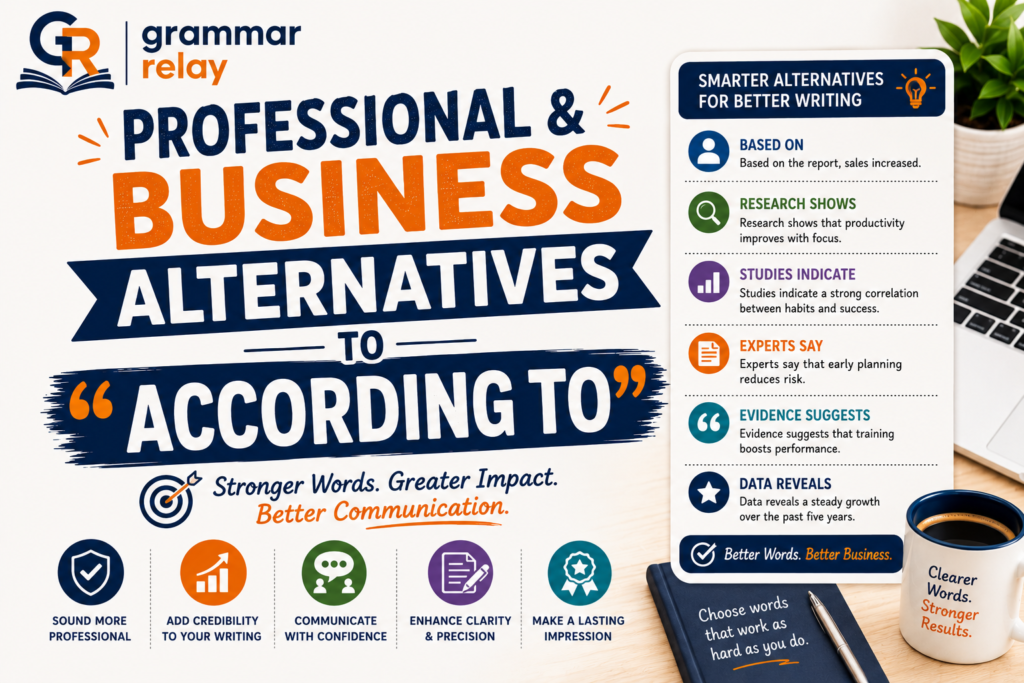
In business writing, according to alternatives need to sound authoritative without being stiff. These phrases work across emails, reports, presentations, and client-facing documents:
- Based on: the most versatile professional alternative; works in almost any context
- Per: efficient and direct but can sound terse; best in internal memos
- As per: slightly more formal than “per” but considered informal by some style guides
- In line with: great for showing alignment with strategy or policy
- In accordance with: best for legal, compliance, and regulatory writing
- As confirmed by: signals verified information from a credible source
- As outlined by: ideal when referencing documents, frameworks, or plans
- Consistent with: shows agreement between two sources or findings
- As indicated by: neutral and clean for data-heavy reports
- As revealed by: adds slight emphasis; good for surprising findings
Pro tip: “Based on” is your safest swap in almost any professional context. It’s clean, credible, and never sounds out of place. When in doubt, reach for it first.
Casual & Conversational Alternatives
Not everything needs formal attribution. Here’s how to say according to in everyday speech and informal writing:
- “As [person] puts it…”
- “In [person’s] words…”
- “From what [person] says…”
- “The way [person] sees it…”
- “If you ask [person]…”
- “[Person] makes the case that…”
- “[Person] reckons that…”
These work beautifully in blogs, casual articles, podcasts, and conversational emails. They’re warm and human which is exactly what formal attribution language often isn’t.
Alternatives Specifically for Citing Data, Statistics & Research
This section matters more than most people realize. Data citation has its own vocabulary and the ways to say according to when referencing numbers and studies are quite specific.
Here’s the critical distinction between common data attribution verbs:
| Verb | What It Signals | Example |
|---|---|---|
| Suggests | Tentative finding, not conclusive | “Research suggests a link between X and Y” |
| Indicates | Moderate confidence, directional | “Data indicates a 23% increase” |
| Demonstrates | Strong evidence, shown clearly | “The trial demonstrates efficacy” |
| Proves | Absolute certainty, use rarely | Reserved for mathematical or logical proofs |
| Reveals | Surprising or newly uncovered finding | “Analysis reveals an unexpected pattern” |
One major mistake to avoid: “Studies show” is increasingly flagged as vague and weak. Which studies? From when? By whom? Instead, name the source specifically:
❌ “Studies show that exercise improves mood.”
✅ “A 2023 meta-analysis published in The Lancet found that 30 minutes of daily moderate exercise reduces depressive symptoms by up to 26%.”
Alternatives for Framing Opinion vs. Fact
One of the most important distinctions in attribution language and one most writers completely miss. Using the same phrase for facts and opinions creates dangerous ambiguity.
| Attribution Type | Use When | Best Phrases |
|---|---|---|
| Fact attribution | Source states verifiable information | “As confirmed by,” “As established by” |
| Opinion attribution | Source shares a viewpoint | “In the view of,” “As argued by” |
| Analysis attribution | Source interprets data | “As concluded by,” “As determined by” |
| Contested claim | Source makes a debatable assertion | “As claimed by,” “As suggested by” |
Notice how “as claimed by” subtly signals skepticism while “as confirmed by” signals endorsement. That’s not accidental, it’s precision. Strong writers use attribution language to quietly guide the reader’s relationship with a source before they’ve even read the cited content.
You might be interested in 40+ Other Ways to Say “Get Well Soon”
Another Way of Saying “According To” in Specific Writing Contexts
In Academic Essays & Research Papers
Academic style guides have clear preferences. APA 7th edition recommends using the author’s name directly with a strong verb: “Smith (2022) argues that…” rather than “According to Smith (2022)…” The difference seems minor but signals authorial confidence.
Other preferred academic phrases:
- “As [Author] (year) demonstrates…”
- “[Author] (year) contends that…”
- “Evidence presented by [Author] (year) suggests…”
In Journalism & News Writing
The AP Stylebook, the journalism industry’s bible actually discourages “according to” for direct quotes from people. Instead, journalists use “said,” “reported,” “confirmed,” and “stated.” However, “according to” remains the preferred phrase when attributing information to documents, reports, and official records.
In Business Reports & Professional Emails
The another phrase for according to that dominates corporate writing is “based on.” It’s clean, direct, and universally understood. For compliance and legal documents, “in accordance with” is the gold standard.
In Creative & Narrative Nonfiction
Attribution in storytelling needs to maintain narrative momentum. Heavy attribution phrases interrupt flow. Instead, skilled nonfiction writers weave attribution into the sentence itself: “As Malcolm Gladwell famously observed in Outliers…” the attribution becomes part of the story rather than a speed bump before it.
Words That Sound Like Good Alternatives But Aren’t
Some other ways of saying according to are actually worse than the original. Avoid these:
| Weak Phrase | The Problem | Better Choice |
|---|---|---|
| “Studies show” | Vague, no specific source | “A 2024 Stanford study found” |
| “Experts say” | Who exactly? Undermines credibility | “Dr. [Name], [Institution], argues” |
| “It is said that” | Passive and completely sourceless | “Researchers at [X] report” |
| “They say” | Unattributable to anyone | Name the actual source |
| “Research proves” | Science rarely proves, it suggests | “Research strongly indicates” |
The pattern? Vagueness masquerading as attribution is worse than no citation at all. It signals that you’ve heard something somewhere but can’t actually back it up.
Another Way of Saying “According To” by Context
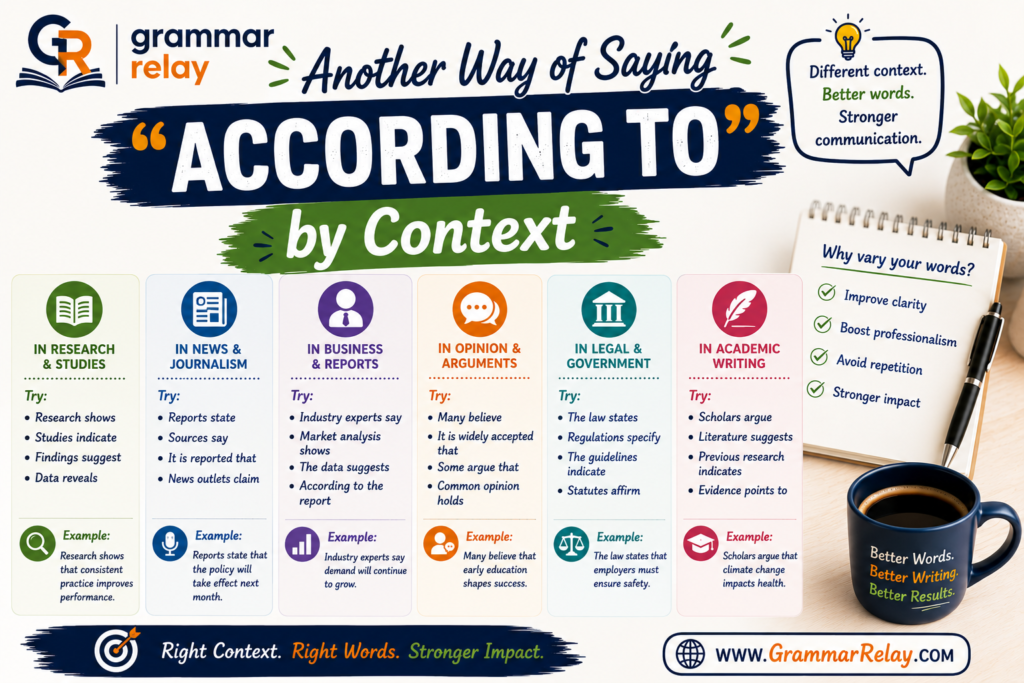
| Context | Best Alternative |
|---|---|
| Academic essay | “As argued by” / “As evidenced by” |
| Research paper data | “Findings from [X] indicate” |
| Business email | “Based on” / “Per” / “In line with” |
| News article | “Reported by” / “Confirmed by” |
| Casual conversation | “The way [person] sees it” |
| Opinion framing | “In the view of” / “As [X] contends” |
| Legal or compliance writing | “In accordance with” / “In compliance with” |
| Presenting statistics | “Data from [X] shows” |
How to Choose the Right Alternative Every Time
When exploring according to someone attribution, run through this three-question framework before writing:
- Who is the source? A named person, an institution, a dataset, or an official document?
- What type of claim is it? A verified fact, a stated opinion, an analytical conclusion, or a contested assertion?
- What’s the register? Formal academic, professional business, journalistic, or conversational?
Answer those three questions and the right phrase becomes almost obvious. It takes two seconds and makes your writing measurably stronger every time.
Common Mistakes to Avoid With Attribution Language
Even experienced writers stumble here. Watch out for:
- Overusing “per”: “it sounds terse and bureaucratic outside internal memos”
- Using “as per” in formal academic writing: “most style guides consider it informal”
- Writing “studies show” without naming the study: “instantly undermines your credibility”
- Using “according to” for your own analysis: “attribution implies an external source”
- Treating “as claimed by” and “as proven by” as interchangeable: “they signal completely different levels of confidence”
Frequently Asked Questions
What’s the best alternative to “according to” in a formal essay?
“As argued by” and “as evidenced by” are your strongest academic options. They don’t just credit a source they signal how the source relates to your argument. APA 7th edition also recommends placing the author’s name directly before a strong verb: “Smith (2022) contends that…”
Is “as per” professional or informal?
It sits in an awkward middle ground. Most style guides consider “as per” informal despite its professional-sounding tone. In formal academic writing, avoid it entirely. In business emails and internal memos, it works fine just don’t lean on it heavily.
Can I use “per” instead of “according to” in business writing?
Yes, but sparingly. “Per the report” or “per our last conversation” works well in internal communications. However, it can sound terse and cold in client-facing documents. “Based on” is almost always the safer, warmer swap.
What’s the difference between “as stated by” and “as argued by”?
A significant one. “As stated by” presents information as straightforward fact. “As argued by” signals that someone is making a case implying the position could be debated. Choose based on whether the source is reporting a fact or defending a viewpoint.
How do I cite data without using “according to”?
Name the source specifically and use a precise verb. Instead of “according to a study,” write “a 2024 meta-analysis published in The Lancet found.” Specificity organization, year, publication instantly boosts credibility and readability.
Which alternative works best for attributing opinions versus facts?
Use “as confirmed by” or “as established by” for verifiable facts. Use “as argued by,” “in the view of,” or “as contended by” for opinions and interpretations. Using the same phrase for both creates ambiguity and quietly undermines your writing’s precision.
Read more grammar lessons on Grammar Relay
Conclusion
Here’s the bottom line about finding alternatives to according to: the phrase you choose to attribute a source isn’t just a stylistic preference. It’s a signal. It tells your reader how confident you are in the source, how you relate to the claim, and how deeply you’ve engaged with the material.
“According to” will always have its place. But it shouldn’t be the only tool in your kit. Pick two or three alternatives from this guide and use them in your next essay, report, or email. Watch how your writing immediately feels sharper, more precise, and more authoritative.
