

Staring at your draft and seeing “for example” pop up for the fifth time? Yeah. It happens to everyone. The phrase works but lean on it too hard and your writing starts to feel like a broken record.
Here’s the good news: English is ridiculously rich. There are dozens of sharper, more precise ways to introduce an illustration, make a point land, or guide your reader from one idea to the next. This guide covers all of it other ways to say “for example,” every type of phrase in English, and the transition words that make writing flow like it was effortless.
Why “For Example” Gets Boring Fast
Repetition is the enemy of engaging writing. When a reader sees the same phrase over and over, their brain starts skimming and skimming means your ideas don’t land.
Research in cognitive linguistics shows that varied language keeps readers more alert and engaged. Think of it like music. A song that plays the same chord endlessly isn’t interesting but one that shifts, builds, and surprises? That sticks with you.
The fix is simple: expand your vocabulary of transition phrases and illustrative expressions. Once you know your options, choosing the right one becomes second nature.
Abbreviations That Replace “For Example”
Sometimes the cleanest move is a well-placed abbreviation. Here’s a breakdown of the most useful ones:
| Abbreviation | Full Form | Best Used In |
| e.g. | exempli gratia (Latin: “for example”) | Academic papers, formal writing |
| ex. | Example | Casual notes, bullet lists |
| i.e. | id est (Latin: “that is”) | Technical or clarifying contexts |
e.g. vs. i.e. — The Difference Most People Get Wrong
This trips up even experienced writers. Here’s the rule:
- e.g. introduces an example: “She loves citrus fruits, e.g., lemons and oranges.”
- i.e. restates or clarifies: “She’s a morning person, i.e., she wakes up before 6 a.m.”
A simple trick swap “e.g.” with “for example” in your head. If it fits, you’ve used it correctly. If it doesn’t, you probably need “i.e.” instead.
One-Word Alternatives to “For Example”
Sometimes one word does more heavy lifting than a full phrase. These other words for “for example” work across most writing styles:
- Namely points to something specific
- Specifically narrows focus
- Including signals a partial list
- Particularly highlights what stands out
- Notably draws attention to something significant
- Like casual and conversational
- Such typically paired with “as”
When One Word Is Stronger Than a Full Phrase
Longer isn’t always better. Compare these two sentences:
“Several cities, for example New York, have strict noise ordinances.”
“Several cities, notably New York, have strict noise ordinances.”
The second feels tighter. One precise word often outperforms a clunky three-word phrase especially in professional or journalistic writing.
Two-Word Substitutions for “For Example”
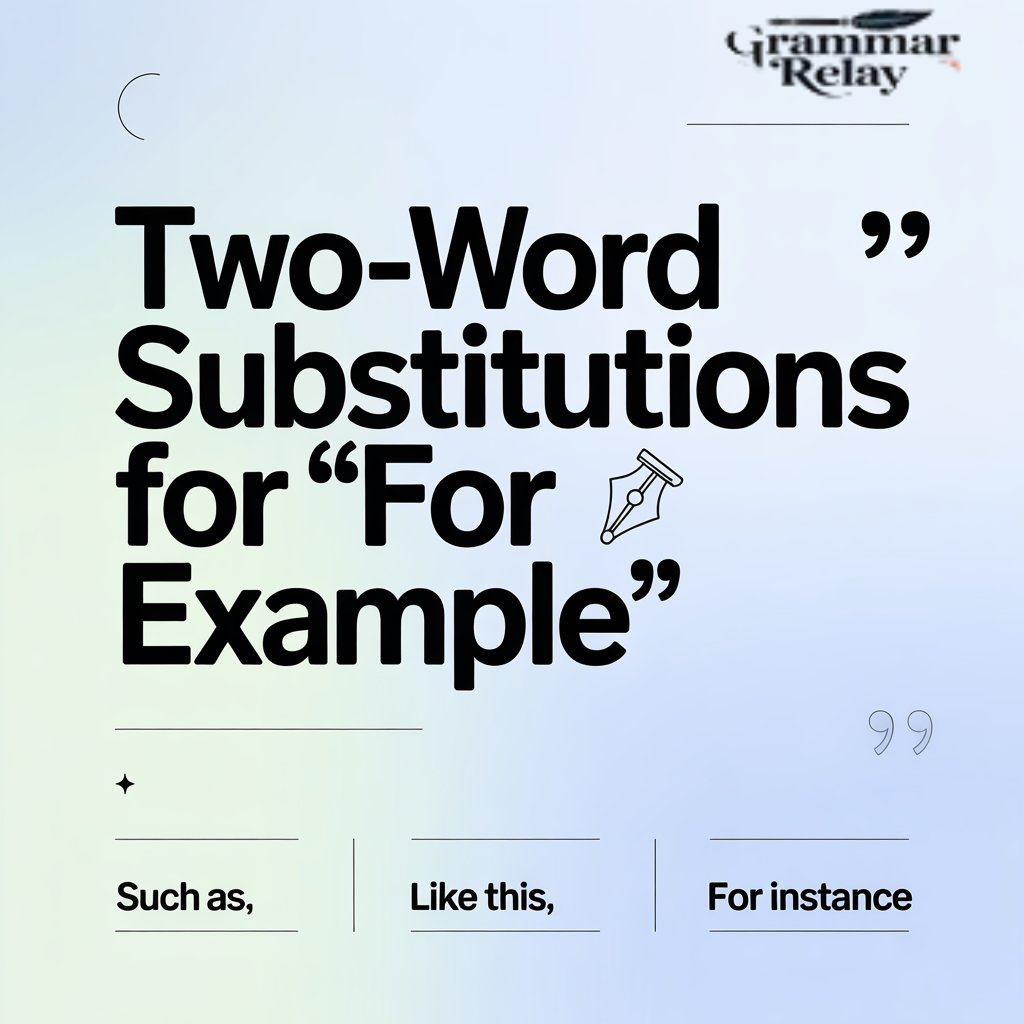
These different ways to say “for example” hit a sweet spot natural enough for conversational writing, polished enough for formal pieces:
- Such as smooth and widely accepted
- For instance a classic swap, slightly more formal
- As in casual and punchy
- Most notably adds emphasis
- To illustrate signals a visual or explanatory example
- Especially when brings in condition-based examples
- Like when very conversational, great for blogs
Choosing the Right Two-Word Phrase for Your Context
Context matters enormously. “Such as” fits comfortably in a business report. “Like when” belongs in a personal essay or casual blog post. Match your phrase to your audience always.
Longer Phrases and Expressions to Say “For Example”
These work beautifully at the start of a sentence or paragraph, giving your writing a more deliberate, thoughtful feel. These are some of the best other ways to say “for example” when you want more texture:
- To give you an idea…
- As a case in point…
- By way of illustration…
- Take, for instance…
- One clear illustration is…
- This is evident in…
- To demonstrate this point…
- A good example of this is…
- Consider, for example…
- In particular, consider…
“The difference between the right word and the almost right word is the difference between lightning and a lightning bug.” Mark Twain
Twain’s point applies perfectly here. “As a case in point” signals a real, grounded example. “To give you an idea” feels more conversational. Choose based on tone, not habit.
Using Longer Phrases to Open Paragraphs Powerfully
Longer illustrative phrases are especially effective as paragraph openers. They signal to the reader: we’re shifting from theory to evidence now. That transition builds trust.
Read more about “Like Means”!
Phrases to Avoid — When Substitutions Go Wrong
Not every alternative is an upgrade. Avoid phrases that sound pompous or vague:
- “In light of the aforementioned…” overly bureaucratic
- “It goes without saying…” then why say it?
- “As previously mentioned…” lazy callback, not an example
Context Is Everything — Matching Your Phrase to Your Tone
| Writing Type | Best Phrases |
| Academic / Formal | e.g., namely, as a case in point, by way of illustration |
| Blog / Conversational | like, for instance, take for example, like when |
| Creative / Essay | one clear illustration, consider this, to put it another way |
| Business / Professional | specifically, notably, to illustrate, such as |
Transition Words — The Bigger Picture
Transition words are the connective tissue of good writing. Without them, your ideas feel like scattered puzzle pieces. With them, everything clicks together.
What Makes a Word a Transition Word?
A transitional word bridges two ideas showing the reader how they relate. Is the second idea a contrast? A result? An example? A transition word answers that question before the reader even has to ask.
Agreement / Addition / Similarity
Use these when ideas build on each other:
Furthermore, moreover, in addition, likewise, similarly, also, besides, equally, by the same token
Example: The product is affordable. Furthermore, it’s built to last.
Opposition / Limitation / Contradiction
Use these to introduce contrast or pushback:
However, on the other hand, nevertheless, yet, even so, that said, conversely, despite this
Example: The plan looked solid on paper. However, execution was another story.
Cause / Condition / Purpose
These show why something happened or what triggered it:
Because, since, so that, provided that, given that, in order to, assuming that
Example: Given that sales dropped last quarter, a new strategy is overdue.
Examples / Support / Emphasis
The category where “for example” lives alongside its many cousins:
For example, for instance, in fact, above all, chiefly, to clarify, notably, especially
Effect / Consequence / Result
Therefore, as a result, consequently, hence, thus, so, for this reason, accordingly
Example: The data was corrupted. As a result, the entire report had to be rebuilt.
Conclusion / Summary / Restatement
These conclusion transition words wrap things up cleanly:
In conclusion, to summarize, in short, all in all, ultimately, in essence, to put it simply
Time / Chronology / Sequence
First, then, next, afterward, previously, simultaneously, finally, at the same time, subsequently
Space / Location / Place
Above, below, nearby, beyond, across from, adjacent to, opposite, within
How to Use Transition Words in Essays — With Real Examples
Transition words for essays serve three specific jobs: connecting sentences, linking paragraphs, and signaling logical relationships.
Transitions Within a Sentence
People use 43 muscles to frown but only 28 to smile.
Notice how “but” does the work of contrast without announcing itself.
Transitions Between Sentences
The campaign flopped in its first week. Consequently, the team scrapped the entire creative direction.
Short. Sharp. Logical. That’s what good transitions do.
Transitions Between Paragraphs
Opening a paragraph with a transition tells the reader: the previous idea and this one are connected. Without it, paragraphs feel like separate documents rather than a flowing argument.
You might be interested in “Conversation Topics for Adults”
Common Transition Mistakes in Student Writing
- Overusing “however” contrast has other words too
- Mismatching the transition to the relationship using “therefore” when you mean “for example”
- Starting every sentence the same way vary your entry points
What Exactly Is a Phrase?
A phrase is a group of words that functions as a unit but unlike a clause, it doesn’t contain both a subject and a predicate. Phrases are the building blocks of sentences. Master them and your writing instantly improves.
The Types of Phrases — With Clear Examples
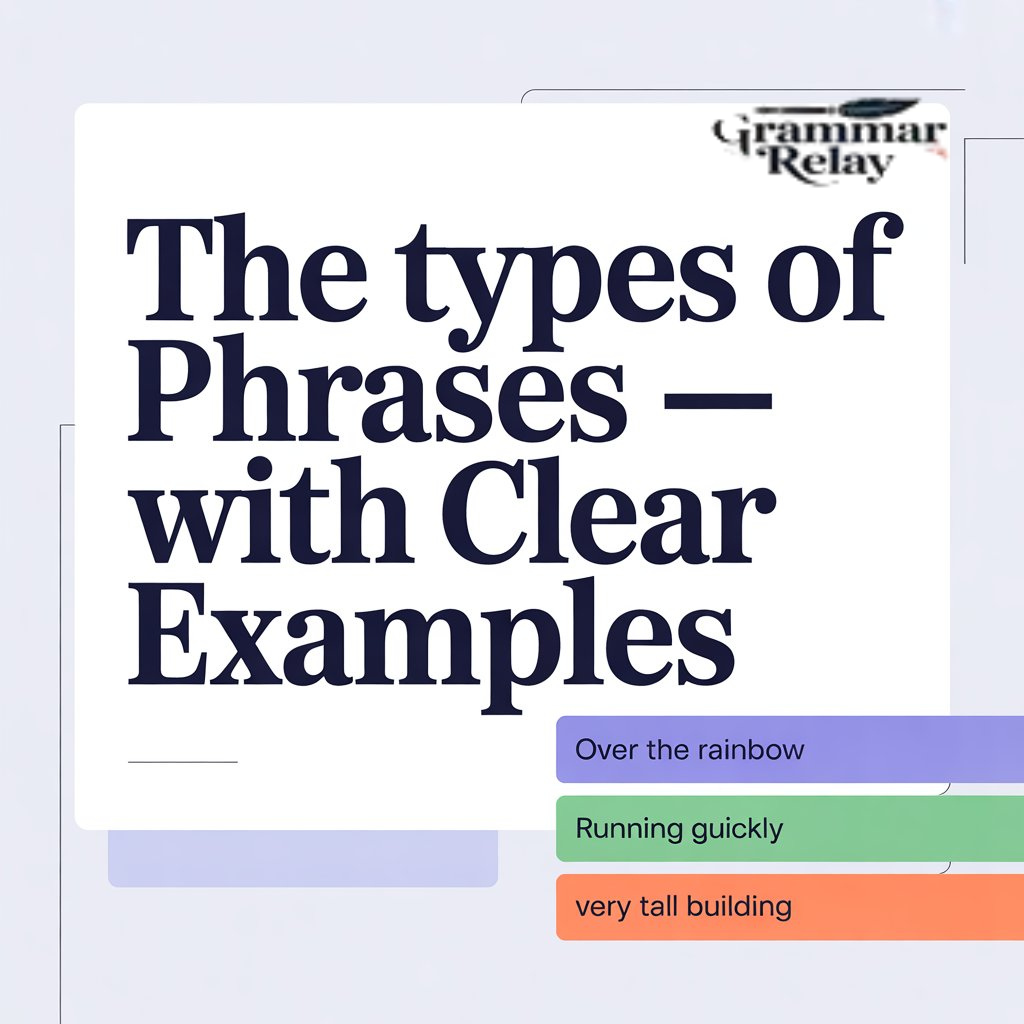
Understanding the different types of phrases helps you build more varied, expressive sentences. Here’s every major type:
Noun Phrase
Acts as a noun. Example: The exhausted marathon runner collapsed at the finish line.
Verb Phrase
The main verb plus its helpers. Example: She has been training for six months.
Adjective Phrase
Modifies a noun. Example: A car too expensive to justify.
Adverb Phrase
Modifies a verb or adjective. Example: He answered in a surprisingly calm voice.
Prepositional Phrase
Starts with a preposition. Example: The keys are under the kitchen table.
Participial Phrase
Uses a participle to modify a noun. Example: Running late, she skipped breakfast.
Infinitive Phrase
Starts with “to” + a verb. Example: To win the championship was everything.
Gerund Phrase
A verb form ending in “-ing” that acts as a noun. Example: Swimming every morning keeps her sharp.
These types of phrases with examples show just how flexible English really is. Each one gives you a different tool for building sentences that don’t all sound the same.
Phrases vs. Clauses — A Comparison That Finally Makes Sense
| Feature | Phrase | Clause |
| Has a subject? | No | Yes |
| Has a verb? | Sometimes | Always |
| Forms a complete thought? | No | Sometimes |
| Can stand alone? | No | Depends |
| Example | under the bridge | She stood under the bridge |
A clause can become a full sentence. A phrase cannot it needs the support of a clause to make complete sense.
Phrases and Punctuation — The Rules Worth Knowing
- Introductory phrases usually take a comma: Running down the hall, she knocked over a stack of books.
- Phrases mid-sentence often don’t need punctuation unless they’re parenthetical.
- Phrases don’t start with capital letters unless they begin a sentence.
Quick-Reference Cheat Sheet
50+ Alternatives to “For Example” — By Tone
| Formal | Conversational | Emphatic |
| Namely | Like | Above all |
| Such as | Take, for instance | Most notably |
| By way of illustration | Like when | In particular |
| As a case in point | As in | Especially |
| e.g. | For instance | Chiefly |
Key Takeaways
- Vary your illustrative phrases “for example” is fine once; rely on it too much and your writing suffers
- Match your phrase to your tone formal, conversational, and creative writing each have their best options
- Transition words aren’t decoration they show logical relationships between ideas
- Phrases are building blocks understanding the eight types makes you a more deliberate writer
- One word can outperform three precision beats length every time
Frequently Asked Questions
Are phrases and quotes the same thing?
No. A quote is someone’s exact words. A phrase is a grammatical unit it may or may not be a quotation.
Are phrases and idioms the same?
Not exactly. All idioms are phrases but not all phrases are idioms. “Kick the bucket” is an idiom (a phrase with a figurative meaning). “The red car” is a phrase with a literal meaning.
Can a phrase stand alone as a sentence?
No, not in standard grammar. A phrase lacks a subject-verb pair so it can’t form a complete thought on its own.
What’s the difference between a phrase and an expression?
An expression is a broader, often informal term for a fixed saying or turn of phrase. Technically, every expression is a phrase but “expression” implies familiarity or cultural usage.
Read more grammar lessons on Grammar Relay
Conclusion
Good writing isn’t about sounding smart. It’s about being clear, varied, and intentional with every word you choose.
“For example” isn’t a bad phrase — it’s just overworked. Now you’ve got 50+ alternatives to pull from, a full toolkit of transition words, and a solid understanding of every type of phrase in English. That’s not a small upgrade. That’s a complete rewiring of how you approach sentences.
Here’s what to take with you:
- Swap “for example” deliberately — match the phrase to your tone and context
- Use transitions purposefully — they’re logical signals, not decorative filler
- Build with phrases — knowing your noun phrases from your gerund phrases makes every sentence a conscious choice
- Read your writing out loud — if it sounds robotic, it probably is
