

Two words. One letter different. Endless confusion.
If you’ve ever frozen mid-sentence wondering whether to write “woman” or “women,” you’re in excellent company. Native English speakers make this mistake daily. Journalists get it wrong. Social media posts get ratioed over it. Even autocorrect occasionally makes a mess of it.
The good news? Once you understand what’s actually happening linguistically, the confusion disappears completely. This guide covers everything: definitions, etymology, pronunciation, grammar rules, and memory tricks that actually stick.
Is “Woman” Singular or Plural?
Here’s the direct answer with zero padding:
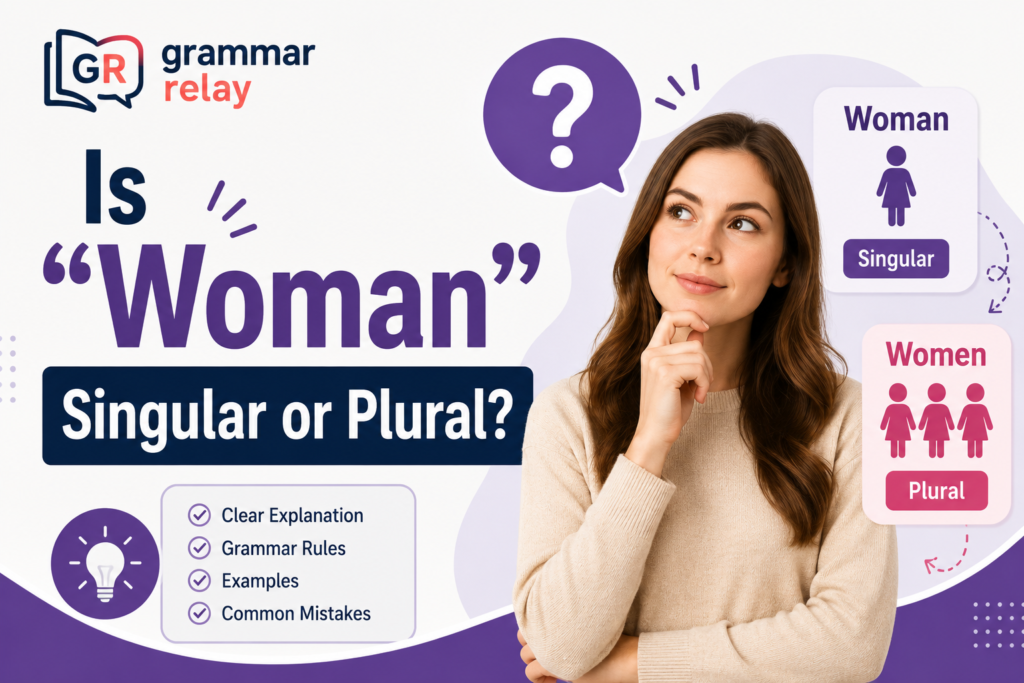
“Woman” is singular. It refers to one female person. “Women” is plural. It refers to two or more female persons.
The memory trick that works every time: the letter “A” appears in “womAn” and also in “one.” Single letter, single person. Done.
Now let’s go deeper, because understanding the why makes the rule impossible to forget.
What Does “Woman” Mean?
Woman is a singular noun referring to one adult female human being. It functions as a standard countable noun in English grammar, meaning it pairs with singular articles and singular verbs.
Correct usage looks like this:
- “She is a woman of remarkable patience.”
- “That woman founded the entire organization.”
- “A woman called asking about the position.”
The word carries weight beyond grammar too. Linguistically, “woman” has evolved from a descriptor of biological sex into a term that encompasses identity, agency, and social standing. That cultural evolution matters when choosing between “woman,” “female,” and “lady” in different contexts, but more on that shortly.
What Does “Women” Mean?
Women is the plural form of “woman.” It refers to two or more adult female human beings. Here’s where things get interesting: unlike most English nouns, “women” doesn’t form its plural by adding “-s.” Instead, the internal vowel changes.
Correct usage:
- “The women on the committee reached a unanimous decision.”
- “Three women applied for the same role.”
- “Women built this company from the ground up.”
Understanding women vs woman at this level makes correct usage feel instinctive rather than memorized.
The Fascinating Origin of “Woman” and “Women”
Etymology solves this puzzle completely. The difference between women and woman isn’t arbitrary. It’s ancient.
In Old English, the word was “wifman“ (literally “wife-person” or “female person”). The plural was “wifmen.” Over centuries of linguistic drift, “wifman” contracted and evolved into “woman” and “wifmen” evolved into “women.”
Here’s the key: the vowel shift in the plural happened through a process called umlaut, a Germanic linguistic phenomenon where the vowel in a word changes to signal plural meaning rather than adding a suffix. German, Dutch, and Old Norse all used this same mechanism.
A brief timeline:
| Period | Singular | Plural |
|---|---|---|
| Old English (450-1100) | wifman | wifmen |
| Middle English (1100-1500) | womman | wommen |
| Early Modern English (1500-1700) | woman | women |
| Modern English (1700-present) | woman | women |
This is why women or woman trips people up. The spelling looks almost identical but the pronunciation tells a completely different story.
Why Is “Women” an Irregular Plural?
Most English plurals follow a simple rule: add “-s” or “-es.” Cats. Dogs. Boxes. Branches. Easy.
Women belongs to a small but important group of irregular plurals where the internal vowel mutates instead. You already know several of these:
- man → men
- foot → feet
- tooth → teeth
- mouse → mice
- goose → geese
- louse → lice
All of these inherited their irregular plural forms from Old English and Proto-Germanic roots. English kept them because they were too deeply embedded in everyday speech to replace. The result is a handful of stubborn irregulars that every English learner has to memorize.
Women singular or plural is therefore a question with a firm answer: “women” is always plural, never singular. There is no grammatical context where “women” functions as a singular noun.
Read more about 60+ Another Word for “Afternoon”
How “Woman” and “Women” Are Pronounced Differently
This is where the real confusion lives. The spelling looks nearly identical but the pronunciation is noticeably different.
| Word | Phonetic Spelling | Sounds Like |
|---|---|---|
| Woman | /ˈwʊmən/ | WUH-man |
| Women | /ˈwɪmɪn/ | WIH-min |
The first syllable is the key difference. “Woman” uses the “oo” sound (as in “wood”). “Women” uses the “ih” sound (as in “win”). Say them out loud right now and the difference clicks immediately.
This pronunciation gap directly causes spelling errors. People hear “WIH-min” and their brain doesn’t map it cleanly to the spelling “women.” So they write “womens” or “woman” when they mean the plural. Understanding the phonetics solves the spelling problem at the root.
The Most Common Grammar Mistakes with “Woman” and “Women”
Writing “a women” Instead of “a woman”
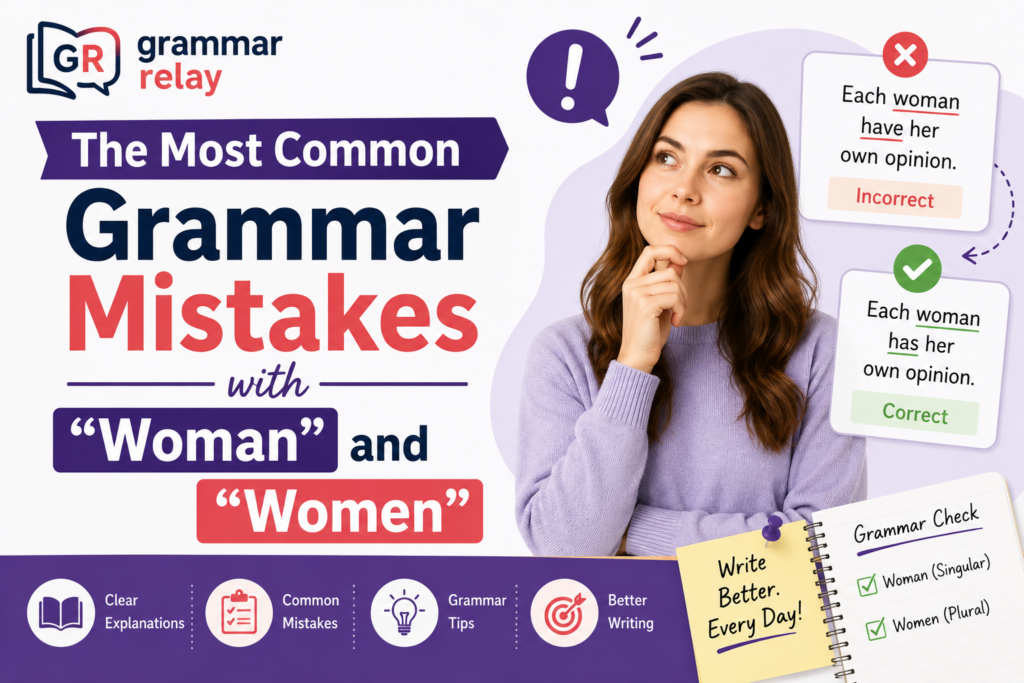
This is the single most frequent error. The indefinite article “a” always precedes a singular noun. “A women” is grammatically impossible because “women” is plural and plurals don’t take “a.”
Wrong: “She is a women of great integrity.” Right: “She is a woman of great integrity.”
Quick fix: if “a” or “an” sits before the word, it must be “woman.”
Writing “womens” Without an Apostrophe
“Womens” is never correct in any context. However, the possessive form “women’s” is perfectly correct and widely used.
- Wrong: “The womens restroom is on the left.”
- Right: “The women’s restroom is on the left.”
This distinction matters in womens or women debates. Without the apostrophe, the word is simply wrong. With it, “women’s” correctly signals possession or association.
Using “woman” as a Modifier Incorrectly
This one trips up even careful writers. When using the word attributively (as a modifier before another noun), the rules shift slightly.
- “A woman doctor” works informally but stylistically, many style guides prefer “a female doctor.”
- “A women’s clinic” uses the possessive plural correctly.
- “A women doctor” is grammatically incorrect because you can’t use a bare plural as a modifier this way.
The AP Stylebook recommends using “woman” or “female” as a modifier rather than “women” in most journalistic contexts.
Plural Verb Agreement Errors
“Women is” is wrong. Always. Because “women” is plural, it takes a plural verb.
- Wrong: “Women is underrepresented in this field.”
- Right: “Women are underrepresented in this field.”
A quick mental test: swap “women” for “men.” You’d never write “men is.” The same rule applies.
Simple Tricks to Never Confuse “Woman” and “Women” Again
Four reliable methods:
The vowel trick: “WomAn” contains the letter A. “A” signals singular. One woman, one A.
The number replacement test: Replace the word with “one” or “two.” If “one” fits naturally, use “woman.” If “two” fits, use “women.”
The man/men swap test: Swap the word for “man” or “men.” If “man” fits, use “woman.” If “men” fits, use “women.” This works because they follow identical patterns.
The article test: If “a” or “an” precedes the word, it must be “woman.” Plurals never take indefinite articles.
“Woman” and “Women” in Real Sentences
Understanding women and woman in context matters as much as knowing the rules in theory.
| Context | Woman (Singular) | Women (Plural) |
|---|---|---|
| Professional | She’s a woman of exceptional skill | The women leading this project are outstanding |
| News | A woman won the award | Women swept the top five positions |
| Possessive | That woman’s research changed the field | Women’s contributions shaped modern science |
| Descriptive | She’s a resilient woman | They are incredibly resilient women |
| Formal writing | One woman spoke against the motion | Several women spoke in favor |
You might be interested in 60+ Unique Ways to Say “Good Morning”
“Woman” vs. “Female” vs. “Lady”: Quick Usage Guide
These three words aren’t interchangeable. Each carries a different register and connotation.
Woman is the most neutral and broadly appropriate choice in nearly all contexts. It’s direct, respectful, and universally understood.
Female works well as an adjective (“female athlete,” “female executive”) but using it as a standalone noun (“a female”) can sound clinical or reductive depending on context. Many style guides recommend “woman” over “female” as a noun.
Lady carries a more formal or old-fashioned tone. It’s appropriate in certain social contexts but can sound condescending in professional settings if used carelessly. The AP Stylebook advises using “woman” over “lady” in most journalistic writing.
“Woman” and “Women” in Different Writing Contexts
In Academic and Formal Writing
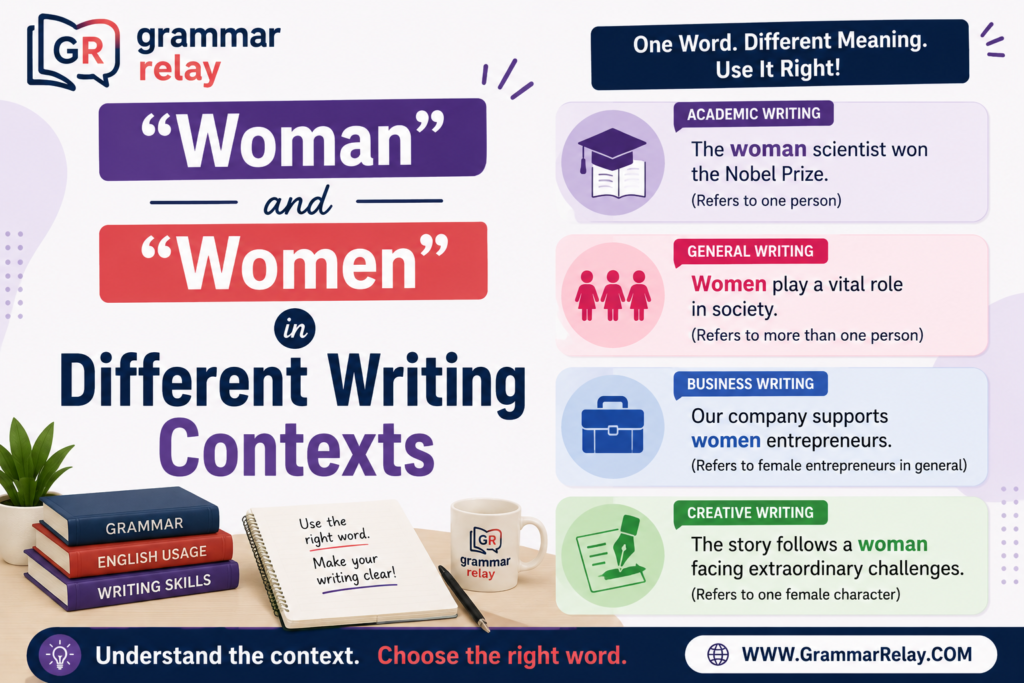
Academic writing demands precision. Women or woman errors in scholarly papers signal carelessness and undermine credibility. The Chicago Manual of Style and MLA both treat “women” as a standard irregular plural requiring no special treatment beyond correct usage.
“Women’s studies,” “women’s health,” and “women’s rights” all use the possessive plural correctly. These are established academic and policy terms with specific meaning.
In News and Journalism
The AP Stylebook is clear: use “woman” for singular and “women” for plural. Headlines frequently use “women” because stories about gender equity, representation, and achievement typically address groups rather than individuals.
Real examples of correct headline usage:
- “Women Outnumber Men in Entering Medical School Class for Fifth Consecutive Year”
- “A Woman Becomes the First to Hold the Position in 40 Years”
In Everyday Emails and Professional Communication
One misused “womens” in a professional email is a small thing that registers as a large lapse in attention. Proofreading specifically for this error takes five seconds and preserves credibility.
On Social Media
Autocorrect and fast typing make this mistake rampant on social platforms. Posts using “woman” when “women” is needed (or vice versa) frequently draw correction in comments. Building a quick mental habit of the vowel trick before posting eliminates the problem entirely.
British English vs. American English: Any Difference?
None whatsoever on spelling. Both British and American English spell the words identically: woman and women.
Pronunciation differs slightly. British English tends toward a more clipped first syllable in “women” (closer to “WIM-in”) while American English uses a slightly more open vowel. Neither variation affects spelling or grammar rules.
Quick Grammar Reference Table
| Feature | Woman | Women |
|---|---|---|
| Number | Singular | Plural |
| Article usage | A woman, the woman | The women (never “a women”) |
| Verb agreement | She is a woman | They are women |
| Possessive form | Woman’s | Women’s |
| Pronunciation | WUH-man | WIH-min |
| As a modifier | A woman doctor (informal) | A women’s clinic |
| Correct example | One woman changed everything | Many women changed everything |
Frequently Asked Questions
Is “woman” singular or plural?
“Woman” is always singular. It refers to exactly one adult female person. This is the core answer to the woman singular or plural question.
Can you say “a women”?
Never. “A” is an indefinite article that only precedes singular nouns. “A women” is always incorrect. Use “a woman” for singular and “the women” or simply “women” for plural.
Why doesn’t “women” end with “-s”?
Because it’s an irregular plural inherited from Old English, where vowel mutation (umlaut) indicated plural meaning instead of a suffix. The same pattern produced “men” from “man” and “feet” from “foot.”
Is “women” ever used as a singular word?
No. “Women” is exclusively plural in standard English grammar. There is no grammatical context where it functions as a singular noun.
What is the possessive form of “woman” and “women”?
The possessive of “woman” is “woman’s” (the woman’s perspective). The possessive of “women” is “women’s” (women’s rights, women’s health).
What is “womxn” and when is it used?
“Womxn” is an alternative spelling used by some communities to explicitly include transgender women and nonbinary individuals in the term. It appears primarily in activist, academic, and progressive organizational contexts rather than mainstream usage.
What’s the difference between “woman” and “female”?
“Woman” is generally preferred as a noun referring to a person. “Female” works better as an adjective. Using “female” as a standalone noun can sound clinical. Most style guides recommend “woman” over “female” when referring to people in non-medical contexts.
Read more grammar lessons on Grammar Relay
Conclusion
Woman is singular. Women is plural. That’s the whole rule in five words.
But understanding why the rule exists, rooted in Old English vowel mutations, Germanic linguistic inheritance, and centuries of natural language evolution, makes it genuinely impossible to forget. Grammar rules you understand stick. Rules you merely memorize fade.
The next time you write either word, run the vowel test in one second: “A” in womAn means one. No A in women means more than one. That’s it. That’s the whole system.
