

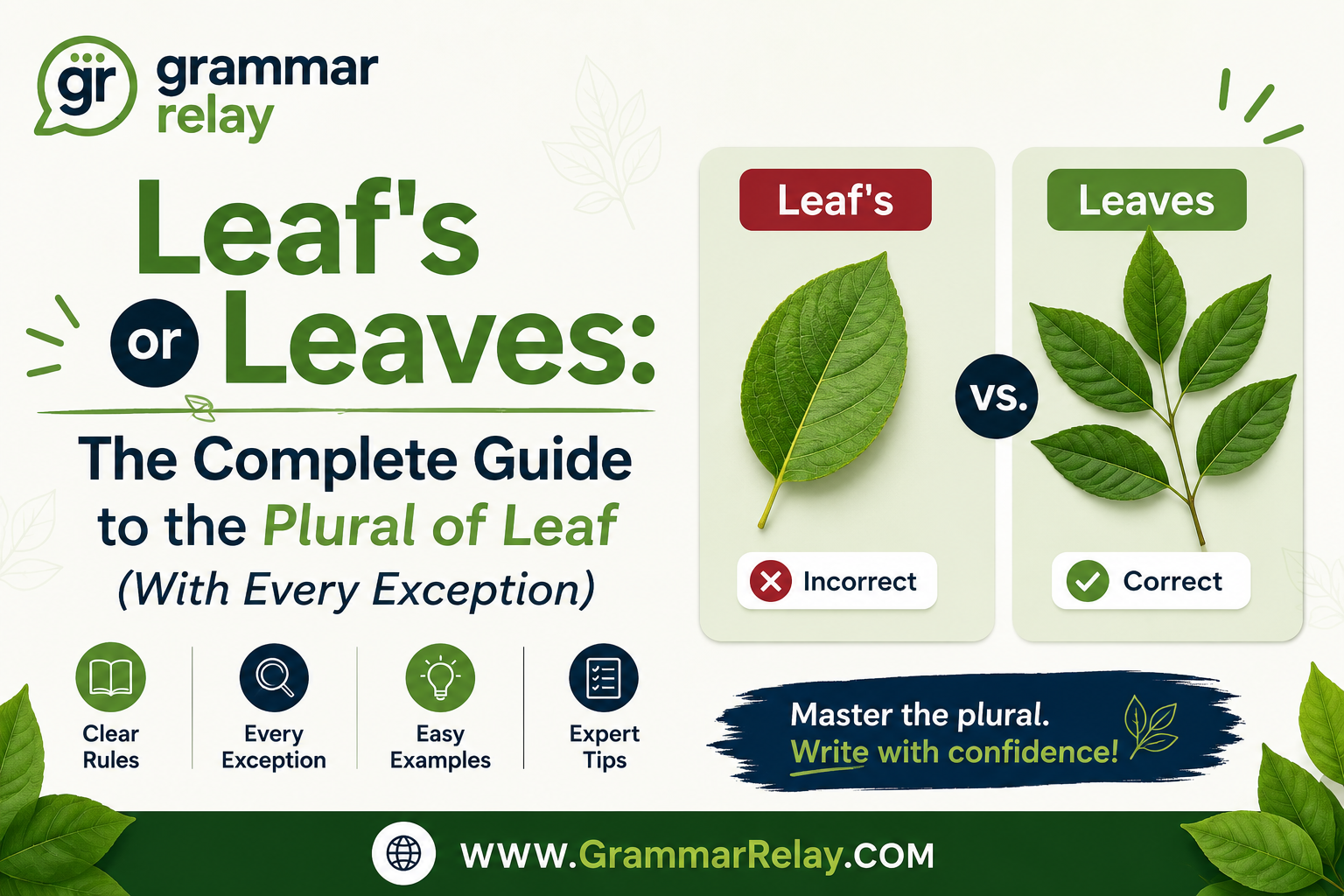
One word. Two spellings. Surprisingly fierce debate.
If you’ve ever typed “leaf’s” and felt a nagging doubt, or confidently written “leaves” only to second-guess yourself, you’re not alone. This particular word trips up native speakers, language learners, sports journalists, and grammar enthusiasts with equal enthusiasm.
Here’s the good news: the rules are actually straightforward once you understand what’s driving them. And yes, both spellings are correct in specific contexts. This guide covers everything including the standard plural, the verb form, the famous sports exception, idioms, etymology, and the memory tricks that make this stick permanently.
Quick Answer: What Is the Correct Plural of Leaf?
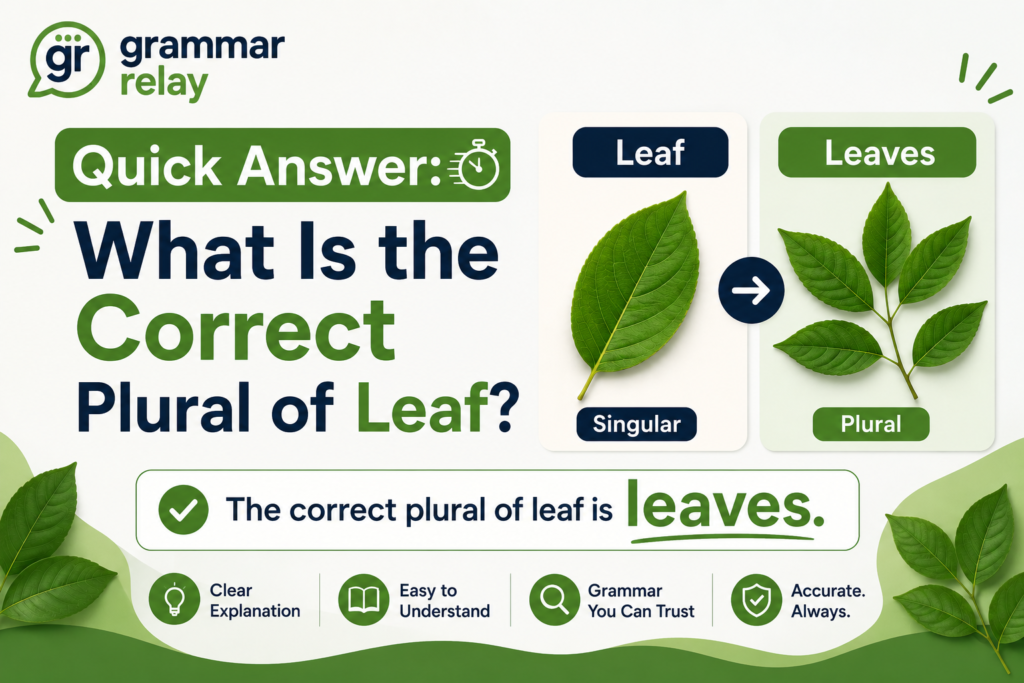
“Leaves” is the standard plural of “leaf.” Full stop.
However, “leafs” is also correct in two specific situations: as a third-person singular verb (“she leafs through the pages”) and as part of a proper noun (“the Toronto Maple Leafs”).
The memory trick that works every time: ask yourself whether you’re talking about actual leaves or describing an action. If it’s a noun referring to multiple foliage units, it’s leaves. If someone is flipping through something, it’s leaf’s.
What Does “Leaf” Mean?
Before tackling leafs vs leaves, it helps to understand just how many things “leaf” actually refers to.
As a noun, “leaf” covers several distinct meanings:
- Botanical: the flat, green photosynthetic organ of a plant
- Typographical/literary: a single sheet in a book or manuscript (one leaf contains two pages)
- Culinary: a thin, flat extension of a dining table (hence table leaves or leafs, with “leaves” being correct)
- Architectural: a hinged section of a door or window
- Metalwork: an extremely thin sheet of metal, as in “gold leaf”
As a verb, “leaf” means to flip or browse through pages quickly. “She leafs through magazines” is correct and natural.
Understanding which meaning you’re working with instantly clarifies is it leafs or leaves for your particular sentence.
The Grammar Rule Behind “Leaves” as the Correct Plural
English has a specific pluralization pattern for words ending in “-f” or “-fe”: they typically change to “-ves” in the plural. This is why leaf plural takes the form “leaves” rather than “leaf’s.”
Here’s the broader pattern with familiar examples:
| Singular | Plural | Pattern |
|---|---|---|
| Leaf | Leaves | f → ves |
| Loaf | Loaves | f → ves |
| Wolf | Wolves | f → ves |
| Shelf | Shelves | f → ves |
| Half | Halves | f → ves |
| Knife | Knives | fe → ves |
| Wife | Wives | fe → ves |
| Life | Lives | fe → ves |
| Thief | Thieves | fe → ves |
| Scarf | Scarves | f → ves |
The pattern is consistent enough that once you recognize it, what is the plural of leaf becomes an easy question. It follows the same logic as knife/knives and wolf/wolves. No exceptions for the standard noun plural.
Read more about Woman or Women: Is “Woman” Singular or Plural?
When “Leaf’s” Is Actually Correct
“Leaf’s” as a Verb
This is where most confusion originates. “Leaf’s” is completely grammatically correct when used as a third-person singular present tense verb.
Consider the full conjugation:
| Tense | Form | Example |
|---|---|---|
| Present (I/You/We/They) | Leaf | I leaf through old journals |
| Present (He/She/It) | Leafs | She leafs through the catalog |
| Past simple | Leafed | He leafed through every page |
| Past participle | Leafed | She had leafed through the manual |
| Present participle | Leafing | He was leafing through old photos |
“She leafs through the report every morning” is perfectly correct English. Anyone who corrects this to “leaves” is actually introducing an error. Context makes the difference crystal clear.
“Leafs” in Proper Nouns and Team Names
Proper nouns operate by their own rules entirely. The most famous example in the English-speaking world is the Toronto Maple Leafs, the NHL hockey team founded in 1927.
The story behind that name is genuinely fascinating. Owner Conn Smythe deliberately chose “Leafs” over the grammatically standard “Leaves” as a tribute to the Maple Leaf Regiment, Canadian soldiers who served in World War One. The non-standard spelling was intentional, patriotic, and permanent.
Today the team name appears in every major style guide as a proper noun exception. Sports journalists who write “Maple Leaves” when covering the team are technically making an error, even though “leaves” would be correct in virtually every other context.
Other sports teams with grammatically non-standard plurals include the Miami Heat (no plural form), the Orlando Magic (same), and the Oklahoma City Thunder (collective noun used as team name).
“Leafs” in Informal Usage
Informally, some writers use “leafs” as a noun plural in very casual contexts. However, no major style guide endorses this usage and it consistently reads as an error to careful readers. Stick with “leaves” for any noun plural in formal or semi-formal writing.
The Fascinating Origin of “Leaves” vs “Leaf’s”
The word traces back to Old English “lēaf”, which came from Proto-Germanic laubaz. The “-f” to “-ves” plural transformation developed during the Middle English period as part of a broader phonological shift affecting voiced and voiceless consonant pairs.
Here’s the interesting linguistic detail: not every word ending in “-f” follows the “-ves” pattern. Some simply add “-s.” The key distinction lies in phonology.
| Word | Plural | Why |
|---|---|---|
| Leaf | Leaves | Voiced stem vowel triggers “-ves” |
| Roof | Roofs | Short vowel resists the change |
| Belief | Beliefs | Abstract noun, resists “-ves” |
| Chef | Chefs | French loanword, keeps “-s” |
| Cliff | Cliffs | Double consonant, keeps “-s” |
| Proof | Proofs | Short vowel, keeps “-s” |
Understanding this pattern answers how do you spell leaves definitively: the long vowel in “leaf” (leef sound) triggers the classic “-f” to “-ves” transformation. The word has followed this pattern consistently since at least the 13th century.
“Leaf’s” or “Leaves” on a Tree: Settling the Nature Debate
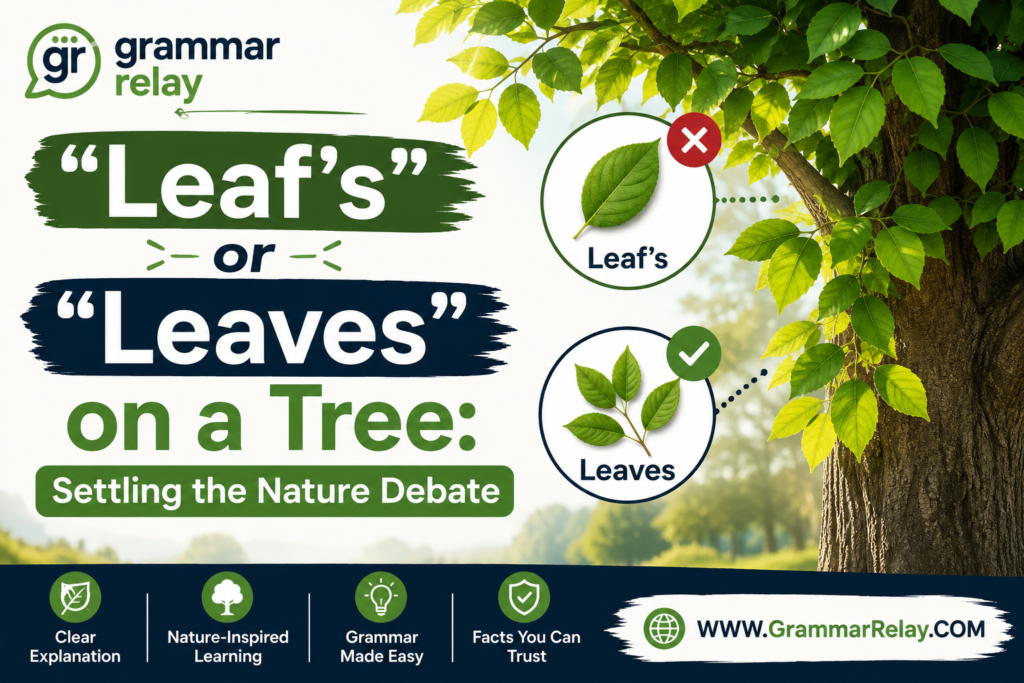
For botanical, ecological, and nature writing contexts, the question of leafs or leaves on a tree has exactly one answer: leaves. Always.
Scientific literature, academic journals, biology textbooks, and nature writing use “leaves” without exception. “The leaves on a deciduous tree” is correct. “The leafs on a deciduous tree” would raise immediate red flags in any scientific or editorial review.
This extends to compound botanical terms too. Compound leaves, opposite leaves, alternate leaves, and simple leaves all use the standard plural. The science of studying leaves falls under the field of phyllology, and every term in that discipline uses “leaves” as the plural form.
Common Idioms and Expressions That Always Use “Leaves”
Every English idiom containing this word uses “leaves” exclusively. Never “leafs.”
| Idiom | Meaning | Example |
|---|---|---|
| Turn over a new leaf | Start fresh, change behavior | “She turned over a new leaf after the setback.” |
| Take a leaf out of someone’s book | Follow their example | “Take a leaf out of her book and plan ahead.” |
| Shaking like a leaf | Trembling with fear or cold | “He was shaking like a leaf before the speech.” |
| Leaf through | Browse quickly (verb form) | “She leafed through the brochure.” |
The origin of “turn over a new leaf” is genuinely interesting. In the 16th century, “leaf” referred to a page in a book or manuscript. Turning over a new leaf literally meant starting on a fresh, blank page. The phrase entered common usage around 1530 and has meant “beginning again” ever since.
Table Leaves or Leaf’s: Which Is Correct?
This specific question comes up often because dining tables with extendable sections are common and the terminology confuses people. The answer is straightforward: table leaves is always correct.
The extensions that slide in or fold out to enlarge a dining table are called leaves in furniture terminology. “We added two leaves to the dining table for Thanksgiving” is correct. “We added two leafs to the table” is not.
This usage goes back centuries to the same root meaning: a thin, flat section. Just as a book leaf is a flat page, a table leaf is a flat extension panel. The botanical plural “leaves” applies consistently across all noun meanings.
“Leaf’s” vs “Leaves”: Complete Side-by-Side Comparison
| Feature | Leaves | Leafs |
|---|---|---|
| Standard plural noun? | Yes | No |
| Used in nature writing? | Always | Never |
| Used as a verb? | No | Yes (she leafs through) |
| Used in sports? | Incorrect for Toronto team | Toronto Maple Leafs specifically |
| Used in literature? | Yes | No |
| Used for table extensions? | Yes (table leaves) | No |
| Used in idioms? | Always | Never |
| Grammatically correct as noun plural? | Yes | No (except proper nouns) |
You might be interested in 60+ Another Word for “Afternoon”
Leaves and Leaf’s in Different Writing Contexts
In Academic and Scientific Writing
“Leaves” appears without exception in peer-reviewed literature. A 2022 study in the Journal of Plant Biology references “photosynthetic leaves” throughout. Botanical nomenclature treats “leaves” as the only acceptable plural in scholarly contexts.
In Sports Writing and Journalism
The AP Stylebook instructs journalists to use team names as the organization uses them officially. That means “the Toronto Maple Leafs” in sports coverage, even though “leaves” would be grammatically standard everywhere else.
Correct sports headline: “Toronto Maple Leafs Win Game Seven in Overtime” Incorrect: “Toronto Maple Leaves Advance to the Finals”
In Everyday Conversation and Informal Writing
Most errors fall into two categories: writing “leafs” as a noun plural in casual text messages, and writing “leaves” when conjugating the verb (“she leaves through the pages” is incorrect; “she leafs through the pages” is correct).
In Creative and Literary Writing
Walt Whitman’s “Leaves of Grass” (first published 1855) remains one of the most celebrated poetry collections in American literature. Whitman used “leaves” both literally and metaphorically, equating blades of grass with printed pages. The title plays on both meanings simultaneously and demonstrates how “leaves” functions with rich symbolic weight in literary contexts.
Symbolism and Cultural Significance of Leaves
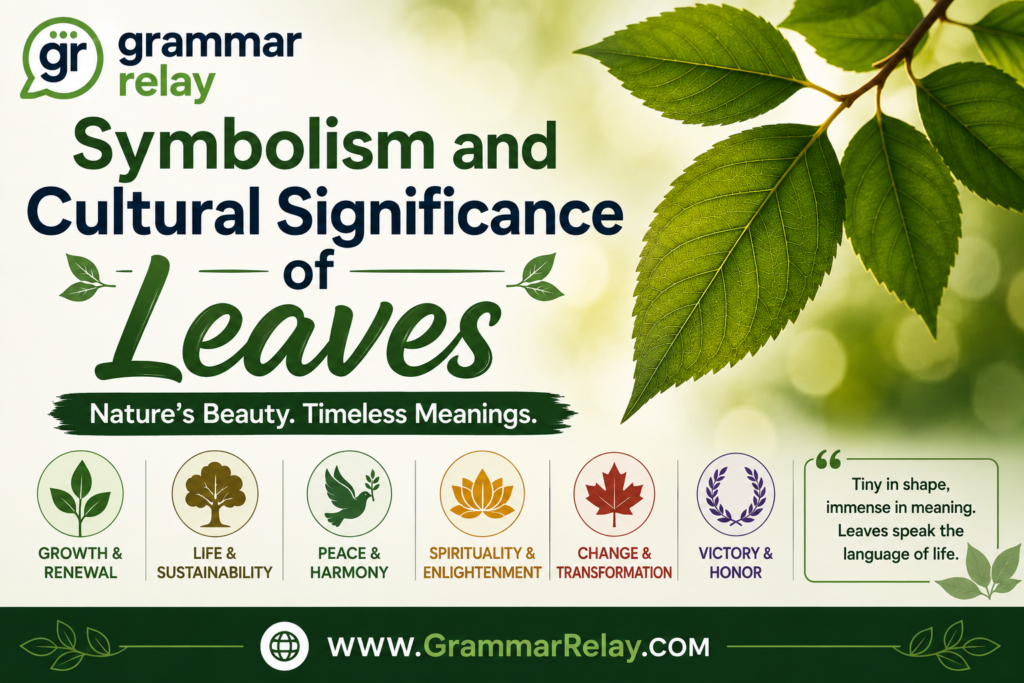
Leaves carry profound symbolic meaning across cultures that reinforces their linguistic dominance over “leafs.”
In Japanese culture, the tradition of “momijigari” (maple leaf viewing in autumn) treats falling leaves as symbols of impermanence and beauty. The entire tradition centers on the word “leaves” as a collective experience of change.
In Canadian national identity, the maple leaf appears on the flag, coinage, and dozens of national symbols. Interestingly, the national symbol uses “leaf” (singular) while the hockey team uses “Leafs” (proper noun plural), creating a linguistic distinction that Canadians navigate naturally.
In Western literary tradition, leaves symbolize growth, change, mortality, and renewal. From Shakespeare to Keats to Whitman, the imagery of leaves consistently represents the cycle of life.
Most Common Mistakes Writers Make
Watch out for these specific errors:
- Writing “leafs” as a noun plural in any nature, botanical, or general context. It reads as an error every time.
- Writing “leaves” when conjugating the verb. “She leaves through pages” is wrong. “She leafs through pages” is correct.
- Overcorrecting “Maple Leafs” to “Maple Leaves” in sports writing. Proper nouns don’t follow standard grammar rules.
- Writing “table leafs” instead of “table leaves” when discussing furniture extensions.
- Assuming “leafs” is never a real word. It’s a legitimate verb form and a legitimate proper noun component.
Memory Tricks to Get It Right Every Time
Four reliable methods:
The verb test: Can you replace the word with “flips”? “She flips through the report.” Yes, that works, so “leafs” is correct as the verb form.
The noun test: Can you replace it with “pages” or “foliage”? Then “leaves” is correct as the plural noun.
The pattern connection: Remember knife/knives and wolf/wolves. Leaf follows the exact same “-f” to “-ves” pattern. If you know those, you know this.
The proper noun rule: If it’s a team or brand name, use whatever spelling they officially use. Grammar yields to identity in proper nouns.
Quick Grammar Reference Table
| Question | Answer |
|---|---|
| Plural of leaf (noun) | Leaves |
| Third person singular verb | Leafs |
| Correct: “two leafs”? | Never correct as noun plural |
| Correct: “she leafs through”? | Always correct as verb |
| Table extensions | Table leaves |
| Toronto team name | Maple Leafs (proper noun) |
| Idioms use which form? | Always “leaves” |
| Scientific writing | Always “leaves” |
Frequently Asked Questions
Is “leaf’s” ever correct as a noun plural?
Only in proper nouns like the Toronto Maple Leafs. As a standard noun plural in any other context, “leafs” is incorrect. Use “leaves” every time.
Why do the Toronto Maple Leaf’s spell it that way?
Owner Conn Smythe chose “Leafs” in 1927 as a deliberate tribute to the Maple Leaf Regiment of World War One. The non-standard spelling was patriotic and intentional.
What are other words that change “-f” to “-ves”?
Knife/knives, wolf/wolves, shelf/shelves, half/halves, loaf/loaves, wife/wives, life/lives, thief/thieves, and scarf/scarves all follow the same pattern.
Is “leaf’s” correct in any style guide?
As a verb form, yes. As a noun plural (outside the Toronto team name), no major style guide endorses it.
Can I write “Maple Leaves” when talking about the Toronto team?
Technically no. AP Style and journalistic convention both use the team’s official name: the Toronto Maple Leafs.
Why do some “-f” words take “-s” instead of “-ves”?
Phonological factors drive the distinction. Words like “roof,” “proof,” and “belief” have short vowels or come from French/Latin roots that resist the Germanic “-ves” transformation.
Read more grammar lessons on Grammar Relay
Conclusion
“Leaves” is the correct plural of “leaf” as a noun. That’s the core rule and it doesn’t bend outside of proper nouns.
But “leafs” earns its place in the language too, specifically as a verb form and as part of team names built on historical tribute rather than grammatical convention. Context determines correctness every single time.
The fastest habit you can build: before writing either form, ask one question. “Am I describing multiple leaves or describing someone flipping through something?” That single question eliminates 95% of errors instantly.
