

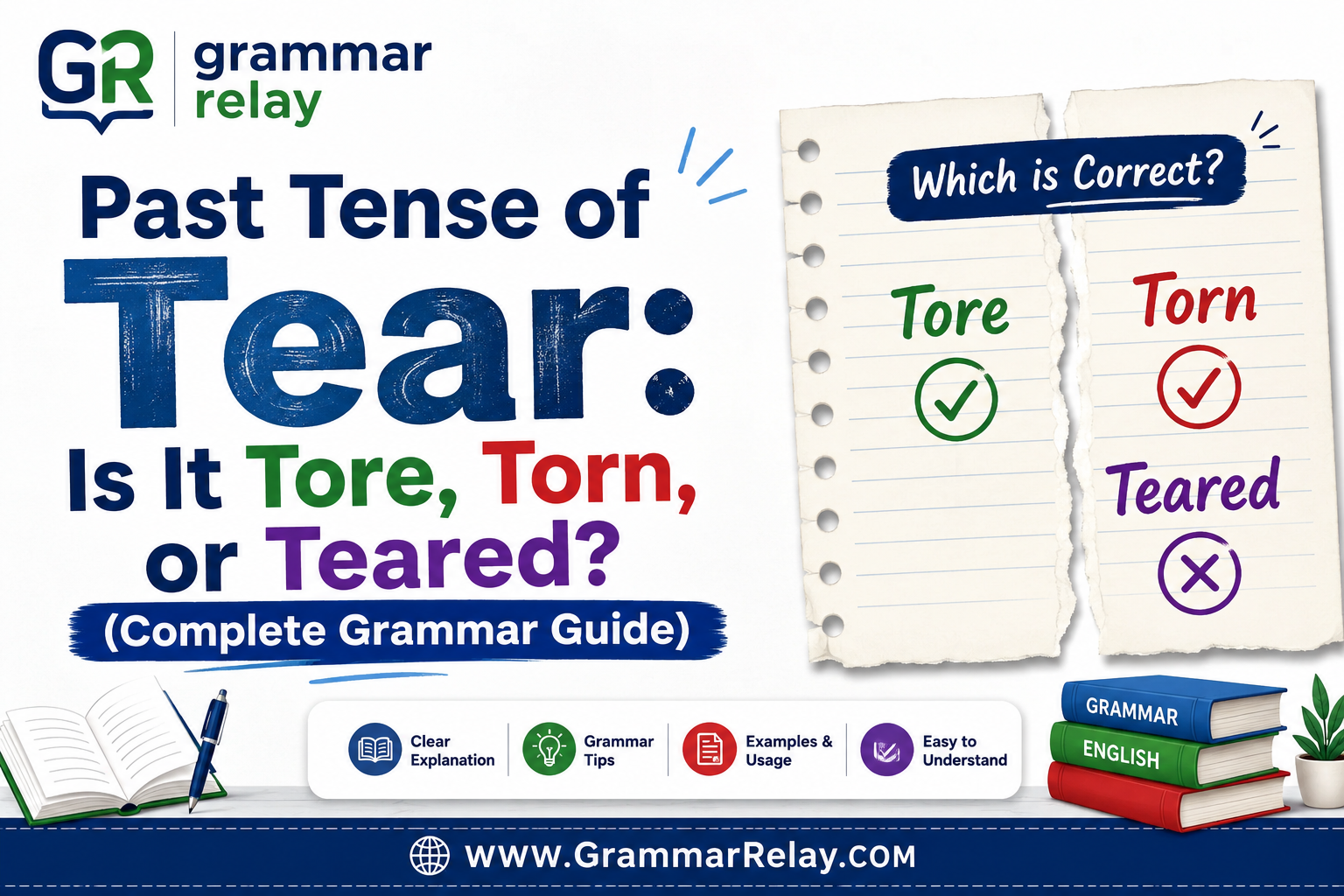
Two letters apart. Worlds of confusion between them.
“Tore” and “torn” trip up writers every single day, including fluent English speakers who’ve been using the language their entire lives. And then there’s “teared,” sitting quietly in the corner, waiting for someone to either defend it or throw it out entirely.
Here’s what makes this verb genuinely fascinating: “tear” is actually two completely different words that happen to share identical spelling. That single fact explains most of the confusion surrounding its past tense forms. Once you understand what’s really happening linguistically, every form clicks into place and stays there.
This guide covers everything: etymology, full conjugation, every tense, passive constructions, adjective usage, idioms, and memory tricks that work permanently.
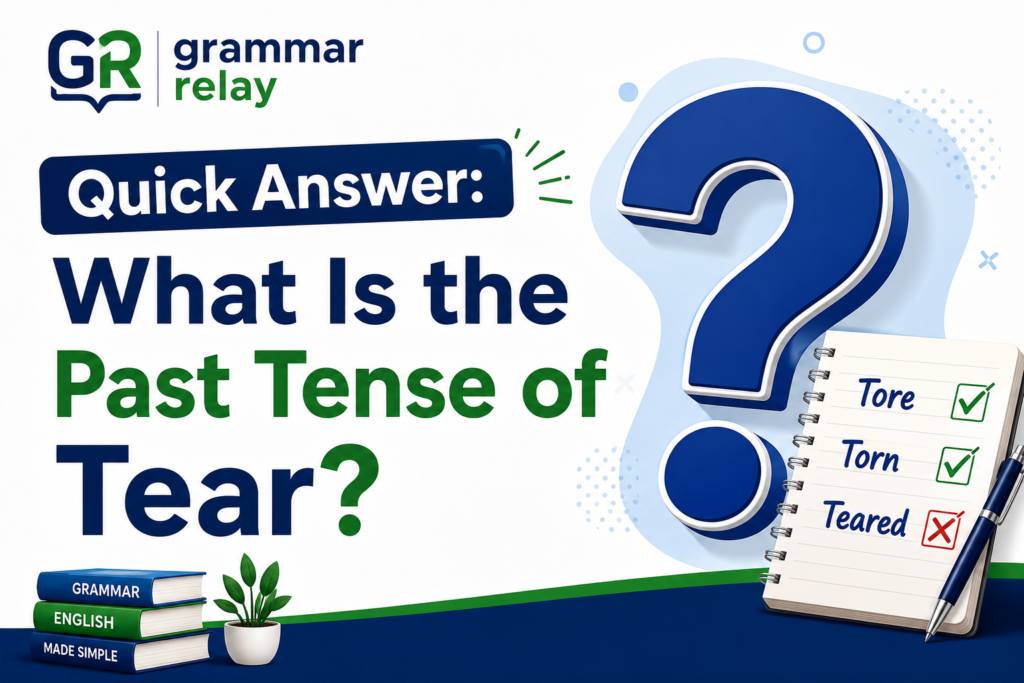
Quick Answer: What Is the Past Tense of Tear?
For the ripping meaning:
- Simple past: tore (“She tore the letter in half.”)
- Past participle: torn (“Someone has torn the fabric.”)
For the eye-moisture meaning:
- Simple past: teared up (“He teared up during the ceremony.”)
The rule that eliminates 90% of errors: if your sentence contains “has,” “have,” or “had,” use “torn.” If it stands alone without a helper verb, use “tore.” That’s the entire system in one sentence.
The Double Life of “Tear”: Two Completely Different Words
Before tackling the past tense of tear, you need to understand something crucial: “tear” is a homograph. It’s actually two separate words wearing identical spelling like a disguise.
Tear (rhymes with “care”): to rip, pull apart, or lacerate something physical or metaphorical.
Tear (rhymes with “here”): a drop of saline liquid produced by the eye during emotional or physical stimulation.
These two words come from completely different Old English ancestors and have unrelated meanings. They just happen to look identical on the page. Pronunciation is the only immediate signal: “tare” for ripping, “tier” for crying.
Why does this matter for grammar? Because each meaning follows different conjugation patterns. The ripping “tear” is an irregular verb (tear/tore/torn). The crying “tear” used as a verb in “tear up” takes a regular past tense (“teared up”). Mixing these up creates errors that confuse readers immediately.
The Fascinating Etymology of “Tear”
Understanding where tear verb forms come from makes the irregular conjugation feel inevitable rather than arbitrary.
The ripping “tear” descends from Old English “teran”, meaning to pull apart or lacerate, which came from Proto-Germanic tairan. Related words in modern Germanic languages include German “zerren” (to tug) and Dutch “teren.” The Old English “teran” belonged to a class of strong verbs that changed internal vowels to indicate past tense rather than adding “-ed.” That’s exactly why “tear” becomes “tore” and “torn” rather than “teared.”
The eye-liquid “tear” has a completely separate origin: Old English “tēar”, from Proto-Germanic tarhaz, related to Greek “dakry” and Latin “lacrima.” Two ancient words, two completely independent etymological journeys, one collision point in modern English spelling.
A brief evolution timeline:
| Period | Ripping Verb | Development |
|---|---|---|
| Proto-Germanic | *tairan | Strong verb class IV |
| Old English | teran | Conjugated: tær (past), toren (past participle) |
| Middle English | tere/tere | Vowel shifts reshape pronunciation |
| Early Modern English | tear/tore | Modern forms solidify |
| Modern English | tear/tore/torn | Current standard forms |
Complete Verb Conjugation of “Tear” (To Rip)
Here’s the full tear verb forms reference covering every tense:
| Tense | Form | Example Sentence |
|---|---|---|
| Base form | Tear | I tear the paper along the edge |
| Simple past | Tore | She tore the contract immediately |
| Past participle | Torn | The letter has been torn |
| Present participle | Tearing | He is tearing through the packaging |
| Third person singular | Tears | She tears receipts every day |
| Past perfect | Had torn | They had torn the agreement apart |
| Future simple | Will tear | She will tear the document tomorrow |
| Future perfect | Will have torn | He will have torn it by then |
| Conditional | Would tear | She would tear it without hesitation |
| Past continuous | Was tearing | He was tearing the pages methodically |
| Present perfect | Has/have torn | The muscle has torn badly |
| Past perfect continuous | Had been tearing | She had been tearing pages for hours |
The plural of tear as a noun (multiple drops from the eye) is simply “tears.” As a verb, “tear” doesn’t have a plural form since verbs don’t pluralize. This distinction matters when discussing grammar across different languages where “tear ki second form” (the second form of tear) refers specifically to the simple past “tore.”
“Tore”: When and How to Use the Simple Past
“Tore“ is the simple past tense of the ripping “tear.” It describes a completed ripping action at a specific point in the past without any helping verb.
Key characteristics of “tore”:
- Stands completely alone, no helper verb needed or wanted
- Describes a single completed action
- Works in both active and narrative writing
- Never correct with “had,” “has,” or “have” before it
Correct “tore” sentences across contexts:
- Everyday physical action: “He tore the packaging open with his hands.”
- Emotional context: “She tore the photograph into pieces after the argument.”
- Sports writing: “The defender tore the ball away from the striker.”
- Medical narrative: “He tore his hamstring during the final sprint.”
- Formal writing: “The agreement tore apart when negotiations collapsed.”
Wrong vs. Right:
| Wrong | Right | Why |
|---|---|---|
| She had tore the letter | She had torn the letter | “Had” needs “torn” |
| The fabric was tore | The fabric was torn | Passive needs “torn” |
| He has tore through it | He has torn through it | “Has” needs “torn” |
Read more about Plural of Alumna: Alumnae and Alumni
“Torn”: When and How to Use the Past Participle
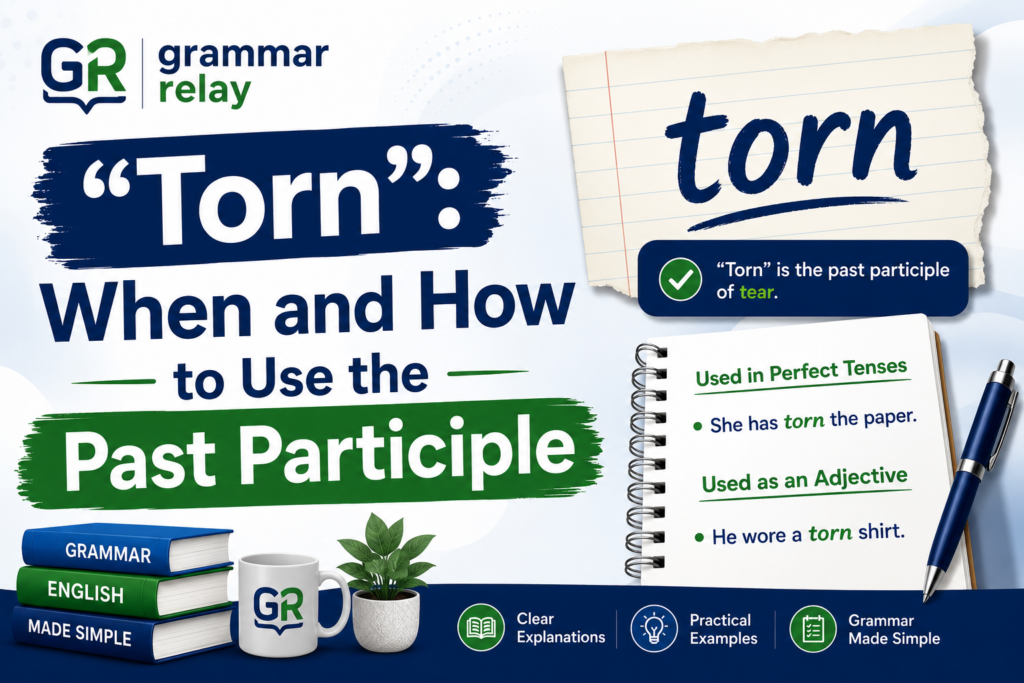
“Torn“ is the past participle of tear and does double duty: it works with auxiliary verbs in perfect tenses and passive constructions, and it functions as a standalone adjective.
As a past participle with helper verbs:
- Present perfect: “She has torn every letter he ever sent.”
- Past perfect: “The team had torn the playbook apart by halftime.”
- Future perfect: “By tomorrow, he will have torn through the entire archive.”
- Active present: “Something tears the fabric beyond repair.”
- Active past: “Both parties tore up the agreement.”
As an adjective describing a noun directly:
- Medical: “A torn ligament requires surgical intervention.”
- Physical: “She wore a torn jacket to the protest.”
- Emotional: “He felt torn between his career and his family.”
- Literary: “A torn community struggled to rebuild trust.”
The adjective use of “torn” is powerful precisely because it carries both literal and metaphorical weight simultaneously. When a novelist writes “she stood there, torn,” readers understand physical and emotional meanings simultaneously without needing further explanation.
“Teared”: Is It Ever Correct?
Here’s where most grammar guides either get it wrong or skip the nuance entirely. “Teared” is legitimate in exactly one context: the phrasal verb “teared up,” meaning the eyes filled with tears.
“Teared up” is the correct past tense from when referring to someone’s eyes filled with tears. Unlike the irregular verb “tear”(to rip),the phrasal verb “tear up” follows the standard “-ed” ending for regular verbs.
Correct “teared up” usage:
- “She teared up when she heard the news.”
- “He teared up during his daughter’s graduation speech.”
- “The entire audience teared up at the final scene.”
Merriam-Webster includes “teared up” as an accepted phrasal verb usage. The Cambridge Dictionary similarly acknowledges it as standard in informal English.
However, “teared” is never correct for the ripping meaning:
- Wrong: “She teared the envelope open.”
- Right: “She tore the envelope open.”
The distinction is absolute. Ripping always uses “tore” for simple past. Crying always uses “teared up” for the phrasal form.
Tore vs Torn vs Teared: Complete Comparison
| Form | Grammatical Role | Needs Helper? | Which “Tear”? | Example |
|---|---|---|---|---|
| Tore | Simple past | Never | Ripping only | She tore the page in half |
| Torn | Past participle or adjective | Usually | Ripping only | The page has been torn |
| Teared | Phrasal past (teared up) | No | Eye tears only | He teared up at the speech |
| Tearing | Present participle | Yes | Both meanings | She was tearing the paper |
| Tears | Third person present or noun | No | Both meanings | She tears up easily |
The Irregular Verb Pattern: Why Tear Follows the “Wear” Family
“Tear” isn’t alone in its irregular behavior. It belongs to a specific class of strong Germanic verbs that change internal vowels rather than adding “-ed.” Recognizing this family makes every member easier to remember.
| Infinitive | Simple Past | Past Participle |
|---|---|---|
| Tear | Tore | Torn |
| Wear | Wore | Worn |
| Swear | Swore | Sworn |
| Bear | Bore | Born/Borne |
The pattern is identical across all four verbs: the vowel shifts from “ea” to “o” in past tense and past participle. Once you internalize this pattern through “wear/wore/worn” (which most speakers find more intuitive), “tear/tore/torn” follows automatically.
This is precisely what tear ki second form refers to in grammatical terminology: “tore” as the second principal part of the verb, following the base form “tear” and preceding the past participle “torn” as the third form.
“Tear” in Passive Voice Constructions
Passive voice changes which “torn” form appears but doesn’t change the word itself.
| Active | Passive |
|---|---|
| She tore the letter | The letter was torn by her |
| He has torn the fabric | The fabric has been torn |
| They had torn the agreement | The agreement had been torn |
| The wind tore the banner | The banner was torn by the wind |
Passive constructions with “torn” appear frequently in:
- Legal writing: “The original document was found torn and unsigned.”
- Medical reports: “The tissue was torn during the procedure.”
- News writing: “The banner was torn from the building during the storm.”
- Insurance claims: “The merchandise arrived torn and damaged.”
In all passive constructions, “torn” is the correct form. “Tore” never appears in passive voice because passive voice always requires a past participle.
You might be interested in Singular Form of Dice: Is It “Die” or “Dice”?
Common Mistakes Writers Make
Using “Tore” as a Past Participle
The most frequent error. “Had tore” and “has tore” are always wrong.
Wrong: “The muscle had tore during training.”
Right: “The muscle had torn during training.”
Using “Torn” Without a Helping Verb
The orphaned past participle problem. “Torn” without “has,” “have,” “had,” “was,” or “been” is almost always wrong unless functioning as an adjective.
Wrong: “She torn the contract deliberately.”
Right: “She tore the contract deliberately.”
Using “Teared” for Physical Ripping
Wrong: “He teared the letter into small pieces.”
Right: “He tore the letter into small pieces.”
Regularizing the Verb to “Teard” or “Teared”
Some writers attempt to regularize the irregular verb, especially in informal writing or when uncertain.
Wrong: “She teard the wrapping paper off excitedly.”
Right: “She tore the wrapping paper off excitedly.”
Idioms and Expressions Using Tear, Tore, and Torn
| Idiom | Meaning | Example |
|---|---|---|
| Tear someone apart | Criticize harshly or cause deep pain | The critics tore the performance apart |
| Torn between | Unable to choose between two options | She felt torn between loyalty and truth |
| Tear up | Shred a document or fill with tears | He tore up the contract in front of everyone |
| Tore into | Attacked verbally with great force | The manager tore into the team after the loss |
| Tear down | Demolish or aggressively dismantle | They tore down the old stadium overnight |
| Torn to shreds | Completely destroyed or harshly criticized | Her argument was torn to shreds in court |
| Wear and tear | Gradual damage through regular use | The engine showed significant wear and tear |
| That’s torn it | British: something has gone badly wrong | Well, that’s torn it completely |
Synonyms for “Tear” (Ripping Meaning) and Their Nuances
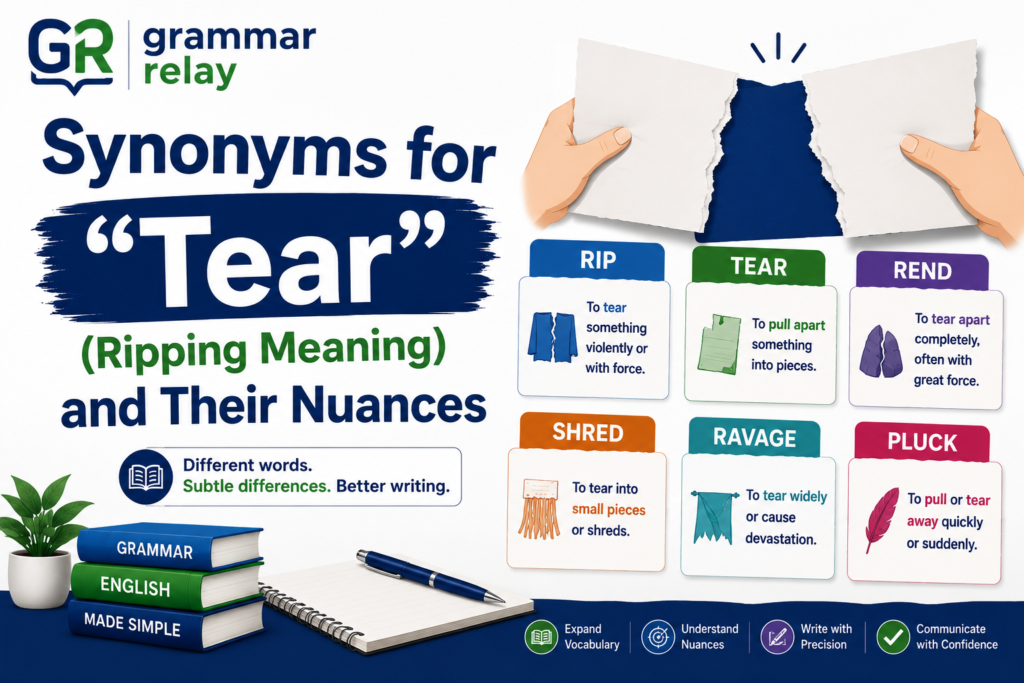
Not every ripping action calls for the same word. Here’s how the alternatives differ:
| Synonym | Nuance | Best Context |
|---|---|---|
| Rip | Sudden, forceful, usually loud | Casual, everyday physical tearing |
| Shred | Into many thin strips | Documents, paper, cheese |
| Lacerate | Medical; deep, jagged wound | Clinical and medical writing |
| Split | Along a natural line or grain | Seams, wood, relationships |
| Rupture | Sudden violent separation | Pipes, vessels, relationships |
| Sever | Complete separation, often deliberate | Ropes, ties, connections |
Pronunciation Guide for All Forms
| Word | IPA Pronunciation | Rhymes With |
|---|---|---|
| Tear (rip) | /tɛr/ | Care, bare, dare, share |
| Tear (eye liquid) | /tɪr/ | Here, fear, near, clear |
| Tore | /tɔːr/ | More, floor, core, store |
| Torn | /tɔːrn/ | Corn, born, worn, sworn |
| Tearing | /ˈtɛrɪŋ/ | Caring, daring, sharing |
| Teared up | /tɪrd ʌp/ | Feared up, cleared up |
Getting the pronunciation right for tear past tense forms matters in spoken communication as much as written. “Tore” and “torn” are distinct enough phonetically that mispronunciation signals unfamiliarity with the verb.
Memory Tricks to Get Tore and Torn Right Every Time
Four methods that genuinely work:
The helper verb test: Does your sentence contain “has,” “have,” “had,” “was,” “were,” or “been”? Use “torn.” No helper verb anywhere? Use “tore.” This single test catches nearly every error.
The wear/wore/worn parallel: Tear follows the exact same pattern as wear. If you’d write “she wore the dress” (not “she worn the dress”), write “she tore the paper” (not “she torn the paper”). Same logic, every time.
The adjective check: Describing a noun directly without a helper verb? Use “torn.” A torn muscle, a torn page, a torn relationship: all adjective uses, all correct.
The “teared up” isolation rule: Reserve “teared” exclusively for eye-related emotional moments. It never touches the ripping meaning under any circumstances.
Quick Grammar Reference Table
| Question | Answer |
|---|---|
| Simple past of tear (rip) | Tore |
| Past participle of tear | Torn |
| Past tense of “tear up” (cry) | Teared up |
| Correct: “had tore”? | Never correct |
| Correct: “she torn it”? | Never correct |
| “Torn” without helper verb? | Only as an adjective |
| Third person singular present | Tears |
| Present participle | Tearing |
| Second form of tear | Tore |
| Third form of tear | Torn |
Frequently Asked Questions
What is the simple past tense of tear?
For the ripping meaning, the simple past is “tore.” “She tore the envelope open.” He teared up during the eulogy.
Is “torn” a past tense form of tear?
“Torn” is the past participle, not the simple past. It always works with helper verbs (“has torn,” “had torn,” “was torn”) or as an adjective (“a torn muscle”).
When is “teared” correct?
Only in the phrasal verb “teared up,” meaning the eyes filled with tears. “He teared up during the eulogy” is correct. “She teared the paper” is always wrong.
Why is “tear” an irregular verb?
Because it descends from Old English “teran,” a strong verb that changed internal vowels to signal tense rather than adding “-ed.” This Germanic pattern survived intact into modern English.
What other verbs follow the same pattern as tear?
Wear/wore/worn, swear/swore/sworn, and bear/bore/borne all follow the identical vowel-shift pattern. Learning one helps you remember all of them.
Can “torn” be used as an adjective?
Absolutely. “A torn ligament,” “torn between two choices,” and “the torn fabric” all use “torn” as a descriptive adjective. This is standard and correct usage.
What is the difference between “tore” and “torn”?
“Tore” is simple past and stands alone. “Torn” is past participle and works with helper verbs or as an adjective. Using one where the other belongs is the most common error with this verb.
Is “had tore” ever grammatically correct?
Never. “Had” always requires the past participle “torn.” “Had tore” is an error in every context without exception.
Read more grammar lessons on Grammar Relay
Conclusion
“Tore” for simple past. “Torn” for past participle. Seven words compress the whole rule.
The past tense of tear follows the same beautiful irregular pattern as wear, swear, and bear: vowel shift rather than “-ed” ending, a direct inheritance from Old English strong verbs that have survived a thousand years of linguistic change. Understanding that ancestry makes the forms feel logical rather than arbitrary.
Build one habit starting today: before writing “tore” or “torn,” check for helper verbs. “Has,” “have,” “had,” “was,” “were,” or “been” anywhere in the sentence means “torn.” No helper verb means “tore.” Apply that test once per writing session until it becomes automatic and this particular grammar puzzle disappears from your list of concerns permanently.
