

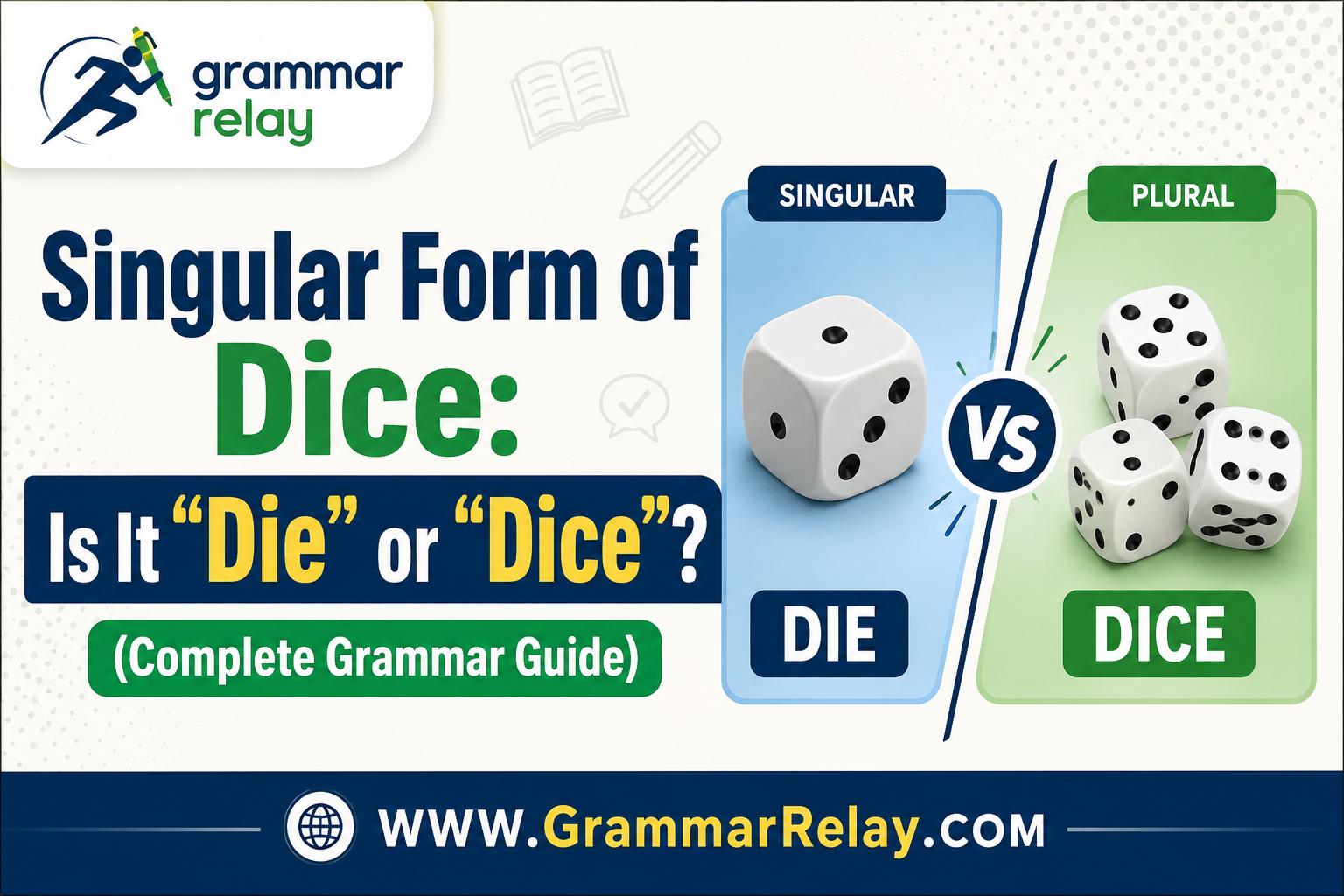
One small cube. Enormous grammatical confusion.
Ask ten people what the singular form of dice is and you’ll likely get seven different answers, two confident shrugs, and one person who walks away mid-conversation. It’s that kind of word.
Here’s the thing: both “die” and “dice” have legitimate claims to the singular spot depending on who you ask, what you’re writing, and when you’re writing it. The rules have genuinely shifted over the past few decades and knowing exactly where the language stands in 2026 makes all the difference between sounding precise and sounding uncertain.
This guide covers everything: etymology, style guide positions, gaming culture, manufacturing terminology, idioms, regional variations, and memory tricks that actually stick.
Quick Answer: What Is the Singular Form of Dice?
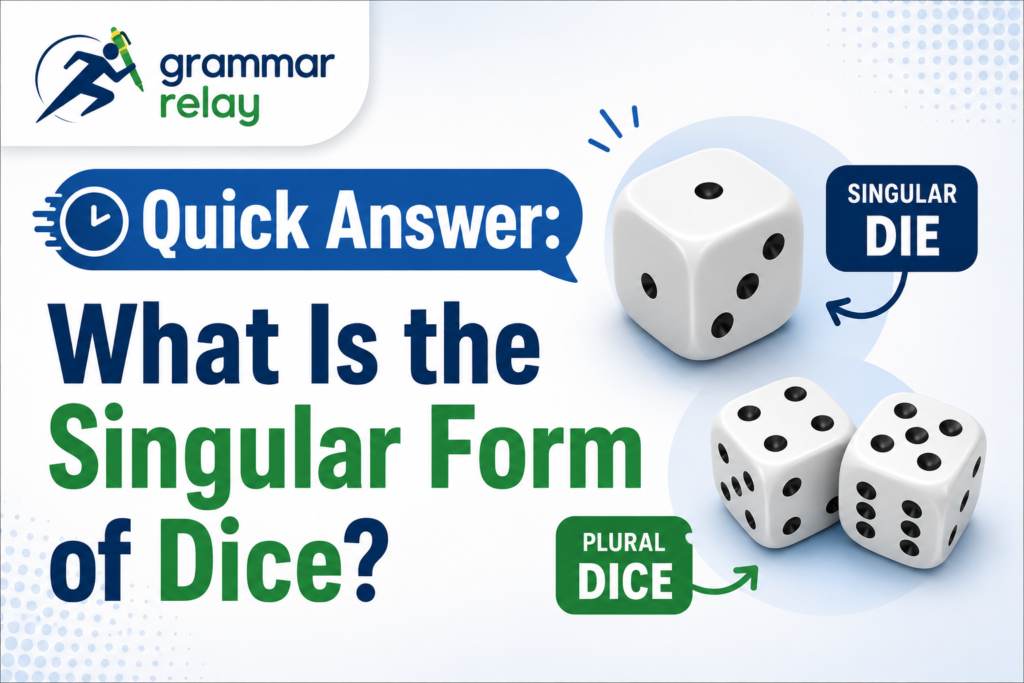
The traditional singular form of dice is “die.” One cube is a die. Multiple cubes are dice.
However, in modern everyday English, “dice“ increasingly functions as both singular and plural. “Pass me a dice” sounds completely natural to most contemporary English speakers even though traditional grammar marks it as incorrect.
The single most important factor determining which form to use: formality level. Formal and academic writing demands “die” for singular. Casual conversation and informal writing increasingly accept “dice” for singular without raising eyebrows.
Memory trick that works instantly: “Die” has one syllable for one cube. “Dice” has one syllable too but ends in a plural sound. More usefully, think of a single die as a lone soldier and dice as the whole army.
What Does “Die” Mean?
“Die” as a singular noun refers to one small cube marked with numbers or symbols on each face, used in games of chance. Roll one and you’re rolling a die. Simple.
But “die” carries several other meanings beyond the gaming table:
- Manufacturing: a hardened tool used for cutting, stamping, shaping, or molding material
- Semiconductor production: a single chip cut from a silicon wafer (also called a “chip die”)
- Printing and embossing: a metal plate used to impress a design onto paper or material
- Screw cutting: a threaded tool that cuts external threads onto a rod or bolt
Context separates these meanings effortlessly. Nobody at a board game night is confused about which “die” is being referenced. In engineering documentation, the gaming meaning never intrudes.
Correct singular usage in sentences:
- “She picked up the die and rolled a six.”
- “The machinist replaced the worn die in the press.”
- “Only one die remains in the cup.”
What Does “Dice” Mean?
“Dice” traditionally serves as the plural of die. Two cubes, three cubes, twenty cubes: they’re all dice.
In modern usage, “dice” does three distinct jobs:
- Traditional plural noun: “The dice landed on four and two.”
- Informal singular noun: “Pass me a dice” (increasingly common and widely understood)
- Culinary verb: “Dice the onions before adding them to the pan”
That third usage, “dice” as a verb meaning to cut food into small uniform cubes, is entirely separate from the noun and causes zero confusion in practice. When a recipe tells you to dice something, nobody wonders whether it means “roll it.”
The Fascinating Etymology: Where Did “Die” and “Dice” Come From?
The origin story here is genuinely interesting and explains why the confusion exists in the first place.
Both forms entered English from Old French: “de” (singular) and “des” (plural). Those Old French words traced back to the Latin “datum” meaning “something given” or “something played,” from the verb dare (to give).
A brief timeline of the word’s journey:
| Period | Development |
|---|---|
| Classical Latin | “Datum” used in gaming contexts |
| Old French (900-1300) | “De” (singular) and “des” (plural) in common use |
| Middle English (1300s) | Both forms borrowed into English simultaneously |
| Early Modern English (1500s) | “Dice” established as standard plural |
| 18th-19th Century | “Die” as singular firmly codified in grammar guides |
| 20th Century | Singular “dice” begins appearing in casual speech |
| 2026 | Both forms accepted depending on context and register |
The first recorded use of “die” in English dates to approximately the 14th century. The word has been evolving ever since, which is why arti dice (the meaning of dice) in linguistic terms carries both historical and contemporary dimensions. Understanding dice artinya (what dice means) requires acknowledging that the word now operates simultaneously as traditional plural and emerging singular.
Read more about Leaf’s or Leaves: The Complete Guide to the Plural of Leaf
The Traditional Grammar Rule: Die Is Singular, Dice Is Plural
The classical rule states it simply: one die, two dice.
Major style guides historically aligned on this position:
- The Chicago Manual of Style recommends “die” for singular in formal writing contexts
- Merriam-Webster lists “die” as the primary singular entry with usage notes acknowledging “dice”
- Oxford English Dictionary defines “die” as the singular and “dice” as the plural while noting the shift toward singular “dice” in informal use
- Cambridge Dictionary presents “die” as singular but acknowledges “dice” as “often used” for singular in everyday speech
Real examples applying the traditional rule correctly:
- “Roll the die once to determine your starting position.” (one cube)
- “Roll the dice to see who goes first.” (multiple cubes)
- “One die fell off the table.” (singular)
- “Both dice landed on six simultaneously.” (plural)
In formal writing, published books, and academic papers, “die” as singular remains the standard. Editors at major publishing houses still correct “a dice” to “a die” in manuscripts.
How Modern English Has Shifted the Rules
Language doesn’t ask permission before evolving. That’s precisely what’s happening with “dice.”
Google Ngram data shows a measurable increase in singular “dice” usage in published texts since the 1970s, with acceleration through the 1990s and 2000s as tabletop gaming culture expanded dramatically. The rise of Dungeons and Dragons (first published 1974), followed by the board game renaissance of the 2010s, pushed gaming vocabulary into mainstream consciousness at unprecedented scale.
By 2026, Merriam-Webster’s online entry explicitly acknowledges that “dice” is “used as a singular” in informal contexts, a significant shift from purely prescriptive guidance. The dictionary describes language as it’s actually used, not just how grammarians wish it were used.
The prescriptivist position: “a dice” is an error because it ignores 600 years of grammatical convention.
The descriptivist position: “a dice” is valid because it reflects how millions of native speakers actually communicate.
Both positions have merit. Neither is going away soon.
Die vs Dice: Complete Side-by-Side Comparison
| Feature | Die | Dice |
|---|---|---|
| Traditional role | Singular noun | Plural noun |
| Modern role | Singular (formal) | Singular and plural (informal) |
| Used in formal writing? | Yes | Plural only |
| Used in gaming culture? | Declining in speech | Dominant in speech |
| Used as a verb? | No | Yes (to dice vegetables) |
| Manufacturing meaning? | Yes (stamping/cutting tool) | No |
| Semiconductor meaning? | Yes (chip die) | No |
| Idiom usage | “The die is cast” | “No dice,” “roll the dice” |
“Dice” as a Verb: A Completely Separate Meaning
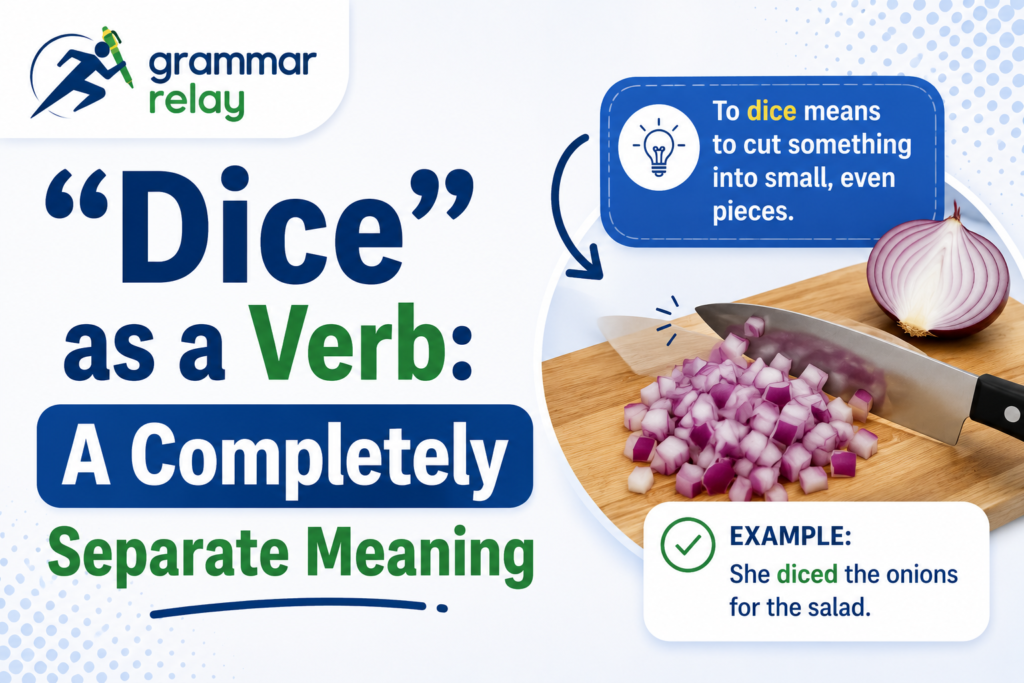
When a recipe instructs you to dice an ingredient, it means cutting food into small, uniform cubes roughly 6mm to 12mm in size. This is entirely distinct from the noun and never creates ambiguity.
The culinary hierarchy of cutting terms:
| Cut | Size | Description |
|---|---|---|
| Dice | 6-12mm cubes | Small uniform cubes |
| Mince | Very fine | Tiny irregular pieces |
| Chop | Irregular | Rough uneven pieces |
| Julienne | Thin strips | Long matchstick cuts |
| Brunoise | 1-3mm cubes | Very fine precise cubes |
“She dices the carrots before adding them to the stew” uses “dice” as a third-person singular verb. “She diced the onions” uses it as a past tense verb. Neither usage creates any confusion with the gaming or manufacturing meanings.
The Technical Meanings of “Die” in Manufacturing
Beyond board games, “die” carries significant technical weight in industrial and engineering contexts. These meanings always use “die” for singular and “dies” (not “dice”) for the plural.
- Stamping die: a hardened tool that cuts or shapes sheet metal under pressure
- Casting die: a mold used in die casting to shape molten metal
- Extrusion die: a shaped opening through which material is forced to create a profile
- Thread-cutting die: a tool that cuts helical threads onto a bolt or rod
- Semiconductor die: a single functional chip cut from a larger silicon wafer
This is crucial: in manufacturing documentation, engineering specs, and technical writing, the plural is always “dies” rather than “dice.” A machine shop orders “ten stamping dies,” not “ten stamping dice.” This technical plural never crosses into gaming territory and vice versa.
Singular Form of Dice in Gaming Culture
Tabletop gaming communities represent the cultural frontline of this grammatical debate.
Dungeons and Dragons, the world’s most popular tabletop roleplaying game with over 50 million players globally as of 2024, uses “die” as singular in its official Player’s Handbook. The standard notation system uses:
| Notation | Meaning |
|---|---|
| d4 | Four-sided die |
| d6 | Six-sided die (standard) |
| d8 | Eight-sided die |
| d10 | Ten-sided die |
| d12 | Twelve-sided die |
| d20 | Twenty-sided die |
Official D&D documentation consistently uses “die” for singular (“roll a d20” means roll one die). Yet in actual gaming communities, Discord servers, and YouTube videos, players routinely say “grab a dice” without anyone stopping the game to correct them.
This gap between official documentation and community speech perfectly illustrates the broader linguistic tension around this word.
You might be interested in Woman or Women: Is “Woman” Singular or Plural?
Common Mistakes and How to Fix Them
Using “Dices” as a Noun Plural
“Dices” as a noun plural is always wrong. It doesn’t exist. The only correct use of “dices” is as a third-person singular verb: “She dices the vegetables efficiently.”
Wrong: “Roll both dices.”
Right: “Roll both dice.”
Using “Die” for Multiple Cubes
The reverse error also trips people up. “Roll the die” when you’re clearly throwing multiple cubes confuses readers who know the rule.
Wrong: “She threw the die and got a combined score of eleven.”
Right: “She threw the dice and got a combined score of eleven.”
Writing “A Dice” in Formal or Academic Writing
In casual conversation, “a dice” passes without comment. In a published book, academic paper, or formal document, it signals grammatical imprecision.
Informal (acceptable): “Grab a dice from the box.”
Formal (required): “Retrieve one die from the container.”
Idioms and Expressions Involving Die and Dice
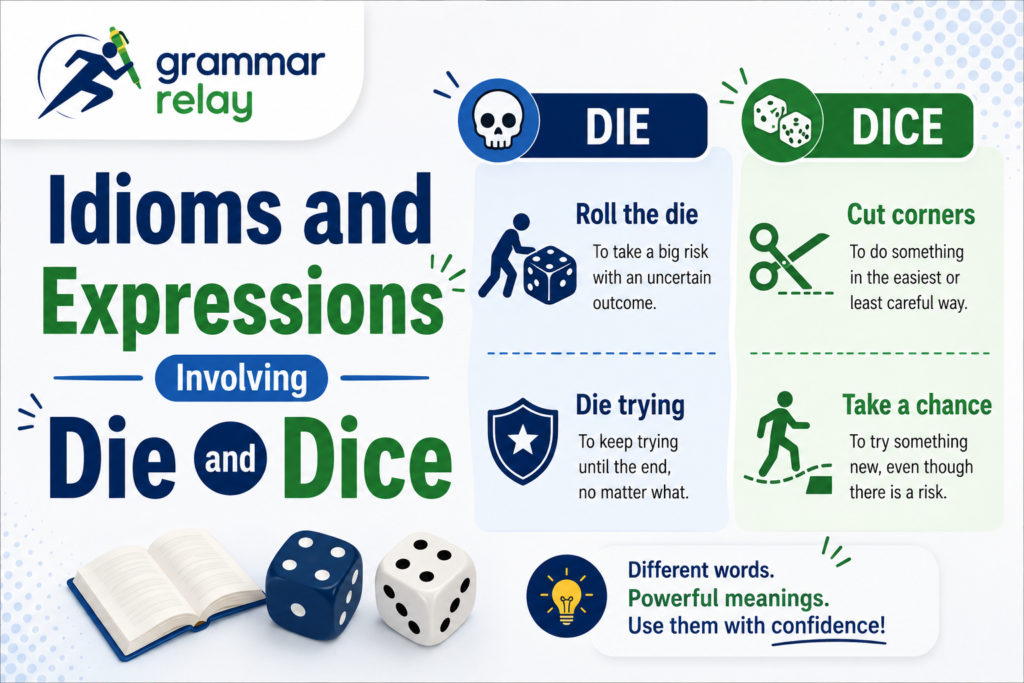
| Idiom | Meaning | Origin |
|---|---|---|
| The die is cast | A decision is irreversible | Julius Caesar crossing the Rubicon, 49 BC |
| Roll the dice | Take a chance on something uncertain | Direct from gaming to metaphor |
| No dice | No luck, no success, no deal | American slang, early 20th century |
| Dice with death | Take extreme, life-threatening risks | British English idiom |
| Loaded dice | A rigged or unfair situation | Gambling culture reference |
| The dice are loaded | The odds are stacked against you | Extension of loaded dice metaphor |
“The die is cast” deserves special attention. When Julius Caesar crossed the Rubicon River in 49 BC, making war against Rome inevitable, he reportedly said “Alea iacta est” in Latin, meaning “the die has been cast.” That single phrase, recorded by historian Suetonius, embedded the gaming singular “die” into political and historical language permanently. Every time someone says “the die is cast” today, they’re echoing a 2,000-year-old moment of irreversible decision-making.
Memory Tricks to Get It Right Every Time
Four reliable methods:
The syllable-quantity connection: “Die” refers to one cube. Think “die alone.” One cube, singular word.
The manufacturing anchor: Industrial tools always use “die” for singular and “dies” for plural, never “dice.” If you remember the technical usage, the gaming usage follows identical logic.
The formal writing test: About to write something professional? Use “die” for singular. Every major style guide backs you up.
The verb test: Does the sentence involve cutting food? Then “dice” is a verb and the noun question doesn’t apply at all.
Quick Grammar Reference Table
| Question | Answer |
|---|---|
| Singular of dice (traditional) | Die |
| Plural of die | Dice |
| Acceptable singular informally? | Dice (increasingly accepted) |
| Correct: “a dices” as noun? | Never correct |
| Correct: “she dices vegetables”? | Always correct as verb |
| Manufacturing singular | Die (always) |
| Manufacturing plural | Dies (never “dice”) |
| Formal writing singular | Die (always) |
| Gaming community informal singular | Dice (widely used) |
Frequently Asked Questions
What is the singular form of dice?
Traditionally and formally: “die.” One gaming cube is a die. However, “dice” functions as an accepted singular in informal modern English and many contemporary dictionaries acknowledge this shift.
Is “a dice” grammatically correct?
Not in formal or academic writing. In casual everyday speech, it’s widely understood and increasingly accepted. Context determines whether it’s appropriate.
Why do people say “a dice” if it’s not traditional?
Because language evolves through use rather than through rulebooks. When millions of native speakers use “a dice” naturally and consistently, that usage gains legitimacy over time regardless of what grammar guides originally specified.
Is “die” too old-fashioned for everyday speech?
Not at all. “Die” sounds completely natural in gaming contexts and remains the standard in all formal writing. It’s precise, correct, and unambiguous.
What does “no dice” mean?
It means no success, no luck, or no agreement. “I asked for a refund but got no dice” means the attempt failed. The phrase originated in early 20th-century American slang and derives from gambling culture where “no dice” meant the roll didn’t count.
Can “dices” ever be correct?
Only as a verb. “She dices onions every morning” is perfectly correct. As a noun plural, “dices” doesn’t exist in standard English.
What do Merriam-Webster and Oxford say about singular “dice”?
Both dictionaries acknowledge that “dice” functions as a singular in informal use. Merriam-Webster explicitly notes this in its current entry. Oxford records the historical singular as “die” while acknowledging the modern shift. Neither dismisses singular “dice” outright in contemporary usage notes.
Read more grammar lessons on Grammar Relay
Conclusion
The traditional singular form of dice is “die.” That rule held unchallenged for centuries and still governs formal writing today.
But language doesn’t freeze. The shift toward singular “dice” in casual speech reflects organic linguistic evolution driven by gaming culture, casual communication, and the natural human tendency to simplify irregular forms. Both Merriam-Webster and Oxford now acknowledge this reality rather than pretending it doesn’t exist.
The practical takeaway is clean and simple: use “die” in formal writing, published work, and professional contexts. Use “dice” as singular in casual conversation and informal writing without guilt. And when someone confidently corrects your “a dice” at the board game table, you now have 600 years of etymology and a Julius Caesar quote ready to respond with.
