

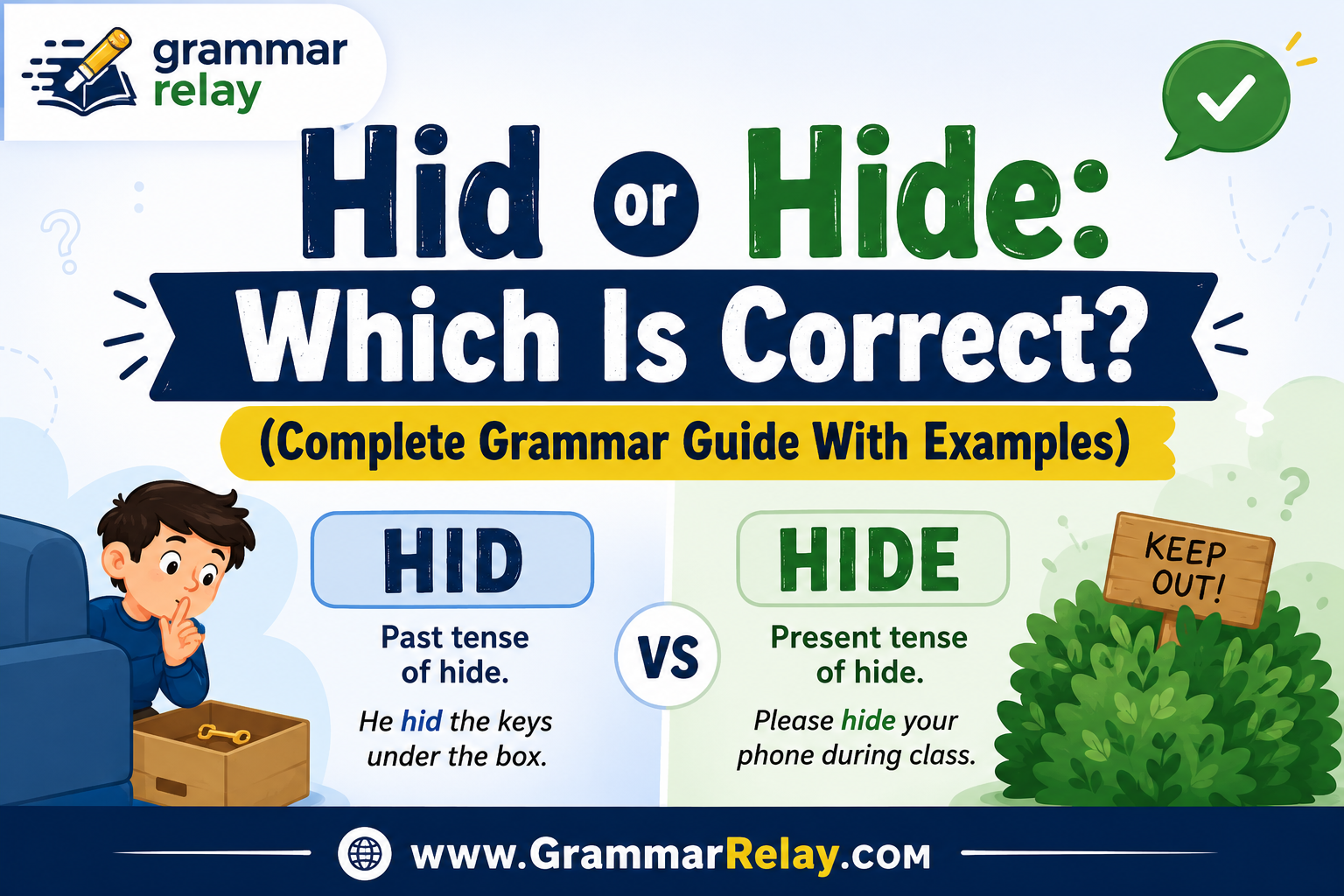
One letter of difference. Endless confusion in writing.
“Hid” and “hide” trip up writers constantly, and honestly, it’s not hard to see why. Both words look almost identical, sound similar, and share the same root. Toss “hidden” into the mix and suddenly even confident writers start second-guessing every sentence.
Here’s the reassuring truth: the rules governing hid or hide are actually straightforward once you see the full picture. No obscure exceptions. No regional quirks. Just a clean, logical system that clicks into place permanently once you understand it.
This guide covers everything: etymology, complete conjugation, every tense, passive constructions, adjective usage, idioms, and memory tricks that genuinely work.
Quick Answer: Hid or Hide?
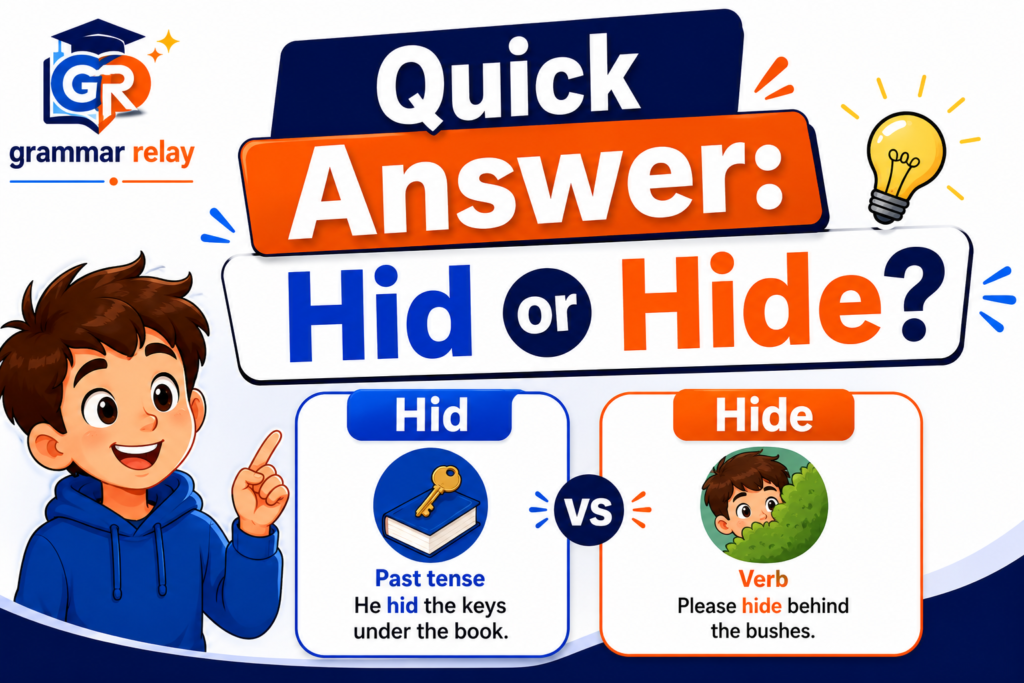
“Hide” is the present tense base form. “Hid“ is the simple past tense. “Hidden“ is the past participle.
That’s the entire core system in one sentence. But the details matter enormously in practice so let’s go deep on every form.
The rule that eliminates most errors instantly: if your sentence contains “has,” “have,” or “had,” use “hidden.” If the verb stands alone without a helper, use “hid.” Present tense or infinitive? Use “hide.”
What Does “Hide” Mean? (All Definitions)
Most people know “hide” as a verb meaning to conceal something. But the word actually carries four distinct meanings depending on context.
Hide as a verb (concealment): To place something or someone out of sight deliberately. This is the primary meaning and the one most relevant to grammar discussions.
Hide as a noun (animal skin): The skin of a large animal, typically used in leather production. “Cowhide,” “rawhide,” and “buffalo hide” all use this meaning. This is an entirely separate word etymologically.
Hide as a noun (wildlife shelter): A camouflaged structure used by birdwatchers and wildlife photographers to observe animals without disturbing them. This is primarily British English; Americans say “blind” instead.
Hide as a historical measurement: An Old English land unit equal to approximately 60 to 120 acres depending on soil quality. This meaning appears in the Domesday Book of 1086 and matters primarily in historical and academic writing.
Real example sentences for every meaning:
- “She needed to hide the birthday present before her children got home.” (verb)
- “The craftsman worked with genuine cowhide to produce the belt.” (noun: animal skin)
- “The birdwatcher settled into the hide at dawn to photograph the herons.” (noun: shelter)
- “The estate covered twelve hides according to the Domesday record.” (historical measurement)
What Does “Hid” Mean?
“Hid” is the simple past tense of “hide” in its concealment meaning. It describes a completed hiding action at a specific point in the past and stands completely alone without needing any helper verb.
Understanding hid past tense correctly means recognizing what it never does: it never pairs with “has,” “have,” or “had.” That combination always demands “hidden” instead. “Had hid” is a common error and always wrong. “Had hidden” is the correct form every single time.
Correct “hid” sentences:
- “She hid the letter under her mattress.”
- “The children hid behind the sofa during the thunderstorm.”
- “He hid his disappointment remarkably well throughout the meeting.”
- “The suspect hid the documents before police arrived.”
The Fascinating Etymology of “Hide” and “Hid”
Knowing where hide or hid came from makes the irregular conjugation feel inevitable rather than arbitrary.
The concealment verb “hide” descends from Old English “hydan”, meaning to conceal or keep secret, which came from Proto-Germanic khudjan. This verb belonged to a class of Old English strong verbs that changed internal vowels to indicate past tense rather than simply adding “-ed.” That ancient pattern is precisely why “hide” becomes “hid” and “hidden” rather than “hided.”
The animal skin “hide” has a completely separate origin: Old English “hyd”, from Proto-Germanic hudiz, related to Latin “cutis” (skin) and Greek “kytos” (hollow vessel). Two unrelated words sharing the same modern spelling.
A brief evolution timeline:
| Period | Verb Form | Development |
|---|---|---|
| Proto-Germanic | *khudjan | Strong verb class |
| Old English (450-1100) | hydan / hȳdde | Past tense uses vowel shift |
| Middle English (1100-1500) | hiden / hidde | Pronunciation shifts reshape forms |
| Early Modern English (1500-1700) | hide / hid | Modern forms solidify |
| Modern English (1700-present) | hide / hid / hidden | Current standard forms established |
Complete Verb Conjugation of “Hide”
Here’s the full reference table covering every tense for past tense of hide and all other forms:
| Tense | Form | Example Sentence |
|---|---|---|
| Base form | Hide | I hide the spare key outside |
| Simple past | Hid | She hid the letter in her drawer |
| Past participle | Hidden | The treasure has been hidden for years |
| Present participle | Hiding | He is hiding behind the curtain |
| Third person singular | Hides | She hides her emotions brilliantly |
| Present perfect | Has/have hidden | They have hidden the evidence carefully |
| Past perfect | Had hidden | She had hidden it before he arrived |
| Future simple | Will hide | He will hide the surprise gift tonight |
| Future perfect | Will have hidden | She will have hidden it by noon |
| Conditional | Would hide | He would hide it if he could |
| Past continuous | Was hiding | She was hiding under the stairs |
| Past perfect continuous | Had been hiding | He had been hiding for three hours |
When to Use “Hide” (Present Tense and Beyond)
“Hide” works in five distinct grammatical situations:
- Present tense statements: “I hide my journal in the desk drawer.”
- After modal verbs: “She can hide it easily.” / “You must hide the documents.”
- As a command: “Hide behind the tree and don’t move.”
- In infinitive constructions: “She needs to hide the birthday cake.”
- In zero conditionals: “If you hide it well, nobody will find it.”
The key thing about hide or hid in present tense contexts: “hide” never changes form except for the third person singular, which becomes “hides.” Everything else uses the base form “hide” unchanged.
Read more about Past Tense of Tear: Is It Tore, Torn, or Teared?
When to Use “Hid” (Simple Past Tense)
“Hid” describes a single completed concealment action that happened at a specific moment in the past. No ambiguity. No helper verbs. Just a clean past action.
The most important rule for hid past tense: it always stands alone. The moment “has,” “have,” or “had” appears before it, the sentence needs “hidden” instead.
Real examples across different contexts:
- Everyday physical action: “She hid the Christmas presents in the attic weeks ago.”
- Emotional and metaphorical: “He hid his grief behind humor for years.”
- Narrative and storytelling: “The fugitive hid in the abandoned warehouse for three days.”
- Professional writing: “The company hid the financial irregularities from auditors.”
- News writing: “Officials hid the report from the public for six months.”
When to Use “Hidden” (Past Participle)
“Hidden” does double duty as a past participle and as an adjective. Both roles matter enormously in daily writing.
As a past participle with helper verbs:
- Present perfect: “The investigators have hidden the preliminary findings.”
- Past perfect: “She had hidden the will before anyone else knew it existed.”
- Future perfect: “By the time he arrives, they will have hidden all the evidence.”
- Passive present: “The camera is hidden behind the bookshelf.”
- Passive past: “The documents were hidden in a Swiss bank vault.”
As a standalone adjective describing a noun directly:
- Business: “Read the contract carefully and check for hidden costs.”
- Psychology: “A hidden agenda often drives seemingly innocent requests.”
- Geography: “The town is a genuine along the coastline.”
- Medical: “The scan revealed a hidden fracture that X-rays had missed.”
- Literary: “She carried a hidden grief that nobody around her suspected.”
The adjective usage of “hidden” is particularly powerful because it carries both literal and metaphorical weight simultaneously. Writers who use it well can load a single word with layers of meaning.
“Hided”: Does It Exist and When Is It Correct?
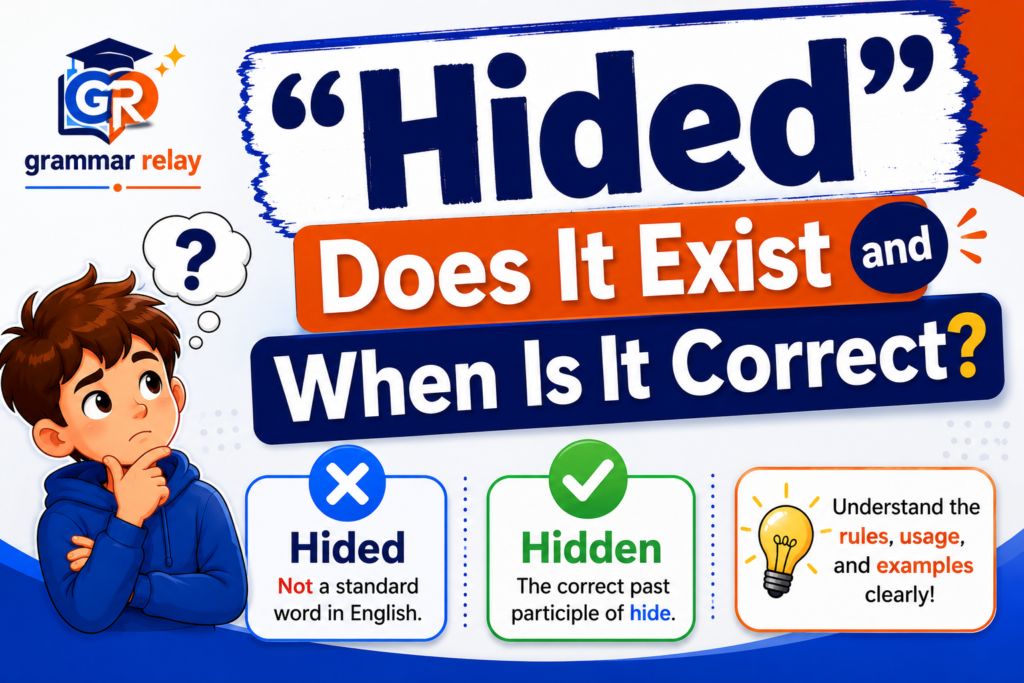
Here’s the part most grammar guides skip entirely. “Hided” is a legitimate English word but only in one very specific context: the animal skin meaning of “hide.”
When “hide” refers to treating or processing animal skin, it takes a regular past tense. A tanner who processed leather yesterday “hided” the material. This isn’t a common usage in everyday writing but it’s grammatically valid and appears in agricultural and historical texts.
“Hided” is never correct for the concealment meaning. Not in formal writing, not in informal speech, not anywhere.
- Wrong: “He hided under the bed during the argument.”
- Right: “He hid under the bed during the argument.”
- Correct but rare: “The craftsman hided the material using traditional methods.” (animal skin context)
Hid vs Hide vs Hidden: Complete Three-Way Comparison
| Feature | Hide | Hid | Hidden |
|---|---|---|---|
| Grammatical role | Base form / present tense | Simple past | Past participle / adjective |
| Needs helper verb? | No (present) | Never | Usually yes |
| Used as adjective? | No | No | Yes |
| Correct with “had”? | No | Never | Always |
| Correct standalone? | Yes | Yes | Only as adjective |
| Example sentence | I hide my diary daily | She hid her diary last night | The diary was hidden for years |
The Irregular Verb Pattern: Why “Hide” Doesn’t Follow Normal Rules
“Hide” belongs to a family of strong irregular verbs inherited from Old English that change internal vowels rather than adding “-ed.” Recognizing this family makes every member easier to remember and use correctly.
| Infinitive | Simple Past | Past Participle |
|---|---|---|
| Hide | Hid | Hidden |
| Ride | Rode | Ridden |
| Drive | Drove | Driven |
| Write | Wrote | Written |
| Bite | Bit | Bitten |
| Stride | Strode | Stridden |
The pattern connecting “hide/hid/hidden” to “ride/rode/ridden” is particularly useful. Most English speakers feel completely confident with “ride/rode/ridden” and never mix up “rided” or “had rode.” Apply that same certainty to “hide/hid/hidden” and the errors disappear.
“Hide” in Passive Voice Constructions
Passive voice always demands “hidden,” never “hid.”
| Active | Passive |
|---|---|
| She hid the documents | The documents were hidden by her |
| He has hidden the money | The money has been hidden |
| They had hidden the evidence | The evidence had been hidden |
| The spy hid the device | The device was hidden by the spy |
Passive constructions with “hidden” appear frequently in:
- Legal writing: “The assets were hidden in offshore accounts.”
- Medical reports: “The tumor had been hidden behind dense tissue.”
- Journalism: “The payments were hidden from regulatory oversight.”
- Insurance documentation: “The damage was hidden beneath surface materials.”
Common Idioms and Expressions Using “Hide” and “Hidden”
| Idiom | Meaning | Example |
|---|---|---|
| Hide and seek | Children’s concealment game | They played hide and seek until dark |
| Hidden agenda | Concealed motive or purpose | She suspected a hidden agenda behind his generosity |
| Hide your light under a bushel | Conceal your talents through false modesty | Don’t hide your light under a bushel at the interview |
| Nowhere to hide | No escape from scrutiny or consequences | When the audit results came in there was nowhere to hide |
| Hidden gem | Something valuable and underappreciated | That coastal village is a complete hidden gem |
| Hide the ball | Deliberately withhold information | Stop hiding the ball and share the actual figures |
| Hidden in plain sight | Concealed by being too obvious to notice | The answer had been hidden in plain sight the entire time |
| Hidden costs | Unexpected financial charges | Always read the fine print and check for hidden costs |
You might be interested in Plural of Alumna: Alumnae and Alumni
Common Mistakes Writers Make with Hid, Hide, and Hidden
Using “Hid” as a Past Participle
The most frequent error by far. “Had hid” feels natural to many writers but is always grammatically wrong.
Wrong: “She had hid the money before the search.”
Right: “She had hidden the money before the search.”
Using “Hidden” Without a Helper Verb
The orphaned past participle creates an immediate grammatical error.
Wrong: “She hidden the letter in her jacket.”
Right: “She hid the letter in her jacket.”
Writing “Has Hid” Instead of “Has Hidden”
Wrong: “He has hid the documents from the investigators.”
Right: “He has hidden the documents from the investigators.”
Using “Hided” for Concealment
Wrong: “The child hided under the table during the game.”
Right: “The child hid under the table during the game.”
Confusing “Hide” the Verb With “Hide” the Noun
Context resolves this almost instantly in most sentences but watch for it in ambiguous constructions. “She found the hide” could mean she found the animal skin or the wildlife shelter depending entirely on context.
How to Spell “Hid” and “Hidden” Correctly
Questions about how to spell hid come up more often than you’d expect, particularly among language learners and people writing quickly without autocorrect.
How to spell hid: H-I-D. Three letters. Simple and direct. No doubled consonants, no silent letters, no complexity whatsoever.
How to spell hidden: H-I-D-D-E-N. Six letters with a doubled “d” before the “-en” ending. The doubled consonant follows a standard English pattern for past participles of short-vowel verbs. Compare: “hidden,” “bitten,” “ridden,” “written.” All double the final consonant before “-en.”
When you spell hid correctly in writing, you’re working with one of the shorter past tense forms in the English language. Its brevity is part of what makes it feel uncertain to some writers. Three letters somehow seems too simple for a complete past tense word but it’s absolutely correct.
“Hid vs Hide” in Different Writing Contexts
In Professional Emails and Business Communication
Hid vs hide errors in professional emails undermine credibility faster than most writers realize. A misused “had hid” in a formal business document signals carelessness to careful readers.
Wrong email close: “As I mentioned, the team had hid the revised figures in the appendix.” Correct: “As I mentioned, the team had hidden the revised figures in the appendix.”
In Academic and Formal Writing
Academic writing demands precision. The Chicago Manual of Style treats irregular verb forms as non-negotiable in formal contexts. “Hidden” as past participle and adjective appears extensively in psychological, legal, and literary scholarship.
In Creative and Literary Writing
“Hidden” carries exceptional symbolic weight in narrative writing. Consider how differently these sentences land:
- “She hid her grief.” (simple past, action completed)
- “Her grief remained hidden.” (adjective, ongoing state)
- “She had hidden her grief for so long it had become part of her.” (past perfect, duration and consequence)
Each form creates a different emotional texture. Skilled writers choose deliberately between them.
In News and Journalism
AP Style guidance treats irregular verbs consistently: use the standard forms without exception. News headlines frequently use “hidden” as an adjective because it packs maximum meaning into minimum space.
Real headline patterns:
- “Hidden Funds Discovered in Offshore Accounts”
- “Officials Hid Report for Six Months, Investigation Finds”
- “The Hidden Cost of Free Services: A Deep Dive”
Memory Tricks to Get Hid, Hide, and Hidden Right Every Time

Four methods that genuinely eliminate errors:
The helper verb test: Scan your sentence for “has,” “have,” “had,” “was,” “were,” or “been.” Any of these present means use “hidden.” None present means use “hid.” This single test catches nearly every error.
The ride/rode/ridden parallel: Hide follows the exact same pattern as ride. “She rode her bike” not “she ridden her bike.” “She hid the present” not “she hidden the present.” Same logic, applied consistently.
The adjective check: Directly describing a noun without a helper verb anywhere nearby? Use “hidden.” Hidden agenda, hidden costs, hidden camera: all correct adjective uses.
The timeline test: Single completed action at one specific past moment means “hid.” Action described in relation to another event or as an ongoing state means “hidden.”
Quick Grammar Reference Table
| Question | Answer |
|---|---|
| Present tense of hide | Hide |
| Simple past of hide | Hid |
| Past participle of hide | Hidden |
| Correct: “had hid”? | Never correct |
| Correct: “she hidden it”? | Never as standalone verb |
| “Hidden” without helper verb? | Only as adjective |
| Third person singular present | Hides |
| Present participle | Hiding |
| Is “hided” ever correct? | Only for animal skin meaning |
| How to spell hid | H-I-D |
| How to spell hidden | H-I-D-D-E-N |
Frequently Asked Questions
Is “hid” the past tense of “hide”?
Yes. “Hid” is the simple past tense of “hide” in its concealment meaning. “She hid the letter” is correct. It stands alone without any helper verb.
What is the past participle of “hide”?
“Hidden” is the past participle. It works with helper verbs (“has hidden,” “had hidden,” “was hidden”) and as an adjective (“hidden costs,” “hidden agenda”).
Can I say “has hid” in a sentence?
Never. “Has” always requires the past participle “hidden.” “Has hid” is always grammatically incorrect. Write “has hidden” every time without exception.
Is “hided” a real word?
Yes but only for the animal skin meaning of “hide.” “Hided” never applies to concealment. For hiding something or someone, the past tense is always “hid.”
What is the difference between “hid” and “hidden”?
“Hid” is simple past and stands alone. “Hidden” is past participle and typically needs a helper verb, or functions as an adjective describing a noun directly. Using one where the other belongs is the most common error with this verb.
Why is “hide” an irregular verb?
Because it descends from Old English “hydan,” a strong verb that changed internal vowels to signal tense rather than adding “-ed.” This Germanic pattern survived intact from Old English through to modern usage.
Can “hidden” be used as an adjective?
Absolutely and frequently. “Hidden treasure,” “hidden agenda,” “hidden costs,” and “hidden gem” all use “hidden” as a straightforward adjective. This is entirely correct and extremely common in both formal and informal writing.
Is “had hid” ever grammatically correct?
Never. “Had” always requires the past participle “hidden.” “Had hid” is an error in every context, every register, and every dialect of English without exception.
Read more grammar lessons on Grammar Relay
Conclusion
“Hid” for simple past. “Hidden” for past participle. Seven words containing the entire rule.
The past tense of hide follows the same elegant irregular pattern as ride, drive, and write: vowel shift rather than “-ed” ending, a direct inheritance from Old English strong verbs that survived a thousand years of linguistic change completely intact.
Build one habit starting now: before writing “hid” or “hidden,” check for helper verbs. “Has,” “have,” “had,” “was,” “were,” or “been” anywhere in the sentence means “hidden.” No helper verb means “hid.” Apply that test consistently until it becomes automatic and hid vs hide confusion disappears from your writing permanently.
