

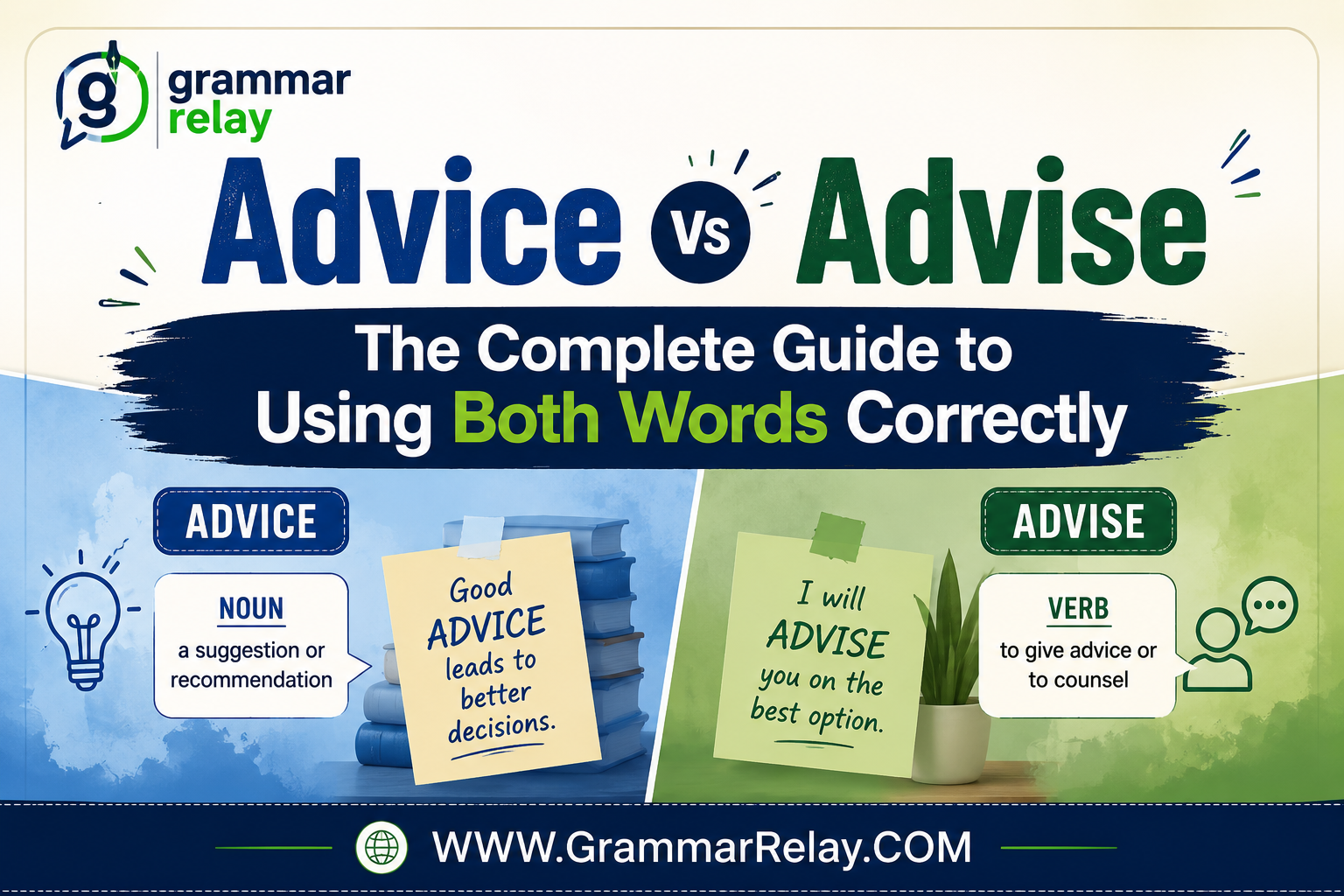
Two words. One sound. A thousand mix-ups.
If you’ve ever paused mid-sentence wondering whether you need “advice” or “advise,” you’re definitely not alone. This pair trips up native speakers just as often as English learners, and honestly, the reason makes total sense once you see it laid out.
Here’s the short version: advice is something you receive, and advise is something someone does. One’s a thing. The other’s an action. But the real magic happens when you understand exactly why English split these words this way and how to spot the difference instantly, every single time.
Quick Answer: Advice or Advise?
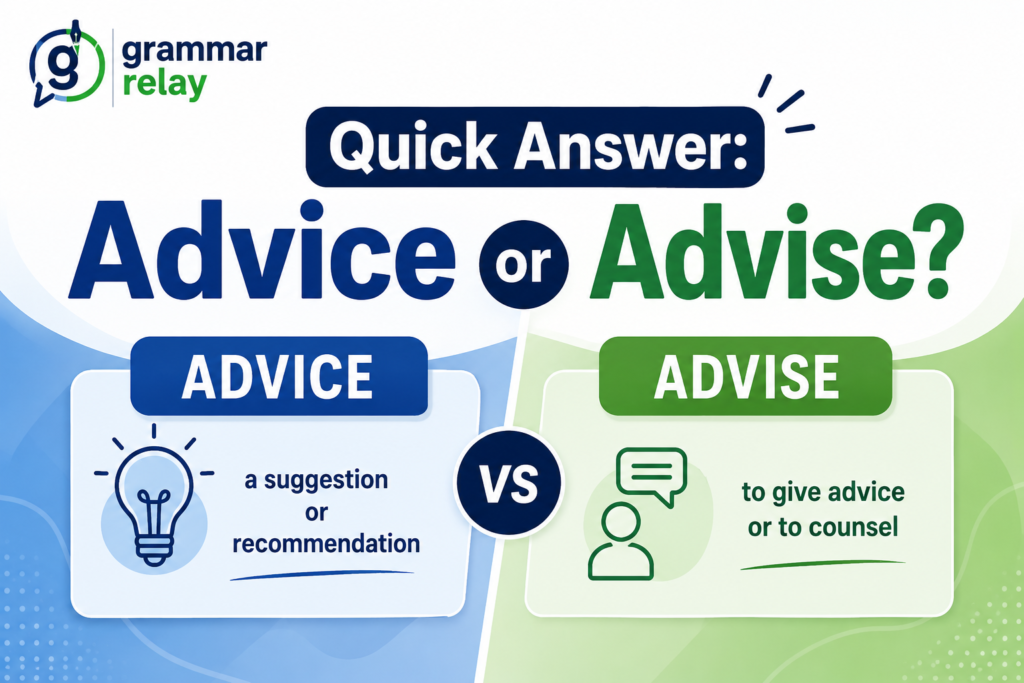
“Advice“ is a noun. It refers to guidance, recommendations, or suggestions someone gives you. “Advise“ is a verb. It means to give that guidance to someone.
“She gave me great advice” uses the noun. “She advised me to wait” uses the verb. That’s the entire system in one sentence.
The fastest way to settle advice vs advise on the spot: listen to how the word sounds in your head. If it rhymes with “ice,” you want “advice.” If it rhymes with “rise,” you want “advise.” Your ear already knows the answer most of the time. You just need to trust it.
Why Do “Advice” and “Advise” Confuse So Many People?
Three factors collide here, and together they create the perfect storm for mix-ups.
First, the words look nearly identical on the page. Swap a “c” for an “s” and that’s the entire visual difference. Your eyes can easily skip right past it, especially when typing quickly.
Second, the pronunciation difference is subtle. “Advice” ends with a hard “s” sound (like “ice”). “Advise” ends with a “z” sound (like “rise”). In fast, casual speech, that distinction sometimes blurs together, especially for non-native speakers whose languages don’t make this same sound distinction.
Third, both words appear in the exact same topics and contexts. Career guidance, medical recommendations, legal notices, relationship counsel: all of these involve both advice and advise constantly, which means your brain is juggling both words in the same mental space at the same time.
Add British English’s parallel pairs like “practice/practise” and “licence/license,” and you’ve got a recipe for genuine, ongoing confusion that even professional writers occasionally fall into.
What Does “Advice” Mean? (Complete Definition)
Advice is an uncountable noun referring to guidance, suggestions, or recommendations offered to help someone make a decision or solve a problem.
Here’s the grammatical detail that trips people up constantly: because “advice” is uncountable, you can’t say “an advice” or “advices.” Ever. It simply doesn’t pluralize the normal way. Instead, you quantify it using phrases like:
- “a piece of advice”
- “some advice”
- “a bit of advice”
- “plenty of advice”
- “good advice”
Think of “advice” the same way you’d think of “information” or “water.” You don’t say “an information” or “two waters” (well, maybe casually for drinks, but grammatically it’s “two glasses of water”). Same logic applies here.
Advice shows up across nearly every life situation:
- Professional: “Her advice helped me land the promotion.”
- Medical: “Follow your doctor’s advice closely.”
- Legal: “Seek legal advice before signing anything.”
- Personal: “I really value your advice on this.”
- Financial: “His financial advice saved us thousands.”
What Does “Advise” Mean? (Complete Definition)
Advise is a verb meaning to offer guidance, recommend a course of action, or formally inform someone of something. Unlike its noun cousin, advise conjugates fully and behaves like any regular verb.
Understanding advise meaning in practice means recognizing it works wherever you’d use “recommend,” “counsel,” or “suggest.” If your sentence describes someone doing the advising, you need this verb form.
Advise appears constantly in:
- Professional recommendations: “I advise reviewing the contract again.”
- Legal and official notifications: “Please be advised that the meeting has moved.”
- Medical instructions: “The doctor advised complete rest for two weeks.”
- Coaching and mentorship: “She advises startups on funding strategies.”
Read more about Hid or Hide: Which Is Correct?
The Pronunciation Difference That Settles Everything
This is genuinely the cleanest trick in the entire advice and advise debate, and it works almost every time.
| Word | Pronunciation | Rhymes With |
|---|---|---|
| Advice | ad-VICE | Ice, mice, price, nice |
| Advise | ad-VIZE | Rise, wise, prize, surprise |
Notice the pattern? The “c” in “advice” produces a soft “s” sound. The “s” in “advise” produces a “z” sound. This isn’t random. English has several word pairs that follow this exact same noun/verb pattern, where the noun ends in “-ice” (s-sound) and the verb ends in “-ise” (z-sound):
- Practice (noun) / Practise (verb) — British English
- Device (noun) / Devise (verb)
- Licence (noun) / License (verb) — British English
Say your sentence out loud. Whichever sound feels right tells you which spelling you need. This single trick alone resolves the difference between advice and advise for most people instantly.
The Noun vs Verb Test: The Fastest Way to Choose Correctly
Beyond pronunciation, here’s a practical substitution test that works every single time.
Try swapping in “guidance” or “recommend”:
- If “guidance” fits naturally, use advice. “I need your guidance” → “I need your advice.” ✓
- If “recommend” fits naturally, use advise. “I recommend caution” → “I advise caution.” ✓
The article test: Can you put “the,” “some,” or “a piece of” in front of the word? If yes, it’s advice. “Some advice” works. “Some advise” doesn’t.
The conjugation test: Can you change the word to “-d” or “-ing” form? “Advised” and “advising” both exist and work fine. “Adviced” and “advicing” do not exist in English at all. If you’re tempted to write advicing or advising, the correct answer is always “advising,” because advise is the verb that conjugates.
Advice vs Advise: Complete Side-by-Side Comparison
| Feature | Advice | Advise |
|---|---|---|
| Part of speech | Noun | Verb |
| Pronunciation | ad-VICE (rhymes with ice) | ad-VIZE (rhymes with rise) |
| Countable? | No (uncountable noun) | N/A |
| Takes articles? | “Some advice,” “a piece of advice” | Never |
| Conjugates? | No | Yes (advises, advised, advising) |
| Can follow “to”? | No | Yes (“to advise someone”) |
| Formal legal use | N/A | “Please be advised” |
| Example | She gave me good advice | She advised me to leave early |
Complete Verb Conjugation of “Advise”
Since advise is a fully conjugating verb, here’s the complete picture:
| Tense | Form | Example |
|---|---|---|
| Base form | Advise | I advise caution here |
| Third person singular | Advises | She advises the board regularly |
| Simple past | Advised | He advised against the decision |
| Past participle | Advised | They have been advised of their rights |
| Present participle | Advising | She is advising the committee |
| Future | Will advise | He will advise you tomorrow |
| Present perfect | Has/have advised | She has advised dozens of clients |
Notice there’s no entry for “adviced.” That word genuinely does not exist in standard English, no matter how natural it might sound when you’re typing quickly.
Specific Phrases People Get Wrong Every Time
“I Need Your Advice” or “Advise”?
This one’s easy once you know the rule: you’re asking for guidance, a thing, so it’s “I need your advice.” Never “I need your advise.” If you wanted the verb, you’d phrase it differently entirely: “Could you advise me on this?”
“Kindly Advice” or “Kindly Advise”?
In professional emails, “kindly advise” is correct because you’re asking someone to perform an action (to inform or recommend). “Kindly advice” is always wrong because “advice” can’t follow “kindly” as an action request.
Correct: “Kindly advise on the next steps.”
Incorrect: “Kindly advice on the next steps.”
“Doctor’s Advice” or “Doctor’s Advise”?
Medical guidance from a physician is always “doctor’s advice.” This uses “advice” as a noun modified by the possessive “doctor’s.” “Doctor’s advise” is grammatically impossible since “advise” can’t take a possessive modifier this way.
“Payment Advice” or “Payment Advise”?
In banking and accounting, “payment advice” is a specific technical term referring to a notification document confirming a payment has been made or is due. It’s always “advice,” never “advise,” and appears constantly in invoicing and accounts payable communication.
“Please Advise” or “Please Advice”?
This is the single most common error in professional emails worldwide. “Please advise” is correct because you’re requesting an action (someone informing or recommending something to you). “Please advice” is always incorrect.
Correct: “Please advise on how you’d like to proceed.”
Incorrect: “Please advice on how you’d like to proceed.”
Advice and Advise in Professional Workplace Communication
Getting advise and advice wrong in professional settings carries real consequences. A misused “please advice” at the bottom of an email might seem minor, but it signals a lack of attention to detail to careful readers, particularly in industries like law, finance, and consulting where precision matters.
Before and after examples:
Wrong: “Please advice if this timeline works for your team.”
Right: “Please advise if this timeline works for your team.”
Wrong: “Thank you for your advise on the proposal.”
Right: “Thank you for your advice on the proposal.”
Legal and compliance writing relies heavily on “please be advised that…” as a formal notification opener. This phrase appears in contracts, terms of service, and official correspondence precisely because it signals formal notice in a way that “please be informed” doesn’t quite match.
Related Words in the Advice and Advise Family
| Word | Part of Speech | Meaning | Example |
|---|---|---|---|
| Advice | Noun | Guidance or recommendation | She gave sound advice |
| Advise | Verb | To recommend or counsel | He advised caution |
| Adviser | Noun | A person who gives advice | She works as a financial adviser |
| Advisor | Noun | Alternative spelling of adviser | The presidential advisor spoke |
| Advisory | Adjective/Noun | Relating to giving advice | An advisory committee was formed |
| Advisable | Adjective | Recommended or wise | It is advisable to check first |
| Inadvisable | Adjective | Not recommended | The trip was inadvisable |
| Ill-advised | Adjective | Poorly considered | That was an ill-advised decision |
Both “adviser” and “advisor” are correct spellings. “Adviser” is more common in British English and traditional usage, while “advisor” appears more frequently in American English, particularly in formal titles like “financial advisor” or “academic advisor.”
You might be interested in Past Tense of Tear: Is It Tore, Torn, or Teared?
Similar Word Pairs That Follow the Same Pattern
Once you understand advise vs advice meaning, you’ll start spotting the same pattern everywhere in English:
| Noun (s-sound) | Verb (z-sound) | Notes |
|---|---|---|
| Advice | Advise | Same in all English dialects |
| Practice | Practise | British English distinction; American English uses “practice” for both |
| Device | Devise | Same pattern in all dialects |
| Licence | License | British English distinction; American English uses “license” for both |
| Prophecy | Prophesy | Same sound-based logic |
If you’ve mastered advice vs advise, you’ve essentially mastered this entire family of word pairs. The logic transfers directly.
Synonyms for “Advice” and “Advise” and Their Nuances
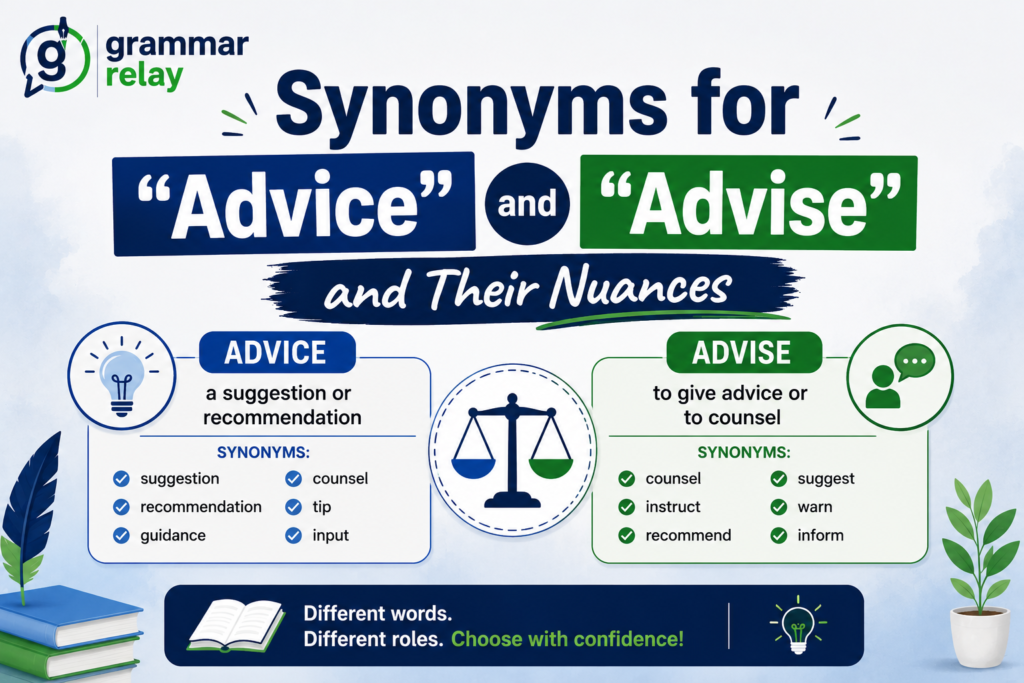
The Synonyms for “Advice” (Noun)
| Synonym | Nuance | Example |
|---|---|---|
| Guidance | Broader, ongoing direction | Career guidance from a mentor |
| Counsel | Formal, often legal or serious | Legal counsel on the matter |
| Recommendation | Specific suggested action | A recommendation to invest |
| Suggestion | Lighter, less formal | A helpful suggestion |
| Input | Collaborative contribution | Team input on the decision |
Synonyms for “Advise” (Verb)
| Synonym | Nuance | Example |
|---|---|---|
| Recommend | Suggest a specific course | She recommended caution |
| Counsel | Formally guide | He counseled the client |
| Suggest | Lightly propose | She suggested a different approach |
| Urge | Strongly encourage | He urged them to reconsider |
| Notify | Formally inform | Please notify all parties |
Common Mistakes People Make with Advice and Advise
- Writing “advise” when you need the noun “advice.” “Thanks for your advise” should be “Thanks for your advice.”
- Writing “advice” when you need the verb “advise.” “Can you advice me?” should be “Can you advise me?”
- Using “an advice” or “advices” as a plural. Neither exists. Use “a piece of advice” or “some advice.”
- Writing “please advice” in professional emails. Always “please advise.”
- Using “adviced” as a past tense. It doesn’t exist. The correct past tense is “advised.”
Memory Tricks That Actually Work
The ice/rise sound trick: “Advice” sounds like “ice.” “Advise” sounds like “rise.” Say it out loud before writing.
The substitution method: Swap in “guidance” (for advice) or “recommend” (for advise) and see which fits.
The “C for Counsel” connection: Both “advice” and “counsel” are nouns, and both can start with the letter pattern that signals “thing you receive.”
The conjugation test: If you can add “-d” or “-ing” and it still sounds like a word, you’re dealing with advise noun‘s verb counterpart, “advise.” “Advised” and “advising” both work. “Adviced” and “advicing” never do.
Quick Grammar Reference Table
| Question | Answer |
|---|---|
| “Advice” part of speech | Noun |
| “Advise” part of speech | Verb |
| Correct: “an advice”? | Never |
| Correct: “advices”? | Never |
| Correct: “please advise”? | Always correct |
| Correct: “please advice”? | Never correct |
| Correct: “adviced”? | Never (not a word) |
| Past tense of “advise” | Advised |
| Related adjective | Advisable |
Frequently Asked Questions
What is the main difference between advice and advise?
“Advice” is a noun referring to guidance or recommendations. “Advise” is a verb meaning to give that guidance. One’s a thing, the other’s an action.
Can I say “an advice”?
No. “Advice” is uncountable, so it never takes “an.” Use “a piece of advice” instead.
Is “adviced” a real word?
No. The correct past tense of “advise” is “advised.” “Adviced” doesn’t exist in standard English.
Which is correct: “please advice” or “please advise”?
“Please advise” is always correct. “Please advice” is always incorrect, regardless of context.
Can “advice” ever be used as a verb?
No. “Advice” functions exclusively as a noun. If you need a verb, “advise” is the only correct option.
What is the plural of “advice”?
There isn’t one. “Advice” is uncountable. Use quantifiers like “some advice,” “a piece of advice,” or “plenty of advice” instead.
Is “advisor” or “adviser” the correct spelling?
Both are correct. “Adviser” leans British and traditional, while “advisor” appears more often in American English and formal titles.
Does British English use different rules for advice and advise?
The core noun/verb distinction is identical across dialects. British English simply applies the same logic to related pairs like “practice/practise” and “licence/license” more consistently than American English does.
Read more grammar lessons on Grammar Relay
Conclusion
“Advice” is the noun. “Advise” is the verb. Six words, and that’s the whole rule.
The “ice/rise” sound trick is your fastest, most reliable tool: say your sentence aloud and trust your ear. If it sounds like “ice,” write “advice.” If it sounds like “rise,” write “advise.”
Build this habit starting today: before sending any email containing “please advise” or thanking someone for their “advice,” run a quick mental sound check. Within a week, this will become completely automatic, and the advice and advise confusion that’s followed you for years will finally, permanently disappear.
