


Here’s a grammar question that trips up even confident writers. You finish a sentence and suddenly freeze. Did you dreamed or dreamt last night? Which one is actually correct? And does it even matter?
Short answer: both are correct. Longer answer: knowing when to use each one makes your writing sharper, more appropriate, and more credible. Whether you’re crafting a novel, writing a business email, or just texting a friend, this guide walks you through everything you need to know about dreamed vs dreamt.
The One-Sentence Answer You Actually Came For
Both “dreamed” and “dreamt” are valid past tense forms of the verb “dream.” Dreamed dominates American English while dreamt leans British and literary. Neither is wrong. Context and audience make the choice for you.
| Quick Reference | Dreamed | Dreamt |
|---|---|---|
| Correct? | Yes | Yes |
| Most common in | American English | British English |
| Tone | Neutral, modern | Literary, poetic |
| Formal writing | Works perfectly | Works perfectly |
What “Dream” Means as a Verb (And Why It Has Two Past Tenses)
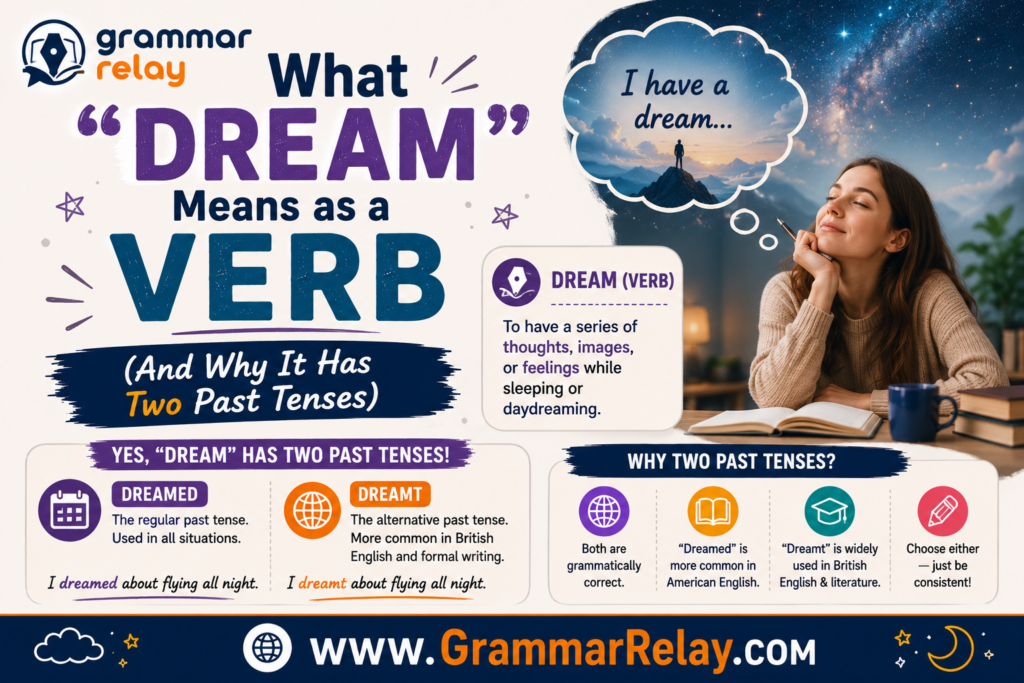
The verb “dream” carries two distinct meanings and both matter here.
First, there’s the involuntary kind. The sleep experience your brain generates at 3 a.m. involving your childhood home and a talking dog. Second, there’s the aspirational kind. The conscious, hopeful vision of a better job, a different life, or something worth working toward.
Both meanings use the same past tense forms: dreamed and dreamt.
Here’s where it gets interesting. The word “dream” traces back to Old English “drēam,” which originally meant joy, music, or noise. It didn’t refer to sleep visions until around the 13th century, likely influenced by Old Norse “draumr.” Over centuries the word shifted meaning entirely and picked up both a regular past tense (dreamed) and an irregular one (dreamt) along the way.
English kept both forms because language doesn’t standardize neatly. Different regions, different literary traditions, and different speech communities held onto whichever form felt natural to them.
What “Dreamed” Means (Definition, Use, and Examples)
Dreamed is the regular past tense of “dream.” You form it exactly like most English verbs: add “-ed” to the base. Simple, clean, and universally understood.
When “Dreamed” Is the Stronger Choice
Use dreamed when:
- Writing for an American audience
- Working in formal, academic, or professional contexts
- You want clarity and a modern, neutral tone
- Your style guide doesn’t specify a preference
Dreamed in Context
| Context | Example Sentence |
|---|---|
| Sleeping | “She dreamed about the ocean all night.” |
| Aspiration | “He dreamed of becoming an architect.” |
| Negative | “I never dreamed it would end this way.” |
| Past perfect | “She had dreamed of this moment for years.” |
| Question form | “Did you dream last night?” |
Notice how dreamed feels clean and direct in every context. It doesn’t draw attention to itself. That’s exactly its strength.
Read more about Other Ways to Say Hi: 50+ Greetings for Every Person, Place, and Platform
What “Dreamt” Means (Definition, Use, and Examples)
Dreamt is the irregular past tense of “dream.” Instead of adding “-ed,” the word takes a “-t” ending, which puts it in the same grammatical family as “leapt,” “knelt,” and “burnt.”
When “Dreamt” Is the Stronger Choice
Use dreamt when:
- Writing for a British audience
- Crafting literary, poetic, or atmospheric creative writing
- You want a slightly formal or old-world stylistic feel
- The rhythm of your sentence calls for a harder ending sound
Dreamt in Context
| Context | Example Sentence |
|---|---|
| Literary | “She dreamt of forgotten cities beneath the sea.” |
| British casual | “I dreamt about work again last night.” |
| Poetic | “He dreamt in colors nobody had names for.” |
| Negative | “I never dreamt things would go this far.” |
| Conversational UK | “Did you know I dreamt about you?” |
“To sleep, perchance to dream.” — Shakespeare, Hamlet
Shakespeare used “dream” in its base form here but writers in his tradition consistently reached for irregular forms like dreamt when rhythm and weight demanded it.
Dreamed vs Dreamt: Side-by-Side Comparison
Here’s the full picture in one place:
| Feature | Dreamed | Dreamt |
|---|---|---|
| Verb type | Regular (dream + ed) | Irregular (dream + t) |
| Dominant region | American English | British English |
| Tone | Neutral, modern, clear | Literary, poetic |
| Global frequency | More common overall | Less common but fully accepted |
| Formal writing | Yes | Yes |
| Creative writing | Yes | Especially strong |
| Pronunciation | DREEMD (rhymes with “screamed”) | DREMT (rhymes with “unkempt”) |
The Grammar Behind Both Words (Regular vs Irregular Verbs)
This is the part most articles skip entirely. Understanding WHY both forms exist makes the whole dreamed vs dreamt question click instantly.
English verbs fall into two camps. Regular verbs form their past tense by adding “-ed.” Walk becomes walked. Talk becomes talked. Dream becomes dreamed.
Irregular verbs don’t follow that pattern. They change in unpredictable ways inherited from older Germanic language roots. Dream becomes dreamt the same way leap becomes leapt and kneel becomes knelt.
Here’s the full companion family:
| Base Verb | Regular Past Tense | Irregular Past Tense |
|---|---|---|
| Dream | Dreamed | Dreamt |
| Learn | Learned | Learnt |
| Burn | Burned | Burnt |
| Spell | Spelled | Spelt |
| Leap | Leaped | Leapt |
| Kneel | Kneeled | Knelt |
| Smell | Smelled | Smelt |
Notice the pattern? American English almost always favors the “-ed” version. British English holds onto the “-t” ending with far more loyalty.
American English vs British English: Where Each Form Lives
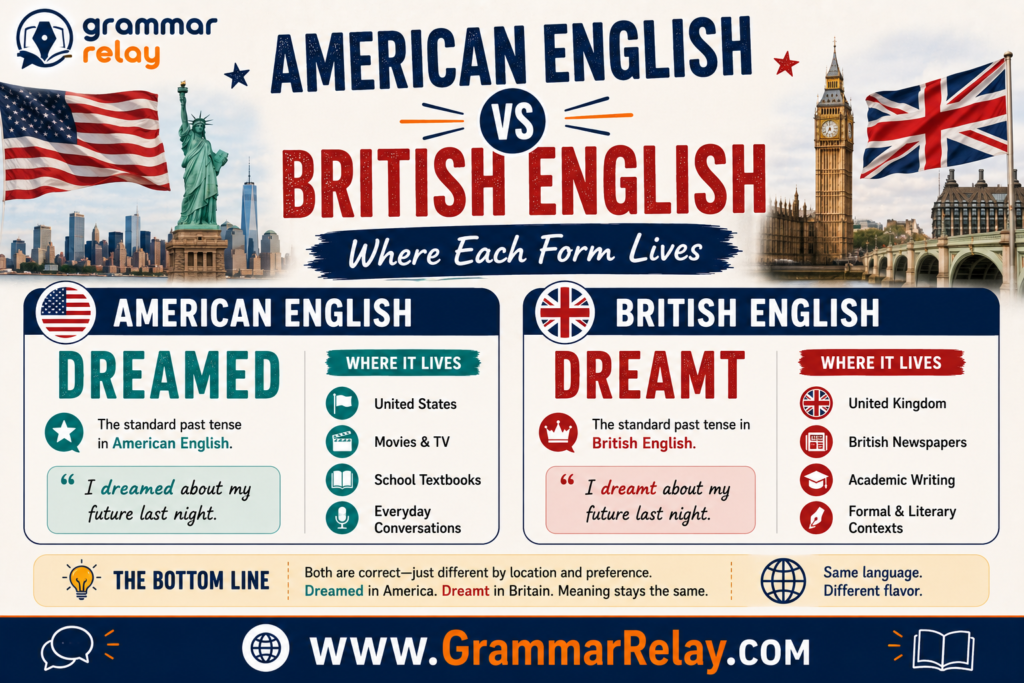
This regional split is the single biggest factor in the dreamt vs dreamed debate.
Why American English Chose “Dreamed”
American English went through a period of deliberate simplification in the 18th and 19th centuries. Noah Webster, the man behind the first major American dictionary in 1828, actively pushed for more regular, phonetic spellings and verb forms. That cultural momentum stuck. Today American writers default to “dreamed” almost automatically.
Why British English Kept “Dreamt”
British English preserved more irregular forms simply because there was no equivalent standardization push. The “-t” ending felt natural and it stayed. British writers, editors, and publishers still use dreamt comfortably in both casual and formal contexts.
What About Australian and Canadian English?
Australia leans British on this one. “Dreamt” appears more frequently in Australian writing than American writing. Canada sits somewhere in the middle, influenced by both British tradition and American proximity. Canadian style guides generally accept both forms without preference.
Google Ngram Viewer data (which tracks word frequency across millions of books) shows that “dreamed” has consistently outpaced “dreamt” globally since the 1960s. However, in British English corpora specifically, “dreamt” maintains a much stronger presence than the global average suggests.
Dreamed vs Dreamt in Different Types of Writing
Your writing context matters as much as your regional preference. Here’s a practical guide:
| Writing Type | Recommended Form | Reason |
|---|---|---|
| Academic paper | Dreamed | Cleaner and widely accepted |
| British novel | Dreamt | Fits regional and literary tone |
| American blog post | Dreamed | Matches reader expectations |
| Poetry | Dreamt | Carries more sonic and emotional weight |
| Business email | Dreamed | Neutral and professional |
| Song lyrics | Either | Depends on rhythm and syllable stress |
| Journalism | Dreamed | Most style guides prefer it |
One rule worth memorizing: whatever form you choose, stay consistent throughout a single piece of writing. Switching between dreamed and dreamt in the same article or story creates an inconsistency that careful readers will notice immediately.
Pronunciation: Do They Actually Sound Different?
Yes and the difference is subtle but real.
- Dreamed: Pronounced DREEMD. One syllable. Rhymes with “screamed” and “beamed.” The “-ed” ending blends smoothly into the word.
- Dreamt: Pronounced DREMT. One syllable. Rhymes with “unkempt.” The “-t” ending gives it a slightly harder, more clipped sound.
For ESL learners this distinction matters practically. “Dreamt” ends with a consonant cluster (mt) that doesn’t exist in many languages so it requires a little extra practice to pronounce cleanly.
Common Mistakes Writers Make With Dreamed and Dreamt
Even experienced writers stumble here. Watch out for these:
- Thinking one form is wrong. Both are grammatically correct. Marking “dreamt” as an error in American writing is technically inaccurate since it remains an accepted variant.
- Mixing forms inconsistently. Using “dreamed” in paragraph two and “dreamt” in paragraph five without stylistic reason creates confusion.
- Using “dreamt” just to sound literary. If your writing style is casual and conversational, dropping “dreamt” in randomly feels jarring not sophisticated.
- Assuming “dreamt” is archaic. It isn’t. British publications including The Guardian and The BBC use it regularly in 2025.
- Confusing the aspirational and sleep meanings across forms. Both forms work for both meanings. There’s no rule that “dreamt” applies only to sleep visions or that “dreamed” applies only to ambitions.
You might be interested in Good Day Greeting: 40+ Ways to Say It Right
Easy Memory Tricks to Remember Which Is Which
Need a quick mental shortcut? Here are two that actually stick:
- ED = Everyday American. Dreamed ends in “-ed” and dominates everyday American English. If you’re writing for a US audience, “-ed” is your default.
- T = Timeless and British. Dreamt ends in “-t” like “leapt” and “knelt.” Think of it as the timeless, traditionally British option.
One more visual anchor: picture dreamt sitting beside “leapt,” “knelt,” and “burnt” at a very British dinner table. They all belong to the same irregular family and they’re all perfectly proper.
Synonyms for Dreamed and Dreamt (When You Want a Fresh Word)
Sometimes neither form fits the sentence you’re building. Here are strong alternatives:
| Synonym | Meaning | Example |
|---|---|---|
| Envisioned | Imagined vividly | “She envisioned a completely different life.” |
| Fantasized | Imagined with longing | “He fantasized about early retirement.” |
| Imagined | Formed a mental picture | “They imagined a better future together.” |
| Pictured | Visualized mentally | “She pictured herself on the main stage.” |
| Wished | Desired something strongly | “He wished things had gone differently.” |
| Hoped | Anticipated positively | “She hoped for a real breakthrough.” |
| Contemplated | Thought deeply about | “He contemplated what could have been.” |
Which Form Should You Use? (Final Decision Guide)
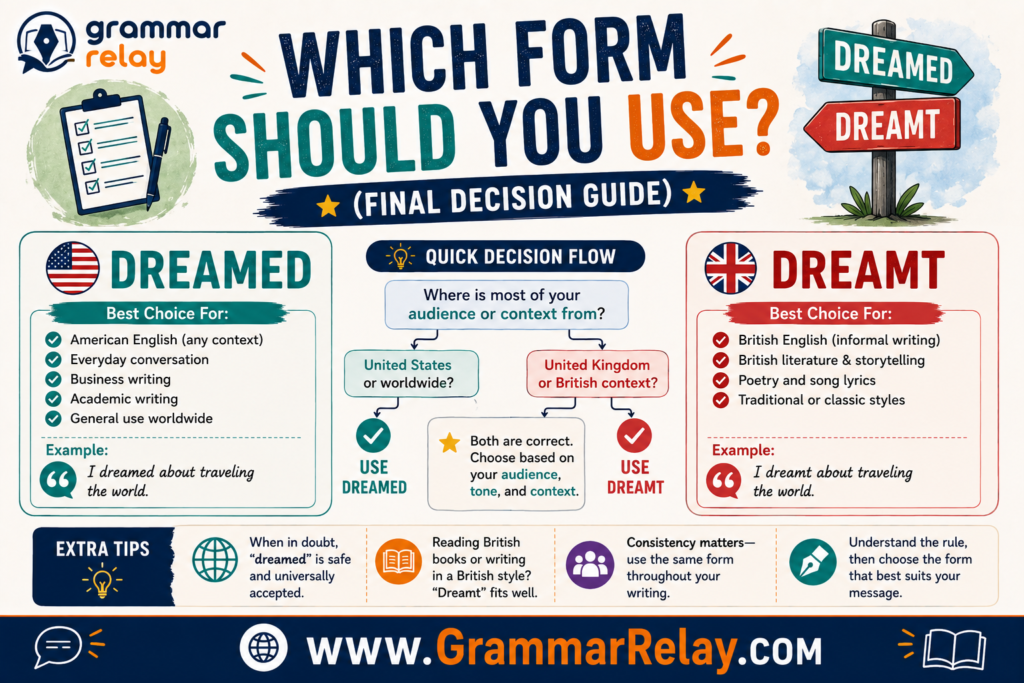
Still not sure? Run through this quick checklist:
Use “dreamed” when:
- Your audience is primarily American
- You’re writing formally or academically
- Your style guide prefers regular verb forms
- You want a clean, modern, neutral tone
Use “dreamt” when:
- Your audience is British or Australian
- You’re writing literary fiction, poetry, or atmospheric prose
- The rhythm of your sentence benefits from the harder “-t” ending
- Your style guide accepts or prefers British conventions
Used either when:
- Your style guide doesn’t specify
- You’re writing creatively with full stylistic freedom
- Just pick one and stay consistent throughout
FAQs
Is dreamt grammatically correct?
Absolutely. Dreamt is a fully accepted irregular past tense form of “dream” used widely in British, Australian, and literary English.
Which is more common globally: dreamed or dreamt?
Dreamed appears more frequently in global English usage overall. However dreamt remains common and standard in British English publications and literary writing.
Can you use dreamt in American English?
Yes. It won’t be marked as wrong but it will read as slightly unusual to American audiences who expect “dreamed” by default.
Why does English have two past tense forms for “dream”?
English inherited irregular verb forms from Old Germanic languages and never fully eliminated them. Regional standardization in America pushed toward regular “-ed” forms while British English retained the irregular “-t” ending.
What’s the past perfect form of dream?
Both “had dreamed” and “had dreamt” are correct past perfect constructions. Choose based on your regional preference and stylistic consistency.
Read more grammar lessons on Grammar Relay
Dreamed or Dreamt? Here’s the Final Word
Here’s what it really comes down to. Dreamed and dreamt are two perfectly correct paths to the same destination. Your audience, your tone, and your style guide make the decision for you far more than any grammar rule does.
Write for Americans? Go with dreamed. Crafting something literary or writing for a British readership? Dreamt earns its place. Working in a context with no clear preference? Pick one and stay consistent from the first sentence to the last.
Good writing isn’t about choosing the “correct” word between two equally valid options. It’s about choosing the word that fits your reader, your voice, and your purpose. Now you know exactly how to do that.
