

Here’s a mistake that sneaks into professional writing more than most people realize. You finish a sentence and pause. Did the study showed or shown the results? Did she showed or shown the client around? One wrong choice and your credibility takes a quiet hit.
The good news? The rule behind shown vs showed is actually straightforward once you see it clearly. This guide breaks it all down with real examples, tables, and memory tricks that stick.
The Quick Answer (For Those in a Hurry)
Here’s the core distinction in two sentences:
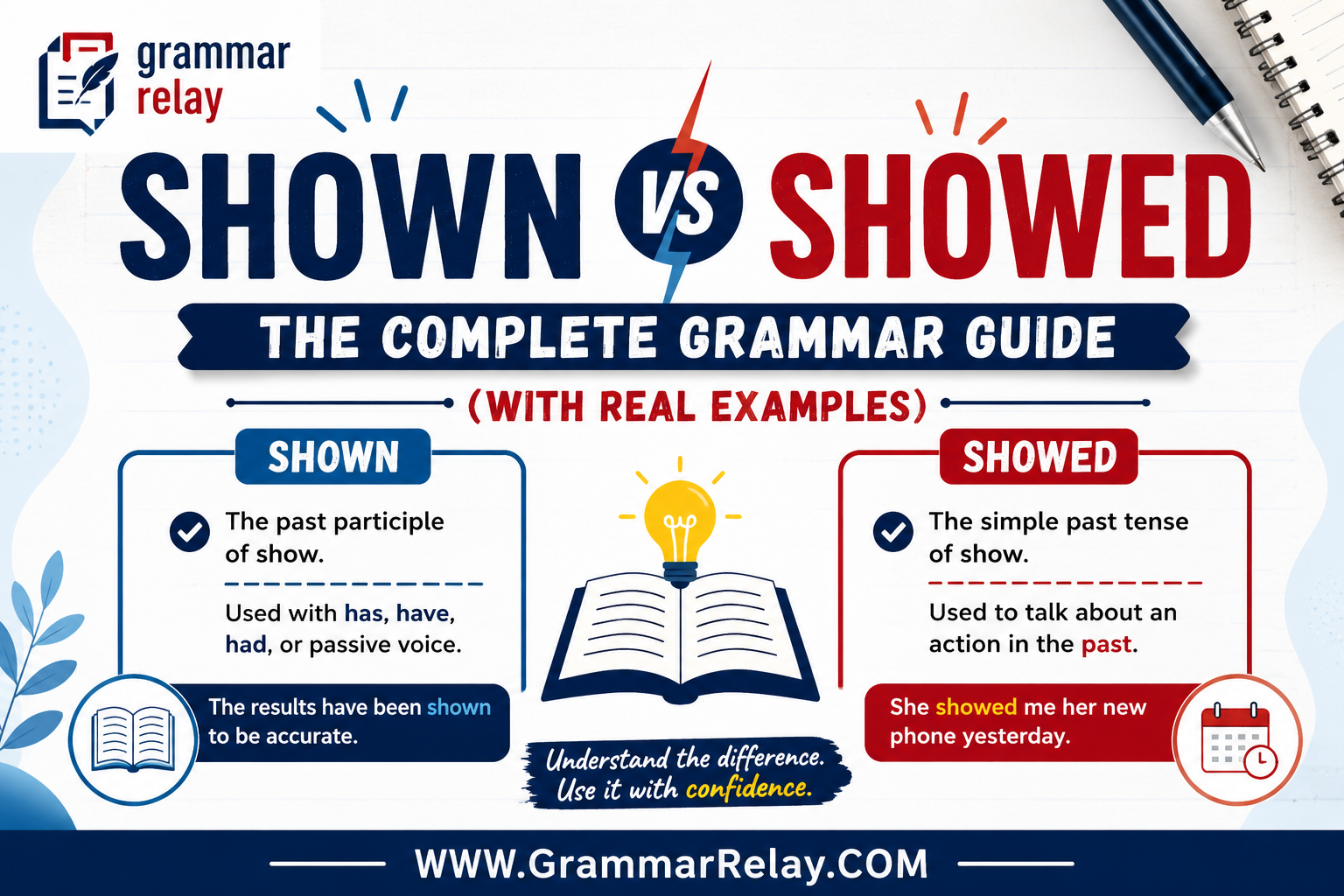
Showed is the simple past tense. It stands alone. Shown is the past participle. It always travels with a helping verb like have, has, had, was, or were.
| Quick Reference | Showed | Shown |
|---|---|---|
| Grammatical role | Simple past tense | Past participle |
| Needs a helper? | No | Yes |
| Example | “She showed me the report.” | “She has shown me the report.” |
| Works in passive voice? | No | Yes |
That one table resolves most of the confusion. But understanding WHY these rules exist makes them stick permanently.
Understanding the Verb “Show” and Why It Has Two Past Forms
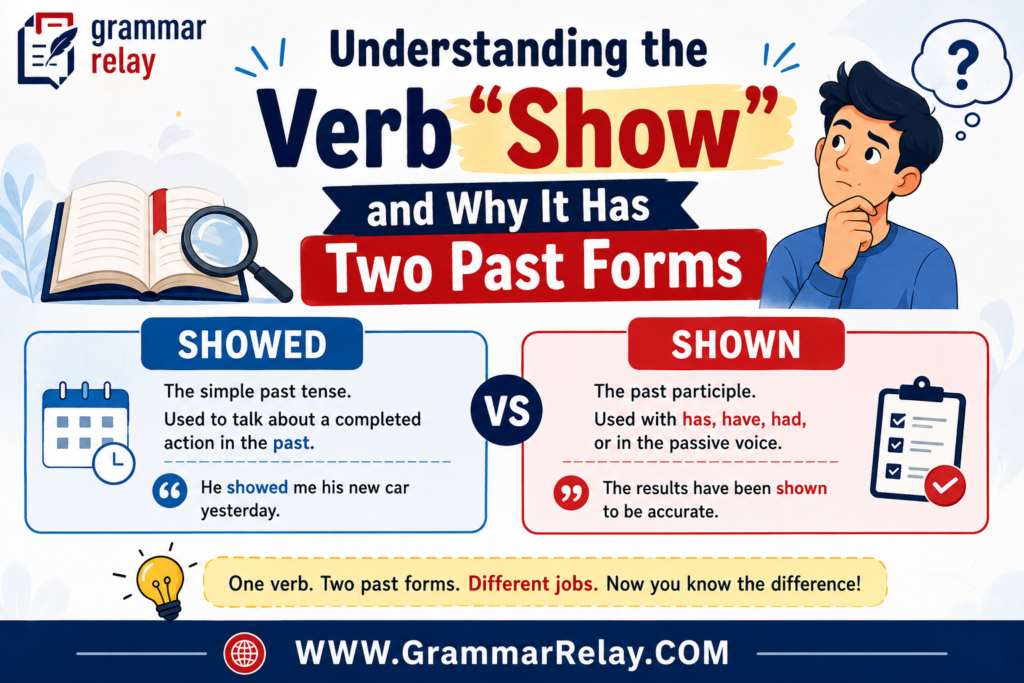
“Show” is what grammarians call a semi-irregular verb. It follows a regular pattern for its simple past tense (show + ed = showed) but uses an irregular past participle (shown) instead of the expected “showed.”
The three principal parts of “show” are:
- Base form: show
- Simple past: showed
- Past participle: shown
Etymologically, “show” traces back to Old English “scēawian,” meaning to look at, inspect, or observe. Over centuries of linguistic evolution the verb developed two distinct past forms as English borrowed patterns from both Germanic and Norse language traditions.
This dual-form system isn’t unique to “show.” Verbs like “know,” “grow,” and “blow” follow the exact same pattern, which we’ll explore in detail later.
What “Showed” Means and When to Use It
Showed is the simple past tense of show. Use it when describing a completed action that happened at a specific point in the past. No helping verb needed. It stands completely on its own.
Showed Standing Alone
This is the defining feature of showed. It doesn’t need grammatical support:
| Sentence Type | Example |
|---|---|
| Affirmative | “She showed me the report yesterday.” |
| Negative | “He showed no hesitation walking into the room.” |
| Question | “Did the results show what you expected?” |
| Time-specific | “The doctor showed up exactly at noon.” |
| Narrative past | “He showed real courage under pressure.” |
Notice something? Every sentence above describes a finished action at a specific past moment. That’s the signal to reach for showed.
Think of it this way: if you can answer “when did this happen?” with a specific time (yesterday, last week, this morning), showed is almost certainly your word.
What “Shown” Means and When to Use It
Shown is the past participle of show. Here’s the rule that matters most: shown never stands alone. It always pairs with a helping verb. Without one, it’s grammatically incomplete.
The helping verbs that accompany shown include: have, has, had, was, were, is, are, will have.
Read more about Dreamed vs Dreamt: The Complete Grammar Guide
Shown in Perfect Tenses
| Construction | Example |
|---|---|
| Present perfect | “She has shown remarkable patience throughout.” |
| Past perfect | “He had shown the results before the meeting started.” |
| Future perfect | “By Friday, they will have shown all their evidence.” |
| Passive present | “The data is shown in Figure 1.” |
| Passive past | “The film was shown to a live audience.” |
Shown carries a slightly more formal weight than showed and appears frequently in academic papers, legal documents, and professional reports. When you see phrases like “research has shown” or “studies have shown,” that’s shown doing its job as a past participle in a present perfect construction.
Shown vs Showed: Full Side-by-Side Comparison
Here’s the complete picture:
| Feature | Showed | Shown |
|---|---|---|
| Grammatical role | Simple past tense | Past participle |
| Needs helping verb? | No | Yes |
| Stands alone? | Yes | No |
| Used in passive voice? | No | Yes |
| Used in perfect tenses? | Rarely | Always |
| Formality level | Neutral | Neutral to formal |
| American English | Very common | Very common |
| British English | Common | Common |
The past of show splits cleanly between these two functions. Neither word is more correct than the other. They simply serve different grammatical purposes.
The Grammar Engine: Perfect Tenses and Why “Shown” Owns Them
Perfect tenses describe actions connected to another point in time. They always use a helping verb plus a past participle. Since shown is the past participle of “show,” it owns every perfect tense construction.
| Tense | Formula | Example |
|---|---|---|
| Present perfect | have/has + shown | “She has shown great leadership this quarter.” |
| Past perfect | had + shown | “They had shown the evidence before the verdict.” |
| Future perfect | will have + shown | “By then, he will have shown what he’s capable of.” |
| Passive present | is/are + shown | “The results are shown in the table below.” |
| Passive past | was/were + shown | “The film was shown at three international festivals.” |
This is where showed or shown confusion peaks for most writers. The moment a helping verb appears in your sentence, shown is the correct choice. Full stop.
Shown vs Showed in Passive Voice
This section is where most grammar guides fall short. Passive voice always requires a past participle and that means passive constructions demand shown every single time. “Showed” can never function in passive voice.
Here’s exactly what that looks like in practice:
| Incorrect | Correct | Why |
|---|---|---|
| “The results were showed.” | “The results were shown.” | Passive requires past participle |
| “The film was showed last night.” | “The film was shown last night.” | Same rule applies |
| “Evidence was showed to the jury.” | “Evidence was shown to the jury.” | Passive voice needs “shown” |
| “The property was showed to buyers.” | “The property was shown to buyers.” | No exceptions here |
This error appears constantly in professional writing. A quick scan for “was showed” or “were showed” in any document will almost always reveal a mistake needing correction.
“Have Showed” vs “Have Shown”: Settling the Debate
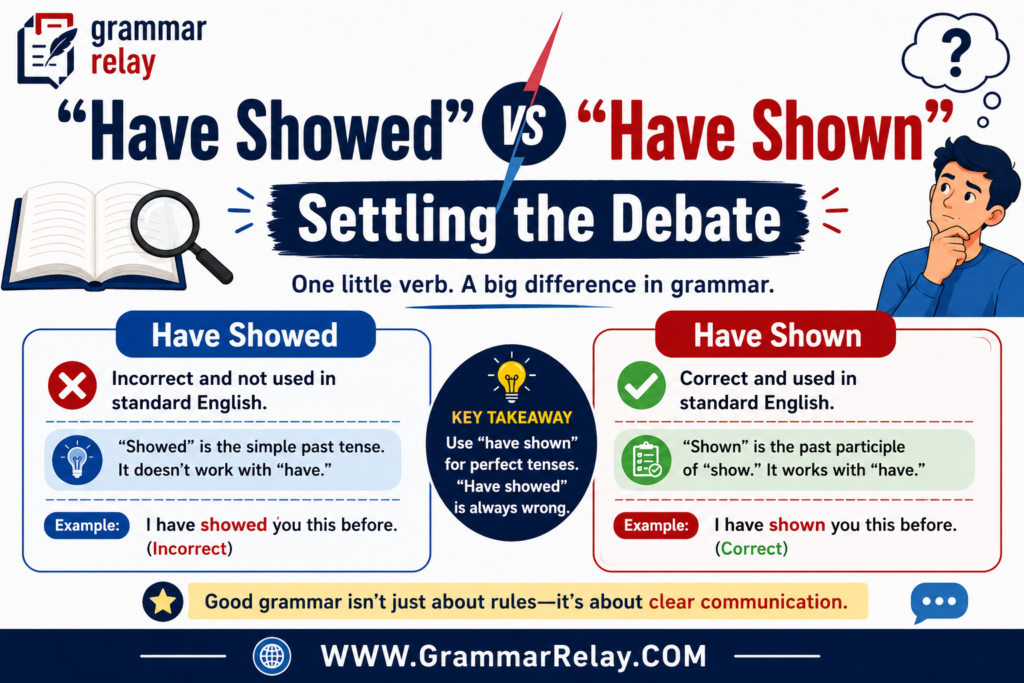
Here’s a question worth answering directly: is “have showed” ever correct?
Technically, in some dialects, yes. Practically, almost never.
Major style guides are clear on this. The Chicago Manual of Style and AP Stylebook both treat “shown” as the standard past participle for perfect tense constructions. Google Ngram Viewer data shows that “have shown” has consistently outpaced “have showed” by a ratio of roughly 20:1 in published English writing since 1950.
“Have showed” survives in some regional American dialects and in very informal speech but it reads as nonstandard in any professional, academic, or published context.
The verdict: default to “have shown” in virtually every situation.
Shown vs Showed Across Different Writing Contexts
| Writing Context | Preferred Form | Example |
|---|---|---|
| Research paper | Shown | “The study has shown a significant correlation.” |
| News article | Showed | “The senator showed up unannounced at the press briefing.” |
| Business email | Shown | “As I have shown in the attached report…” |
| Fiction narrative | Showed | “She showed him the letter and waited for his reaction.” |
| Legal brief | Shown | “The evidence has shown beyond reasonable doubt…” |
| Academic data | Shown | “Figure 3 has shown a consistent upward trend.” |
Similar Irregular Verbs That Follow the Same Pattern
Understanding the grammatical family “show” belongs to makes the showed vs shown rule click permanently. These verbs all follow the exact same pattern:
| Base Verb | Simple Past | Past Participle |
|---|---|---|
| Show | Showed | Shown |
| Know | Knew | Known |
| Grow | Grew | Grown |
| Blow | Blew | Blown |
| Throw | Threw | Thrown |
| Sow | Sowed | Sown |
| Mow | Mowed | Mown |
Notice how every past participle in this family ends in “-n”? That’s not coincidence. It’s a consistent Germanic language pattern that survived into modern English. Once you see it, you start recognizing it everywhere.
You might be interested in Other Ways to Say Hi: 50+ Greetings for Every Person, Place, and Platform
Common Mistakes Writers Make With Shown and Showed
Even experienced writers stumble here. Watch out for these specific errors:
- Using “showed” in passive voice: “The data was showed clearly” should be “The data was shown clearly”
- Using “shown” without a helping verb: “She shown him the way” is incomplete and incorrect
- Writing “have showed”: Almost always should be “have shown” in standard written English
- Confusing “shown” with “shone”: “Shone” is the past tense of “shine.” These words sound similar but serve completely different functions. “The light shone through the window” vs “She has shown great talent”
- Inconsistent usage: Switching between forms within the same document without grammatical reason
Real-World Case Study: How This Mistake Appears in Professional Writing
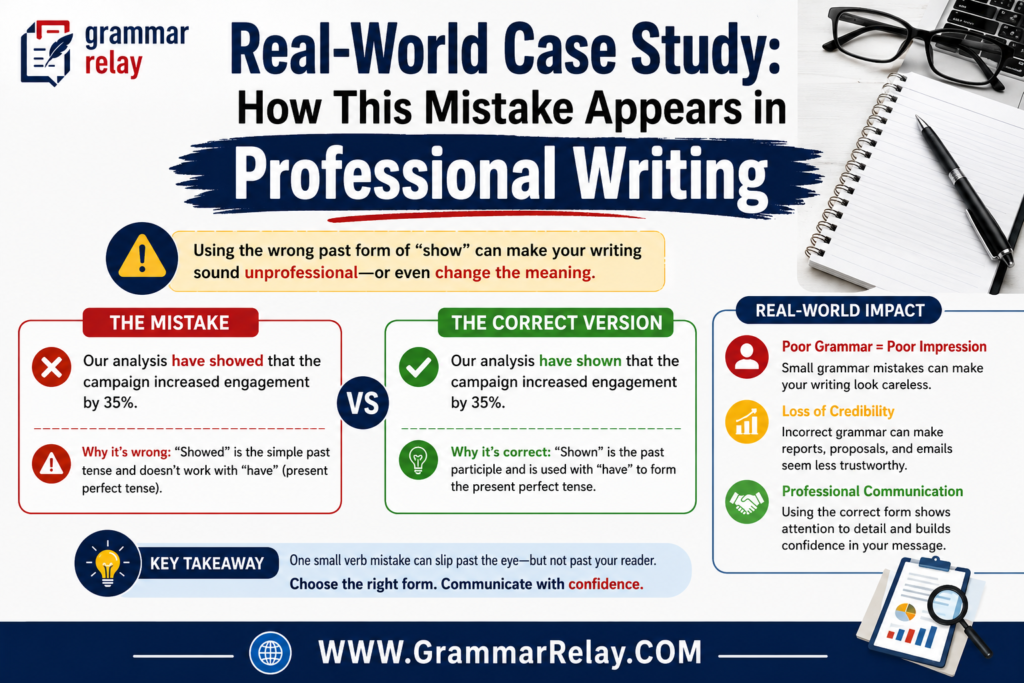
Consider three real scenarios where shown or showed confusion creates credibility problems:
Scenario 1: Corporate Email A marketing director writes: “The campaign has showed strong results across all metrics.” Every recipient who knows grammar notices the error. The correct form is “has shown.”
Scenario 2: Academic Paper A researcher submits: “The experiment was showed to produce consistent outcomes.” The passive construction demands “shown.” A reviewer flags it immediately.
Scenario 3: News Reporting A journalist writes: “Documents were showed to the committee last Thursday.” Again, passive voice requires “shown.” The copy editor catches it before publication but it wastes time.
In each case, the fix takes two seconds. The damage to perceived credibility takes longer to repair.
“Grammar is the logic of speech, even as logic is the grammar of reason.” — Richard Chenevix Trench
Memory Tricks That Actually Stick
Three reliable shortcuts:
The “Eaten” Substitution Test: Replace your word with “eaten.” If “eaten” fits grammatically, use “shown.” If the sentence breaks, use “showed.”
- “She has eaten the report” works structurally so: “She has shown the results” is correct
- “She eaten the report yesterday” breaks so: “She showed the results yesterday” is correct
“Shown Needs a Companion”: Shown always travels with a helping verb. Think of it as the word that refuses to go anywhere alone.
“Showed Stands Solo”: Showed is self-sufficient. No helper required. No passengers.
Synonyms for Show, Showed, and Shown
| Word | Synonym Options | Example |
|---|---|---|
| Show (present) | demonstrate, reveal, display, present | “Let me demonstrate the process step by step.” |
| Showed (past) | demonstrated, revealed, displayed, indicated | “She demonstrated real composure under pressure.” |
| Shown (participle) | demonstrated, revealed, indicated, established | “The data has established a clear pattern.” |
Quick Practice Section (Test Yourself)
Fill in the blank with showed or shown:
- “The teacher has _____ the students three different methods.”
- “Yesterday, he _____ up two hours late.”
- “The evidence was _____ to the court.”
- “By next week, she will have _____ her full range of skills.”
- “He _____ no signs of slowing down.”
Answers: shown, showed, shown, shown, showed
The tricky one? Sentence three. Passive voice demands shown every time and that’s the one most people second-guess.
Frequently Asked Questions
What is the difference between shown and showed?
Showed is the simple past tense and stands alone. Shown is the past participle and always needs a helping verb like have, has, had, was, or were.
Can “shown” ever stand alone without a helping verb?
No. “Shown” without a helper is grammatically incomplete. “She shown the results” is incorrect. It should be “She showed the results” or “She has shown the results.”
Is “has showed” grammatically correct?
Technically accepted in some dialects but widely considered nonstandard in professional and academic writing. “Has shown” is correct in virtually every context.
Which form works in passive voice?
Only shown. Passive voice always requires a past participle and shown is the past participle of show.
Do British and American English use these differently?
Both regions use shown and showed the same way grammatically. The passive voice and perfect tense rules apply universally across all English dialects.
Read more grammar lessons on Grammar Relay
Conclusion
Two words. One clean distinction.
Showed describes a completed past action and stands on its own. Shown works inside perfect tenses and passive voice and never travels alone.
When you’re unsure, run the “eaten” test. If “eaten” fits the sentence structure, reach for shown. If the sentence needs a standalone past tense verb, showed is your word.
