

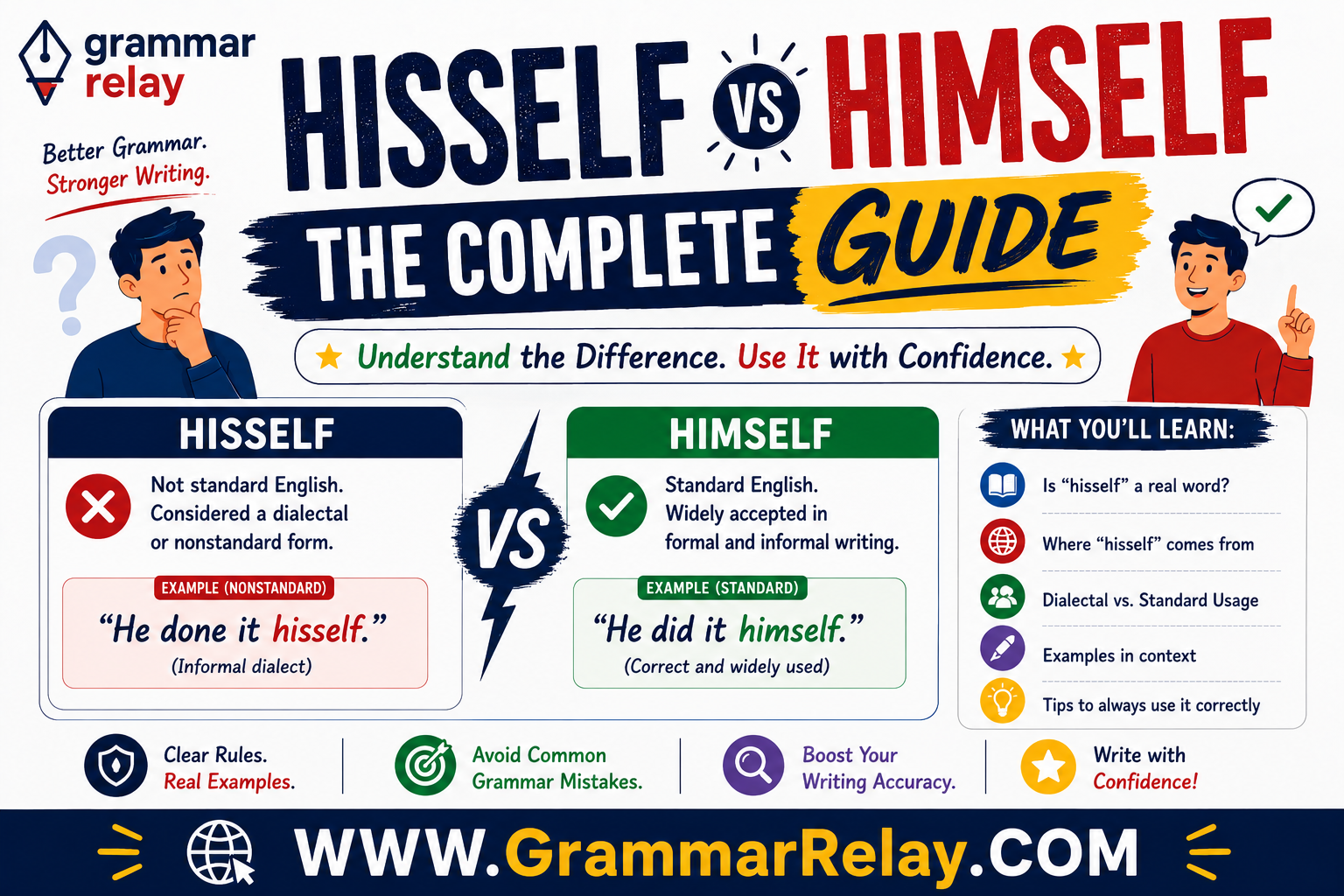
Here’s a word that makes grammar teachers wince and linguists lean forward with interest. Hisself. Say it out loud and it sounds perfectly natural in certain parts of the United States. Write it in a professional email and it undermines your credibility before the reader finishes the sentence.
The hisself vs himself debate is more intellectually interesting than most grammar questions because “hisself” isn’t simply a random error. It follows a logical pattern. It has historical roots. And it survives in recognized American dialects spoken by millions of people today.
This guide covers both words completely: what they mean, why one is standard and one isn’t, where “hisself” actually comes from, and exactly when each form is appropriate.
The Direct Answer (And Why It’s More Nuanced Than You’d Expect)

Himself is the standard English form. Use it in all formal, professional, and academic writing without exception. Hisself is nonstandard but not random: it follows a coherent linguistic pattern and exists in recognized American dialects with documented historical usage.
| Form | Standard English? | Dictionary Entry? | Use In Formal Writing? |
|---|---|---|---|
| Himself | Yes | Yes (all major dictionaries) | Always |
| Hisself | No (nonstandard) | Limited (dialect dictionaries) | Never |
So is it himself or hisself in standard writing? Always himself. But understanding why “hisself” exists makes the rule stick permanently and gives you genuine insight into how English actually works.
What Reflexive Pronouns Are and How the English System Works
Before tackling hisself or himself, you need to understand what reflexive pronouns do and how English forms them.
A reflexive pronoun reflects the action of a verb back to the subject. When the subject and object of a sentence are the same person, a reflexive pronoun handles the object role. “He hurt him” means two different people. “He hurt himself” means one person both performed and received the action.
Reflexive pronouns also work as emphatics, adding stress or surprise without changing the basic meaning. “The president himself attended” emphasizes who attended in a way that “the president attended” doesn’t.
Here’s the complete English reflexive pronoun system:
| Person | Subject Pronoun | Base Form Used | Reflexive Pronoun | Pattern |
|---|---|---|---|---|
| First singular | I | Me (object) | Myself | Object + self |
| Second singular | You | You (object) | Yourself | Object + self |
| Third singular male | He | Him (object) | Himself | Object + self |
| Third singular female | She | Her (possessive) | Herself | Possessive + self |
| Third singular neutral | It | It (object) | Itself | Object + self |
| First plural | We | Us (object) | Ourselves | Object + self |
| Second plural | You | You (object) | Yourselves | Object + self |
| Third plural | They | Them (object) | Themselves | Object + self |
The Logical Inconsistency at the Heart of the English Reflexive System
Here’s the section every competitor article misses entirely and it’s the most important one for understanding himself vs hisself.
Look carefully at the table above. Notice anything odd? Herself uses the possessive form “her” as its base, not the object form. Every other reflexive pronoun in the standard system uses the object form. “Myself” comes from “me,” not “my.” “Yourself” comes from “you.” “Itself” comes from “it.” “Themselves” comes from “them.”
But “herself” comes from “her” the possessive, not “her” the object. The two happen to be identical in form so nobody notices the inconsistency.
Now look at “himself.” If English had been perfectly consistent, it would follow the “herself” pattern and use the possessive “his” as its base: his + self = hisself. That’s exactly the logic speakers who say “hisself” are applying.
| Reflexive Pronoun | Base Form Used | Consistent With Majority? |
|---|---|---|
| Myself | Me (object) | Yes |
| Yourself | You (object) | Yes |
| Himself | Him (object) | Yes (standard) |
| Herself | Her (possessive) | No (exception to majority pattern) |
| Itself | It (object) | Yes |
| Ourselves | Us (object) | Yes |
| Themselves | Them (object) | Yes (standard) |
| Hisself | His (possessive) | Logical but nonstandard |
| Theirselves | Their (possessive) | Logical but nonstandard |
“Hisself” and “theirselves” are linguistically logical. They apply the same possessive + self pattern that “herself” uses. English simply didn’t standardize around that pattern for third person masculine singular and plural forms. The result is a system that’s internally inconsistent in ways that generate entirely predictable “errors.”
“A language is a dialect with an army and a navy.” — Max Weinreich
What “Himself” Means: Full Definition and Every Function
Himself does two distinct jobs in English sentences and both matter for using it correctly.
Reflexive Use
The subject performs an action that affects the subject directly:
- “He cut himself while cooking.” (action reflects back to subject)
- “He reminded himself to call.” (mental action directed inward)
- “He introduced himself to the team.” (social action directed at self)
Emphatic Use
Himself adds stress, contrast, or surprise without changing the basic meaning:
- “The CEO himself approved the decision.” (emphasizes importance)
- “He himself admitted the mistake.” (emphasizes that this particular person confessed)
- “He built the entire system himself.” (emphasizes doing it without help)
In Fixed Idiomatic Expressions
| Expression | Meaning | Example |
|---|---|---|
| By himself | Alone or without help | “He built the cabin by himself.” |
| To himself | Privately, not sharing | “He kept the news to himself.” |
| For himself | For his own benefit | “He cooked dinner for himself.” |
| Not himself | Behaving unusually | “He seems off; he’s not himself today.” |
| Beside himself | Extremely emotional | “He was beside himself with excitement.” |
| Come to himself | Regain composure or consciousness | “He finally came to himself after the shock.” |
“Beside himself” is particularly interesting. The phrase implies such extreme emotion that the person seems to exist outside their normal self. It works with joy, grief, rage, or excitement. No other reflexive pronoun generates quite this range of idiomatic richness.
Read more about There Has Been or Have Been: The Complete Grammar Guide (With Real Examples)
What “Hisself” Means and Where It Actually Came From
Hisself functions as a reflexive pronoun carrying the same meaning as himself. “He hurt hisself” and “he hurt himself” communicate identical information. The difference is register, not meaning.
Historical Evidence
His self and hisself aren’t modern inventions. They appear in English texts dating back centuries before grammar standardization occurred.
| Period | Status of “Hisself” | Context |
|---|---|---|
| Pre-1400s | Both forms in use | No codified standard grammar |
| 1500s-1600s | Appears in literary texts | Shakespeare-era varied usage |
| 1700s | Begins to be stigmatized | Grammar books standardize “himself” |
| 1800s | Marked as dialectal | Regional American dialects retain it |
| 1900s | Firmly nonstandard | Standard English rejects it completely |
| Present | Dialectal/nonstandard | Survives in specific American dialects |
The 18th century grammar codification movement, driven by scholars like Robert Lowth whose “Short Introduction to English Grammar” (1762) shaped prescriptive grammar for generations, played the decisive role in stigmatizing nonstandard reflexives. Before that standardization, “hisself” was simply one available option among several.
Where “Hisself” Survives in American English Dialects
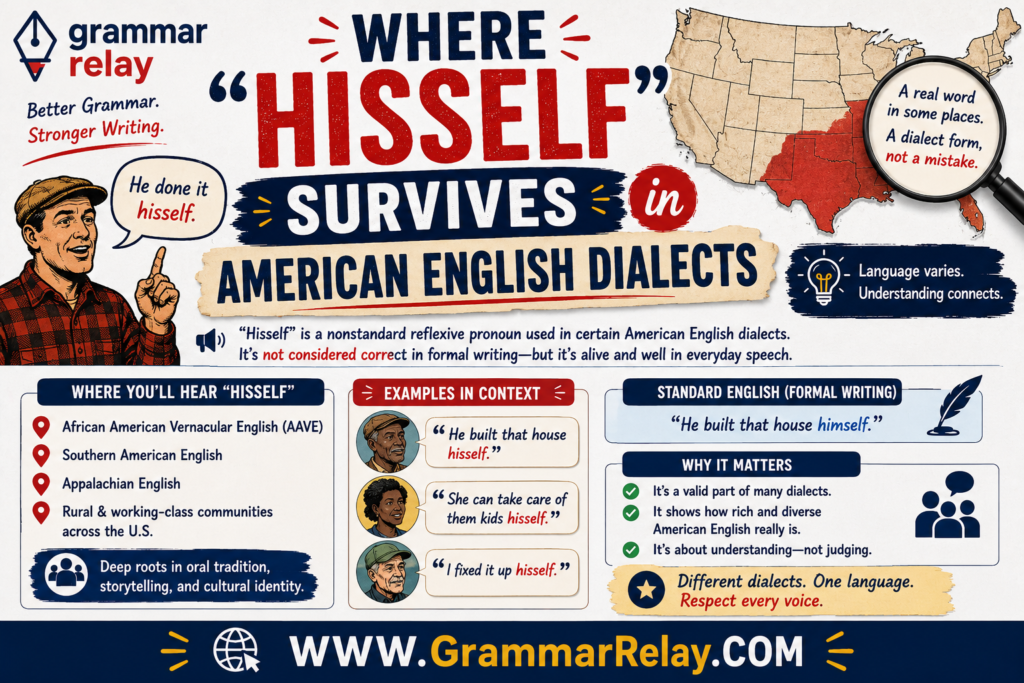
Hisself isn’t distributed randomly across American English. It concentrates in specific dialect regions with documented linguistic research behind them.
| Dialect/Region | Uses “Hisself”? | Notes |
|---|---|---|
| Appalachian English | Yes, commonly | Extensively documented in academic linguistics |
| Southern American English | Sometimes | Varies significantly by area and speaker generation |
| Ozark English | Yes | Historically documented in fieldwork recordings |
| Standard American English | No | “Himself” always required |
| British English | No | “Himself” universally standard |
| Australian English | No | “Himself” universally standard |
Appalachian English is the most thoroughly studied dialect retaining hisself. Linguists at universities including the University of North Carolina and Virginia Tech have documented its usage in recordings of native Appalachian speakers. The form isn’t random or careless in this context: it’s a consistent feature of a coherent dialect system.
This matters because dismissing “hisself” as simply ignorant misses the linguistic reality. Dialect speakers who use “hisself” typically also speak standard English in formal contexts and code-switch between registers the same way most speakers do.
“Hisself” in Literature, Media, and Popular Culture
Skilled authors use hisself deliberately to signal character, region, and authenticity. It’s a tool, not an error, when it appears in dialogue.
| Author/Work | Usage | Purpose |
|---|---|---|
| Mark Twain, Huckleberry Finn | “Hisself” in character dialogue | Authentic Mississippi River regional voice |
| John Steinbeck, Of Mice and Men | Dialectal speech throughout | Working class and rural characterization |
| Cormac McCarthy, various novels | Nonstandard reflexives | Southern and Appalachian realism |
| Film/TV Westerns | “Hisself” in period dialogue | Historical and regional authenticity |
Twain’s commitment to dialect accuracy in Huckleberry Finn was so thorough that he included a prefatory note explaining the distinct dialects he’d rendered. Using “himself” in Huck’s voice would have destroyed the authenticity that makes the novel work. The nonstandard form carries information that the standard form cannot.
The key distinction: hisself in character dialogue signals authenticity. Hisself in narrative prose or formal writing signals an error. Same word, completely different implications depending on where it appears on the page.
The Grammatical Case for “Himself” Over “Hisself”
Five major style guides agree completely on this question:
| Style Guide | Position on “Hisself” | Recommended Form |
|---|---|---|
| Chicago Manual of Style | Nonstandard, avoid | Himself |
| AP Stylebook | Not recognized | Himself |
| Oxford English Dictionary | Marks as dialectal | Himself |
| Merriam-Webster | Notes as nonstandard | Himself |
| Cambridge Grammar of English | Nonstandard | Himself |
The grammatical argument for himself over hisself rests on the majority pattern. Most English reflexive pronouns use the object form as their base: me, you, it, us, them. “Himself” follows this majority pattern. “Hisself” applies the minority pattern (possessive + self) to a pronoun where the standard form uses the object base.
The fact that “herself” breaks the majority pattern is an acknowledged inconsistency in English grammar but it doesn’t justify extending that inconsistency to “himself” in standard written English.
You might be interested in I Look Forward to Working With You: 50+ Ways to Say It Right
“Himself” vs “Hisself” in Writing Contexts
| Writing Context | Use Himself | Use Hisself | Notes |
|---|---|---|---|
| Academic papers | Always | Never | Standard form required |
| Business communication | Always | Never | Professional standard |
| Journalism | Always | Never | Style guides require standard |
| Legal documents | Always | Never | Precision required |
| Creative fiction dialogue | Default | When character speaks dialect | Authentic regional voice |
| Dialect narrative voice | Default | Sometimes | Depends on narrative style |
| Casual text/messaging | Default | Understood but nonstandard | Context-dependent |
| ESL writing | Always | Never | Learn standard form first |
For ESL learners specifically, himself is the only form worth learning initially. The dialect dimension of hisself becomes relevant only after achieving solid command of standard reflexive pronouns.
Common Mistakes and Misconceptions
Writers and speakers make five recurring errors around hisself vs himself:
- Thinking “hisself” is simply lazy speech: It follows a documented linguistic pattern used in recognized dialects with historical roots going back centuries
- Using “hisself” in professional or academic writing: Context where standard English is required demands “himself” without exception
- Correcting “hisself” in dialect literature or character dialogue: Authors who use it deliberately are making a craft choice, not an error
- Assuming dialects using “hisself” are grammatically inferior: Dialect variation reflects different rule systems, not the absence of rules
- ESL learners adopting “hisself” from informal American speech exposure: Informal dialect exposure can accidentally teach nonstandard forms as if they were standard
Memory Tricks That Make “Himself” Automatic
Three anchors that make the correct form permanent:
The pronoun chain: He → him → himself. All three forms use the same consonant cluster without switching to the possessive. If you’d say “give it to him” (not “give it to his”), the reflexive is “himself” (not “hisself”).
The majority pattern: Myself, yourself, itself, ourselves, themselves. Every single one uses the object base form. Himself fits that pattern. Hisself breaks it.
The “herself” awareness trick: “Herself” is the genuinely anomalous form using the possessive. It’s the exception, not the model. Remembering that “herself” is the odd one out prevents the logical extension of its pattern to “himself.”
Synonyms and Alternatives When “Himself” Feels Awkward
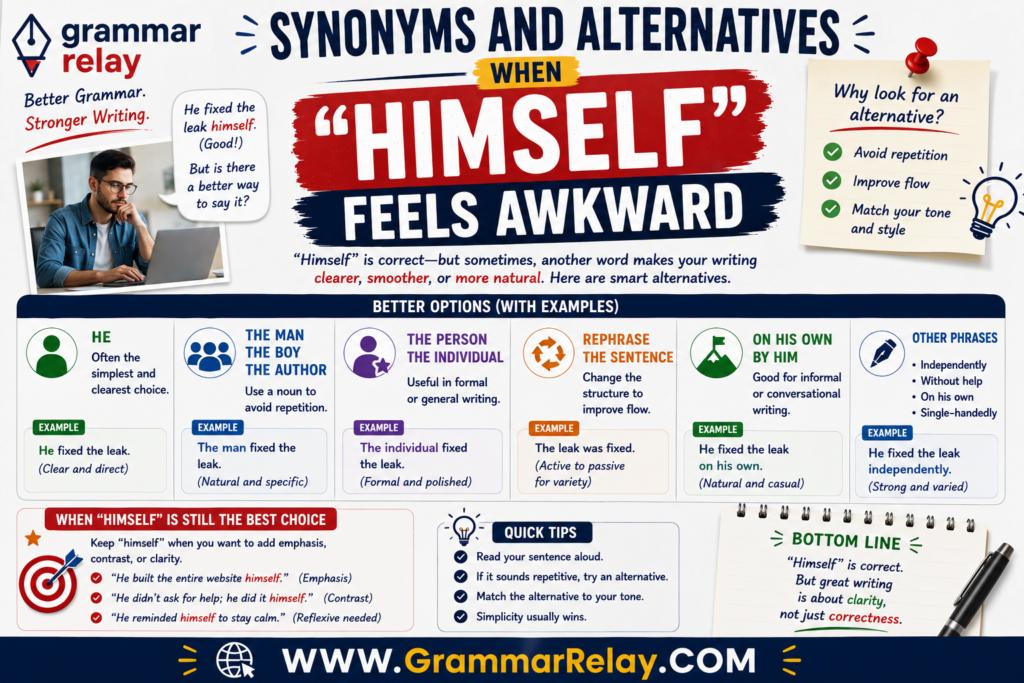
Sometimes restructuring the sentence works better than reaching for the reflexive:
| Awkward Construction | Better Alternative | Notes |
|---|---|---|
| “He himself said so.” | “He said so personally.” | More natural in casual writing |
| “He did it by himself.” | “He did it alone.” | Simpler and equally clear |
| “He told himself to stop.” | “He reminded himself to stop.” | More specific and vivid |
| “He himself was surprised.” | “Even he was surprised.” | More natural emphasis |
Frequently Asked Questions
Is “hisself” a real word in the English language?
It’s a real word in the sense that millions of speakers use it and it appears in dialect dictionaries and linguistic research. It isn’t a real word in the sense that standard English dictionaries recognize it as acceptable. Merriam-Webster notes it as nonstandard. The Oxford English Dictionary marks it as dialectal.
Why do people say “hisself” if it’s nonstandard?
Because it follows a logical pattern (possessive + self) that “herself” uses and that speakers extend analogically to masculine singular. It also survives in Appalachian, Southern, and Ozark English dialects where it’s a consistent grammatical feature rather than a random error.
Is “hisself” ever acceptable in writing?
In creative fiction where a character speaks an Appalachian or Southern dialect, yes. In all other writing contexts including business, academic, journalistic, and legal, no. Always use “himself.”
What’s the difference between reflexive and emphatic use of “himself”?
Reflexive: the subject’s action affects the subject directly (“He hurt himself”). Emphatic: “himself” adds stress without changing the meaning (“He himself signed the documents”). Both uses are standard and both require “himself” not “hisself.”
What’s the equivalent nonstandard form for “themselves”?
“Theirselves” follows the same logic as “hisself,” applying the possessive + self pattern to the plural third person. It’s equally nonstandard in formal English and equally logical from a pattern-application perspective.
Read more grammar lessons on Grammar Relay
Conclusion
Here’s the bottom line on hisself vs himself.
Hisself makes linguistic sense. It’s apply the same possessive + self pattern that “herself” uses. It has historical roots predating grammar standardization. It survives in recognized American dialects and serves a legitimate purpose in dialect literature and creative writing.
Himself is the universally required standard form in all formal, professional, academic, and journalistic writing. Every major style guide agrees and there are no exceptions.
Understanding both words doesn’t just help you avoid an error. It gives you genuine insight into how English evolved, why its reflexive pronoun system is internally inconsistent, and how dialect and standard forms coexist in a living language.
Use himself whenever standard English is required. Appreciate hisself for what it actually is: a logical variant with deep roots that standard grammar simply didn’t standardize around.
