

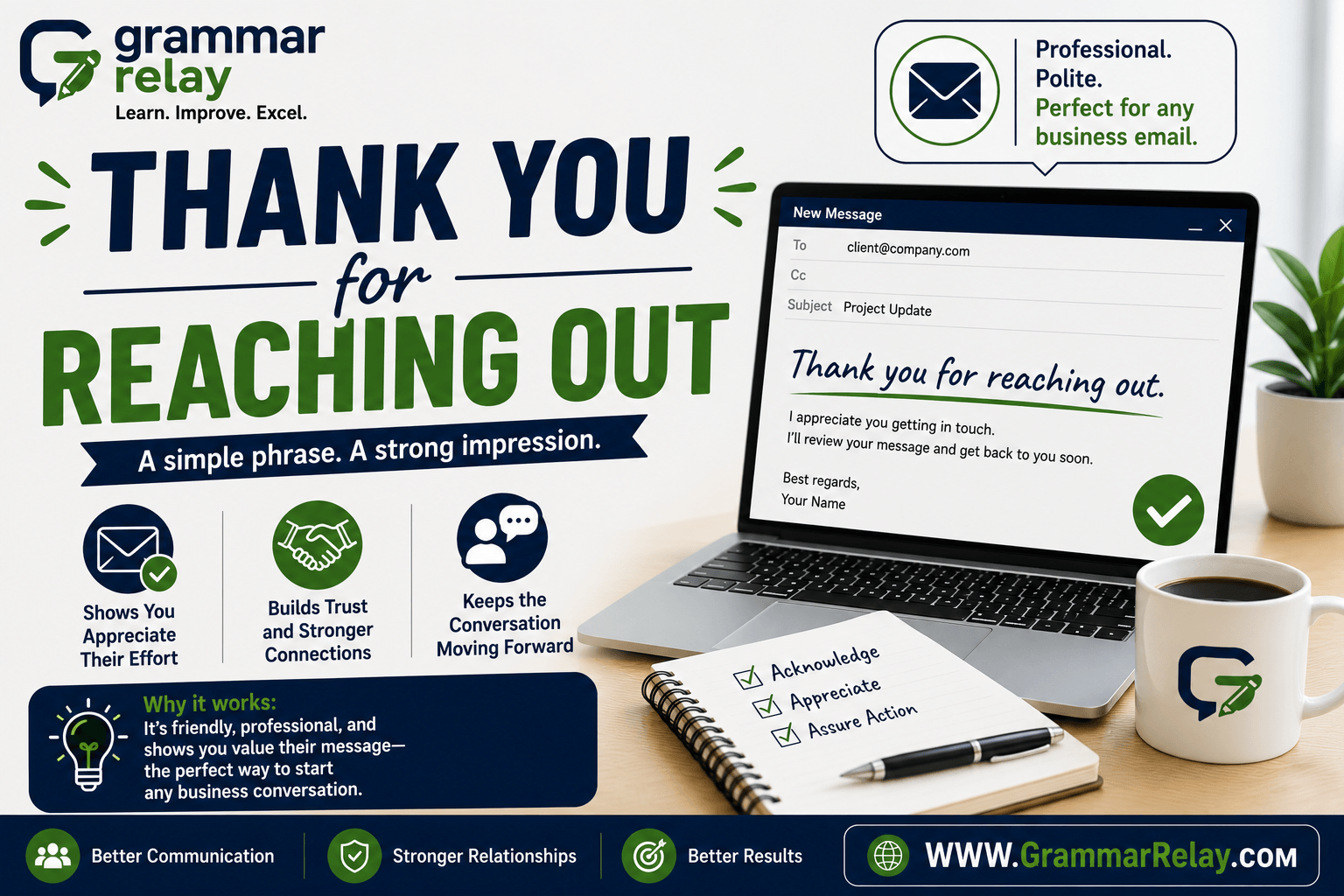
Some phrases become so embedded in professional communication that they stop communicating anything at all. “Thank you for reaching out” is one of them. Read it in enough email openers and it starts to feel less like genuine gratitude and more like a loading screen. It tells you the system received your message. Nothing more.
That’s not a reason to retire the phrase. It’s a reason to understand when it genuinely works and when something more specific, warmer, or more direct serves everyone better.
This guide covers 50+ alternatives organized by formality, situation, channel, and culture so you always have exactly the right response available.
Why “Thank You for Reaching Out” Gets Overused
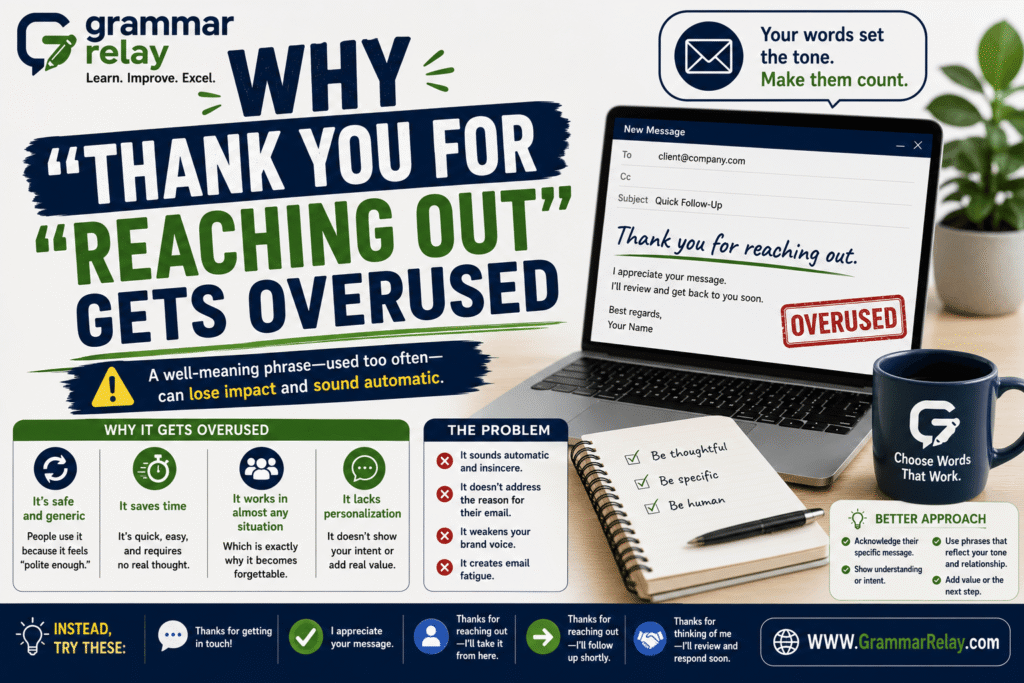
Professional communication runs on templates. They save time and reduce cognitive load which is genuinely useful. The problem arrives when a template phrase becomes so automatic that the person receiving it can feel the absence of thought behind it.
“Thank you for reaching out meaning” is simple: I acknowledge that you contacted me and I’m grateful you did. That’s a perfectly valid thing to communicate. The issue is frequency. When every customer service email, every LinkedIn reply, and every inquiry response opens with the identical phrase, it stops functioning as gratitude and starts functioning as punctuation.
According to State of the Connected Customer report, 80% of customers say the experience a company provides matters as much as its products or services. The first sentence of your reply shapes that experience before you’ve said anything substantive.
| Situation | Best Response Style | Tone Needed |
|---|---|---|
| Customer inquiry or complaint | Warm + action-focused | Empathetic and professional |
| Job applicant reaching out | Encouraging and clear | Formal but human |
| Networking or LinkedIn connection | Genuine and specific | Warm professional |
| Sales or cold outreach received | Polite and direct | Neutral to warm |
| Colleague checking in | Brief and friendly | Casual professional |
| Media or press inquiry | Formal and responsive | Professional |
| Partnership or collaboration inquiry | Enthusiastic and open | Warm professional |
What “Thank You for Reaching Out” Actually Means
At its core, “thank you for reaching out to me” performs three functions simultaneously: it acknowledges receipt, expresses gratitude, and signals openness to continue the conversation. Those are all genuinely useful things to communicate.
The phrase works best in three specific contexts: customer service responses where clients professionally expected warmth, networking situations where you want to signal genuine welcome, and first-contact professional emails where you need a warm but neutral opener.
Where it falls flat is when you use it reflexively regardless of context. A customer who emails with an urgent complaint doesn’t need a thank you for reaching out first. They need to know you’re on it. “Thank you for contacting me” at the top of a delay-laden reply can actually feel dismissive rather than welcoming.
The thank you for reaching out synonym question matters because different situations call for different registers. “Thank you for your inquiry” suits formal business correspondence. “Glad you got in touch” suits a warm professional email. “Thanks for the message” suits a quick Slack reply. Same basic gratitude. Completely different impressions.
Formal Alternatives to “Thank You for Reaching Out”
When the context demands formality, these alternatives carry appropriate professional weight:
| Alternative | Best Used When | Example In Context |
|---|---|---|
| “Thank you for your inquiry.” | Formal business or customer contact | Response to product or service question |
| “I appreciate you taking the time to contact us.” | Customer service or support | First reply to a customer email |
| “Thank you for initiating contact regarding this matter.” | Legal or formal business | Official correspondence opener |
| “We appreciate your communication and will respond promptly.” | Corporate customer response | Company-to-customer formal email |
| “Thank you for bringing this to our attention.” | Complaint or concern received | Customer complaint response |
| “I’m grateful for the opportunity to connect with you.” | Executive networking | C-suite or senior professional email |
| “Thank you for taking the time to reach out to our team.” | Company receiving inquiry | Business development or support |
“Thank you for bringing this to our attention” deserves special notice. When someone contacts you about a problem, this phrase does something the generic original can’t: it reframes their action as valuable rather than inconvenient. It signals that you treat incoming concerns as useful information rather than burdens to manage.
For “thank you for reaching out to me” formal contexts, “I appreciate you taking the time to contact us” consistently performs well. It acknowledges effort, not just action. That small distinction matters in high-stakes professional relationships.
Read more about Noted With Thanks in Email
Semi-Formal Alternatives: Professional Without Sounding Robotic
Most professional communication lives between stiff formality and casual friendliness. These thanks for reaching out synonyms work across the broadest range of professional contexts:
| Alternative | Tone | Best Context |
|---|---|---|
| “Thank you for getting in touch.” | Warm, professional | Any professional first contact |
| “I appreciate you reaching out.” | Genuine and direct | Client or professional contact |
| “Thanks for connecting with me.” | Warm professional | LinkedIn or networking email |
| “I’m glad you got in touch.” | Welcoming and open | New contact or referral |
| “Thanks for reaching out so promptly.” | Appreciative + specific | Fast response to your message |
| “I appreciate you taking the time to write.” | Formal-warm | Detailed inquiry or thoughtful message |
| “Thank you for your message. I’m happy to help.” | Professional + action-oriented | Customer or client support |
| “I’m pleased you reached out about this.” | Engaged and interested | Topic-specific inquiry |
“I’m glad you got in touch” is one of the most underused alternatives in professional email. It sounds genuinely human. It implies that the contact was welcome rather than merely processed. And it opens the conversation with warmth rather than formality.
“People will forget what you said, people will forget what you did, but people will never forget how you made them feel.” — Maya Angelou
That feeling starts with your first sentence.
Context-Specific Alternatives That Match Why Someone Reached Out
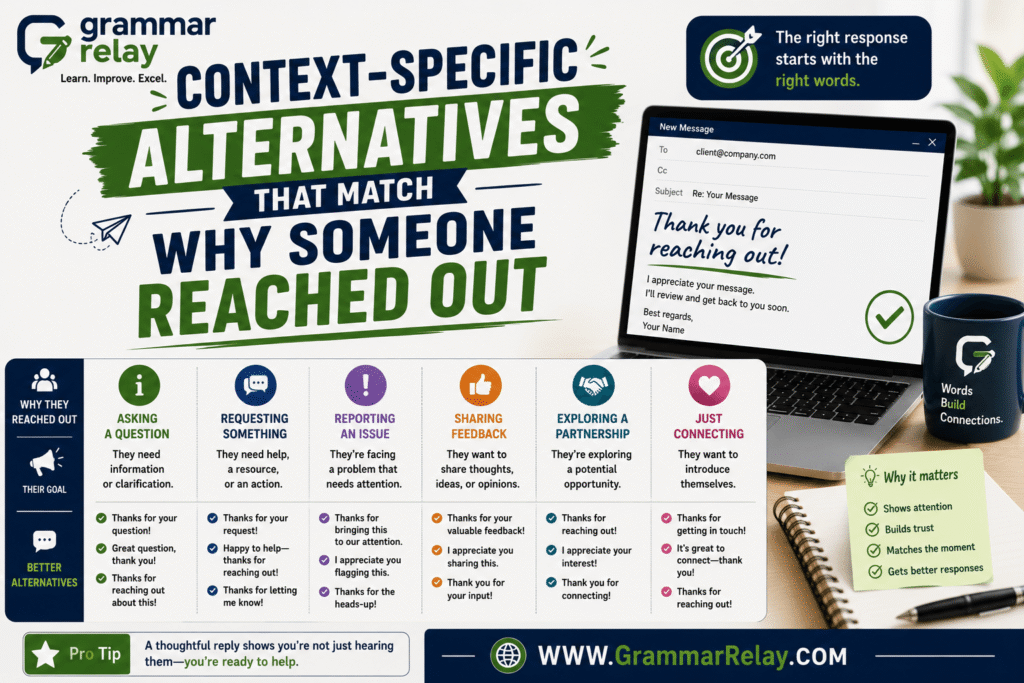
Here’s where most competitor guides fall short. The right phrase depends entirely on the reason someone contacted you. Generic gratitude for reaching out lands very differently than gratitude that acknowledges the specific purpose of the message.
| Context of Outreach | Best Alternative | Why It Fits |
|---|---|---|
| Job application inquiry | “Thank you for your interest in joining our team.” | Acknowledges the specific purpose |
| Sales or cold outreach | “Thank you for reaching out. Here’s what I’d suggest…” | Polite but redirects to value quickly |
| Media inquiry | “Thank you for contacting us regarding [topic].” | Formal and specific |
| Partnership proposal | “I’m glad you reached out. This sounds worth exploring.” | Open and engaged |
| Complaint received | “Thank you for bringing this to our attention.” | Empathetic and responsible |
| Referral introduction | “Lovely to meet you, and thanks to [name] for the introduction.” | Personal and warm |
| Speaking inquiry | “Thank you for thinking of me for this opportunity.” | Specific and appreciative |
When someone reaches out through a referral, “thanks to [name] for the introduction” does double work: it acknowledges the new contact AND honors the person who made the connection. That small gesture builds goodwill across multiple relationships simultaneously.
Casual Alternatives for Informal Professional Contexts
Startup culture, creative agencies, and conversational workplaces call for language that sounds like a real person typed it:
| Alternative | Register | Best Platform |
|---|---|---|
| “Thanks for reaching out!” | Casual professional | Email, social media, Slack |
| “So glad you got in touch.” | Warm and friendly | Personal professional |
| “Thanks for the message!” | Brief and warm | Quick reply, social media |
| “Great to hear from you.” | Friendly and open | Familiar professional contact |
| “Thanks for checking in.” | Warm | Follow-up or check-in message |
| “Appreciate you dropping a line.” | Casual and genuine | Informal professional context |
| “Happy you reached out!” | Upbeat and welcoming | Social or community context |
“Great to hear from you” works particularly well as another way to say thanks for reaching out in contexts where you have some prior relationship with the person. It implies their contact was genuinely welcome which is a warmer signal than pure acknowledgment.
How to Personalize Any Version of This Phrase
Personalization separates a phrase that resonates from one that readers skim. Any thank you for reaching out synonym becomes dramatically more effective when paired with one specific detail from the actual message you received.
| Generic Version | Personalized Version | What Changed |
|---|---|---|
| “Thank you for reaching out.” | “Thank you for reaching out about the partnership opportunity.” | Named the specific topic |
| “I appreciate your message.” | “I appreciate your message, especially your point about the timeline.” | Referenced specific content |
| “Thanks for getting in touch.” | “Thanks for getting in touch. Your pricing question is one I can answer directly.” | Moved straight into value |
| “I’m glad you reached out.” | “I’m glad you reached out. [Name] spoke very highly of your work.” | Added a personal bridge |
“Thanks for getting back to me” functions differently from the other phrases in this guide. It’s the appropriate response when someone replied to YOUR initial outreach rather than when they contacted you first. The distinction matters and using the wrong directional phrase can subtly signal that you haven’t paid attention to the flow of the conversation.
You might be interested in I Look Forward to Meeting You
Autoresponder and Template Versions That Actually Sound Human
Every competitor ignores this use case, despite its massive practical need. Automated replies account for a significant portion of professional “thank you for reaching out” usage and most of them sound exactly like what they are: automated.
Three elements make an autoresponder feel personal: a specific acknowledgment of what was sent, clear expectation-setting about response time, and something immediately useful that doesn’t require waiting.
| Context | Template Example |
|---|---|
| General business inquiry | “Thanks for reaching out! We’ve received your message and aim to respond within one business day. In the meantime, [relevant resource or link].” |
| Customer support | “Thank you for contacting our support team. Your ticket has been logged and a team member will respond within 24 hours.” |
| Job application | “Thank you for your interest in joining our team. We’ve received your application and will review it carefully. You’ll hear from us within two weeks.” |
| Speaking inquiry | “Thank you for thinking of me for your event. I’ll review your message and respond within 48 hours to discuss availability.” |
“Thank you for reaching us” appears in many autoresponders as a variant of the standard phrase. It’s perfectly acceptable but adding a specific action item or resource immediately after it transforms a passive acknowledgment into an active service gesture.
“Thank You for Reaching Out” Across Communication Channels
Platform context shapes phrasing more than most professional writers realize:
| Channel | Recommended Style | Length | Example |
|---|---|---|---|
| Formal email | Full phrase + immediate value | 1-2 sentences | “Thank you for your inquiry. Here’s what I can tell you…” |
| Brief and specific | Half sentence | “Thanks for connecting. I’d love to learn more about your work.” | |
| Customer service | Warm + action-focused | 1 sentence | “Thank you for reaching out. I’ll resolve this for you today.” |
| Social media DM | Casual and brief | 3-5 words | “Thanks for the message!” |
| Autoresponder | Warm + expectation-setting | 2-3 sentences | “Thank you for reaching out. We’ve received your message and will respond within 24 hours.” |
| Phone/verbal | Natural and direct | 1 phrase | “Really glad you called.” |
“Thank you for messaging me” works naturally in social media and messaging app contexts where “reaching out” can feel slightly formal for the platform. Match the register of the channel and you immediately sound more native to the environment.
Cultural Calibration: How This Phrase Lands Differently Around the World
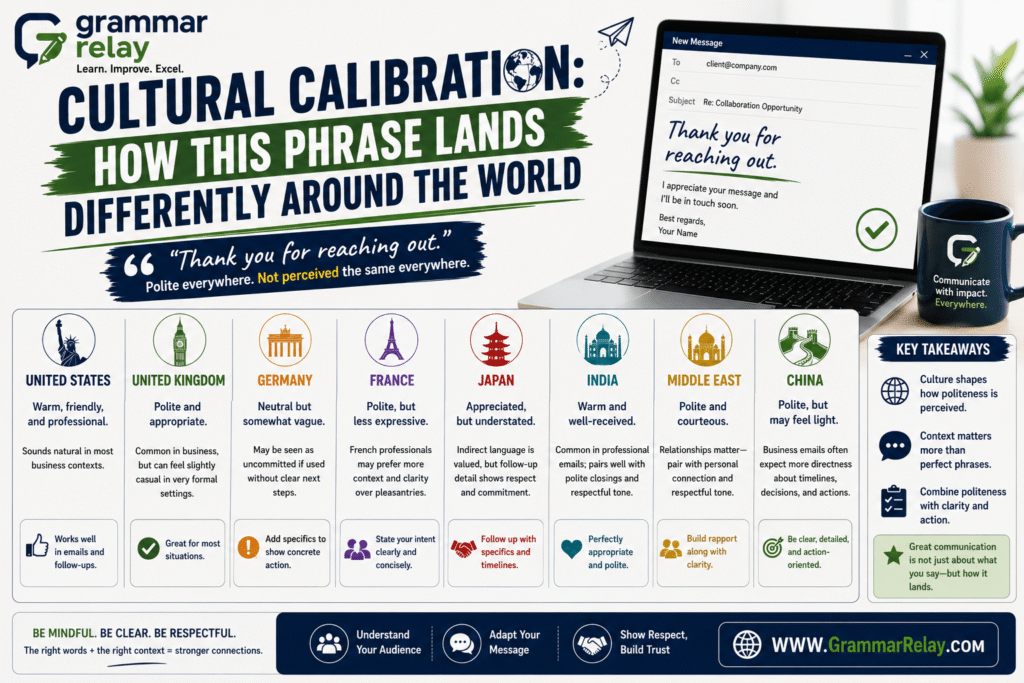
| Culture/Region | Preferred Tone | Recommended Phrase |
|---|---|---|
| United States | Warm and direct | “Thanks for reaching out! Here’s what I can help with.” |
| United Kingdom | Measured and polite | “Thank you for getting in touch.” |
| Germany/Nordics | Formal and direct | “Thank you for your inquiry.” |
| Japan | Formal and respectful | “Thank you for taking the time to contact us.” |
| Middle East | Relationship-focused | “I’m very glad you reached out and look forward to connecting.” |
| Australia | Casual and direct | “Thanks for getting in touch!” |
In Japanese business communication specifically, the formality of the acknowledgment signals respect for the relationship before any content is exchanged. “Thank you for taking the time to contact us” acknowledges both the outreach and the effort invested in it, which aligns with Japanese professional communication values around respect and consideration.
How to Respond When You Can’t Help Right Away
Most guides cover how to acknowledge outreach. Nobody covers what to say when you need time before you can respond fully.
| Situation | Best Response | Example |
|---|---|---|
| Need more time to respond | Acknowledge + timeline | “Thank you for reaching out. I’ll review your message fully and respond by [date].” |
| Wrong contact | Redirect warmly | “Thank you for getting in touch. For this specific question, [name] is your best contact.” |
| Busy period | Acknowledge + set expectation | “Thanks for your message. Response times are currently longer than usual; I’ll be in touch within [timeframe].” |
| Need more information | Acknowledge + ask | “Thank you for reaching out. To help you properly, could you share a bit more about [specific detail]?” |
“Reaching back to me” is a phrase that sometimes appears in these delayed-response contexts, often from non-native English speakers. It’s understood but sounds slightly non-standard. The cleaner construction is “getting back to me” or “following up” depending on the direction of the conversation.
Phrases to Avoid and Why They Backfire
| Phrase to Avoid | Why It Backfires | Better Alternative |
|---|---|---|
| “I truly appreciate your heartfelt message.” | Over-the-top for most professional contexts | “I appreciate your message.” |
| “It is with great pleasure that I acknowledge your outreach.” | Overly formal and archaic | “Thank you for getting in touch.” |
| “Thank you for reaching out to me in this manner.” | Unnecessarily wordy | “Thanks for reaching out.” |
| “I am humbled by your communication.” | Sounds performative | “I’m glad you got in touch.” |
| “Your message has been duly received.” | Cold and bureaucratic | “Thank you for your message.” |
Frequently Asked Questions
Is “thank you for reaching out” professional?
Yes. Professional English-speaking business cultures widely accept it. The issue isn’t the phrase itself but reflexive overuse and context mismatch. In time-sensitive or complaint contexts, moving directly to action often serves better than leading with gratitude.
What’s the most formal alternative to “thank you for reaching out”?
“Thank you for your inquiry” or “I appreciate you taking the time to contact us” both work well in formal business and legal correspondence. “I acknowledge receipt of your communication” suits the most formal contexts including legal correspondence.
How do you respond when someone reaches out on LinkedIn?
Keep it brief and specific. “Thanks for connecting. I noticed your work in [area] and would love to learn more” outperforms any generic thank-you because it signals genuine attention to who they actually are.
What’s the difference between “thank you for reaching out” and “thank you for contacting me”?
They mean essentially the same thing. “Reaching out” is slightly more informal and modern. “Contacting me” reads as slightly more formal. Both are professional; the choice depends on your register.
How do you make this phrase sound genuine rather than templated?
Add one specific detail from the actual message you received. Reference the topic they raised, the question they asked, or the connection you share. Specificity is what separates genuine acknowledgment from automated courtesy.
Read more grammar lessons on Grammar Relay
Conclusion
Here’s the honest conclusion about “thank you for reaching out” and every alternative in this guide.
The phrase works when you use it with genuine intention. What works even better is leading with the specific acknowledgment and then moving immediately into the value the person actually contacted you for.
“Thanks for reaching out” followed by genuine engagement with what they wrote is always more effective than a more elaborate alternative phrase followed by a generic response. The words matter but the substance matters more.
