


Professional communication has a template problem. Someone gets introduced to a new contact, schedules a meeting, or accepts an interview and almost reflexively types the same closing line that’s been closing emails since the dawn of the inbox: “I look forward to meeting you.”
This is not wrong. It’s not offensive. It’s just… expected. Like elevator music. Technically present but functionally invisible.
The goal of this guide isn’t to retire a perfectly serviceable phrase. It’s to give you genuine options that match your actual tone, your specific situation, and the relationship you’re building. Sometimes the original phrase is exactly right. Sometimes something more specific, warmer, or more distinctive serves you better.
Why “I Look Forward to Meeting You” Sometimes Falls Flat

Imagine reading 200 job application emails in a week. If 190 of them end with the same sentence, that sentence stops communicating anything. It becomes punctuation rather than language.
Research consistently shows that personalized communication outperforms templated language in response rates, relationship building, and first impressions. A 2021 study by Boomerang analyzing email response rates found that emails with specific, tailored closings generated measurably higher reply rates than generic sign-offs.
The phrase works when you mean it. It falls flat when you type it automatically without thinking.
| Situation | Best Approach | Tone Needed |
|---|---|---|
| First email to a potential employer | Formal and confident | Professional |
| Networking event follow-up | Warm and specific | Semi-formal |
| Meeting a new client | Confident and outcome-focused | Professional |
| Virtual meeting confirmation | Practical and friendly | Semi-formal |
| Reconnecting with someone you’ve met | Personal and warm | Conversational |
| Academic or research context | Formal and respectful | Scholarly |
| Creative industry first contact | Genuine and energetic | Warm-professional |
Is “I Look Forward to Meeting You” Grammatically Correct?
Yes and understanding exactly why helps you use alternatives correctly too.
“Look forward to” is a phrasal verb that requires a gerund (the -ing form of a verb) as its object. “To” here is a preposition, not an infinitive marker. So “I look forward to meeting you” is correct and “I look forward to meet you” is always wrong.
| Form | Correct? | Formality | Best Context |
|---|---|---|---|
| I look forward to meeting you | Yes | Formal | Emails, letters, formal messages |
| I’m looking forward to meeting you | Yes | Semi-formal | Emails, messages, casual professional |
| I look forward to meet you | No | N/A | Always incorrect |
| I’m looking forward to meet you | No | N/A | Always incorrect |
| I looked forward to meeting you | Yes | Past tense | After the fact |
| I will look forward to meeting you | Yes | Future emphasis | Scheduling context |
“I look forward to meeting you” (present simple) reads as more formal and composed. “I’m looking forward to meeting you” (present continuous) sounds warmer and more immediate. Both are grammatically correct and both appear constantly in professional writing. The choice between them is a tone decision, not a grammar one.
Formal Alternatives to “I Look Forward to Meeting You”
When the stakes are high and the register needs to match, these alternatives carry the right weight without tipping into stiffness.
| Alternative | Best Used When | Example In Context |
|---|---|---|
| “I anticipate the opportunity to meet with you in person.” | Executive or high-stakes meeting | Email to senior decision-maker |
| “I welcome the opportunity to introduce myself in person.” | Job application follow-up | Cover letter closing |
| “I look forward to the prospect of meeting you at your convenience.” | Formal scheduling email | First contact with new client |
| “I would be honored to meet with you to discuss this further.” | Senior executive or respected figure | Requesting a meeting |
| “I am eager to introduce myself and learn more about your work.” | Networking or academic context | Conference or research meeting |
| “I trust this meeting will be the start of a productive relationship.” | New business relationship | Formal partnership introduction |
“I would be honored to meet with you” works particularly well when reaching out to someone significantly senior, a recognized expert, or a public figure. The word “honored” signals genuine respect without veering into flattery.
For cover letters specifically, “I welcome the opportunity to discuss my contribution in person” outperforms the generic original because it pivots from anticipation to value. You’re not just looking forward to meeting them. You’re signaling that the meeting itself will be worthwhile.
Read more about Might As Well or Mine As Well: The Complete Guide
Semi-Formal Alternatives: Professional but Human
Most professional communication lives in this middle zone. Formal enough to be taken seriously. Warm enough to feel like a real person wrote it.
These looking forward to meeting you synonyms work across client emails, LinkedIn messages, and team introductions:
| Alternative | Best Used When | Tone |
|---|---|---|
| “Really looking forward to meeting you in person.” | Confirmed meeting | Warm professional |
| “Can’t wait to put a face to the name.” | Someone you’ve emailed extensively | Friendly professional |
| “Excited to finally connect in person.” | Long-awaited meeting | Warm |
| “Looking forward to our conversation next week.” | Confirmed scheduled meeting | Practical and warm |
| “I’m looking forward to learning more about your work when we meet.” | Research or expertise-focused meeting | Respectful and curious |
| “Genuinely excited to meet and hear your perspective.” | Creative or collaborative context | Open and warm |
“Can’t wait to put a face to the name” is one of the most effective semi-formal alternatives because it acknowledges the existing relationship (you’ve been communicating) while expressing genuine anticipation for the in-person dimension. It sounds like something a thoughtful human would actually say.
Casual Alternatives for Informal Contexts
Startup culture, creative agencies, and informal professional environments call for language that sounds human rather than corporate.
| Alternative | Best Used When | Example |
|---|---|---|
| “Can’t wait to meet you!” | Casual professional or social | Text or Slack message |
| “So excited to put a face to the name!” | Extended email relationship | Warm, genuine email |
| “Looking forward to meeting up.” | Informal professional | Casual email or message |
| “Excited to finally connect!” | Mutual introduction | LinkedIn or email |
| “Can’t wait to catch up in person.” | Reconnecting | Social-professional hybrid |
“Looking forward to connecting” and “looking forward to connecting with you” both work in casual professional contexts. They signal openness and interest without the formality of “meeting” which can sometimes feel like an appointment rather than a genuine interaction.
Alternatives for Specific Meeting Types

Here’s the section that makes this guide genuinely different from a generic phrase list. The right words for a job interview differ from the right words for a virtual coffee chat. Specificity of context produces specificity of language.
| Meeting Type | Best Alternative | Why It Fits |
|---|---|---|
| Job interview | “I look forward to discussing how my experience aligns with your team’s goals.” | Specific and outcome-focused |
| Virtual coffee chat | “Looking forward to our chat next week.” | Casual and approachable |
| Client discovery call | “I’m excited to learn more about your goals and explore how we can help.” | Client-centered and purposeful |
| Conference networking | “Looking forward to connecting at the event.” | Brief and practical |
| Informational interview | “I’m genuinely grateful for your time and look forward to learning from your experience.” | Respectful and humble |
| Mentorship meeting | “I look forward to gaining your perspective and making the most of our time together.” | Appreciative and specific |
| Team onboarding | “I’m excited to meet everyone and start contributing.” | Warm and ready |
“Looking forward to meeting you soon” works across most of these contexts when you need brevity. The addition of “soon” grounds the anticipation in time rather than leaving it vague which makes the phrase feel more concrete and genuine.
“You never get a second chance to make a first impression.” — Will Rogers
How to Personalize Any Version of This Phrase
Personalization is what separates a phrase that resonates from one that gets skimmed. Any look forward to meeting you synonym becomes dramatically more effective when paired with a specific detail.
| Generic Version | Personalized Version | What Changed |
|---|---|---|
| “I look forward to meeting you.” | “I look forward to meeting you and discussing the Q3 product roadmap.” | Added specific context |
| “Can’t wait to meet you.” | “Can’t wait to meet you, especially after reading your work on behavioral economics.” | Referenced something specific |
| “Looking forward to connecting.” | “Looking forward to connecting at the Chicago conference on Thursday.” | Named specific event |
| “Excited to meet you.” | “Excited to meet you and learn more about how your team approaches UX research.” | Shows genuine curiosity |
The pattern is consistent: take any phrase from this guide, add one specific detail (a project, a piece of their work, a shared event, a specific topic), and the phrase immediately communicates genuine attention rather than template behavior.
“I Look Forward to Meeting You” Across Communication Channels
Platform context shapes phrasing. What works in a cover letter sounds stilted in a Slack message. What works in a text sounds too casual in a formal email.
| Channel | Recommended Style | Length | Example |
|---|---|---|---|
| Formal email | Full phrase or formal alternative | 1 sentence | “I look forward to meeting you on Thursday.” |
| LinkedIn message | Shorter and warmer | Half sentence | “Looking forward to connecting at the event.” |
| Cover letter | Confident and specific | 1-2 sentences | “I welcome the opportunity to discuss my contribution in person.” |
| Calendar invite | Practical and brief | 5-8 words | “Looking forward to our call.” |
| Text/WhatsApp | Casual and short | 3-5 words | “Can’t wait to meet!” |
| Verbal (phone) | Natural and warm | 1 phrase | “Really looking forward to it.” |
Looking forward to meeting you email examples follow a consistent structure: the phrase appears in the final paragraph after the substantive content of the email. Placing it mid-email dilutes its function as a warm closing signal. It belongs at the end, just before the sign-off.
You might be interested in Words to Describe Your Best Friend
Cross-Cultural Considerations: How This Phrase Lands Differently
How to say looking forward to seeing you professionally varies meaningfully across cultures. American professional enthusiasm can read as insincere in Northern European contexts. British understatement can read as cold to American counterparts.
| Culture/Region | Preferred Tone | Recommended Phrase |
|---|---|---|
| United States | Warm, enthusiastic | “I’m excited to meet you and discuss the opportunity.” |
| United Kingdom | Reserved, understated | “I look forward to meeting you.” |
| Germany/Nordics | Direct, task-focused | “I look forward to a productive meeting.” |
| Japan | Formal, respectful | “I am honored by the opportunity to meet with you.” |
| Middle East | Relationship-focused | “I look forward to meeting you and learning more about your work.” |
| Australia | Casual, direct | “Really looking forward to meeting up.” |
When corresponding across cultures, matching your level of expressed enthusiasm to the recipient’s cultural norm signals both awareness and respect. The original phrase “I look forward to meeting you” in its neutral formal version actually works across most cultural contexts precisely because it’s measured rather than effusive.
Phrases to Avoid and Why They Backfire
| Phrase to Avoid | Why It Backfires | Better Alternative |
|---|---|---|
| “I’m over the moon about meeting you!” | Too casual for most professional first contacts | “I’m genuinely looking forward to our meeting.” |
| “I await our meeting with great anticipation.” | Overly formal and slightly archaic | “I look forward to our conversation.” |
| “It would be my absolute pleasure to meet you.” | Sycophantic in most professional contexts | “I’d love the opportunity to meet.” |
| “Hoping we can meet sometime.” | Vague and non-committal | “I look forward to meeting you at [specific time].” |
| “Please let me know if you’d like to meet.” | Passive and lacks confidence | “I look forward to connecting on [date].” |
The last example is particularly worth noting. Phrases that leave the decision entirely with the other person can signal lack of confidence. “Another way to say looking forward to meeting you” that includes a specific time or event signals both genuine interest and professional initiative.
Responding When Someone Says “I Look Forward to Meeting You”
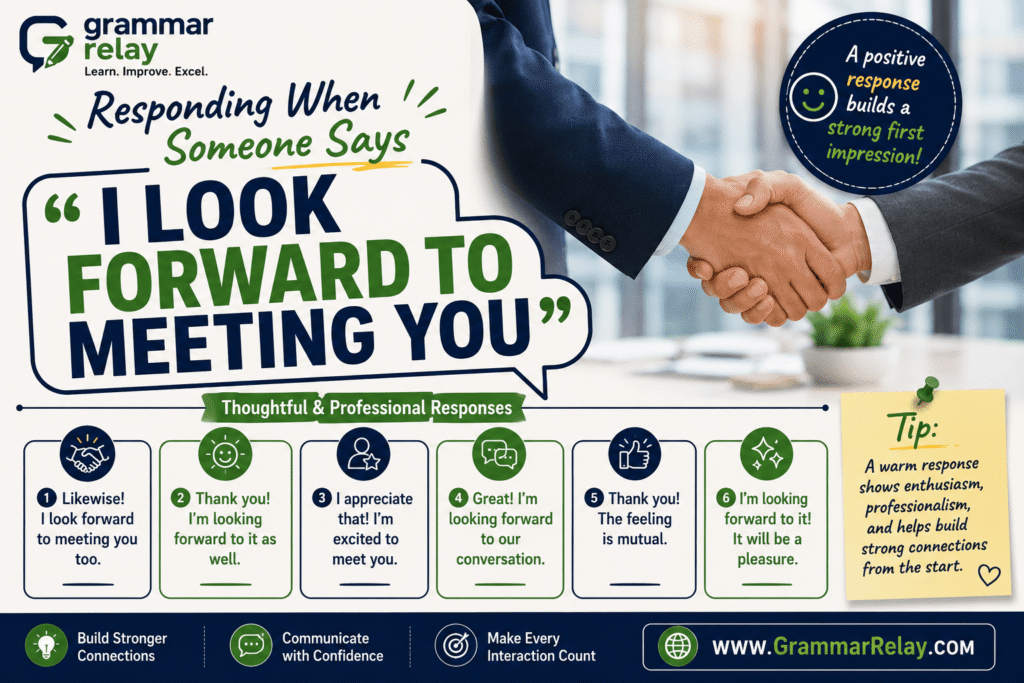
Most guides cover how to use this phrase but nobody covers how to respond to it. Here are clean, natural responses across different registers:
| Their Message | Your Response | Tone Match |
|---|---|---|
| “I look forward to meeting you.” | “Likewise, I’m looking forward to it.” | Matched formal |
| “Can’t wait to meet you!” | “Same here! See you Thursday.” | Matched casual |
| “I anticipate our meeting with great interest.” | “I share your anticipation and look forward to a productive conversation.” | Matched formal |
| “Looking forward to connecting.” | “Looking forward to it as well. See you then.” | Matched semi-formal |
The principle: mirror the formality level of the original message. If someone uses “another way to say I look forward to meeting you” that’s warm and casual, matching their energy builds rapport. If they use formal language, matching that signals respect.
Frequently Asked Questions
Is “I look forward to meeting you” grammatically correct?
Yes. “Look forward to” requires a gerund so “meeting” is correct. “I look forward to meet you” is always grammatically wrong.
What’s more formal: “I look forward to meeting you” or “I’m looking forward to meeting you”?
“I look forward to meeting you” (present simple) reads as slightly more formal. “I’m looking forward to meeting you” (present continuous) sounds warmer and more immediate. Both are standard in professional writing.
What’s a good looking forward to meeting you alternative in a cover letter?
“I welcome the opportunity to discuss my contribution in person” works well because it focuses on value rather than just expressing anticipation.
Can you say “I look forward to meeting you” in a virtual meeting context?
Yes but consider “I look forward to our conversation” or “I’m looking forward to connecting with you” which don’t assume physical presence and feel more natural for video calls.
What’s the difference between “I look forward to meeting you” and “I look forward to seeing you”? “Meeting you” implies a first encounter or formal gathering. “Seeing you” implies an existing relationship or a more casual reunion. Use “meeting” for first contacts and “seeing” for people you already know.
How do you use “looking forward to meeting you soon” effectively?
Adding “soon” only works when a meeting is actually confirmed or imminent. Using it before any meeting is scheduled can feel presumptuous. After confirmation, it adds a warm note of genuine anticipation.
Read more grammar lessons on Grammar Relay
Conclusion
No single phrase outperforms the original in every situation. What matters is authenticity, specificity, and tonal match. “I look forward to meeting you” said genuinely with a specific reference to what you’re actually anticipating outperforms any clever alternative delivered on autopilot.
Use the formal alternatives when the stakes and register demand them. Use the casual versions when warmth and personality serve the relationship better. Personalize every version with a specific detail whenever you can.
And when in doubt, ask yourself one question before hitting send: does this closing line communicate something real about your genuine anticipation, or does it simply fill the space before your name? The answer tells you exactly whether to keep the original or reach for something better.
