

“I agree.” Two words. Perfectly functional. But say them enough times in a meeting, an email chain, or an academic essay and something starts to erode your credibility, your perceived intelligence, and honestly, the other person’s interest in what you’re saying.
Here’s the thing: how you agree matters just as much as whether you agree. A well-chosen phrase signals that you’ve actually processed what was said. It shows emotional intelligence, professional polish, and genuine engagement. A lazy “I agree” signals none of those things.
Whether you need other ways to say I agree in a boardroom, a college essay, a job interview, or a casual conversation this guide covers every situation with real examples you can use immediately.
Why Saying “I Agree” Over and Over Weakens Your Communication
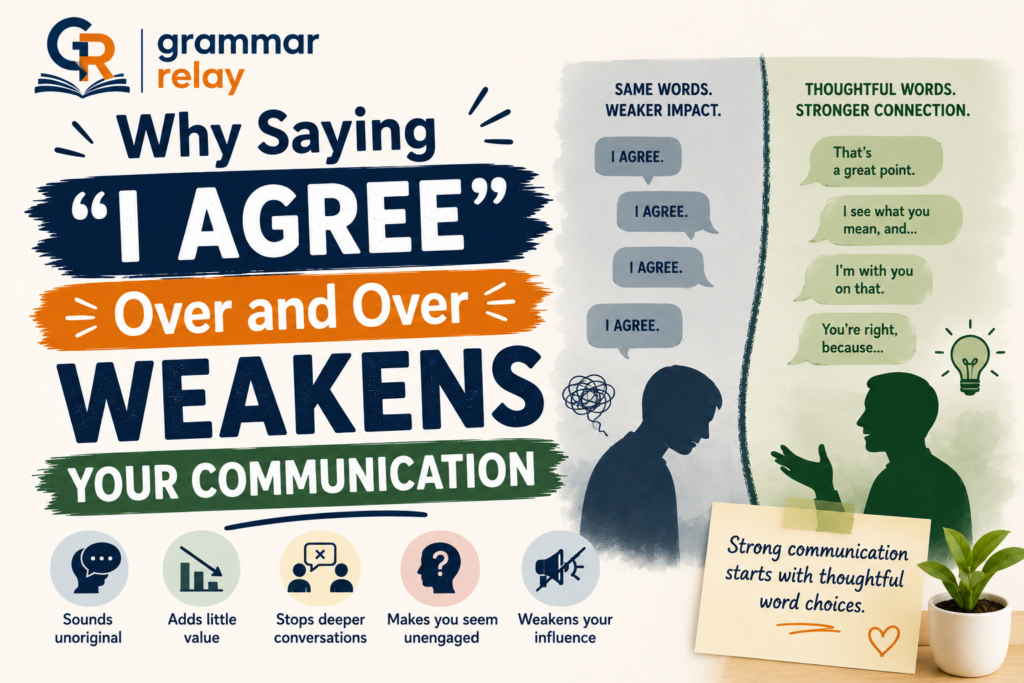
Repetition flattens your voice. When every point of agreement sounds identical, the person you’re talking to stops feeling heard they just feel processed.
There’s also a credibility issue. In professional settings, defaulting to “I agree” repeatedly can make you sound passive. Like someone who validates without thinking. And in academic writing? It’s even worse. Essays that lean on “I agree” signal surface-level engagement with complex ideas.
A 2019 study from the Harvard Business Review found that leaders who vary their affirmative language using specific, contextual agreement phrases are perceived as significantly more engaged and trustworthy than those who use generic responses.
The fix is simple. Learn the right phrase for the right moment.
The Different Types of Agreement: And Why They Need Different Phrases
Not all agreement is equal. Treating it like it is? That’s the core mistake.
Here are the five distinct types worth knowing:
- Full agreement: you’re completely on board with everything said
- Partial agreement: you agree with part of the argument but have additions or reservations
- Reluctant agreement: you agree but not enthusiastically
- Enthusiastic agreement: you wholeheartedly champion the idea
- Formal agreement: used in essays, official meetings, and professional correspondence
Lumping all five into “I agree” is like using the same tool for five completely different jobs. It works barely but it never works well.
Formal & Professional Ways to Say “I Agree”
Knowing how to say I agree professionally is one of the most underrated communication skills in the workplace. These phrases work in emails, meetings, presentations, and any formal correspondence:
| Phrase | Formality Level | Best Used For |
|---|---|---|
| I concur | Formal | Meetings, official emails |
| I’m in full agreement | Formal | Business decisions, proposals |
| That aligns with my perspective | Semi-formal | Team discussions, client calls |
| I share your position on this | Semi-formal | Ongoing professional relationships |
| I endorse that view | Formal | Written reports, formal reviews |
| We’re aligned on this | Casual-professional | Team meetings, quick check-ins |
| I echo that sentiment | Semi-formal | Group discussions, brainstorms |
| I stand behind that position | Formal | Negotiations, presentations |
| That tracks with what I’ve observed | Casual-professional | Data discussions, team reviews |
| I acknowledge the validity of that | Formal | Formal debates, written responses |
Example in action:
“Having reviewed the proposal thoroughly, I concur with the recommended approach. This aligns with both our budget constraints and long-term strategic goals.”
That response does something “I agree” never could it signals that you’ve actually thought about it.
When someone asks other ways to say I agree with you formally, these are the phrases that deliver real professional weight without sounding stiff or robotic.
Read more about 40+ Other Ways to Say “Get Well Soon”
Casual Ways to Say “I Agree” (For Everyday Conversations)
Not every agreement needs a formal stamp. For texts, casual chats, and low-stakes conversations, keep it natural:
- “Absolutely” versatile and warm
- “Totally” relaxed and genuine
- “You’re not wrong” understated but effective
- “Same here” simple and relatable
- “No argument here” easy and breezy
- “Fair point” acknowledges their thinking
- “You took the words right out of my mouth” enthusiastic and personal
- “You’re preaching to the choir” great for shared frustrations
- “100%” modern, punchy, universally understood
- “Couldn’t have said it better myself” warm and affirming
The key with casual phrases? Don’t drag them into formal settings. Responding to a client’s budget concern with “100%” works in a startup with a casual culture. In a law firm? Not so much. Read the room every single time.
Academic & Essay Ways to Say “I Agree”
This section matters enormously and most people get it completely wrong.
In academic writing, “I agree” is almost always the wrong choice. It’s vague. It doesn’t add analytical value. And most professors will flag it as weak argumentation.
How to say I agree in an essay effectively means doing two things simultaneously: signaling agreement and advancing the argument. Here’s how:
- “This argument holds considerable merit, particularly when considering…”
- “The evidence strongly supports this claim, as demonstrated by…”
- “Scholars have rightly noted that…”
- “This position finds broad corroboration in the existing literature.”
- “One cannot reasonably dispute that…”
- “The data corroborates this assertion, especially in light of…”
- “This reasoning is both sound and well-substantiated.”
- “This view aligns with the broader academic consensus on…”
“The most dangerous phrase in the language is ‘we’ve always done it this way.” Grace Hopper
Apply that to writing. The most limiting phrase in academic essays is “I agree.” Push further.
How to say you agree with a statement in an essay without those two words? Cite the evidence that shows your agreement rather than simply declaring it. That’s the difference between a B paper and an A paper.
And another word for I agree in an essay? Try “corroborate,” “substantiate,” “affirm,” or “validate” each one signals intellectual engagement rather than passive acceptance.
Ways to Express Partial or Nuanced Agreement
Here’s a counterintuitive truth: partial agreement is often more persuasive than full agreement. It shows you’ve thought critically rather than just nodding along.
These phrases nail that balance perfectly:
- “I agree up to a point though I’d push back slightly on…”
- “You make a fair point, and I’d build on that by adding…”
- “That’s largely true, however the full picture also includes…”
- “I’m mostly with you on this, except when it comes to…”
- “There’s real truth in that with one important caveat.”
- “I can get behind most of that argument.”
- “That’s a reasonable take, though context changes things here.”
When you tell someone I agree with you but then add a thoughtful qualification, you instantly become the most interesting person in the conversation.
Ways to Say “I Agree” in Specific Professional Situations
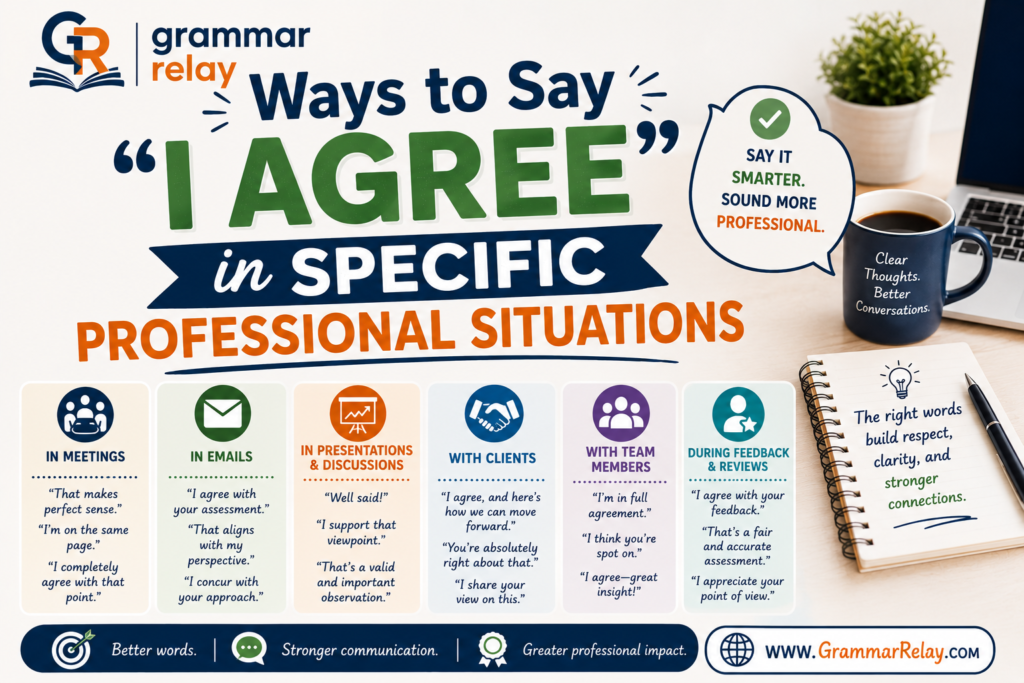
In a Job Interview
Agreeing with an interviewer is a delicate art. Too much agreement sounds sycophantic. Too little sounds combative. The sweet spot:
- “That resonates strongly with my experience at [company].”
- “I’ve seen exactly that dynamic play out and I handled it by…”
- “That aligns with my own philosophy around team leadership.”
In a Team Meeting or Brainstorm
The goal here isn’t just agreement, it’s momentum. Build on the idea while crediting its source:
- “I’m fully on board and I’d add that we could also…”
- “That’s a strong foundation. What if we also considered…”
- “Agreed completely. Let’s take that one step further.”
In a Negotiation or Difficult Conversation
Strategic agreement is one of the most powerful negotiation tools available. Find common ground first then make your case:
- “We’re clearly aligned on the core issue here, which makes this easier.”
- “I agree with the underlying goal, it’s really just the approach we need to work through.”
In Customer Service or Client-Facing Roles
Validating a client’s concern before solving it builds instant trust:
- “You’re absolutely right and here’s exactly how we’re going to address that.”
- “That’s a completely fair observation. Let me walk you through what happened.”
The phrase agree with you in client contexts should always be followed immediately by a concrete next step. Validation without action is just words.
Phrases That Sound Like Agreement But Aren’t
Watch out for these. They’re commonly mistaken for agreement but they’re not:
| Phrase | What It Actually Signals |
|---|---|
| “That’s interesting” | Polite deflection, not agreement |
| “I hear you” | Acknowledgment only, not agreement |
| “That’s one way to look at it” | Mild disagreement dressed up politely |
| “Fair enough” | Reluctant acceptance, not enthusiasm |
| “Sure” | Ambiguous, could mean anything depending on tone |
Knowing the difference matters enormously in negotiations, client meetings, and performance reviews. Misreading “that’s interesting” as agreement has derailed more than a few business deals.
Words to Avoid When Expressing Agreement
Some phrases actively undercut your credibility, even when your agreement is genuine:
- “Obviously” implies the other person should have known already; condescending
- “Right, right, right” signals you’re not really listening
- “Exactly, exactly” hollow filler that loses meaning fast
- “Sure, whatever” sounds dismissive even if you mean it sincerely
- “I mean, yeah” too casual for almost any professional setting
The pattern here? Filler agreement is worse than silence. If you can’t think of a better phrase in the moment, a simple nod or a genuine pause works better than a meaningless verbal tic.
You might be interested in 40+ Other Ways to Say “Take Care”
International & Cultural Nuances of Expressing Agreement
Different cultures express agreement very differently and misreading those signals can create real friction:
| Language | Phrase | Literal Meaning |
|---|---|---|
| Spanish | Estoy de acuerdo | I am in agreement |
| French | Je suis d’accord | I am of the same opinion |
| German | Ich stimme zu | I agree / I consent |
| Japanese | Sō desu ne | That’s right / I see |
| Arabic | Muwāfiq | I agree / Agreed |
| Italian | Sono d’accordo | I am in agreement |
| Mandarin | 我同意 (Wǒ tóngyì) | I agree |
One fascinating cultural note: in Japanese business culture, the concept of nemawashi involves building consensus through informal one-on-one conversations before a formal meeting. By the time the meeting starts, everyone already agrees the meeting simply makes it official. Agreement, in that context, is a process rather than a moment.
Western professionals working with Japanese counterparts often misread silence or “sō desu ne” as strong agreement when it may simply signal that someone is listening. Context is everything.
Other Ways to Say “I Agree” by Context
| Context | Best Phrase |
|---|---|
| Formal business email | “I’m in full agreement” / “I concur” |
| Team meeting | “I’m on board and I’d add…” |
| Casual conversation | “Absolutely” / “You’re not wrong” |
| Academic essay | “This position is well-substantiated” |
| Job interview | “That resonates with my experience” |
| Negotiation | “We’re aligned on the core issue” |
| Client-facing role | “You’re absolutely right here’s our next step” |
| Text message | “100%” / “Totally” / “Same here” |
How to Make Any Agreement Phrase Land Better
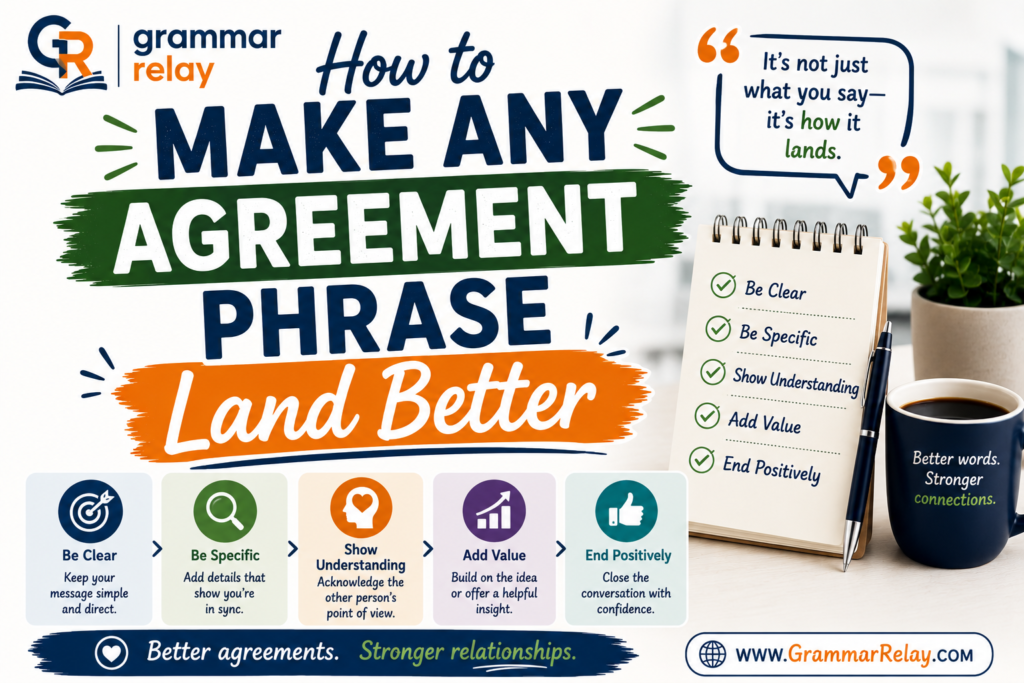
The phrase matters but delivery matters more. Here’s how to make any agreement hit harder:
- Add your reasoning: don’t just agree, explain why you agree
- Reference something specific: tie your agreement to a concrete detail or example
- Build on the idea: agreement plus a new angle is far more valuable than agreement alone
- Match the register: formal settings get formal phrases; casual settings get casual ones
- Mean it: hollow agreement damages trust faster than honest disagreement ever could
“The art of communication is the language of leadership.” James Humes
The ways to say I agree that land best are always the ones rooted in genuine engagement. Everything else is just noise.
Frequently Asked Questions
Why should I vary my agreement phrases?
Repetition flattens your credibility. Saying “I agree” every time signals passive listening rather than active engagement. Varied phrases show you’ve actually processed what was said and that distinction matters enormously in professional and academic settings.
What’s the most professional way to say “I agree”?
“I concur” and “I’m in full agreement” carry the most formal weight. For semi-formal settings, “That aligns with my perspective” or “We’re aligned on this” strike the perfect balance between polish and warmth.
How do I agree without sounding like a pushover?
Add your reasoning immediately after agreeing. “I concur and I’d build on that by suggesting…” signals independent thinking while still validating the other person’s point. Agreement plus contribution is always stronger than agreement alone.
Can I use casual agreement phrases in professional emails?
Generally, no. “Totally” and “100%” work in startup cultures or casual Slack messages but fall flat in formal correspondence. When in doubt, lean toward “I’m in full agreement” or “That aligns with my understanding.”
What’s the best way to express partial agreement?
“I agree up to a point though I’d add…” or “That’s largely true, however…” are your strongest options. Partial agreement actually makes you more persuasive than full agreement because it signals critical thinking rather than blind validation.
How do I agree with someone in an essay without weakening my argument?
Never just declare agreement show it through evidence. Phrases like “The data corroborates this assertion” or “This position finds strong support in the literature” signal agreement while simultaneously advancing your analytical argument. That’s the difference between a strong essay and a weak one.
Read more grammar lessons on Grammar Relay
Conclusion
Knowing other ways to say I agree isn’t about sounding smarter. It’s about communicating more honestly and more effectively. The right phrase at the right moment signals that you’ve actually listened that you’ve processed what was said and genuinely engaged with it.
That’s rare. And people notice.
Pick one phrase from this guide and use it in your next email, meeting, or conversation. Notice how differently people respond when your agreement actually sounds like you mean it.
