


Grab a board game off the shelf, and someone at the table will probably say “roll the dice,” even if there’s only one cube in their hand. Is that wrong? Not exactly. The story behind die vs dice turns out to be one of the more interesting little grammar quirks in English, and once you understand it, you’ll never feel unsure about which word to reach for again.
Here’s the short version: “die” is technically the singular form, one small cube with numbered sides. “Dice” is technically the plural, referring to two or more. But English being English, actual usage has drifted quite a bit from that “technically” part, and that drift is exactly what makes this topic worth digging into.
What Does “Die” Mean?

Die, in the gaming sense, refers to a single cube marked with numbers or symbols, used to introduce randomness into a game. Roll it, and whatever face lands up determines your result. Simple enough on the surface.
Grammatically, this word behaves unusually. Most English nouns pluralize by adding an S or ES: one cat, two cats. But “die” doesn’t follow that pattern at all. Instead, it shifts into “dice,” an irregular plural that doesn’t look anything like its singular form once you compare them side by side. This isn’t some modern inconsistency either. English has a small collection of these irregular plurals, “goose” becoming “geese,” “child” becoming “children,” “mouse” becoming “mice,” and “die” becoming “dice” sits right alongside them.
Example sentences using “die” correctly:
- “Roll the die and see what number turns up.”
- “He kept a single die in his pocket for good luck.”
- “The Yahtzee set includes five identical dice, but if you lose four, you’re down to just one die.”
What Does “Dice” Mean?
Dice, traditionally speaking, is the plural of “die.” If you’ve got more than one cube on the table, that’s dice. But here’s where it gets genuinely interesting: in everyday, casual English, plenty of people use “dice” to describe a single cube too, and this usage has become common enough that major dictionaries now recognize it.
Merriam-Webster, for example, lists “dice” as an accepted singular noun in addition to its traditional plural role. That’s a real shift worth noting, not a mistake sneaking past editors. Language changes when enough people consistently use a word a certain way, and “dice” as singular has reached that tipping point in casual speech, even if formal writing and board game rulebooks still lean toward “die” for singular use.
Example sentences using “dice”:
- “Grab the dice from the box before we start.” (traditional plural)
- “I only need one dice for this turn.” (increasingly common singular usage)
- “The dice are loaded.” (plural, referring to multiple cubes rigged for cheating)
Where This Word Pair Actually Comes From
The history here traces back further than most people expect. “Die” descends from Old French “de,” which itself came from Latin “datum,” meaning “something given” or, more specifically in a gambling context, “that which is given by lot.” The idea of chance being handed to you, quite literally, sits baked into the word’s origin.
The irregular plural formed the way many old English plurals did, through gradual sound shifts over centuries rather than any deliberate grammar rule. By the time Modern English settled into its current form, “die” and “dice” had already split into their current singular-plural pairing, and that pairing stuck around largely unchanged since.
If you’re wondering about dice artinya or looking up arti dice (Indonesian phrases both essentially asking “what does dice mean”), the answer lines up with everything covered here: it’s the plural (and increasingly accepted singular) form of the small numbered cube used in games of chance.
Read more about Ageing vs. Aging: Which Spelling Is Actually Correct?
Is “Dice” Ever Correctly Singular?
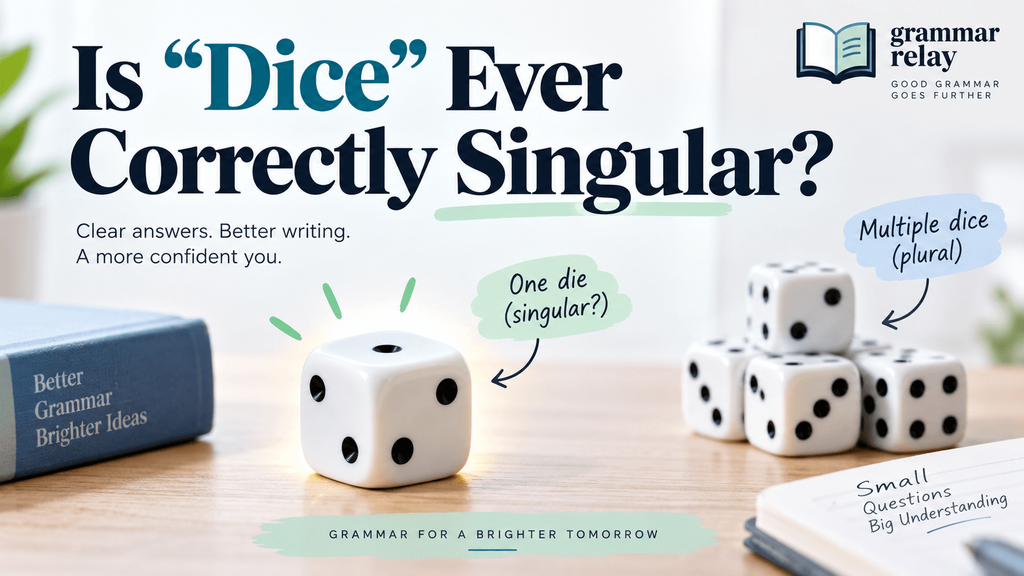
This is genuinely the most debated part of the whole die dice conversation, so it deserves a direct answer rather than a shrug.
Traditional grammar rules say no, “die” should always be singular, and “dice” should always be plural. Board game manuals, formal writing guides, and stricter editors still hold this line firmly. If you’re writing instructions for a tabletop game or submitting formal academic work, “die” for one cube is the safer, more precise choice.
That said, real-world spoken English tells a different story. Ask ten people to hand you “a dice,” and virtually none of them will blink or correct you. This casual singular use has become so widespread that dictionaries had to catch up to reality rather than the other way around. So while “die” remains the technically correct singular form, “dice” as singular isn’t an error anymore either. It’s simply the more relaxed, conversational choice.
Side-by-Side Comparison: “Die vs. Dice”
| Feature | Die | Dice |
|---|---|---|
| Traditional grammar role | Singular (one cube) | Plural (two or more cubes) |
| Modern casual usage | Sounds formal, less common in speech | Widely used for both singular and plural |
| Dictionary status | Standard singular | Accepted as both plural and casual singular |
| Best used in | Formal writing, game rulebooks | Everyday conversation, casual writing |
| Example | “He rolled a single die.” | “They rolled the dice together.” |
How to Use Die vs. Dice in Real Sentences
Context shapes which word feels natural. In formal or instructional writing, like board game rulebooks or technical documentation, “die” for singular still dominates: “Each player rolls one die per turn.” Casual conversation, on the other hand, leans almost entirely on “dice” regardless of quantity: “Just roll the dice already.”
Neither context is “wrong.” They’re simply different registers of the same language, formal versus conversational, and both have their place depending on who’s reading or listening.
The Other Meaning of “Die” You Should Know
Here’s a quick but important callout: “die” also functions as a completely unrelated verb meaning to stop living. “The old oak tree began to die after the drought” has nothing to do with games or cubes whatsoever. Context almost always makes the intended meaning obvious within a sentence, but it’s worth naming directly since the word carries two entirely separate identities depending on how it’s used.
You might be interested in Inpatient vs. Impatient: What’s the Real Difference
Common Mistakes Writers Make: “Die vs. Dice”
A handful of errors show up repeatedly with this word pair, and they’re worth flagging clearly:
- Writing “dices” as a plural. Since “dice” is already plural, adding an S creates a nonstandard word that doesn’t exist in proper English.
- Assuming “die” is always wrong for casual singular use. It’s not wrong at all, just increasingly rare in everyday conversation compared to “dice.”
- Confusing the gaming noun with the verb. “The die is cast” (a famous idiom, more on that below) has nothing to do with anyone dying, yet the overlap in spelling occasionally trips up quick readers.
Die vs. Dice: A Simple Way to Remember the Difference
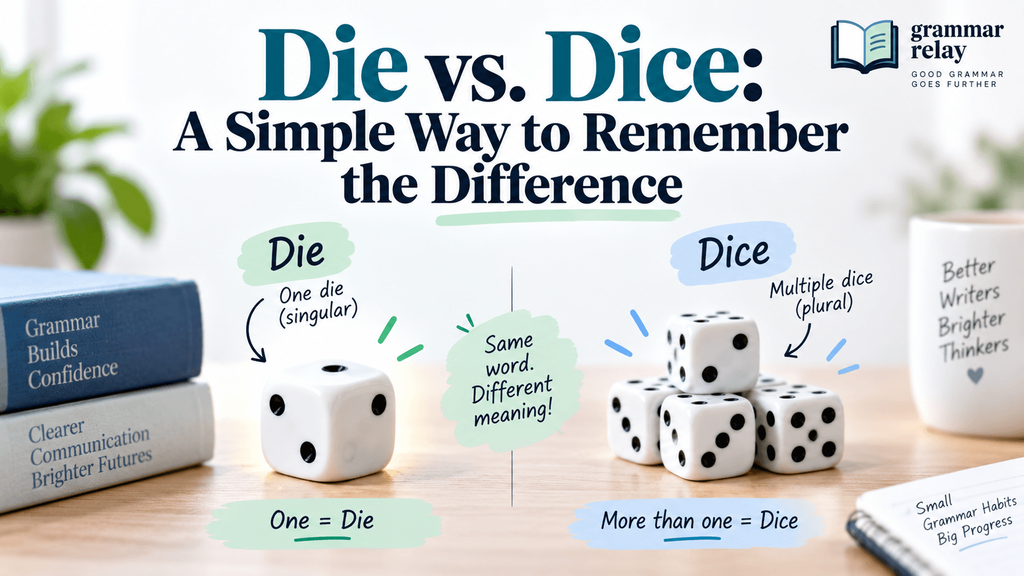
Here’s the cleanest rule to keep in your back pocket: if you’re following a rulebook or writing formally, use “die” for one and “dice” for more than one. If you’re just talking casually with friends over game night, “dice” works fine either way, and nobody’s going to stop the game to correct your grammar.
Frequently Asked Questions
Is it “a die” or “a dice”?
Traditionally, “a die” is correct for one cube. Casually, “a dice” has become widely accepted too, especially in spoken English.
Is “dice” ever singular?
Yes. While “die” remains the traditional singular form, “dice” is now recognized by major dictionaries as an acceptable singular noun as well.
What’s the plural of “die”?
“Dice” is the plural, an irregular form that doesn’t follow the standard rule of simply adding an S.
Why doesn’t “die” just add an S to become plural?
Because it’s one of English’s older irregular plurals, similar to “goose” becoming “geese.” These patterns formed through historical sound changes rather than modern grammar rules.
Is “die” only used for games?
No. “Die” also works as a common verb meaning to stop living, completely separate from its meaning as a gaming cube.
Read more grammar lessons on Grammar Relay
Conclusion
So, where does that leave you with die vs. dice? The traditional rule still holds up: die for one, dice for more than one. But modern casual English has softened that line considerably, and using “dice” for a single cube isn’t the grammar crime it once was. Save “die” for formal writing or game instructions, lean on “dice” for everyday conversation, and you’ll always land on the right side of correct, whichever way the cube happens to fall.
