


Here’s a spelling mistake that slides past spell-checkers, confuses confident writers, and gets reinforced every time someone opens a design tool on their laptop. Invision or envision one of them is a real English verb, one is a misspelling, and one is a software company. Knowing which is which takes about three minutes to learn and saves you from a credibility-damaging error that appears in professional documents far more often than it should.
This guide covers everything: the correct word, the etymology behind it, why the misspelling feels so natural, and how the brand name InVision factors into the confusion.
The Direct Answer (No Ambiguity)
Envision is the correct English verb. Invision is not a word in any major English dictionary. InVision is a proper noun referring to a design collaboration platform founded in 2011. Three forms. Three completely different statuses.
| Form | Type | Correct? | When to Use |
|---|---|---|---|
| Envision | Standard English verb | Yes | Any time you mean “to imagine or picture mentally” |
| Invision | Common misspelling | No | Never as a verb or common noun |
| InVision | Brand/proper noun | Yes (as brand name only) | Only when referring to the design software company |
That table settles the invision vs envision question permanently. However, understanding WHY envision is correct and invision isn’t makes the right choice completely automatic going forward.
What “Envision” Actually Means: Full Definition and Every Usage
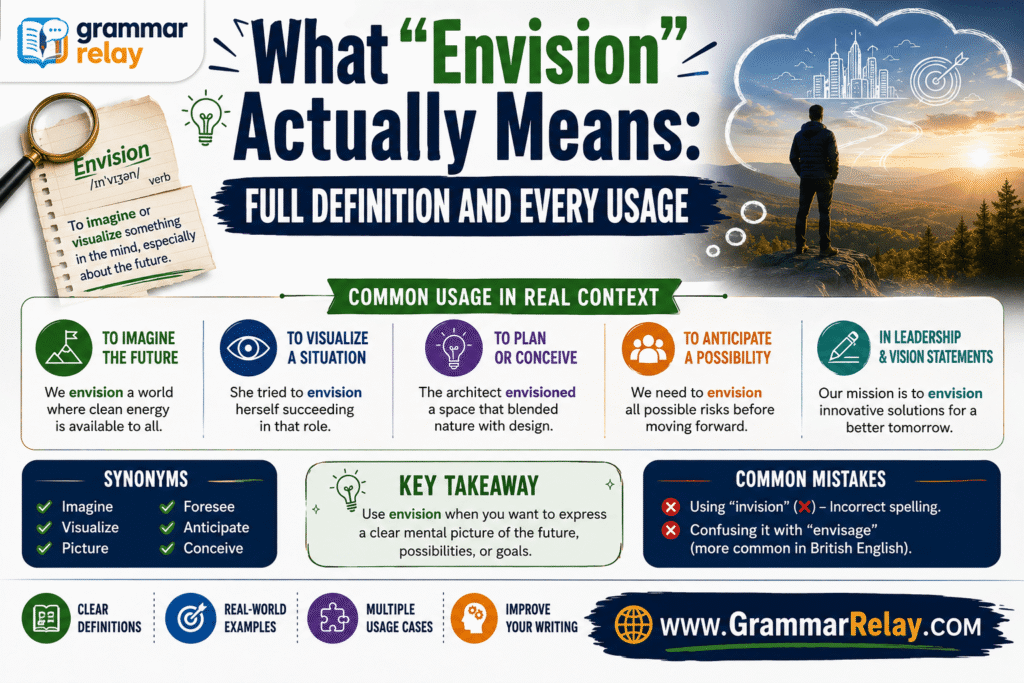
Envision meaning in its simplest form: to picture something in your mind, particularly a future possibility or desired outcome. It implies purposeful mental construction rather than passive daydreaming. When a leader says they envision a different future, they’re not just hoping vaguely. They’re actively constructing a specific mental image of what that future looks like.
The envision definition extends across multiple professional and creative contexts:
| Context | Example Sentence | Register |
|---|---|---|
| Leadership/business | “She envisioned a company that put employees first.” | Professional/formal |
| Creative work | “The director envisioned a scene bathed in amber light.” | Creative/artistic |
| Personal planning | “He envisioned himself crossing the finish line.” | Personal/motivational |
| Academic writing | “The researchers envisioned a world where antibiotics were obsolete.” | Formal/academic |
| Everyday conversation | “I can’t envision doing this any other way.” | Casual/informal |
| Strategic planning | “The team envisioned three possible outcomes.” | Professional |
Notice how envision carries a forward-looking, purposeful quality in every context. That’s not accidental. It’s baked into the word’s etymological DNA.
Etymology: Why “Envision” Starts With “En-” Not “In-“
The invision word confusion often starts here. People assume the prefix should be “in-” because “in-” appears at the start of so many English words. But the prefix in “envision” isn’t “in-” at all. It’s “en-“ and that single letter difference changes everything.
“En-” means “to cause to be” or “to put into a state.” The root is Latin “visio” meaning sight or mental image. So en-vision literally means “to put oneself into a state of vision.” It’s an active, causative construction.
| Word | Prefix | Root | Combined Meaning |
|---|---|---|---|
| Envision | en- (to cause to be) | vision (sight/mental image) | To cause oneself to see mentally |
| Enable | en- | able | To make able |
| Enlighten | en- | light | To bring light to/illuminate |
| Encourage | en- | courage | To put courage into |
| Inactive | in- (not) | active | Not active |
| Invalid | in- (not) | valid | Not valid |
See the pattern? “En-“ adds capability or creates a state. “In-“ typically means “not” when used as a prefix. “Invision” would logically mean “not vision” which is essentially the opposite of what the word is supposed to convey. The prefix “en-” is doing specific grammatical work that “in-” simply cannot replicate.
Read more about Spoilt vs Spoiled: The Complete Grammar Guide
Why “Invision” Feels Right to So Many Writers
Understanding the psychology behind the invision or envision confusion matters as much as knowing the correct answer. Several converging forces push writers toward the misspelling:
Phonetic confusion is the biggest factor. In natural conversational speech, “envision” and “invision” sound nearly identical. The “en-” and “in-” sounds blur together at normal speaking pace and the brain registers them as the same syllable.
Beyond phonetics, the “in-” prefix trap creates false pattern recognition. English contains hundreds of common words starting with “in-“:
| Word Writers See Frequently | Actual Prefix | How It Misleads |
|---|---|---|
| Invisible | in- (not) | “In” + vision = invision (false logic) |
| Invoice | in- (into) | “In” prefix feels natural |
| Invite | in- (into) | “In” prefix reinforced |
| Involve | in- (into) | “In” prefix reinforced |
| Inspect | in- (into) | “In” prefix reinforced |
| Envision (correct) | en- (to cause) | The odd one out that trips writers |
Additionally, widespread exposure to the InVision design brand creates visual familiarity with the “invision” letter sequence. Designers who use InVision daily see that arrangement of letters constantly. Their brains start treating it as a familiar, correct-looking word even when they’re reaching for the common verb.
Autocorrect makes things worse. Because “invision” isn’t obviously a different real word with its own distinct meaning (unlike “there/their/they’re”), many spell-checkers simply miss it or accept it without flagging.
InVision the Brand: Why Capitalization Matters
InVision (with the capital V) is a digital product design platform co-founded by Clark Valberg and Ben Nadler in 2011. It became one of the most widely used prototyping and design collaboration tools in the industry, particularly popular among UX designers and product teams before Figma rose to dominance.
The capital V in InVision is a stylistic brand choice, not a grammatical convention. Using “invision” (all lowercase) when you mean the brand is incorrect. Using “InVision” when you mean the English verb is equally wrong.
| Situation | Correct Form | Incorrect Form | Example |
|---|---|---|---|
| Referring to the design platform | InVision | invision / Invision | “Our team uses InVision for prototyping.” |
| Using the verb to imagine | envision | InVision / invision | “She envisioned a new workflow.” |
| Start of sentence (brand) | InVision | Invision | “InVision launched a new feature.” |
| Plural reference (brand) | InVision (unchanged) | Invisions | “Both InVision and Figma are popular tools.” |
The practical rule: if you’re discussing design software, write InVision with the capital V. If you’re describing a mental image or future vision, write envision in all lowercase.
“Envision” vs “Envisage”: A Distinction Most Guides Miss
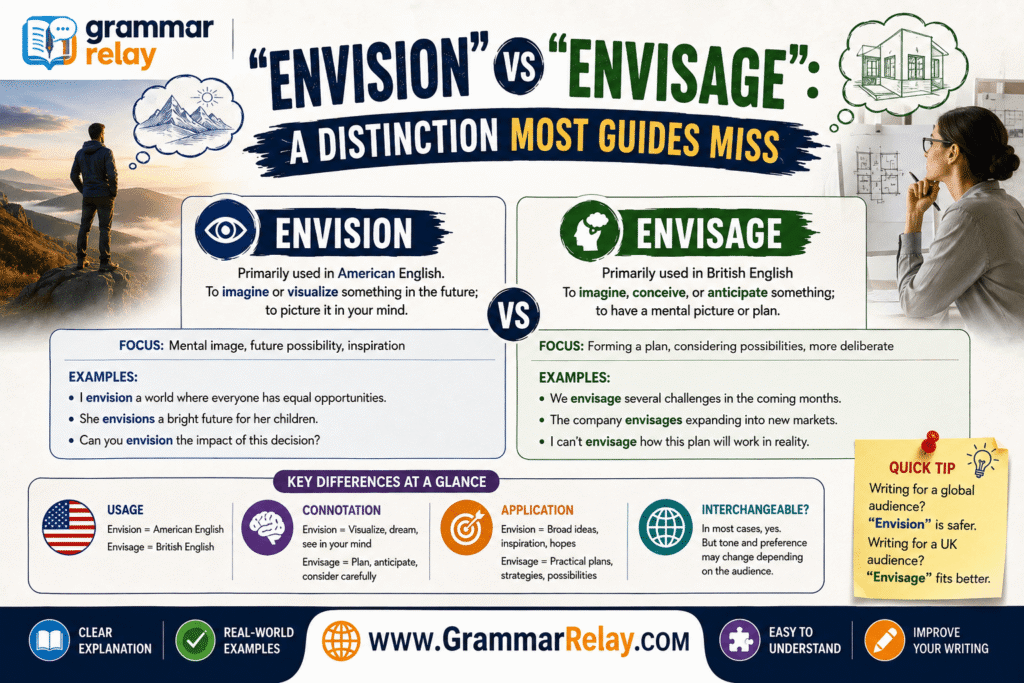
Here’s where envision vs invision articles typically stop but shouldn’t. Writers who correctly know to use “envision” often face a second question: should they use “envision” or “envisage”?
These words are close but not identical:
| Feature | Envision | Envisage |
|---|---|---|
| Origin | American English primarily | British English primarily |
| Tone | Aspirational, forward-looking, positive | Neutral, analytical, practical |
| Typical context | Leadership, vision statements, creative work | Planning, projections, scenarios |
| Formality | Professional to casual | Formal to semi-formal |
| American usage | Very common | Less common |
| British usage | Common | More common than in American English |
| Example | “She envisioned a breakthrough moment.” | “The committee envisaged several outcomes.” |
In American English, envision is almost always the right choice. In British English, envisage appears more frequently in formal and analytical writing. Neither is wrong in its home territory but mixing them inconsistently within a single document can signal unfamiliarity with regional style conventions.
“Envision” vs “Imagine”: When Each Word Works Better
Envisioning something and imagining something overlap significantly but the words aren’t perfectly interchangeable. The distinction is subtle yet professionally meaningful.
| Situation | Better Choice | Why |
|---|---|---|
| Leadership speech about future goals | Envision | Conveys deliberate, purposeful vision |
| Creative brainstorming | Imagine | More open-ended and exploratory |
| Strategic business planning | Envision | More precise and professional |
| Describing a dream or fantasy | Imagine | More natural and casual |
| Motivational writing | Envision | Stronger aspirational connotation |
| Children’s storytelling | Imagine | Warmer and more accessible |
“Envision” implies you’re deliberately constructing a specific mental picture, usually of something achievable and intentional. “Imagine” is broader and more open. You can imagine impossible things. When you envision something, there’s an implicit sense that you’re working toward it.
“Vision without action is a daydream. Action without vision is a nightmare.” — Japanese proverb
The word “envision” carries precisely that sense of actionable mental construction that pure imagination doesn’t always imply.
You might be interested in Thank You for Reaching Out
Full Grammar Guide: Every Form of “Envision”
Envisioning correctly means understanding how the word conjugates and what grammatical structures it works with:
| Grammatical Form | Example | Notes |
|---|---|---|
| Base form | “I envision a different approach.” | Standard present tense |
| Third person singular | “She envisions a brighter future.” | Adds -s |
| Past tense | “He envisioned the final product clearly.” | Regular -ed past |
| Present participle | “Envisioning the outcome helped calm her nerves.” | -ing form |
| Past participle | “The future envisioned by the founders arrived.” | Used in passive/perfect |
| Passive construction | “A collaborative workspace was envisioned from the start.” | With auxiliary verb |
| Perfect tense | “They have envisioned this moment for years.” | With “have/has” |
One specific grammatical point worth noting: “envision” takes a gerund (the -ing form) as its object, not an infinitive. “He envisioned building something different” is correct. “He envisioned to build something different” is wrong. This is a common error even among writers who spell the word correctly.
Synonyms for “Envision” (When You Need an Alternative)
| Synonym | Formality | Best Used When | Example |
|---|---|---|---|
| Visualize | Medium | Sports psychology, creative work | “Visualize your success before it happens.” |
| Imagine | Low-medium | General creative thinking | “Imagine a world without borders.” |
| Envisage | Medium-high | British formal writing | “The plan envisages three phases.” |
| Picture | Low | Casual and conversational | “Picture yourself on that stage.” |
| Conceive | High | Academic and formal writing | “They conceived of an entirely new model.” |
| Foresee | Medium | Prediction contexts | “She foresaw the market shift.” |
| Contemplate | Medium-high | Thoughtful consideration | “He contemplated the possibilities.” |
| Project | Medium-high | Business and data contexts | “The team projected a 30% growth scenario.” |
“Envision” Across Professional and Creative Contexts
The envision definition plays out differently depending on the field:
| Professional Field | Typical Use | Example |
|---|---|---|
| Corporate strategy | Vision and mission statements | “We envision a future where sustainability drives every decision.” |
| Design | Creative briefs | “The creative director envisioned a minimalist aesthetic throughout.” |
| Academic research | Theoretical frameworks | “This paper envisions a new approach to data ethics.” |
| Journalism | Feature writing | “The architect envisioned the building as a living ecosystem.” |
| Motivational writing | Personal development | “Envision the life you want and work backward from there.” |
| Political discourse | Policy advocacy | “The coalition envisions a carbon-neutral economy by 2050.” |
In corporate strategy specifically, “envision” has become something of a power word. Mission statements and vision documents use it constantly because it implies deliberate, forward-directed thinking rather than vague aspiration. That connotation gives the word real professional weight.
Common Mistakes Writers Make With Envision and Invision
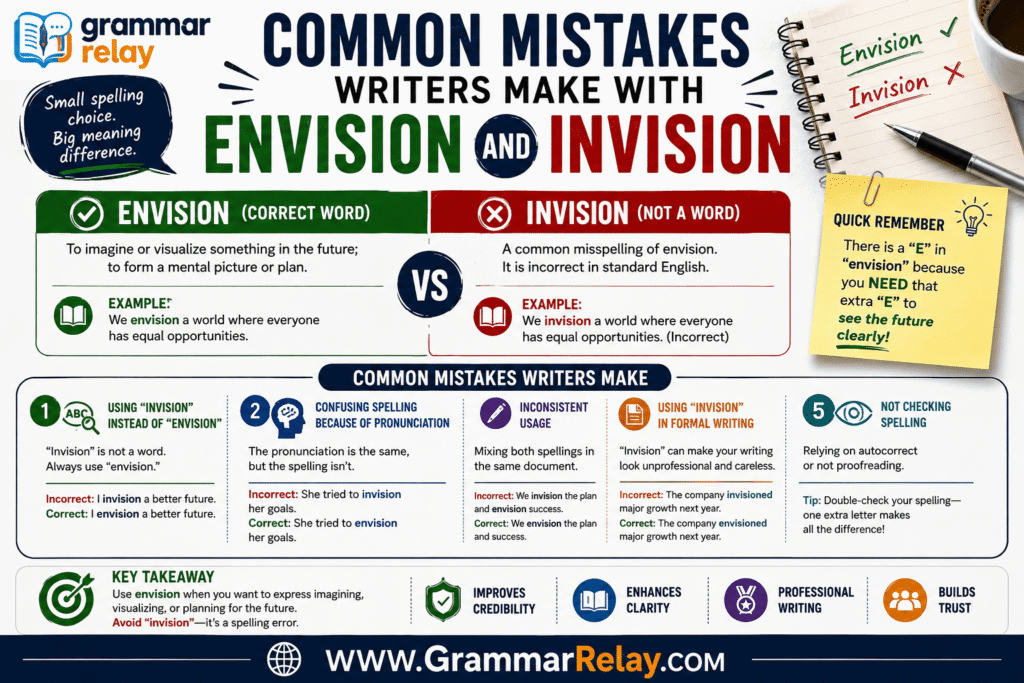
| Incorrect | Correct | Why |
|---|---|---|
| “She invisions a new future.” | “She envisions a new future.” | “Invision” is not a verb |
| “I use InVision to picture ideas.” | “I use InVision to prototype; I envision ideas.” | Brand name ≠ verb |
| “Our team uses invision for design.” | “Our team uses InVision for design.” | Brand requires capitalization |
| “He envisioned to build something different.” | “He envisioned building something different.” | Gerund follows envision, not infinitive |
| “I envisage a totally new product.” (American formal) | “I envision a totally new product.” | American English prefers “envision” |
The most common error by a significant margin: using “invision” as the verb. It appears in LinkedIn posts, business proposals, cover letters, and blog articles with surprising frequency. Because “invision” isn’t a different real word with its own meaning, readers may not consciously notice the error but editors and careful readers absolutely do.
Memory Tricks That Make “Envision” Permanent
Three anchors that make the correct choice automatic:
The “en-” family connection: Enable, enlighten, encourage, envision. All of these words use “en-” to add capability or create a state. Once you see envision as part of this family, the “en-” prefix feels completely natural.
The “in-” = not test: Ask yourself whether “not vision” makes any sense in your sentence. “She not-visioned a better future” obviously doesn’t work. Therefore “invision” can’t be right. The test takes two seconds and works every time.
The brand separation rule: If you’re talking about software with prototype screens and design teams, it’s InVision (capital V). If you’re talking about a thought, a dream, or a future plan, it’s envision (lowercase, starts with E). Two completely different words for two completely different things.
Frequently Asked Questions
Is “invision” ever correct in standard English?
No. “Invision” as a common verb or noun doesn’t exist in Merriam-Webster, Oxford, Cambridge, or any other major English dictionary. It’s a misspelling of “envision” in every standard English context.
What is InVision and why does it cause confusion?
InVision is a digital product design and prototyping platform co-founded in 2011. Its name uses the letter sequence “invision” which creates visual familiarity with that spelling among designers and product teams, contributing to the misspelling of the verb “envision.”
What’s the difference between “envision” and “envisage”?
Both mean to picture something mentally but “envision” is the dominant American English form with aspirational connotations while “envisage” is more common in British English with a slightly more neutral, analytical register. In American professional writing, “envision” is almost always the better choice.
How do you use “envision” correctly in a sentence?
Follow envision with a gerund (the -ing form of a verb) or a noun phrase. “She envisioned building a new team” and “he envisioned a different outcome” are both correct. “She envisioned to build a new team” is grammatically wrong.
Why doesn’t autocorrect catch “invision”?
Because “invision” doesn’t match any other real English word, spell-checkers sometimes accept it as a potential proper noun or unrecognized term rather than flagging it as a clear error. Always proofread manually for this specific mistake in professional documents.
Read more grammar lessons on Grammar Relay
Conclusion
The envision or invision question has exactly one answer for the English verb: envision, always, with an “e.”
“Invision” as a common word doesn’t exist anywhere in the English language. The “en-” prefix does specific grammatical work that “in-” can’t replicate. The brand InVision is a legitimate proper noun requiring correct capitalization but it has no bearing on how you spell the verb when you’re describing a mental image or future vision.
The envision meaning is clear, the etymology is logical, the grammar is consistent, and the memory tricks are permanent once you learn them. Next time your fingers reach for “invision” instinctively, remember: she enables, she enlightens, she encourages, she envisions. The family always uses “en-.”
