

“With that being said.” It rolls off the tongue easily. Too easily, actually. Open any student essay, scroll through any business email thread, or sit through any corporate presentation and you’ll hear it sometimes two or three times in a single paragraph.
Here’s the problem. Overused transitional phrases become invisible. The reader’s brain processes them as noise rather than signal. Worse, “with that being said” carries a subtle grammatical awkwardness the “being said” construction is technically redundant. Something either was said or wasn’t. The passive participle adds weight without adding meaning.
But finding the right synonym for with that being said isn’t as simple as swapping in “however” every time. Different situations demand different phrases. Get it wrong and you change the meaning entirely. Get it right and your writing suddenly flows with purpose and precision.
Why “With That Being Said” Feels Clunky: And When to Drop It
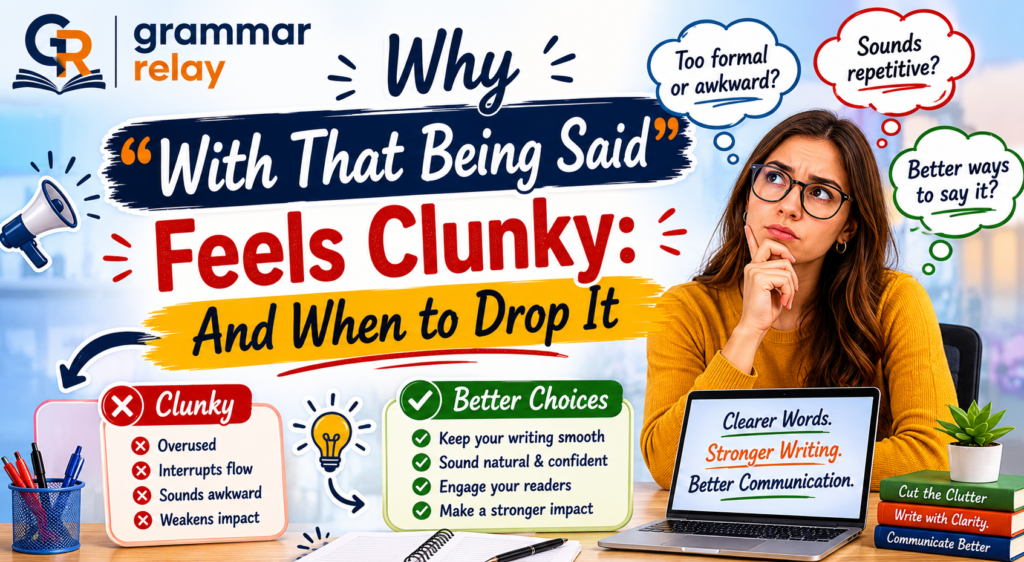
The phrase does real grammatical work, but it’s doing that work inefficiently. “With that being said” takes five words to accomplish what “that said” or “however” does in one or two. In writing, brevity isn’t just stylistic preference. It’s respect for the reader’s time.
Overusing transitional filler also signals something uncomfortable: that the argument’s structure isn’t strong enough to carry itself. Strong writing doesn’t need constant signposting. When ideas connect naturally, heavy pivot phrases become unnecessary scaffolding, visible and ungainly.
That said, the phrase does have its place. It works particularly well in speeches and presentations where the spoken rhythm benefits from a longer pivot. It also works when you genuinely need to acknowledge a prior point before shifting direction. The key is intentionality. Use it when it earns its spot. Cut it when it doesn’t.
What “With That Being Said” Actually Does in a Sentence
Before hunting for the right another way to say with that being said, understand exactly what job the phrase is performing. It actually handles three distinct functions:
- Conceding a point: acknowledging what was just said before introducing a counterargument
- Pivoting: shifting from one topic or idea to an entirely different one
- Qualifying: adding nuance to a statement without fully reversing it
These three functions need three different types of replacements. A contrast phrase doesn’t work where a concession phrase is needed. A pivot phrase falls flat where a qualification is required. Most synonym lists completely ignore this distinction and that’s precisely why writers end up using the wrong replacement.
Read more about 40+ Another Way of Saying “According To”
The Four Categories of Synonyms for “With That Being Said”
The smartest approach to finding another word for with that being said is organizing alternatives by function rather than just alphabetically. Here are the four categories:
- Contrast & counterargument: pushing back against what was just said
- Concession & qualification: acknowledging both sides of an argument
- Topic pivot & transition: shifting direction or introducing new territory
- Conclusion & summary: wrapping up before a final point
Contrast & Counterargument Synonyms (When You’re Pushing Back)
These phrases introduce an opposing point after acknowledging what came before. They’re your go-to with that being said formal replacements in professional and academic writing.
| Phrase | Tone | Best Used For |
|---|---|---|
| However | Formal/Semi-formal | Essays, emails, reports |
| Nevertheless | Formal | Academic writing, formal reports |
| Nonetheless | Formal | Same as nevertheless, slightly warmer |
| Yet | Semi-formal | Creative writing, speeches |
| On the other hand | Semi-formal | Balanced arguments, comparisons |
| In contrast | Formal | Academic essays, analytical writing |
| Conversely | Formal | Research papers, formal analysis |
| That said | Casual-professional | Emails, blog posts, conversations |
| Even so | Semi-formal | Conceding while contrasting |
| Then again | Casual | Conversational writing, texts |
The most important distinction here? “However” signals stronger contrast than “that said.” Use “however” when the opposition is direct and clear. Use “that said” when the pivot is gentler more of a soft redirect than a full counterargument.
Example in action:
“The project exceeded budget expectations. However, the final deliverable surpassed every quality benchmark we set.”
Concession & Qualification Synonyms (When You’re Acknowledging Both Sides)
This is where the synonym for that being said gets genuinely nuanced. Concession phrases don’t just contrast — they acknowledge the prior point’s validity before moving forward.
- “Having said that” the closest true synonym; warm and professional
- “Be that as it may” formal, slightly archaic but highly effective
- “Despite that” direct and clean
- “In spite of that” functionally identical to “despite that”, slightly more emphatic
- “Even so” acknowledges concession warmly
- “All the same” casual but surprisingly versatile
- “Regardless” blunt and confident; signals you’re moving on
- “While that’s true” explicitly validates the prior point
- “Granting that” underused and academically elegant
- “Admittedly” one of the most underrated concession words in English
“Admittedly, the timeline was ambitious. Having said that, the team delivered every milestone on schedule.”
Notice how “admittedly” does something remarkable, it concedes openly and confidently. It signals intellectual honesty rather than defensiveness. That’s why it’s so effective in professional communication.
Topic Pivot & Transition Synonyms (When You’re Shifting Gears)
Sometimes this being said synonym territory is really about changing direction rather than contrasting or conceding. These phrases signal: we’re moving on now.
- “Moving forward” clean and action-oriented
- “With this in mind” connects the pivot to what came before
- “In light of that” warm and logical
- “Taking this into account” deliberate and analytical
- “On that note” conversational and smooth
- “That being the case” logical and direct
- “Given that” sets up a consequence or next step
- “Bearing that in mind” thoughtful and measured
- “From another angle” signals a fresh perspective
- “Shifting to” direct and unambiguous
The critical distinction? Pivot phrases connect to what came before. They don’t just change subject they transition using the prior content as a launching pad. “On that note” works beautifully in speeches and presentations. In dense written analysis, “with this in mind” carries more intellectual weight.
Conclusion & Summary Synonyms (When You’re Wrapping Up)
The another way of saying with that being said in closing contexts needs a different touch entirely. These phrases signal finality:
- “All things considered” implies careful weighing of multiple factors
- “All in all” simple, warm, universally understood
- “Taking everything into account” thorough and measured
- “After considering this” deliberate and analytical
- “In any case” cuts through complexity to reach a conclusion
- “At any rate” slightly casual but effective
- “Ultimately” signals the most important final point
- “All considered” concise and clean
- “In the final analysis” formal and authoritative
“Ultimately” deserves special attention. It’s one of the most versatile conclusion signals in English formal enough for academic writing, natural enough for conversation. It tells the reader: here’s what actually matters after everything we’ve discussed.
Synonyms for “With That Being Said” in Specific Contexts
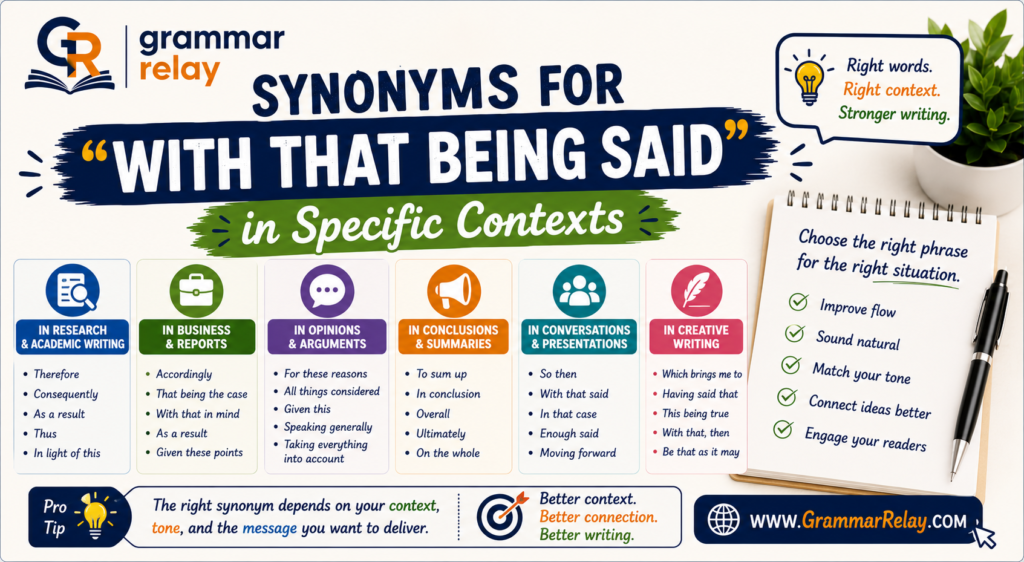
In Professional Emails & Business Writing
Another way to say that being said in workplace communication needs polish without stiffness. These work best:
- “That said, the revised proposal addresses your primary concerns.”
- “Having said that, we remain fully committed to the original delivery date.”
- “Nevertheless, the core objectives haven’t changed.”
Avoid “be that as it may” in casual professional emails it sounds overly formal and slightly dismissive in that context.
In Academic Essays & Research Papers
Academic writing has the least tolerance for transitional filler. The preferred other words for that being said in scholarly work are single-word connectors:
- “Nevertheless” and “nonetheless” the gold standard
- “However” clean, universally accepted
- “Conversely” for direct oppositions
- “Granted” for concession before counterargument
Most academic style guides including APA 7th edition and the Chicago Manual of Style actually recommend minimizing transitional crutch phrases entirely in favor of strong logical structure.
In Speeches & Presentations
Interestingly, “with that being said” works better spoken than written. The longer rhythm suits natural speech patterns. However, these alternatives land even more effectively out loud:
- “On that note…”
- “With all of that in mind…”
- “Moving forward…”
- “Now, here’s what that means for us…”
The last one is particularly powerful in presentations it connects the prior content directly to the audience’s interest.
You might be interested in 40+ Other Ways to Say “I Agree”
In Casual Conversation & Texts
Keep it natural. Nobody texts “nevertheless” to a friend:
- “Still though…”
- “Even so…”
- “Then again…”
- “That said…”
“That said” is the MVP of casual-professional crossover. It works in texts, emails, blog posts, and conversations without ever sounding out of place.
In Creative Writing & Storytelling
Transition phrases interrupt narrative flow. In fiction and narrative nonfiction, “yet” is the single most elegant contrast pivot available:
“The plan was solid. Yet something felt wrong.”
Two sentences. Perfect tension. No clunky pivot phrase required.
The Subtle Differences Between the Most Commonly Confused Synonyms
| Phrase A | Phrase B | Key Difference |
|---|---|---|
| Nevertheless | Nonetheless | Nearly identical, nevertheless is marginally more formal |
| However | That said | However signals stronger contrast; that said is softer |
| Having said that | Be that as it may | Be that as it may sounds more formal and slightly archaic |
| Despite that | In spite of that | Functionally identical, rhythm differs slightly |
| All things considered | All in all | All things considered implies weighing; all in all simply summarizes |
| Even so | Still | Even so acknowledges more concession; still is blunter |
Phrases That Sound Like Synonyms But Aren’t
Some words get mistakenly used as another way of saying with that being said but actually change the meaning significantly:
| Phrase | Why It’s Not a True Synonym | What It Actually Signals |
|---|---|---|
| “Therefore” | Signals cause and effect, not contrast | Conclusion drawn from prior evidence |
| “Furthermore” | Adds to a point, doesn’t pivot away | Continuation, not contrast |
| “Meanwhile” | Signals simultaneity | Two things happening at once |
| “As a result” | Signals consequence | Direct outcome of prior cause |
| “In addition” | Builds on a point | Additive, not contrastive |
Using “therefore” where you mean “however” doesn’t just sound wrong, it changes the logical relationship between your ideas entirely. That matters enormously in professional and academic writing.
Synonyms for “With That Being Said” by Context
| Context | Best Synonym |
|---|---|
| Professional email | “That said” / “Having said that” |
| Academic essay | “Nevertheless” / “Nonetheless” / “However” |
| Speech or presentation | “With that in mind” / “On that note” |
| Casual conversation | “Still” / “Even so” / “Then again” |
| Creative writing | “Yet” / “That said” |
| Conceding a point | “Admittedly” / “Granting that” |
| Wrapping up | “All things considered” / “Ultimately” |
| Topic shift | “Moving forward” / “On that note” |
How to Know Which Synonym to Use Every Time
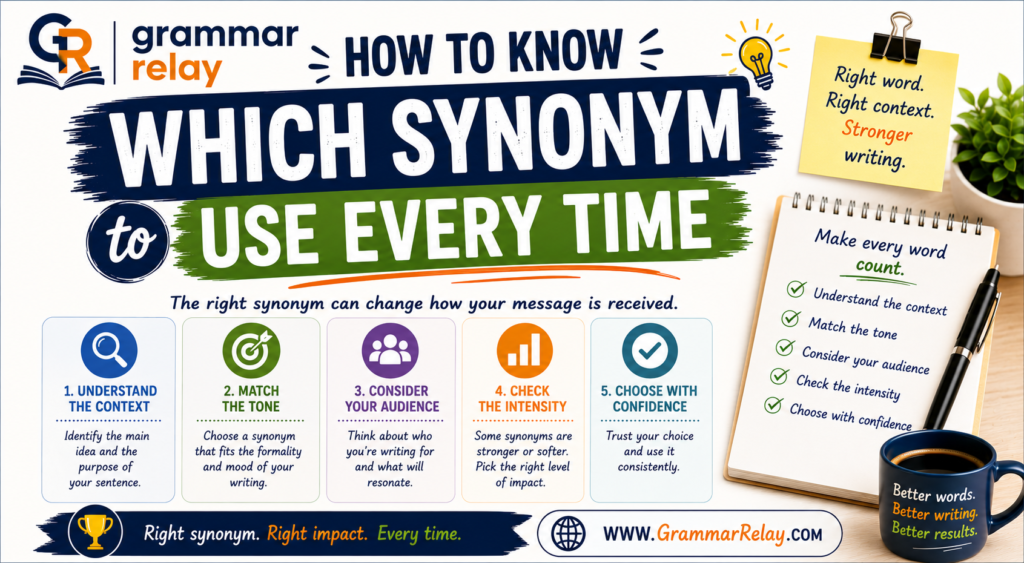
Three questions. Answer them honestly and the right phrase becomes obvious:
- What are you doing with the prior statement? Contrasting it, conceding it, pivoting away from it, or summarizing it?
- What’s the register? Formal academic, professional business, or casual conversation?
- Is a transition phrase even necessary? Sometimes cutting it entirely makes the writing sharper and stronger
“Vigorous writing is concise. A sentence should contain no unnecessary words, a paragraph no unnecessary sentences.” William Strunk Jr., The Elements of Style
That principle applies directly to transitional phrases. If the writing makes sense without the pivot phrase, cut it.
Common Mistakes Writers Make With Transition Phrases
Even experienced writers stumble here. Watch for these:
- Using “with that being said” when there’s nothing prior to reference: the phrase requires an existing statement to point back to
- Stacking multiple transition phrases: in the same paragraph, one is enough
- Choosing a contrast phrase when concession is needed: they serve different logical functions
- Using formal transitions in casual contexts: “nevertheless” in a text message sounds robotic
- Relying on transitions to fix structural problems: if your argument needs five pivot phrases, the argument needs restructuring
Frequently Asked Questions
Is “with that being said” grammatically correct?
Technically yes, but it’s redundant. The “being said” construction adds weight without adding meaning. “That said” accomplishes the exact same job in two words instead of five. Grammatically acceptable doesn’t always mean stylistically strong.
What’s the single closest synonym to “with that being said”?
“Having said that” is the nearest true equivalent. It preserves the same logical function, acknowledging what came before while pivoting forward, without the passive awkwardness of the original phrase. It works across professional, academic, and conversational contexts equally well.
Which synonym works best in professional emails?
“That said” and “having said that” are your safest options. Both strike the right balance between warmth and professionalism. Avoid “be that as it may” in most workplace emails, it reads as overly formal and can come across as slightly dismissive depending on context.
Can I use these alternatives in academic writing?
Yes, but choose carefully. Academic writing strongly favors single-word connectors like “nevertheless,” “nonetheless,” and “however.” Most style guides, including APA 7th edition discourage lengthy transitional phrases in scholarly work. Brevity and logical structure always win.
What’s the difference between “however” and “that said”?
Strength of contrast. “However” signals a direct, clear opposition between two ideas. “That said” is softer more of a gentle redirect than a full counterargument. Use “however” when the contrast is sharp and use “that said” when the pivot is subtle.
When should I cut the transition phrase entirely?
Whenever the writing makes sense without it. If your ideas connect logically and your sentences flow naturally into each other, the pivot phrase is just scaffolding visible and unnecessary. Strong structure makes transitional crutches redundant. That’s always the goal.
Read more grammar lessons on Grammar Relay
Conclusion
The best synonyms for with that being said aren’t just vocabulary swaps. They’re precision tools. Each one signals a specific logical relationship between ideas and choosing the right one tells your reader exactly how to process what comes next.
But here’s the real secret: the strongest writing often needs no transition phrase at all. When your ideas connect logically and your structure is sound, the pivot happens naturally. The reader follows without being told to.
Start with that goal. Then reach for these phrases when the transition genuinely earns its place. Pick two from this guide and use them intentionally this week, in your next email, your next essay, your next presentation. Notice the difference immediately.
