


“You’re welcome.” Said a thousand times a day. In emails, in hallways, in customer service calls, in text messages. It’s polite. It’s expected. But somewhere along the way it became the verbal equivalent of a firm handshake technically correct, completely automatic, and utterly forgettable.
Here’s what most people don’t consider: how you respond to gratitude says as much about you as how you express it. A thoughtful, well-chosen response to “thank you” signals warmth, emotional intelligence, and genuine engagement. A reflexive “you’re welcome” signals that you were barely listening.
Whether you need other ways to say you’re welcome in a professional email, a client meeting, a heartfelt personal moment, or a casual text this guide covers every situation with real examples, practical tables, and phrases that actually land.
Why “You’re Welcome” Sometimes Misses the Mark

The phrase has a subtle power dynamic baked into it. “You’re welcome” implies that the thanks was expected that you’re graciously accepting gratitude as your due. Some people find that slightly presumptuous. Others find it perfectly fine. The difference often comes down to tone, relationship, and context.
There’s also the autopilot problem. When someone says “you’re welcome” without pausing, without warmth, without any variation in tone or phrasing it stops registering as a response at all. It becomes ambient noise.
The professional world has started noticing this. Premium service brands, high-performing sales teams, and emotionally intelligent leaders increasingly train themselves to respond to gratitude with more intentional language. Not because “you’re welcome” is wrong but because something better is usually available.
What “You’re Welcome” Actually Communicates: And When It Works
At its core, “you’re welcome” does one job: it closes the gratitude loop. Someone thanks you. You acknowledge the thanks. The exchange completes.
It works perfectly when:
- The help was significant and the thanks is sincere
- The setting is formal enough to warrant a complete, clear response
- You genuinely want to signal that the assistance was intentional
It feels off when:
- The favor was minor and “you’re welcome” sounds disproportionately formal
- The setting is casual and the full phrase sounds stiff
- Repetition has drained it of warmth
Any strong you’re welcome synonym should accomplish three things simultaneously: acknowledge the thanks without dismissing it, signal genuine warmth, and match the register of the conversation.
The Four Categories of “You’re Welcome” Synonyms
The smartest approach to finding different ways to say you’re welcome is organizing alternatives by function rather than just listing them alphabetically:
- Formal & professional: workplace emails, client interactions, business settings
- Warm & heartfelt: genuine connection, meaningful help, close relationships
- Casual & conversational: everyday interactions, friends, quick exchanges
- Humble & deflecting: minimizing the effort while still acknowledging thanks
Formal & Professional You’re Welcome Synonyms
Knowing how to say you’re welcome professionally in an email is genuinely valuable it shapes how clients, colleagues, and senior leaders perceive you.
| Phrase | Formality Level | Best Used For |
|---|---|---|
| My pleasure | Formal | Client emails, customer service, senior colleagues |
| It was my pleasure entirely | Formal | Significant professional assistance |
| Happy to assist | Semi-formal | General professional correspondence |
| Glad I could be of service | Formal | Customer-facing and client interactions |
| I’m delighted to help | Formal | High-touch client relationships |
| It’s what I’m here for | Semi-formal | Team members, direct reports |
| I appreciate the opportunity to help | Formal | Networking, new professional relationships |
| Please don’t hesitate to reach out again | Semi-formal | Email sign-offs after helping |
| Always happy to support | Semi-formal | Ongoing professional relationships |
| It was a privilege to assist | Formal | Senior leaders, high-stakes situations |
The Ritz-Carlton effect: The luxury hotel chain famously trains every employee to respond with “my pleasure” rather than “no problem.” This single policy shift documented in their Gold Standards service philosophy became a benchmark for premium hospitality worldwide. The phrase signals that helping you wasn’t just acceptable it was genuinely enjoyable. That’s the psychological power of word choice.
Example in action:
“Thank you so much for pulling that report together on short notice.” “My pleasure entirely, please reach out anytime you need support with data.”
Clean. Warm. Professional. Worlds away from “no problem.”
Read more about How to Say Sorry for Your Loss Professionally
Warm & Heartfelt You’re Welcome Synonyms
Sometimes someone thanks you for something that genuinely mattered. A casual “no worries” completely fails that moment. These phrases honor the depth of the gratitude:
- “I’m so glad I could help, truly.”
- “It meant a lot to be able to do that for you.”
- “Anytime. I genuinely mean that.”
- “That’s what friends are for.”
- “I’d do it again in a heartbeat.”
- “It was genuinely my honor.”
- “You would’ve done the same for me.”
- “I’m here whenever you need me, no exceptions.”
- “I’m just glad it worked out the way it did.”
- “Truly, it was no trouble at all.”
These phrases do something “you’re welcome” rarely accomplishes: they deepen the relationship rather than just closing the loop. They say I see you, I care about you, and this wasn’t transactional.
“Too often we underestimate the power of a touch, a smile, a kind word, a listening ear, an honest compliment, or the smallest act of caring.” Leo Buscaglia
Casual & Conversational You’re Welcome Synonyms
Not every exchange needs gravitas. For texts, quick conversations, and low-stakes interactions, these you’re welcome synonyms keep things light and natural:
- “No problem” the most common casual alternative
- “No worries” relaxed and warm
- “Sure thing” breezy and confident
- “Of course” threads the needle between casual and professional beautifully
- “Anytime” open-door warmth in one word
- “Don’t mention it” classic and easy
- “You got it” energetic and friendly
- “Absolutely” enthusiastic and clean
- “It’s all good” very casual; works with close friends
- “Happy to” short and genuine
- “Always” one word that communicates consistent availability
The generational divide is real. Younger speakers overwhelmingly default to “no problem” a 2023 linguistic survey from Preply found that 67% of adults under 35 use “no problem” as their primary response to thanks. Older speakers sometimes bristle at it. Neither group is wrong, context and relationship determine what’s appropriate.
Humble & Deflecting You’re Welcome Synonyms

Sometimes the most gracious response minimizes your own effort. These phrases acknowledge the thanks without making it about you:
- “It was nothing, genuinely.”
- “Don’t worry about it at all.”
- “It was the least I could do.”
- “Really, it wasn’t a big deal.”
- “No thanks needed.”
- “Think nothing of it.”
- “Not at all.”
- “It was no trouble whatsoever.”
- “I just did what anyone would do.”
- “I was happy to do it.”
One important caveat: there’s a fine line between genuine humility and inadvertently dismissing someone’s gratitude. If someone thanks you deeply and sincerely, for something that genuinely impacted their life responding with “it was nothing” can make them feel their thanks was unnecessary or excessive. Read the emotional weight of the moment carefully.
You’re Welcome Synonyms in Specific Professional Situations
In Professional Emails & Written Business Communication
How to say you’re welcome professionally in an email without sounding robotic comes down to one rule: always add one warm, forward-looking sentence after the acknowledgment phrase.
Three levels of formality:
Formal:
“It was my pleasure to assist. Please don’t hesitate to reach out should you need anything further.”
Semi-formal:
“Happy to help, feel free to reach out anytime.”
Casual-professional:
“Of course! Always glad to help, let me know if anything else comes up.”
In Customer Service & Client-Facing Roles
Premium customer service actively avoids “no problem” and for good reason. The phrase implies the request could have been problematic. That’s not the impression any business wants to leave.
What top-tier brands use instead:
- “My pleasure,” Ritz-Carlton standard
- “Absolutely, it’s what we’re here for”
- “I’m so glad we could help”
- “It was a pleasure serving you”
The psychology is straightforward: customers who feel genuinely welcomed spend more, complain less, and return more often.
In a Job Interview or Formal Professional Meeting
High-stakes settings reward confident warmth. Try:
- “It was truly my pleasure.”
- “I’m glad I could contribute to that.”
- “Absolutely, I appreciated the opportunity.”
Avoid “no worries” or “sure thing” too casual for the setting and they can undercut an otherwise strong impression.
In Response to Deep or Emotional Gratitude
When someone thanks you for something that genuinely changed their situation, don’t minimize it and don’t deflect too quickly. Honor the moment:
- “I’m so genuinely glad I could be there for you.”
- “That’s what I’m here for truly.”
- “You matter to me. Of course I was going to help.”
These responses validate both the thanks and the relationship. That’s rare and powerful.
You’re Welcome in Text Slang
You’re welcome in text slang has its own shorthand that younger communicators use constantly:
- “yw” the standard text abbreviation for you’re welcome
- “np” no problem
- “ofc” of course
- “nw” no worries
- “hth” happy to help
These work fine in casual digital contexts between people who know each other well. In any professional or semi-formal digital communication, spell it out.
You might be interested in 40+ Synonyms for “With That Being Said”
“You’re Welcome” Around the World
What different languages reveal about how cultures respond to gratitude:
| Language | Phrase | Literal Meaning |
|---|---|---|
| Spanish | De nada | It’s nothing |
| French | De rien / Je vous en prie | It’s nothing / I pray you |
| German | Bitte | Please / You’re welcome |
| Italian | Prego | Please / I pray |
| Japanese | Dō itashimashite | Don’t mention it |
| Mandarin | 不客气 (Bù kèqi) | Don’t be polite |
| Arabic | العفو (Al-‘afw) | Pardon / Forgiveness |
| Portuguese | De nada | It’s nothing |
The pattern is striking. Across wildly different cultures and languages, the instinctive response to thanks is some variation of “it was nothing.” Humility, not acknowledgment is the universal default. English’s “you’re welcome” is actually the outlier for centering the giver rather than minimizing the gesture.
Phrases That Sound Like Good Synonyms But Aren’t
Some responses to thanks actively miss the mark:
| Phrase | The Problem | Better Alternative |
|---|---|---|
| “No problem” in formal contexts | Implies it could’ve been a problem | “My pleasure” or “Happy to assist” |
| “Obviously” | Sounds condescending | “Of course, anytime” |
| “Yeah, sure” | Dismissive and disengaged | “Absolutely, glad I could help” |
| “I know” | Comes across as arrogant | “I’m really glad it helped” |
| “Uh-huh” | Completely disengaged | Any actual phrase from this list |
The “No Problem” Debate: Is It Actually Rude?
This debate has genuine substance. Here’s the honest breakdown:
“No problem” originated as a casual reassurance it meant “this caused me no inconvenience.” For younger speakers, it carries exactly that warmth. For older speakers and in formal contexts, it can imply that the request could have been problematic which subtly suggests the asker imposed.
Linguists at Language Log have tracked this phrase’s evolution over two decades and consistently find that perception splits sharply along generational and cultural lines. The verdict? Context determines everything. With close friends in casual settings totally fine. In premium professional or customer-facing settings reach for something warmer.
You’re Welcome Synonyms by Context
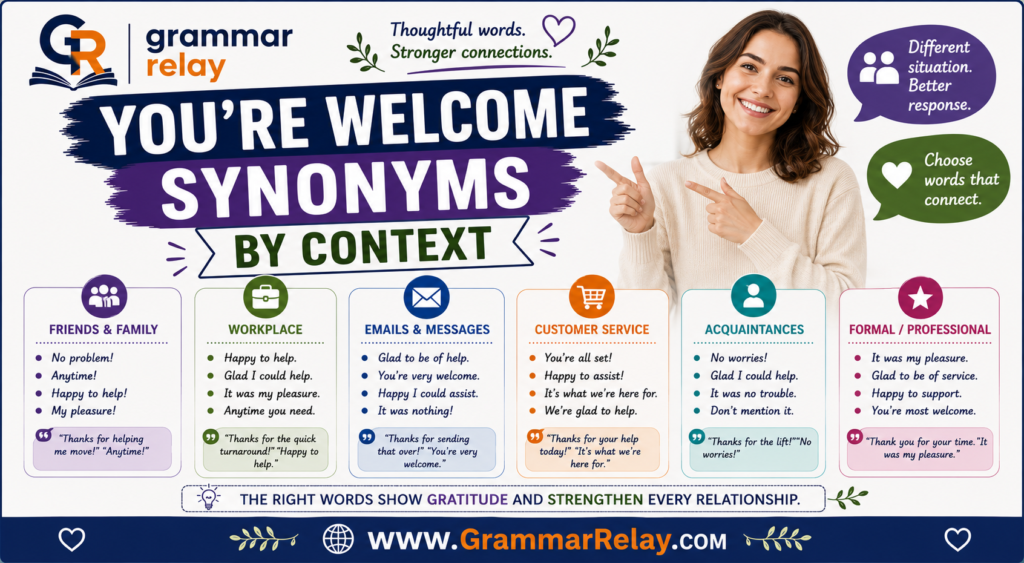
| Context | Best Phrase |
|---|---|
| Formal business email | “My pleasure” / “Happy to assist” |
| Customer service | “My pleasure” / “It’s what I’m here for” |
| Close friend | “Anytime, I mean that” / “That’s what friends are for” |
| Job interview | “It was my pleasure” / “I’m glad I could help” |
| Casual text | “Of course!” / “Always” / “yw” |
| Deep emotional gratitude | “I’m so glad I could be there for you” |
| Team colleague | “Happy to” / “Of course, anytime” |
| Client response email | “It was a pleasure, please reach out anytime” |
How to Choose the Right Synonym Every Time
Three questions. Answer them honestly and the right phrase becomes obvious:
- What’s the relationship? Formal professional, casual friend, or somewhere between?
- How significant was the help? Small favor, meaningful assistance, or genuinely life-changing support?
- What’s the medium? In-person conversation, email, phone call, or text?
Common Mistakes People Make When Responding to Thanks
Even well-intentioned people stumble here. Watch for these:
- Saying nothing at all: awkward, dismissive, and surprisingly common
- Overdoing it: “Oh it was truly my absolute greatest pleasure”, exhausting and performative
- Using casual phrases in formal settings: “no worries” to a senior client is a genuine misstep
- Dismissing deep gratitude: “it was nothing” when someone thanks you profoundly can feel invalidating
- Robotic repetition: saying “my pleasure” to every single interaction strips it of meaning fast
Frequently Asked Questions
Is “you’re welcome” considered rude in professional settings?
Not inherently, but it can feel presumptuous or overly formal depending on context and tone. In premium customer service and client-facing roles, phrases like “my pleasure” or “happy to assist” consistently outperform it because they signal genuine enjoyment rather than simply accepting gratitude as expected.
What’s the most professional alternative to “you’re welcome”?
“My pleasure” wins in almost every formal context. It’s warm, confident, and signals that helping was genuinely enjoyable rather than obligatory. For written professional emails, “happy to assist, please don’t hesitate to reach out again” adds a forward-looking warmth that “you’re welcome” alone never delivers.
Why do some people dislike “no problem” as a response?
It implies the request could have been a problem which subtly suggests the person imposed. Younger speakers rarely read it that way but older speakers and formal contexts often do. When in doubt, especially in professional or customer-facing situations, “my pleasure” or “of course” are safer and warmer alternatives.
What should I say when someone thanks me for something truly significant?
Don’t minimize it and don’t deflect too quickly. “I’m so genuinely glad I could be there for you” or “you matter to me, of course I was going to help” honor the depth of the gratitude without being performative. The moment deserves more than a casual “no worries.”
Can I use casual alternatives in professional emails?
Generally no. “No worries” and “sure thing” work fine in informal Slack messages or texts between colleagues you know well. In client-facing emails or formal correspondence, stick with “my pleasure,” “happy to assist,” or “it was a pleasure.” Casual phrases in formal contexts quietly undercut your professional credibility.
What’s the best one-word response to “thank you”?
“Absolutely” threads the needle beautifully, warm enough for personal exchanges and polished enough for professional ones. “Always” works remarkably well too, especially with people you have an ongoing relationship with. It signals consistent availability without feeling rehearsed.
Read more grammar lessons on Grammar Relay
Conclusion
Here’s the truth about you’re welcome synonyms: the right phrase isn’t about sounding impressive. It’s about making the other person feel that their thanks genuinely landed that you heard it, you appreciated it, and you meant the help you offered.
You’re very welcome will always be a perfectly good response. But “I’m so glad I could help” or “anytime, truly” does something more. It keeps the connection warm rather than just closing the loop.
Pick two or three phrases from this guide that feel natural to you. Use them intentionally this week. Notice how people respond when your acknowledgment of their thanks actually sounds like you mean it.
