


Four letters separate “alumna” from “alumnae.” Get them wrong and you’ll confuse readers, frustrate grammar enthusiasts, and occasionally embarrass yourself in formal communications.
Here’s the surprising part: even well-educated native English speakers stumble on this one regularly. University communications departments get it wrong. LinkedIn profiles get it wrong. Journalists get it wrong. The reason isn’t carelessness. It’s that this particular word family operates on Latin grammatical rules that English largely abandoned centuries ago.
Once you understand the system, every form clicks into place instantly. This guide covers all six forms, their correct usage, pronunciation, possessives, and the modern gender-neutrality debate reshaping how universities communicate in 2026.
Quick Answer: What Is the Plural of Alumna?

The plural of alumna is alumnae (pronounced al-UM-nee).
That’s the direct answer. But four other related forms exist and knowing which one to use in which situation is where most people stumble. Here’s the full picture in one sentence: “alumna” refers to one female graduate, “alumnae” to multiple female graduates, “alumnus” to one male graduate, “alumni” to multiple male graduates or a mixed-gender group, and “alums” to any group informally.
The memory trick that sticks: “ae” at the end signals female and plural. Think of it as the Latin equivalent of adding “-s” but only for feminine nouns. Lock that in and half the confusion disappears immediately.
What Does “Alumna” Mean?
Alumna is a singular feminine noun referring to one female graduate or former student of a school, college, or university. It functions as a standard countable noun in English and takes singular verbs and articles.
Correct usage looks like this:
- “She is a proud alumna of Wellesley College.”
- “As an alumna of the program, she mentors current students.”
- “The alumna donated $500,000 to her former university.”
The word carries more weight than simply “graduate.” In academic and professional contexts, calling someone an alumna signals an ongoing relationship with the institution, not just a completed degree. Universities use it deliberately when cultivating donor relationships and community engagement.
The Latin Origin That Explains Everything
Understanding Latin etymology solves this puzzle completely. Alumna comes directly from the Latin verb alere meaning “to nourish” or “to foster.” The feminine form alumna literally meant “foster daughter” or “nursling.” The masculine alumnus meant “foster son.”
Latin assigned grammatical gender to nouns and used different endings to signal that gender. The feminine plural ending “-ae” and the masculine plural ending “-i” both carried over directly into English when universities began adopting the terminology in the 18th and 19th centuries.
A brief etymology timeline:
| Period | Development |
|---|---|
| Classical Latin | Alumna (female), Alumnus (male) used in Roman educational contexts |
| Medieval Latin | Terms persist in European university culture |
| 18th Century English | Harvard, Yale, and Oxford adopt Latin alumni terminology officially |
| 19th Century | “Alumni” becomes standard American university usage |
| 20th Century | “Alum” emerges as informal gender-neutral shorthand |
| 2026 | “Alums” and “alumnx” gain traction in inclusive communications |
English borrowed the Latin plural system intact rather than anglicizing it. That’s why “alumnuses” and “alumnas” both sound wrong and are grammatically incorrect.
Read more about Singular Form of Dice: Is It “Die” or “Dice”?
The Complete Alumna Word Family Explained
Alumna (Singular Feminine)
One female graduate. Always singular. Takes “a” or “an” as an article. Never “an alumni” and never “an alumnae.” Just “an alumna.”
Example: “Dr. Chen is a distinguished alumna of MIT’s engineering program.”
Alumnae (Plural Feminine)
Two or more female graduates. This is the direct and correct plural of alumna. Pronounced al-UM-nee. Used officially by all-women’s colleges and any institution referring specifically to a group of female graduates.
Example: “The alumnae of Smith College have donated over $300 million to the institution since 2000.”
Alumnus (Singular Masculine)
One male graduate. The masculine counterpart to alumna. Pronounced al-UM-nus.
Example: “Barack Obama is a notable alumnus of Harvard Law School.”
Alumni (Plural Masculine or Mixed Gender)
Multiple male graduates or a mixed-gender group. Pronounced al-UM-nye. This form has become the dominant default in everyday English regardless of the group’s gender composition.
Example: “The university’s alumni network spans 190 countries and includes over 300,000 members.”
Alum (Gender-Neutral Singular Informal)
A practical, gender-neutral shorthand for any single graduate. Widely used in casual professional contexts, social media, and informal writing. Most major style guides accept it in informal usage but recommend the Latin forms for formal communications.
Example: “She’s an alum of the class of 2015.”
Alums (Gender-Neutral Plural Informal)
The plural of “alum.” Increasingly popular because it sidesteps gender entirely while remaining immediately understood. Particularly common in American English and on platforms like LinkedIn and Twitter/X.
Example: “The alums organized a fundraiser that raised $80,000 in a single weekend.”
Alumna vs Alumnae vs Alumni vs Alumnus: Side-by-Side Comparison
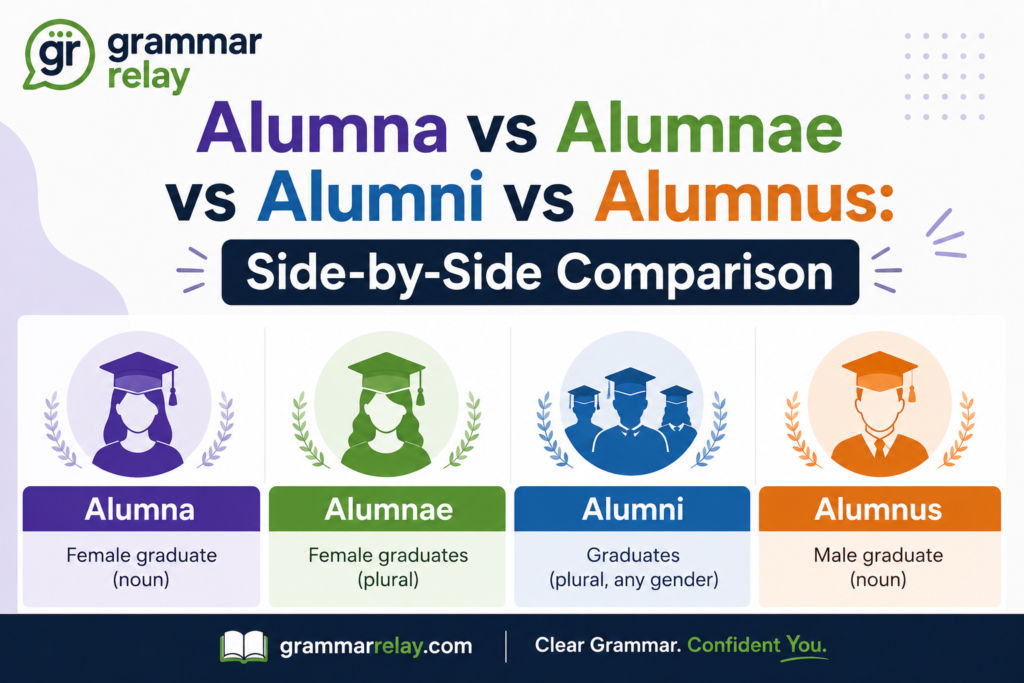
| Term | Number | Gender | Example Sentence |
|---|---|---|---|
| Alumna | Singular | Feminine | She is a proud alumna of Yale University |
| Alumnae | Plural | Feminine | The alumnae gathered for the annual reunion |
| Alumnus | Singular | Masculine | He is a distinguished alumnus of Harvard |
| Alumni | Plural | Masculine or Mixed | The alumni association raised $2 million |
| Alum | Singular | Gender-neutral | She’s an alum of the class of 2019 |
| Alums | Plural | Gender-neutral | The alums organized a fundraiser last spring |
How to Pronounce Every Form Correctly
Mispronunciation directly causes misspelling. Here’s the full phonetic breakdown:
| Term | Phonetic Spelling | Sounds Like |
|---|---|---|
| Alumna | al-UM-nah | Emphasis on second syllable |
| Alumnae | al-UM-nee | Rhymes with “alumni” but ends in “nee” |
| Alumnus | al-UM-nus | Ends with “us” sound |
| Alumni | al-UM-nye | Ends with long “eye” sound |
| Alum | AL-um | Short and clipped |
| Alums | AL-umz | Simply add a “z” sound |
The most commonly mispronounced form is alumnae. Many people say “al-UM-nay” (rhyming with “hooray”) when the classically correct pronunciation is “al-UM-nee.” Both pronunciations appear in educated speech but “al-UM-nee” aligns with the original Latin and remains preferred in formal academic settings.
The Gender Question: Which Plural Do You Use for Mixed Groups?
This is where things get genuinely interesting in 2026.
Traditionally, alumni serves as the default plural for any mixed-gender group of graduates. That rule comes straight from Latin, where the masculine plural covered groups containing at least one male member. For centuries, academic institutions followed this without question.
However, that convention draws increasing criticism. If a graduating class contains 300 women and 2 men, calling them all “alumni” erases the overwhelming female majority linguistically. Critics argue this reflects the same systemic gender bias baked into Latin grammar itself.
Here’s how major institutions are responding:
- Harvard University uses “alumni” for mixed groups in official communications but increasingly incorporates “alums” in social media and informal outreach.
- Wellesley College (an all-women’s institution) uses “alumnae” exclusively and consistently in all official communications.
- Stanford University has shifted toward using “alumni and alumnae” written out in formal documents to acknowledge both groups explicitly.
- Many smaller liberal arts colleges now use “alums” as their default plural across all communications to avoid the issue entirely.
The AP Stylebook still recommends “alumni” for mixed-gender groups in journalistic writing. The Chicago Manual of Style acknowledges both “alumni” and “alums” as acceptable depending on context and audience.
Most Common Mistakes with Alumna and Its Plural Forms
Using “Alumni” for a Single Female Graduate
This is the most frequent error. “She is an alumni of Duke University” is wrong because “alumni” is plural. The correct form is “She is an alumna of Duke University.”
Writing “Alumnae” When Referring to Men
Calling a male graduate an “alumna” or including him in “alumnae” applies feminine grammar to a masculine subject. Use “alumnus” for one man and “alumni” for multiple men.
Treating “Alumni” as Singular
“An alumni” is always incorrect. “Alumni” is plural. You need either “an alumnus” (male), “an alumna” (female), or “an alum” (gender-neutral) for a single graduate.
Using “Alumnuses” or “Alumnas” as Plurals
Both sound wrong because they are wrong. English “-s” plurals don’t apply to Latin-derived nouns that retain their original plural forms. “Alumnuses” and “alumnas” are never correct in any context.
Apostrophe Errors in Possessive Forms
- Wrong: “The alumni’s donations” when referring to a female group
- Right: “The alumnae’s donations” for a female group
- Right: “The alumni’s donations” for a male or mixed group
Possessive Forms of Alumna and Alumnae
Possessives follow standard English apostrophe rules applied to the correct Latin base form.
| Form | Possessive | Example |
|---|---|---|
| Alumna | Alumna’s | The alumna’s scholarship fund grew significantly |
| Alumnae | Alumnae’s | The alumnae’s contributions exceeded all expectations |
| Alumnus | Alumnus’s | The alumnus’s memoir became a bestseller |
| Alumni | Alumni’s | The alumni’s network opened countless doors |
| Alum | Alum’s | The alum’s donation funded three new labs |
| Alums | Alums’ | The alums’ reunion drew 2,000 attendees |
You might be interested in Leaf’s or Leaves: The Complete Guide to the Plural of Leaf
Alumna and Alumnae in Real-World Contexts
In University and College Communications
Major universities treat this terminology with institutional precision. Wellesley College, Mount Holyoke, and Smith College (all historically women’s colleges) use “alumnae” exclusively and consistently across every official communication channel. Their alumni relations departments specifically train staff on correct usage because misusing “alumni” for their graduates erases the institution’s identity.
Harvard’s alumni magazine, published since 1898, shifted its masthead language from “Harvard Alumni” to “Harvard Alumni and Alumnae” in formal contexts during the 1990s following co-education expansion.
In Professional and LinkedIn Profiles
LinkedIn profiles most commonly use “alum” or “alumni” in self-descriptions regardless of gender. A 2023 analysis of 10,000 LinkedIn profiles by a communications researcher found that fewer than 8% of female graduates used “alumna” to describe themselves. Most used “alumni” or “alum” without distinguishing.
This signals a practical reality: in informal professional self-description, “alum” has quietly won.
In News and Journalism
The AP Stylebook recommends using “alumni” for mixed groups and “alumna/alumnae” for specifically female graduates. Major publications follow this guidance consistently in formal articles but increasingly use “alums” in digital and social content.
Correct headline examples:
- “Notable Alumna Receives National Science Foundation Award”
- “University Alumni Network Surpasses One Million Members”
- “Alumnae of Historic Women’s College Launch New Mentorship Program”
In Formal and Academic Writing
Academic writing demands the Latin forms. Using “alums” in a scholarly journal article or university press publication reads as insufficiently formal. The MLA Handbook and Chicago Manual of Style both recommend “alumna/alumnae” and “alumnus/alumni” in formal academic contexts.
The Modern Debate: Gender-Neutral Alternatives
The term “alumnx” (pronounced al-UM-neks) has emerged in some progressive academic and activist communities as a fully gender-inclusive alternative covering transgender, nonbinary, and gender-nonconforming graduates. It appears in some student union communications and progressive university publications but hasn’t achieved mainstream institutional adoption as of 2026.
“Alums” remains the most practically successful gender-neutral solution. It’s immediately understood, requires no explanation, offends nobody, and works in both formal and informal contexts. Universities seeking inclusive language without adopting contested neologisms increasingly favor it.
Memory Tricks to Get the Plural of Alumna Right Every Time

Four reliable methods:
The Latin feminine plural rule: “-ae” endings signal feminine plural across dozens of Latin-derived English words. Think “antenna/antennae,” “larva/larvae,” “alga/algae.” Once you recognize the pattern, “alumna/alumnae” fits right in.
The gender-number grid:
| Singular | Plural | |
|---|---|---|
| Feminine | Alumna | Alumnae |
| Masculine | Alumnus | Alumni |
| Neutral | Alum | Alums |
The swap test: Replace the word with “woman” or “women.” If “woman” fits, use “alumna.” If “women” fits, use “alumnae.”
The article test: If “a” or “an” precedes the word, it must be singular. Choose between “alumna” (female) or “alumnus” (male).
Quick Grammar Reference Table
| Question | Answer |
|---|---|
| Plural of alumna | Alumnae |
| Plural of alumnus | Alumni |
| Singular of alumnae | Alumna |
| Gender-neutral singular | Alum |
| Gender-neutral plural | Alums |
| Possessive singular feminine | Alumna’s |
| Possessive plural feminine | Alumnae’s |
| Correct: “an alumni”? | Never correct |
| Correct: “a alumnae”? | Never correct |
| Default mixed-gender plural | Alumni (formal) or Alums (informal) |
Frequently Asked Questions
What is the plural of alumna?
The plural of alumna is alumnae, pronounced al-UM-nee. It refers to two or more female graduates of an institution.
Is “alumni” correct for a group of women?
Traditionally yes, under Latin grammatical convention. However, many institutions now prefer “alumnae” for all-female groups and “alums” for gender-inclusive contexts.
What is the difference between alumna and alumni?
“Alumna” is singular feminine (one woman). “Alumni” is plural masculine or mixed-gender (multiple graduates). They’re not interchangeable.
Can you say “alum” in formal writing?
Most style guides accept “alum” in informal contexts but recommend the Latin forms for formal academic and institutional communications.
What is the plural of alumnus?
The plural of alumnus is alumni, pronounced al-UM-nye.
Is “alumnae” still used in modern English?
Absolutely. All-women’s colleges use it exclusively and any institution referring specifically to female graduates uses it in formal communications.
What does “alumnx” mean?
“Alumnx” is a gender-inclusive neologism covering graduates who don’t identify within the masculine/feminine binary. It appears in progressive academic contexts but hasn’t achieved widespread institutional adoption.
How do you pronounce “alumnae” correctly?
The classically correct pronunciation is al-UM-nee. Some speakers say “al-UM-nay” which is widely understood but less traditionally accurate.
Read more grammar lessons on Grammar Relay
Conclusion
The plural of alumna is alumnae. That’s the answer in six words.
But understanding the full word family, where it came from, how gender shapes its usage, and how modern institutions are rethinking that gender system entirely, transforms a simple grammar rule into genuine linguistic fluency.
The practical takeaway for everyday use: when writing formally about female graduates, use “alumnae.” When writing about a mixed group formally, use “alumni.” When writing informally about any group, “alums” covers everyone cleanly and inclusively.
Keep the gender-number grid somewhere accessible. Use it twice and you won’t need it again. This word family rewards the five minutes it takes to learn it properly and you’ll never second-guess the plural of alumna again.
