

You know the feeling. The chat has run its course. You’ve said what needed saying. But somehow you’re still standing there, nodding, waiting for an exit ramp that never comes. Learning how to end a conversation cleanly is one of the most underrated social skills out there and almost nobody teaches it.
Why Endings Matter More Than You Think

Psychologist Daniel Kahneman’s “peak-end rule” tells us that people don’t judge an experience by its average they judge it by its peak moment and how it ended. That means a solid, warm conversation goodbye leaves a better impression than the rambling, awkward fade-out, even if everything before it went well.
A clean end of conversation is a gift to both people. It respects their time. It signals confidence. And it makes you someone people want to talk to again.
Reading the Room: Know When It’s Time to Go
Before you can exit well, you need to know when to exit. People send signals constantly. Most of us just miss them.
Verbal cues that the conversation is winding down:
- Repeating earlier points with nothing new to add
- Trailing off with “yeah… totally… mmhm”
- Classic wind-down phrases like “anyway,” “so yeah,” or “well…”
- Answering your questions in shorter and shorter sentences
Non-verbal cues to watch for:
- Shifting weight from one foot to the other
- Glancing toward the door, a clock, or their phone
- The slow lean-back their body is already leaving before they are
- Breaking eye contact more frequently
And here’s one people forget: your own internal signal matters too. You’re allowed to be done. Wanting to end a conversation isn’t rude. It’s honest.
The Psychology Behind Awkward Goodbyes
Why do people overstay conversations? Usually it’s one of three things:
- Fear of seeming rude: We’ve been conditioned to think leaving = rejecting.
- Social anxiety: The exit itself feels like a performance.
- Interaction goal mismatch: One person wants a quick chat; the other wants a full debrief.
Here’s what research in social psychology confirms: most people overestimate how rude a clean exit seems. The person you’re talking to is often relieved you wrapped it up because they didn’t know how to either.
“The art of conversation lies in listening.” Malcolm Forbes
But the art of a good conversation? That lies in knowing when to stop.
Core Exit Strategies — With Real Scripts
Different situations call for different tools. Here are the ones that actually work.
The Direct Wrap-Up
Best for close friends, quick chats, and familiar colleagues. No fluff needed.
- How it works: Summarize what you talked about, signal you’re done, then exit.
- Script: “It’s been great catching up, I’ll let you go!”
Simple. Clean. Effective.
The Reason Exit
This is your go to for how to end a conversation professionally in offices, networking events, or anywhere semi-formal. Real reasons beat invented ones every time. People can tell when you’re faking.
- Script: “I’ve got a call starting in a few good talking with you.”
- Script: “I need to grab something before the meeting kicks off let’s catch up soon.”
The Soft Hand-Off
Introduce them to someone else before you slip away. Done right, it doesn’t feel like a ditch it feels like a favor.
- Script: “Have you met [Name]? You two would have a lot to talk about.”
This works brilliantly at parties and networking events. You leave the person engaged, not abandoned.
The Pre-Set Boundary
Set a time limit at the start of the conversation. It’s the most underused trick here — and one of the best.
- Script: “I’ve only got about 10 minutes but really wanted to say hi.”
When the time’s up, your exit is already built in. No awkwardness required.
The Natural Pause Exit
Every conversation has a natural beat of silence a moment when a topic concludes and nobody jumps to a new one. That’s your window. Take it.
This works especially well in group settings. No announcement needed. Just ride the wave and step out gracefully.
Read more about 50+ phrases to say “For Example”
Phrases to End a Conversation Politely — Quick Reference Table
Here are phrases to end a conversation politely across every major situation:
| Situation | What to Say |
|---|---|
| Casual / Social | “So good to see you, let’s catch up properly soon.” |
| Professional | “I’ll let you get back to it, appreciate the chat.” |
| Phone call | “I should let you go, talk soon.” |
| Stuck with an oversharer | “I hate to interrupt but I’ve really got to run.” |
| Group setting | Smile, wave, slip out, no announcement needed |
| Emotional conversation | “I’m glad we talked. Let’s pick this up when we have more time.” |
| Networking event | “It’s been great meeting you, I’m going to say hi to a few others.” |
| Text message | “Anyway, I’ll let you get to it! Talk soon 😊” |
Situation-by-Situation Playbook
How to End a Conversation at a Party or Social Event
Parties are built for circulating. Nobody expects you to anchor yourself to one person all night. Move confidently.
Use the soft hand-off. Or simply say: “I’m going to grab a drink, so great seeing you!” Then go. No guilt needed.
How to End a Conversation Professionally at Work
The colleague who drops by your desk and stays for 20 minutes? You know this person.
Stand up. It’s the universal “I need to get back to work” signal and it works almost every time. Pair it with: “Good talk I should get back to this deadline.”
No drama. No offense taken.
How to End a Conversation With Someone Who Won’t Stop Talking
Some people genuinely can’t read exit cues and it’s not always selfishness. Sometimes it’s anxiety, loneliness, or just a different communication style.
Escalate your signals gradually:
- Start with non-verbal cues (shift your weight, glance at your watch)
- Use a soft verbal signal (“Anyway…”)
- Give a direct but kind reason (“I really need to get going it was lovely talking.”)
- Last resort: the honest approach “I hate to cut you off but I genuinely have to run.”
You’re not being mean. You’re being clear.
How to End a Conversation on Text Politely
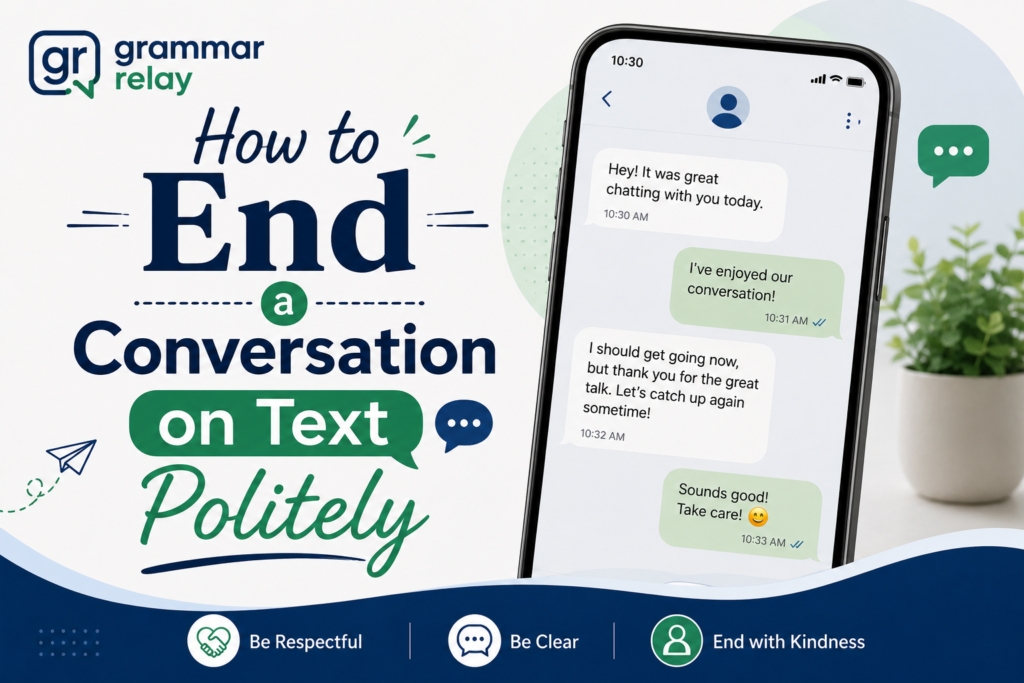
Knowing how to end a conversation on text politely is its own skill. Texts don’t have body language — so your words carry all the weight.
- “Anyway, I’ll let you get to it! Catch you soon.”
- “This was fun let’s pick it up later!”
- “Gotta run but great chatting!”
Don’t leave threads dangling with one-word replies. A warm, definitive closer beats a slow fade every time.
Ending Uncomfortable or Emotionally Heavy Conversations
You’re allowed to protect your energy. Compassion doesn’t mean staying in a conversation past the point you can be present.
Try: “I want to give this the attention it deserves can we find a better time to talk?”
It honors the other person without draining you.
Dialogue Ending Examples — Case Studies
1: The Chatty Office Colleague
Sarah stops by Mark’s desk at 2 p.m. Mark has a report due at 3. After five minutes, Mark stands up, smiles, and says: “Good talk, I really need to push through this report before the deadline. Let’s grab coffee this week.” Sarah nods and leaves. Mark’s action (standing) signaled the end. His words confirmed it. Nobody felt bad.
2: The Networking Event Trap
James gets cornered by someone at a conference who’s been talking for 15 minutes straight. James uses the soft hand-off: “You should meet my colleague Priya she works in exactly that space.” He makes the introduction, excuses himself, and moves on. Clean. Professional. Zero awkwardness.
3: The Text That Never Ends
Lisa and a friend have been texting back and forth for an hour. Lisa needs to focus. She sends: “Haha okay I need to actually get dinner started this was fun though! Talk tomorrow.” Conversation closed. No weirdness.
These are real dialogue ending examples that work because they’re specific, warm, and decisive.
What NOT to Do When Ending a Conversation
Avoid these common mistakes they make exits more painful, not less:
- Don’t fake-promise follow-ups you won’t actually make (“We should totally hang out sometime!” if you don’t mean it, skip it)
- Don’t drag the goodbye out with three rounds of “okay, bye… alright… talk soon… okay…”
- Don’t over-explain your reason for leaving one clear reason is enough
- Don’t apologize excessively it signals that leaving is somehow wrong
- Don’t restart the conversation saying goodbye then bringing up a new topic is the classic false-restart trap
You might be interested in “Conversation Topics for Adults”
Building the Skill — Practice Makes Natural
Here’s the honest truth: how to politely leave a conversation is a learnable skill. It feels awkward at first because most of us never practiced it.
Start small. Use low-stakes exits with cashiers, baristas, neighbors to build the muscle. Notice how a clean “Thanks so much, have a great day!” lands naturally. Then bring that energy into bigger conversations.
The mindset shift that changes everything: an exit isn’t a rejection. It’s a punctuation mark. A good one leaves the whole conversation feeling complete.
The Graceful Exit — Quick Cheat Sheet
| What You Want to Do | Best Strategy |
|---|---|
| Leave a party conversation | Soft hand-off or natural pause exit |
| End a work chat | Stand up + direct reason |
| Cut off an oversharer | Escalate signals → direct statement |
| End a phone call | “I should let you go” works every time |
| Close a text thread | Warm, definitive one-liner |
| Exit a group chat | Smile, wave, no announcement |
A Good Goodbye Is a Gift

The best conversation enders have one thing in common: they’re kind, clear, and confident. Don’t leave the other person guessing. They don’t drag out the discomfort. They close the loop and they do it warmly.
You don’t owe anyone an unlimited conversation. Your time matters. So does theirs. A clean exit respects both.
Next time you feel that familiar trapped feeling, remember: you already have the tools. Use them.
Frequently Asked Questions
Why do I feel so guilty ending conversations?
It’s usually social conditioning we’ve been taught that leaving = rejecting. It doesn’t. A respectful exit honors everyone’s time.
What’s the politest way to end a conversation?
Summarize what you enjoyed about the chat, give a brief reason for leaving, and close warmly. That formula works almost everywhere.
How do I end a conversation with someone who won’t stop talking?
Escalate gradually: non-verbal cues first, then soft verbal signals, then a kind but direct statement. Most people respond by the second step.
Is it rude to end a conversation without giving a reason?
In most casual settings, no. A warm smile and “Great seeing you!” is perfectly sufficient.
What are the best ways to end a conversation over text?
Be warm and definitive. Avoid one-word replies or slow fades. A clear closer like “Gott run talk soon!” works great.
How do I get better at knowing when someone wants to wrap up?
Watch for the verbal and non-verbal cues listed above. And when in doubt offer the exit yourself. Most people are grateful.
Read more grammar lessons on Grammar Relay
Conclusion:
Every conversation has to end. The only question is whether yours ends awkwardly or gracefully.
You now have the tools. The scripts. The situational playbook. All that’s left is putting them to work.
Remember a confident, warm end of conversation isn’t rude. It’s respectful. It tells the other person their time matters to you. And it leaves them with a better impression than any amount of small talk ever could.
So next time you feel that familiar trapped feeling, don’t panic. Take a breath, pick your exit, and close it out cleanly.
