


“Like” is one of the most used and most misused words in English. You’ve said it thousands of times today without thinking twice. But do you actually know how to use it correctly in writing?
This guide breaks it all down. Every role “like” plays. Every rule worth knowing. And dozens of real examples to make it stick.
What Does “Like” Actually Mean?
The like definition depends entirely on how you’re using it. That’s what makes this word so tricky and so fascinating.
At its core, “like” signals similarity, preference, or comparison. But it shape-shifts depending on where it sits in a sentence. It can be a verb, a preposition, a conjunction, a noun, an adjective, or even a filler word in casual speech.
Here’s the short version of the like meaning across different uses:
| Part of Speech | Core Meaning | Quick Example |
|---|---|---|
| Verb | To enjoy or prefer | “I like coffee.” |
| Preposition | Similar to | “She runs like the wind.” |
| Conjunction | In the same way that | “Do it like I showed you.” |
| Noun | A preference or similarity | “They share the same likes.” |
| Adjective | Similar, of the same kind | “They are of like mind.” |
| Filler word | Pause or approximation | “It was, like, amazing.” |
The Many Roles “Like” Plays in English
“Like” as a Verb Expressing Preference
This is the most familiar use. When you use “like” as a verb, you’re expressing enjoyment, preference, or fondness.
Structure: Subject + like/likes + noun or verb-ing
“She likes hiking on weekends.”
“They like the new restaurant downtown.”
Simple enough. But here’s where people slip up the third-person singular needs an -s. “He like pizza” is wrong. “He likes pizza” is right.
“Like” as a Preposition — Making Comparisons
As a preposition, “like” introduces a comparison. It’s followed by a noun or pronoun not a full clause.
Structure: Verb + like + noun/pronoun
“He swims like a fish.”
“This tastes like my grandmother’s cooking.”
One of the most common confusions? “Like” vs. “such as.”
- Use “like” when showing similarity: “Animals like dolphins are intelligent.” (dolphins are an example of a similar group)
- Use “such as” when listing specific examples: “Animals such as dolphins and whales are mammals.”
“Like” as a Conjunction — The Grammar Debate
Here’s where the fun starts. Using “like” as a conjunction connecting two clauses has been controversial for decades.
Traditionalists say: Use “as” or “as if” instead of “like” before a full clause.
❌ “She acted like she owned the place.” (informal)
✅ “She acted as if she owned the place.” (formal)
The reality? In everyday speech and informal writing, “like” as a conjunction is completely accepted. Even major style guides acknowledge this shift. Just know your audience formal essays call for “as if,” casual blog posts are fine with “like.”
“Like” as a Noun — When Preference Becomes a Thing
You can also use “like” as a noun to describe preferences or similarities.
“We should avoid people of his like.”
“Her likes and dislikes are well documented.”
In modern usage, “likes” has also taken on a social media meaning the number of approvals on a post. Language evolves fast.
Read more about How to End a Conversation Gracefully
“Like” as a Filler Word — The Habit Worth Watching
This one’s conversational. “Like” as a filler has been part of informal American English since the 1950s popularized heavily in California slang and, later, valley girl speak.
“It was, like, the best day ever.”
“I was like, totally shocked.”
In speech? Fine. In writing? Avoid it unless you’re deliberately capturing informal dialogue.
“Like” as a Verb — Full Breakdown
Affirmative Sentences With “Like”
These are the simplest. Subject + like + object.
- “I like jazz music.”
- “We like spending time outdoors.”
- “The dog likes its new toy.”
Negative Sentences With “Like”
Add “don’t” or “doesn’t” before “like.”
- “I don’t like crowded places.”
- “She doesn’t like being interrupted.”
- “They don’t like the new policy.”
Questions Using “Like”
Flip the auxiliary verb to the front.
- “Do you like spicy food?”
- “Does she like traveling?”
- “Did they like the presentation?”
Past Tense — “Liked”
Simple past just adds -d.
- “He liked the movie a lot.”
- “We liked how the event was organized.”
- “I liked her immediately.”
“Would Like” — The Polite Power Phrase
“Would like” is one of the most useful constructions in English. It’s softer than “want” and works perfectly in formal and professional settings.
Compare these two sentences:
“I want a refund.” ← direct, almost demanding “I would like a refund.” ← polite, professional
That small change shifts the entire tone. In business emails, customer service, job interviews “would like” is your friend.
Structure:
Subject + would like + noun / to + verb
Affirmative Examples
- “I would like to schedule a meeting.”
- “She’d like the salmon, please.”
- “We would like your feedback.”
Negative Examples
- “I wouldn’t like to be in that situation.”
- “He wouldn’t like that idea at all.”
Question Examples
- “Would you like more time?”
- “What would she like to drink?”
- “Would they like to join us?”
Pro tip: “I’d like” is the contracted form. It’s perfectly correct and sounds more natural in conversation.
“-Like” as a Suffix — Building New Words
Attach -like to a noun and you get a brand-new adjective meaning “resembling” that thing.
Examples:
- Lifelike — realistic, convincing
- Childlike — innocent, simple
- Dreamlike — surreal, hazy
- Businesslike — efficient, professional
- Warlike — aggressive, combative
When to Hyphenate
The rules here trip people up. General guidance:
- No hyphen for well-established words: lifelike, childlike, dreamlike
- Hyphen when the base word ends in -l: eel-like, shell-like
- Hyphen when the base word has multiple syllables and the result looks awkward: centipede-like, bureaucrat-like
When in doubt? Check a style guide or dictionary and default to the hyphen if it aids readability.
50+ Real Example Sentences Using “Like”
Sentences With “Like” as a Verb
- “I like the way you explained that.”
- “Do you like working from home?”
- “Nobody liked the new design.”
- “She likes her coffee black, no sugar.”
- “The kids like playing in the rain.”
Sentences “Like” as a Preposition
- “He sings like a professional.”
- “Nothing feels like home.”
- “She handled it like a pro.”
- “It looks like rain tonight.”
- “Stop acting like a child.”
“Like” as a Conjunction
- “Do it like I showed you.”
- “She talked like she knew everything.”
- “It turned out like I expected.”
“Would Like” Sentences
- “I would like to apply for the position.”
- “Would you like to take a seat?”
- “They’d like a table near the window.”
“-Like” Suffix Sentences
- “The painting had an almost dreamlike quality.”
- “Her approach was calm and businesslike.”
- “The creature moved in a snakelike pattern.”
Common Mistakes People Make With “Like”
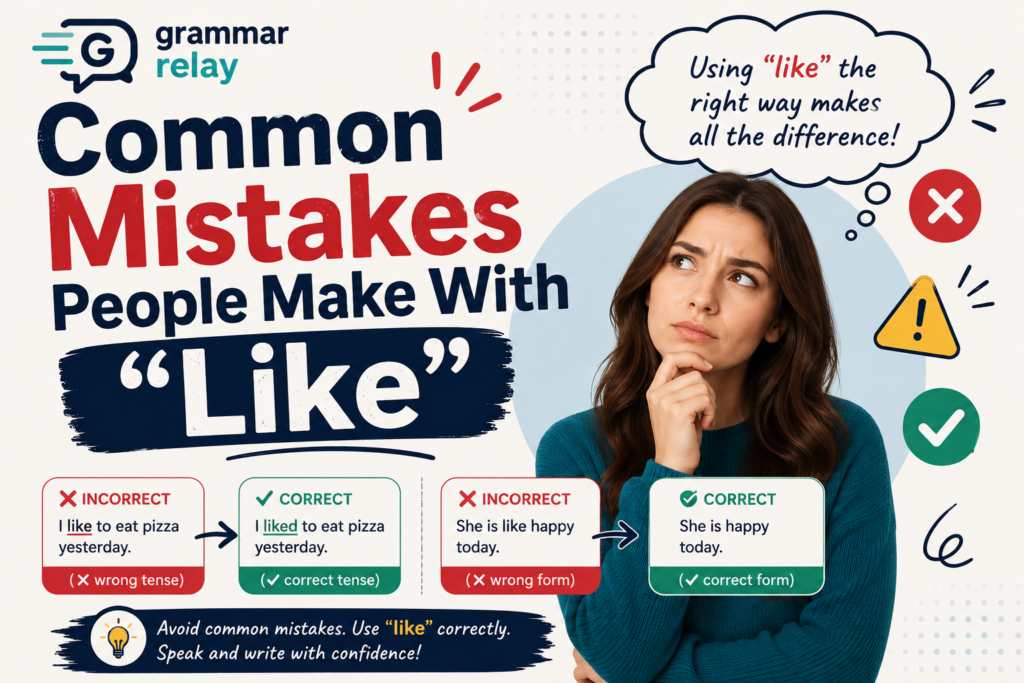
Confusing “like” and “as”
❌ “Do like I say.”
✅ “Do as I say.” (formal writing)
Using “like” when “such as” is more precise
❌ “I enjoy sports like tennis and swimming.”
✅ “I enjoy sports such as tennis and swimming.” (when listing specific examples)
Overusing “like” as filler
Too many “likes” in writing makes it hard to read and undermines your credibility. Read it back if “like” doesn’t serve a grammatical purpose, cut it.
Hyphenation errors with “-like”
❌ “A robot like appearance”
✅ “A robot-like appearance”
You might be interested in 50+ phrases to say “For Example”
Quick Reference — “Like” at a Glance
| Function | Structure | Example |
|---|---|---|
| Verb | Subject + like + noun/-ing | “I like hiking.” |
| Preposition | Verb + like + noun | “Runs like the wind.” |
| Conjunction | like + full clause | “Like I expected.” |
| Noun | Possessive + like/likes | “Her likes and dislikes.” |
| Suffix | Noun + -like | “A lifelike portrait.” |
| Polite request | Would like + to + verb | “I’d like to help.” |
Frequently Asked Questions About “Like”
Is it grammatically wrong to use “like” as a conjunction?
Not in informal English. Traditionally, “as” or “as if” was preferred before full clauses. But modern usage and most contemporary style guides accept “like” as a conjunction in conversational and informal contexts.
What’s the difference between “like” and “as if”?
“As if” introduces a hypothetical or unreal situation. “Like” is more casual and general. “She looked as if she’d seen a ghost” implies she hadn’t it’s imaginary. “She looked like she was tired” is just a comparison.
Can “like” start a sentence?
Yes. “Like most people, she preferred honesty.” That’s a perfectly clean sentence with “like” as a preposition opening a comparative phrase.
Is “would like” more formal than “want”?
Absolutely. “Want” is direct and neutral. “Would like” softens the request and signals politeness which is why it dominates in professional emails, customer service, and formal speech.
Read more grammar lessons on Grammar Relay
Conclusion
“Like” is small. Just four letters. But it punches well above its weight in the English language.
You’ve seen it work as a verb, a preposition, a conjunction, a noun, a suffix, and even a filler word. Each role carries its own rules and now you know them all. From simple sentences like “I like coffee” to polished professional phrases like “I would like to schedule a meeting,” this word does serious heavy lifting every single day.
Here’s what’s worth remembering:
- Context is everything. The same word means different things depending on where it sits in a sentence.
- Formal vs. informal matters. “Like” as a conjunction is fine in casual writing but swap it for “as” or “as if” when the stakes are higher.
- “Would like” is your politeness superpower. One small swap transforms a demand into a gracious request.
- The “-like” suffix is wildly useful. Master it and you unlock a whole new layer of descriptive vocabulary.
