


If you’ve ever typed “calfs” into a sentence and then paused, wondering if that’s actually a word, you’re not alone. English plurals can be sneaky, and the word “calf” is one of those tricky ones that doesn’t just add an “s” at the end. So let’s settle this once and for all: is it calfs or calves?
Quick Answer
The plural of calf is calves. Always. “Calfs” is not a standard English word, no matter which dictionary you check or which context you’re writing in.
Here’s a simple example to lock it in: “The farmer fed three calves” is correct. “The farmer fed three calfs” is not. Same goes for the leg muscle meaning: “My calves are sore after running” is right, while “my calfs are sore” will make any English teacher wince.
This one rule covers both meanings of the word, whether you’re talking about baby cows or the muscles on the back of your lower legs. One word, one plural, no exceptions.
What Does “Calf” Mean?
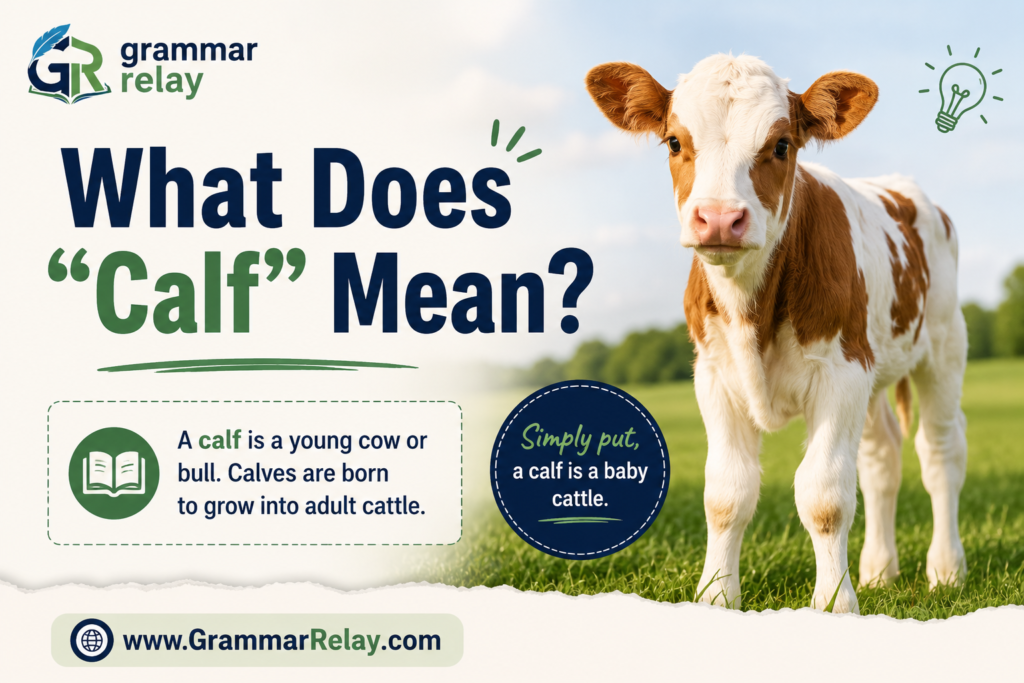
Before diving deeper into the calf vs calve debate, it helps to understand that “calf” actually has two completely different meanings, even though they’re spelled and pronounced the same way.
A Young Cow or Other Animal
The most traditional meaning of calf refers to a baby cow. But it doesn’t stop there. The word also applies to the young of several other large animals, including elephants, whales, and giraffes. A farmer might say, “The cow gave birth to a healthy calf this morning,” and that sentence would be perfectly natural on a dairy farm anywhere in the world.
The Back Part of the Lower Leg
The second meaning has nothing to do with animals at all. It’s the muscular part of your leg, located behind your shin, between your knee and your ankle. This is the meaning most people run into when they’re talking about workouts, injuries, or sore muscles after a long hike.
So when someone asks, “calve or calf, which one applies to my leg?”, the answer is simple: it’s always “calf” in the singular, whether you’re talking about your leg or a baby animal. “Calve” is actually a verb (more on that below), not a noun at all.
Why Calf Becomes Calves
English has a small but stubborn group of nouns that change their final “f” or “fe” to “ves” when they become plural. Calf is one of them, and honestly, once you know the pattern, it’s pretty easy to remember.
Other Words That Follow This Pattern
Here’s a quick table showing some common examples of the same f-to-v shift:
| Singular | Plural |
|---|---|
| calf | calves |
| leaf | leaves |
| knife | knives |
| wolf | wolves |
| half | halves |
| life | lives |
| loaf | loaves |
| shelf | shelves |
| thief | thieves |
| wife | wives |
Notice the pattern? Words ending in a single “f” or “fe” preceded by certain sounds tend to soften that “f” into a “v” sound when you add the plural ending. This softening happened naturally over centuries of spoken English, long before spelling was standardized, and it stuck around in writing even after pronunciation rules shifted elsewhere.
Read more about Advice vs Advise: The Complete Guide to Using Both Words Correctly
Words That Break the Pattern
Now, before you start changing every “f” word in your vocabulary, here’s the catch: not every word ending in “f” follows this rule. Some stay exactly the same except for adding an “s”:
| Singular | Plural |
|---|---|
| roof | roofs |
| chief | chiefs |
| belief | beliefs |
| proof | proofs |
| chef | chefs |
| cliff | cliffs |
There’s no foolproof shortcut for knowing which words belong in which group. It mostly comes down to memorization and exposure, which is honestly true for a lot of English spelling quirks. The good news is that “calf” firmly belongs in the “calves” camp, with zero exceptions in modern standard English.
Is “Calfs” Ever Correct?
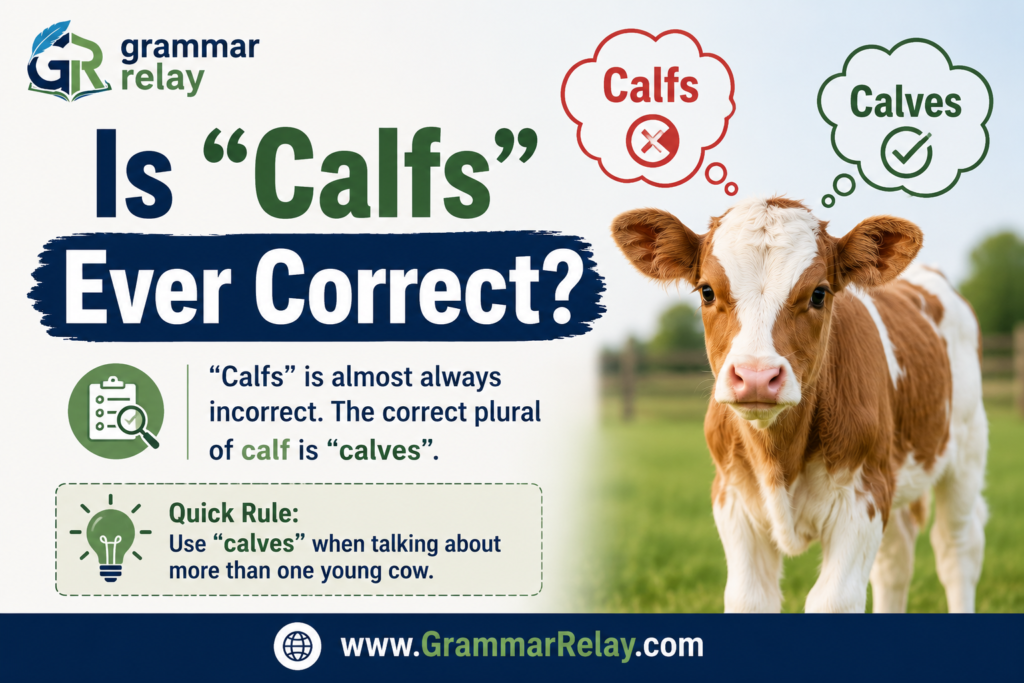
Short answer: no. “Calfs” doesn’t appear in any major dictionary, whether you’re checking Merriam-Webster, Oxford, or Cambridge. It’s simply a spelling error, usually caused by someone applying the regular “add an s” rule to a word that doesn’t follow it.
You might occasionally spot “calfs” in old historical texts or regional dialects, where spelling wasn’t standardized the way it is today. But for any modern writing, whether it’s an email, a blog post, a school paper, or a text to a friend, “calfs” should be treated as a typo, not a valid alternative spelling.
So if you’re wondering about calves or calfs for your next piece of writing, the choice isn’t really a choice. Calves wins every time.
British English vs. American English
Here’s something that might surprise you: when it comes to the calf plural, British and American English actually agree completely. Both varieties use “calves” as the plural form, with identical spelling.
| Feature | British English | American English |
|---|---|---|
| Singular form | calf | calf |
| Plural form | calves | calves |
| Pronunciation of “calf” | /kɑːf/ | /kæf/ |
| Spelling differences | None | None |
The only real difference shows up in pronunciation. British speakers tend to use a longer “ah” sound, similar to how they pronounce “father,” while American speakers use a shorter “a” sound, closer to “cat.” But on paper, both sides of the Atlantic write it exactly the same way. So if you’ve been searching for a calfs or calves spelling difference between US and UK English, you can stop looking. It doesn’t exist.
“Calf Muscle” or “Calves Muscle”? Singular vs. Plural in Context
This is where a lot of people trip up, especially in fitness and medical writing. The confusion usually comes down to whether you’re talking about one leg or both.
If you’re referring to a single leg, you’d say “calf muscle,” as in “I strained my calf muscle during the race.” But if you’re talking about both legs together, which is more common in everyday speech, you’d say “calves” or “calf muscles,” as in “My calves are killing me after that workout” or “Calf muscles tend to get tight if you don’t stretch.”
You’ll almost never hear “calves muscle” as a singular phrase. It just doesn’t sound right to native speakers, and grammatically, it mixes a plural noun with a singular structure in a way that feels off. Stick with either “calf muscle” (singular) or “calves” (plural) depending on what you’re describing.
Calves in Everyday Use
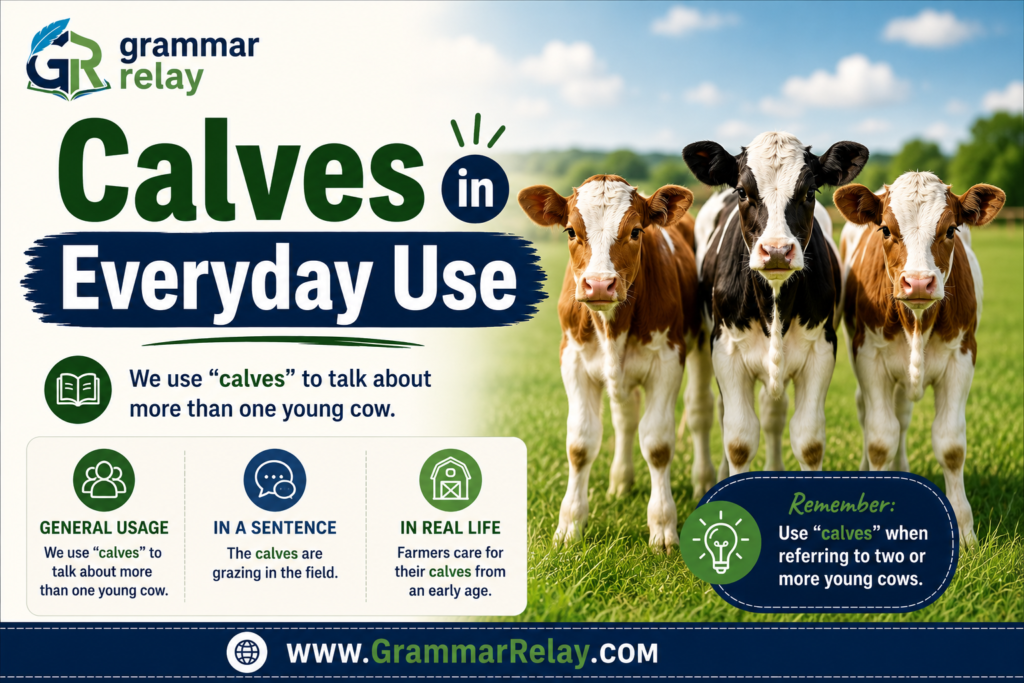
Now that the grammar basics are out of the way, let’s look at how “calves” actually shows up in real-world writing across different fields.
Fitness and Workout Language
If you spend any time at a gym or following workout routines online, you’ve definitely encountered “calves” in phrases like “calf raises,” “calves day,” or “tight calves.” Trainers often say things like, “Don’t skip your calves, they’re easy to neglect but important for overall leg strength.”
Agriculture and Farming
On farms, “calves” is everyday vocabulary. A rancher might mention, “We had a record number of calves born this spring,” or talk about “weaning the calves” once they’re old enough to eat solid food. In this context, the word is as common as “cows” or “cattle.”
Medical and Anatomical Writing
In medical settings, “calves” appears constantly, especially when discussing circulation, swelling, or muscle injuries. A doctor might note, “The patient reported pain in both calves after the flight,” which is a classic symptom doctors watch for related to blood clots.
Common Mistakes and How to Avoid Them
The most frequent mistake people make is writing “calfs” when they mean the plural of “calf.” This usually happens because English speakers learn the basic rule early on that you add “s” to make most nouns plural, like “cats” or “dogs.” Calf just doesn’t play by those rules, and unless someone specifically points that out, it’s an easy trap to fall into.
A second mistake involves confusing “calf” (the noun) with “calve” (the verb). “Calve” means to give birth, specifically used for cows and similar animals, as in “The cow is expected to calve next week.” So when someone asks about “calve or calf” for their leg, the answer is always “calf,” since “calve” only works as a verb related to animal birth.
Here’s a memory trick that works well: think of the phrase “half and calves.” Both “half” and “calf” end in “f,” and both become “ves” in the plural (“halves” and “calves”). If you can remember one, you can remember the other.
You might be interested in Hid or Hide: Which Is Correct? (Complete Grammar Guide)
Quick Reference Table
For a fast cheat sheet, here’s a side-by-side comparison covering the most common variations people search for:
| Term | Correct or Incorrect | Notes |
|---|---|---|
| calf | Correct | Singular noun |
| calves | Correct | Plural noun |
| calfs | Incorrect | Common misspelling |
| calve | Correct (as a verb) | Means “to give birth” for animals |
| calf plural | calves | The answer to this exact phrase |
| calf vs calve | Different words | Calf = noun, calve = verb |
Frequently Asked Questions
Is “calfs” ever correct?
No. “Calfs” is not recognized in any standard English dictionary and is considered a spelling mistake in all contexts.
What is the plural of calf?
The plural of calf is calves, used for both the leg muscle and the young of certain animals.
Why does calf become calves?
It follows an old English pattern where certain words ending in “f” or “fe” shift to “ves” in the plural, a sound change that dates back centuries.
Is it “calf muscles” or “calves”?
Both are correct depending on context. Use “calf muscle” for one leg and “calves” or “calf muscles” when referring to both legs.
Do all words ending in -f change to -ves?
No. Words like “roofs,” “chiefs,” and “beliefs” simply add an “s” without changing the spelling, so each word needs to be learned individually.
Is “calves” used the same way in fitness and farming?
The spelling and pluralization stay identical, though the meaning shifts entirely based on context, referring either to leg muscles or baby animals.
Read more grammar lessons on Grammar Relay
Conclusion
At the end of the day, the calfs or calves question really has just one answer: calves is correct, and “calfs” is not a word you’ll find in proper English writing. Whether you’re talking about a newborn animal on a farm or the muscles burning after leg day at the gym, “calves” covers both meanings without any spelling changes between British and American English.
If you remember the pattern with words like “half” and “leaf,” and you keep “calve” (the verb) separate from “calf” (the noun), you’ll never second-guess this one again. Next time you’re typing out a sentence about sore legs or a new addition to the herd, you’ll know exactly which word to reach for.
