


Three words. Billions of people. And surprisingly little agreement on what each one actually means. Ask someone from the United Kingdom what makes a city and they’ll mention a royal charter and they’ll talk about population and state law. Ask someone from India and they’ll reference municipal corporations and census classifications. The village town city isn’t just a matter of size. It’s a question of governance, history, legal status, economics, and culture all tangled together.
Why the Distinction Between City, Town, and Village Still Matters
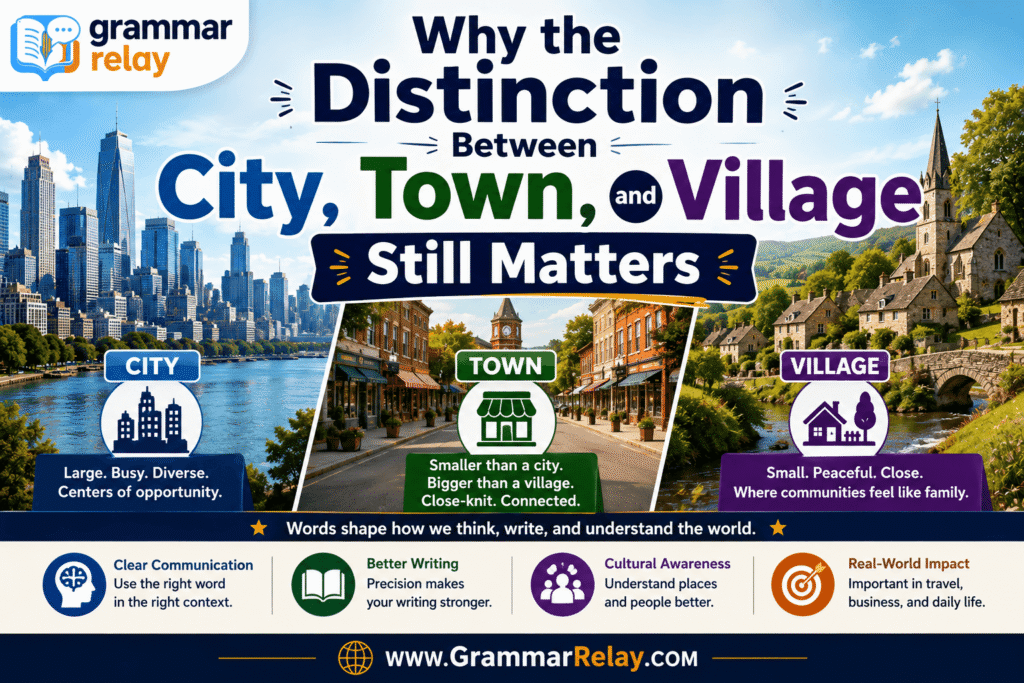
Settlement classification isn’t just an academic exercise. It determines real things in the real world: how much tax revenue a community controls, which federal funding it qualifies for, what level of emergency services it receives, and how many votes it gets in regional governance structures.
A place classified as a village in rural England might receive minimal direct funding and depend on county-level services. A city with the same population in Australia controls its own budget, runs its own police force, and operates independently. The label carries weight.
| Feature | Village | Town | City |
|---|---|---|---|
| Typical population | Under 1,000–5,000 | 1,000–100,000 | 100,000+ (varies by country) |
| Governance | Parish/local council | Town council/municipality | Mayor, city council, full government |
| Economic base | Agriculture, local trade | Mixed: retail, services, light industry | Finance, industry, services, government |
| Infrastructure | Basic | Moderate | Advanced |
| Legal status | Varies widely | Incorporated municipality | Chartered city |
What Is a Village? Full Definition, Characteristics, and Global Variations
A village is a small human settlement, typically rural or semi-rural, smaller than a town and generally organized around agriculture, local craft, or tight community life.
But the specific numbers vary dramatically by country. In the United Kingdom, a village typically has fewer than 1,000 residents. In India, the Census of India classifies any settlement under 5,000 people without a municipal body as a village. United States, there’s no federal definition: individual states set their own thresholds.
| Characteristic | Typical Village Profile | Notes |
|---|---|---|
| Population | Under 1,000–5,000 | Varies significantly by country |
| Economic base | Agriculture, local craft, tourism | Limited commercial zones |
| Governance | Parish council, village panchayat | Minimal formal administration |
| Infrastructure | Basic roads, possibly a school, local shop | Limited public services |
| Social structure | High familiarity, tight community | Low anonymity |
| Land use | Primarily residential and agricultural | Little industrial zoning |
What makes a village feel like a village isn’t just the population count. It’s the social texture. When nearly everyone knows everyone else, when the local pub or communal well serves as the social center, when farming or fishing shapes the daily rhythm: that’s village life in its traditional form.
One fascinating complication: some of the world’s most famous “villages” aren’t villages at all in the technical sense. Greenwich Village in New York City sits within one of the densest urban environments on Earth. The name is historical, not administrative. Is a village a town in cases like these? No: it’s a neighborhood borrowing the name. The label describes history and character, not governance.
What Is a Town? Full Definition, Characteristics, and Global Variations
A town sits between a village and a city in the settlement hierarchy. It has a commercial center, some level of formal self-governance, defined infrastructure, and typically grew from a market or trade function.
What’s the difference between town and village at its most fundamental level? Towns have markets. Historically, the right to hold a regular market was the defining distinction between a village and a town across medieval Europe. The market created economic gravity: merchants, craftsmen, and eventually institutions gathered around it.
| Characteristic | Typical Town Profile | Notes |
|---|---|---|
| Population | 1,000–100,000 | Highly variable by country |
| Economic base | Retail, services, light industry | Regular market activity |
| Governance | Town council, mayor, municipality | Defined local government |
| Infrastructure | Schools, hospitals, transport links | Moderate public services |
| Social structure | Moderate familiarity | Mix of anonymity and community |
| Land use | Mixed residential, commercial, light industrial | Defined zoning |
The town vs village distinction becomes particularly clear in economic terms. A village might have a post office and a general store. A town has a high street, multiple schools, a hospital or clinic, regular transport connections, and professional services ranging from solicitors to accountants to dentists.
What Is a City? Full Definition, Characteristics, and Global Variations
A city is a large, densely populated human settlement with complex governance, economic diversity, and substantial infrastructure. But here’s where the city vs town comparison gets genuinely surprising: population alone doesn’t determine city status in most countries.
In the United Kingdom, city status is granted by royal charter regardless of population. Wells in Somerset has held city status since the Middle Ages with a current population of fewer than 12,000 people. Meanwhile, Reading (population approximately 230,000) is classified as a town. The legal status and the demographic reality diverge dramatically.
In the United States, some chartered cities have populations under 1,000. Maza, North Dakota held city status with fewer than 100 residents. City status is granted by state governments, not the federal government, and the thresholds vary dramatically.
| Characteristic | Typical City Profile | Notes |
|---|---|---|
| Population | 100,000+ (varies widely) | Some chartered cities have far fewer |
| Economic base | Finance, industry, government, services | Highly diversified |
| Governance | Mayor, city council, multiple departments | Complex administration |
| Infrastructure | Extensive transport, hospitals, universities | Full public service range |
| Social structure | High anonymity, diverse communities | Complex social fabric |
| Land use | Dense mixed-use zoning | Commercial, residential, industrial |
How Population Thresholds Define City, Town, and Village Around the World
The village vs city vs town classification system varies enormously across national borders. Here’s the concrete data by country:
| Country | Village Threshold | Town Threshold | City Threshold | Classification Authority |
|---|---|---|---|---|
| United States | No federal standard | Varies by state (often 1,000+) | Varies by state | State governments |
| United Kingdom | Under ~1,000 | No fixed threshold | Royal charter required | Crown/Parliament |
| India | Under 5,000, no municipality | 5,000–100,000, urban local body | 100,000+, municipal corporation | Census of India |
| Japan | N/A (mura/son) | Under 50,000 (machi/cho) | 50,000+ (shi) | National government |
| Australia | Rural settlement | 1,000–100,000 | 100,000+ | State governments |
| Germany | Under 5,000 (Dorf) | 5,000–100,000 (Stadt) | 100,000+ (Großstadt) | State governments |
| China | Administrative village | Township | Prefecture/county-level city | National government |
Japan’s classification is particularly precise. A settlement becomes a “shi” (city) when it reaches 50,000 people AND has at least 60% of households concentrated in the urban district AND has urban facilities and conditions. Population is necessary but not sufficient.
Read more about Behaviour vs Behavior
Historical Evolution: How Villages Became Towns and Towns Became Cities
The village vs town vs city hierarchy isn’t just a modern administrative convenience. It reflects thousands of years of human settlement development.
The oldest known permanent human settlements emerged around 10,000 BCE following the agricultural revolution. Ain Ghazal in modern-day Jordan and Çatalhöyük in modern-day Turkey (inhabited approximately 7500 BCE) represent some of the earliest proto-urban settlements: larger than isolated family groups but not yet the complex cities that would emerge in Mesopotamia around 3500 BCE.
| Period | Development | Example |
|---|---|---|
| ~10,000 BCE | First permanent agricultural villages | Ain Ghazal, Jordan |
| ~3500 BCE | First true cities emerge in Mesopotamia | Uruk, Sumeria |
| ~1000 CE | Market towns flourish in medieval Europe | Winchester, England |
| 1760–1840 | Industrial Revolution creates industrial cities | Manchester, England |
| 1800s | Railways determine town-to-city growth | Chicago, USA |
| 1900s | Suburbanization creates town rings around cities | Greater London suburbs |
| 2000s+ | Megacity emergence and urban sprawl | Tokyo, Shanghai |
The Industrial Revolution compressed centuries of urban development into decades. Manchester grew from a market town of approximately 25,000 people in 1772 to a city of over 300,000 by 1850. The railroad effect in the American West was similarly dramatic: towns with rail connections became cities while equally promising towns without them faded into villages or disappeared entirely.
“The city is not a problem to be solved but a place to be understood.” — Jane Jacobs, The Death and Life of Great American Cities
Governance Structures: How Villages, Towns, and Cities Are Actually Administered
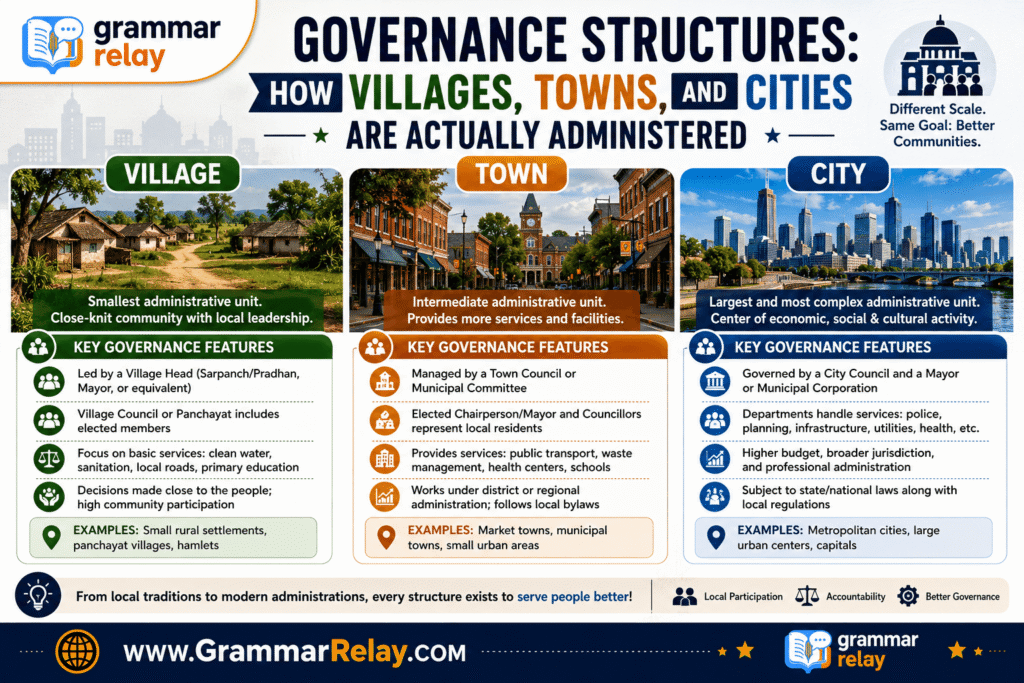
The city vs town vs village distinction carries its clearest practical consequences in governance.
| Governance Element | Village | Town | City |
|---|---|---|---|
| Primary authority | Parish/local council | Town council/board | Mayor and city council |
| Legal incorporation | Usually no | Often yes | Yes |
| Tax-raising power | Limited/none | Moderate | Full |
| Police force | Usually county/state | Sometimes own | Almost always own |
| Planning authority | Limited | Moderate | Full |
| Federal/national funding access | Limited | Moderate | Full |
In England, village parishes can raise a small precept (local tax) but most significant decisions about roads, planning, and services fall to district or county councils above them. In the United States, incorporated cities control their own zoning, issue their own bonds, run their own public works departments, and hire their own city managers.
Infrastructure and Quality of Life: The Real Differences on the Ground
Town vs city vs village life looks dramatically different when you examine what each settlement type actually provides:
| Service/Infrastructure | Village | Town | City |
|---|---|---|---|
| Healthcare | Basic GP/clinic (sometimes none) | Hospital with specialist departments | Multiple hospitals, specialist centers |
| Education | Primary school (often) | Primary and secondary, some higher ed | Full range including universities |
| Transport | Limited bus routes | Bus and often rail links | Subway, rail, bus, airports |
| Internet access | Variable (often limited rural broadband) | Good broadband, some fiber | Comprehensive fiber, 5G |
| Emergency services | County/regional coverage | Local fire and police | Full independent emergency services |
| Cultural institutions | Community hall, local pub | Libraries, local theaters | Museums, concert halls, galleries |
The digital divide between settlement types remains significant. In the United States, the Federal Communications Commission reported in 2023 that approximately 14.5 million Americans in rural areas still lacked access to fixed broadband at speeds of 25/3 Mbps. Villages and small rural communities disproportionately bear this infrastructure gap.
Economic Base: How Villages, Towns, and Cities Generate Wealth
Cities dominate global economic production in a way that’s genuinely staggering. Cities generate approximately 80% of global GDP while housing just over half the world’s population (56% as of 2023, according to UN data). The concentration of economic productivity in urban areas reflects agglomeration effects: when talented people, capital, and institutions cluster together, productivity multiplies.
| Economic Factor | Village | Town | City |
|---|---|---|---|
| Primary industries | Agriculture, forestry, fishing | Manufacturing, retail, services | Finance, tech, government, services |
| Employment diversity | Very limited | Moderate | Highly diverse |
| Average wage levels | Lower | Middle | Higher (varies by sector) |
| GDP contribution | Minimal | Moderate | ~80% globally |
| Property costs | Typically lower | Middle range | Typically highest |
| Remote work potential | Increasing post-COVID | Moderate | Already high |
The hollowing-out of manufacturing towns in the United States and United Kingdom from the 1970s onward represents one of the most significant economic transformations of the 20th century. Towns like Detroit, Youngstown, and Sheffield lost their economic foundation when heavy industry declined. Some recovered through service sector reinvention. Many are still struggling.
You might be interested in Of Course vs Ofcourse: The Complete Guide
Culture and Community: How Settlement Type Shapes Social Life
German sociologist Ferdinand Tönnies articulated the fundamental social distinction between settlement types in his 1887 work Gemeinschaft und Gesellschaft (Community and Society). Gemeinschaft describes the tight, personal, obligation-based relationships of village life. Gesellschaft describes the contractual, impersonal, interest-based relationships of city life. Towns occupy the middle ground.
A 2019 study published in The Lancet found higher rates of anxiety and depression in urban populations compared to rural ones, even after controlling for socioeconomic factors. However, the same research noted that rural isolation carries its own mental health burdens. Neither settlement type is uniformly better for wellbeing: the optimal environment depends on individual temperament, social needs, and economic circumstances.
Environmental Impact: How Villages, Towns, and Cities Affect the Planet
Here’s the counterintuitive finding that surprises most people: dense cities often have lower per-capita carbon emissions than sprawling suburban towns. The reason is density. Urban residents walk more, use public transit more, live in smaller spaces that require less energy to heat and cool, and share walls with neighbors.
Approximately 1.2 million acres of US farmland are lost to development annually, much of it to suburban and exurban expansion rather than to dense urban cores. Village and small-town sprawl, which consumes land without the density to justify the footprint, often represents a worse environmental outcome than true urban density.
Cities like Copenhagen and Singapore are pioneering green urbanism models: Singapore covers approximately 50% of its land area with trees and plants despite being one of the world’s most densely populated countries.
Global Urbanization Trends: How the Balance Is Shifting
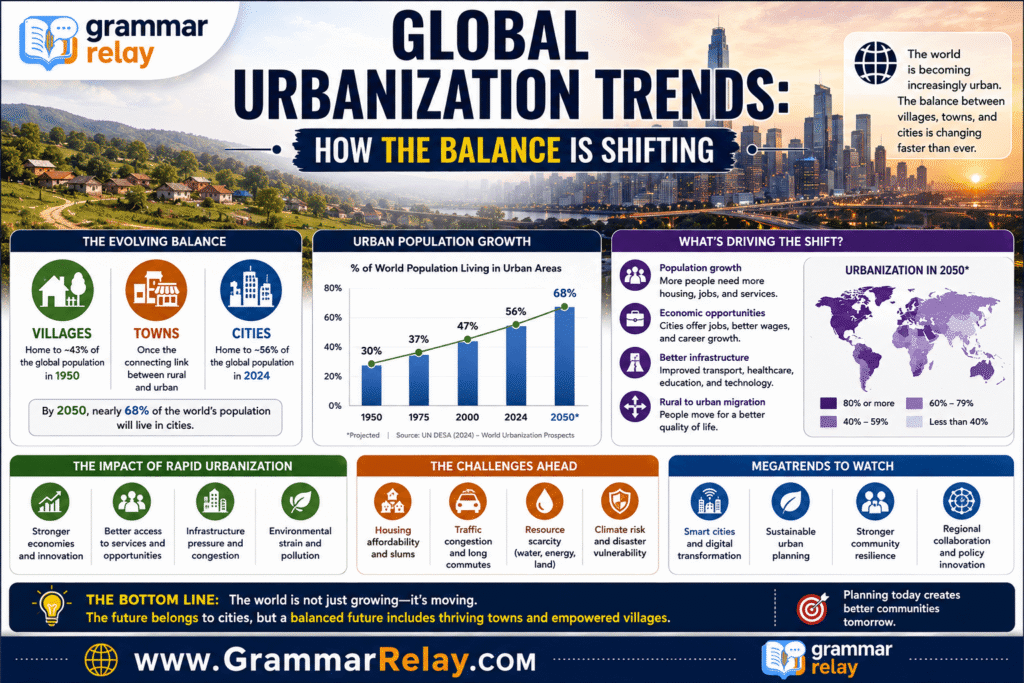
The city vs town balance is shifting at historic speed worldwide.
| Region | Current Urban Population % | Projected 2050 Urban % | Key Trend |
|---|---|---|---|
| North America | 83% | 89% | Suburban expansion |
| Europe | 75% | 83% | Counterurbanization in some areas |
| Latin America | 81% | 88% | Megacity growth |
| Asia | 52% | 66% | Fastest absolute urban growth |
| Africa | 44% | 59% | Fastest proportional urban growth |
| Oceania | 68% | 73% | Stable |
| World average | 56% | 68% | Consistent urbanization trend |
Sub-Saharan Africa is urbanizing faster proportionally than any other region. The UN projects that by 2050, African cities will need to accommodate approximately 950 million additional urban residents: more than the current population of the entire continent’s urban areas.
Post-COVID, a counterurbanization movement emerged in many developed countries. Remote work made it possible to live in towns and villages while maintaining city-level salaries. Between 2020 and 2022, several British towns and American small cities recorded their highest population growth in decades as urban residents relocated.
Famous Examples That Define Each Category
Some settlements define their category so perfectly that they become reference points:
Villages: Hallstatt, Austria (population approximately 800) is so perfectly preserved that UNESCO declared it a World Heritage Site. Bibury in England was called “the most beautiful village in England” by William Morris. Shirakawa-go in Japan maintains 17th century farmhouses in a village setting that draws more than a million visitors annually.
Towns: Bath, England sits in a fascinating contradiction: it holds official city status (granted in 1590) but functions as a market town with a population of approximately 100,000. Asheville, North Carolina demonstrates how a mid-sized American town can develop a distinctive cultural identity. Queenstown, New Zealand built an entire economy around adventure tourism from a small-town base.
Cities transformed from villages: Dubai was a fishing and pearl-diving village of approximately 20,000 people as recently as 1960. Today it’s a city of over 3.5 million with the world’s tallest building. Singapore achieved independence as a city-state in 1965 with a GDP per capita below $500. Today it exceeds $65,000.
Frequently Asked Questions
What is the main difference between a city, a town, and a village?
The differences involve population size, governance structure, economic complexity, and legal status. Villages are small, primarily agricultural, with minimal governance. Towns have markets and formal self-governance. Cities have complex governance, diverse economies, and extensive infrastructure. However, the specific thresholds vary significantly by country.
Is there a universal population threshold that separates these settlement types?
No. There is no internationally agreed standard. Japan requires 50,000 people minimum for city status. The UK grants city status by royal charter regardless of population. Some US cities have fewer than 1,000 residents. Each country applies its own classification system.
How does a village officially become a town or city?
The process varies by country. In the UK, settlements petition the Crown for city status during jubilee years or special occasions. US, communities petition their state legislature for incorporation as a town or city. In India, a settlement gains town status when it acquires an urban local body through state government action.
What percentage of people live in cities globally?
As of 2023, approximately 56% of the world’s population lives in urban areas, according to UN data. This figure is projected to reach 68% by 2050, with the largest growth occurring in Asia and Africa.
Is a village a town?
No. A village and a town are distinct settlement categories. Villages are smaller, have less governance infrastructure, and typically lack the commercial center that defines a town. However, the boundary can blur in practice, and some settlements carry historical names that don’t match their current classification.
What is a hamlet and how is it different from a village?
A hamlet is smaller than a village and typically lacks a church or administrative center. In England, hamlets have no parish council of their own and are usually governed by a neighboring parish. They represent the smallest formal settlement classification in many countries.
Read more grammar lessons on Grammar Relay
Conclusion
They’re different answers to the question of how human beings organize themselves in space. Villages offer community, connection, and proximity to land. Towns offer commercial vitality and a balance between familiarity and privacy. Cities offer opportunity, diversity, and the creative friction that comes from concentrating millions of different people and ideas in one place.
The definitions shift by country. The populations overlap. The character of a place often defies its official classification. But understanding the differences, in governance, economics, infrastructure, and social life gives you a far richer picture of the world’s human geography than population numbers alone ever could.
