


If you’ve ever paused mid-sentence wondering whether to type “ingrained” vs “engrained,” you’re not alone. Both words show up in books, articles, and everyday conversation, and spell check rarely flags either one. So how do you know which is correct?
Here’s the short version: “ingrained” is the standard, modern spelling, and “engrained” is an older variant that’s still technically correct but far less common today. Let’s dig into why that’s the case, where both words came from, and how to use them with confidence.
What “Ingrained” Means
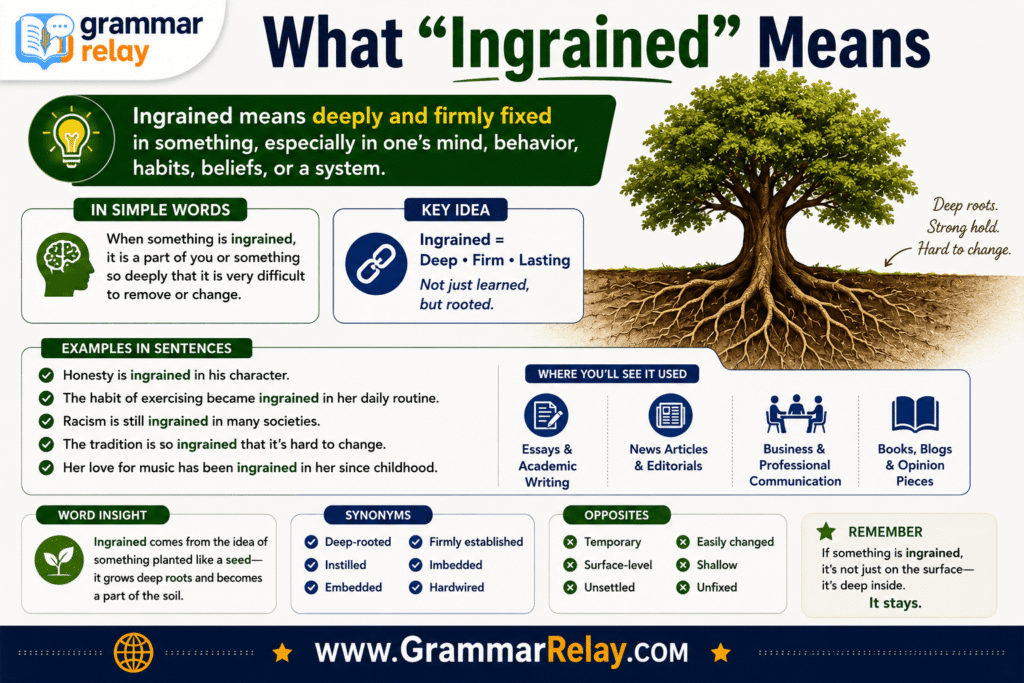
“Ingrained” describes something deeply established or firmly fixed, usually a habit, belief, attitude, or pattern that’s become part of who you are. It can also describe something physical, like a stain that’s worked its way into a fabric’s fibers.
Here’s the ingrained meaning in plain terms: if a behavior or idea is ingrained, it’s no longer surface-level. It’s baked in, hard to shake, and often formed over years of repetition.
A few quick examples:
- Her work ethic was ingrained by years of watching her parents run a small business.
- Racism and bias can become ingrained in institutions long before anyone notices.
- The smell of smoke was ingrained in the curtains after decades of use.
Grammatically, “ingrained” functions as both an adjective and the past participle of the verb “ingrain.” You’ll see it most often describing something that has settled into place over time.
What “Engrained” Means
“Engrained” carries the exact same definition. There’s no shift in meaning, tone, or usage rules between the two. If someone asks you the engrained meaning, you’d give them the same answer you’d give for “ingrained”: something deeply rooted or firmly established.
This is where a lot of confusion starts. People assume two spellings must signal two different meanings, the way “affect” and “effect” do. That’s not what’s happening here. “Engrained” is simply a variant spelling, not a distinct word with its own job to do.
So Are They Actually Different Words?
No, and this is worth saying plainly because a lot of grammar sites overcomplicate it. When you compare ingrained vs engrained, you’re not comparing two words with different jobs. You’re comparing two spellings of the same word, one of which happens to be used far more often today.
Think of it like “gray” and “grey.” Both are correct. One is more common depending on where you live and what you’re reading. Neither is a grammar mistake, but one will look more natural to most modern readers.
So when you’re stuck deciding between engrained or ingrained, the safest move is to reach for “ingrained.” It’s the version readers expect, the version dictionaries list first, and the version that won’t make anyone pause.
Read more about City, Town and Village
Where These Words Came From
The French Root: “En Grain”
Both words trace back to the same source: the Old French phrase en grain, which referred to dyeing fabric “in grain,” meaning the color was worked so deeply into the material that it wouldn’t fade or wash out. Over time, “in grain” became one word and picked up a figurative meaning: something worked so deeply into a substance (or a person’s character) that it became permanent.
How “En-” Became “In-“
English has a long habit of swapping the prefixes “en-” and “in-” depending on the era, the region, and honestly, just popular usage at the time. Both prefixes trace back to Latin roots and were often used interchangeably in Middle English. Over centuries, “in-” versions of many words won out and became the standard, while “en-” versions faded into occasional or archaic use.
You can see this same pattern in other word pairs, though not all of them settled the same way:
| En- Form | In- Form | Which Won |
|---|---|---|
| Enquire | Inquire | In- (US), split (UK) |
| Ensure | Insure | Split, different meanings |
| Engrained | Ingrained | In- |
| Enclose | Inclose | In- (archaic now) |
“Ingrained” simply followed the broader trend and became the dominant spelling in modern English, especially in American usage.
Why “Ingrained” Became the Standard
Language doesn’t evolve by committee. It shifts based on what people actually write and read, and over the last two centuries, “ingrained” has pulled steadily ahead. Data from tools like Google Ngram Viewer shows a clear divergence starting in the 1800s, with “ingrained” overtaking “engrained” and never looking back.
Major dictionaries reflect this too:
“Ingrained: deeply established, or fixed firmly within a person’s character.” Merriam-Webster
Merriam-Webster lists “engrained” as a variant spelling, not a separate entry with its own definition. Oxford does the same. Style guides like the AP Stylebook default to “ingrained” as well, which matters if you’re writing for publications, blogs, or professional documents.
Is “Engrained” Wrong?
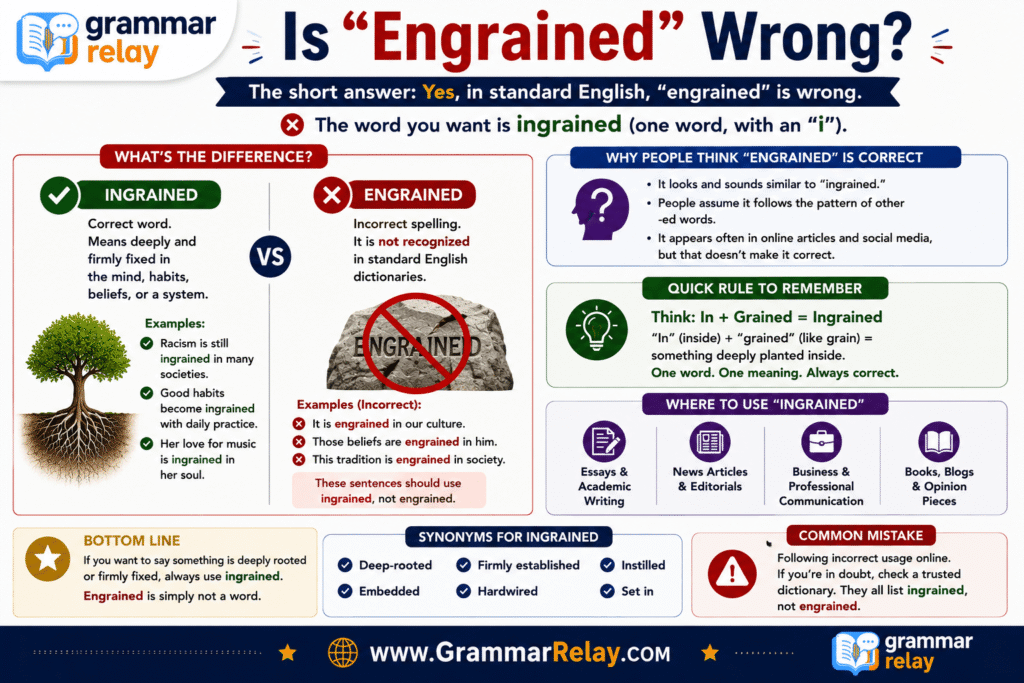
No, and it’s important not to overstate this. “Engrained” isn’t a typo or an error the way “definately” is. It’s a legitimate, dictionary-recognized spelling that simply fell out of favor.
You’ll still spot it occasionally in:
- Older books and historical texts
- Some British English writing (though even there, “ingrained” is now more common)
- Formal or academic writing where a writer leans toward older conventions
If you’re editing someone else’s writing and see “engrained,” you don’t need to treat it as a mistake. But if you’re writing something new, especially for a modern audience, “ingrained” is the safer, more expected choice.
The Verbs: “Ingrain” vs. “Engrain”
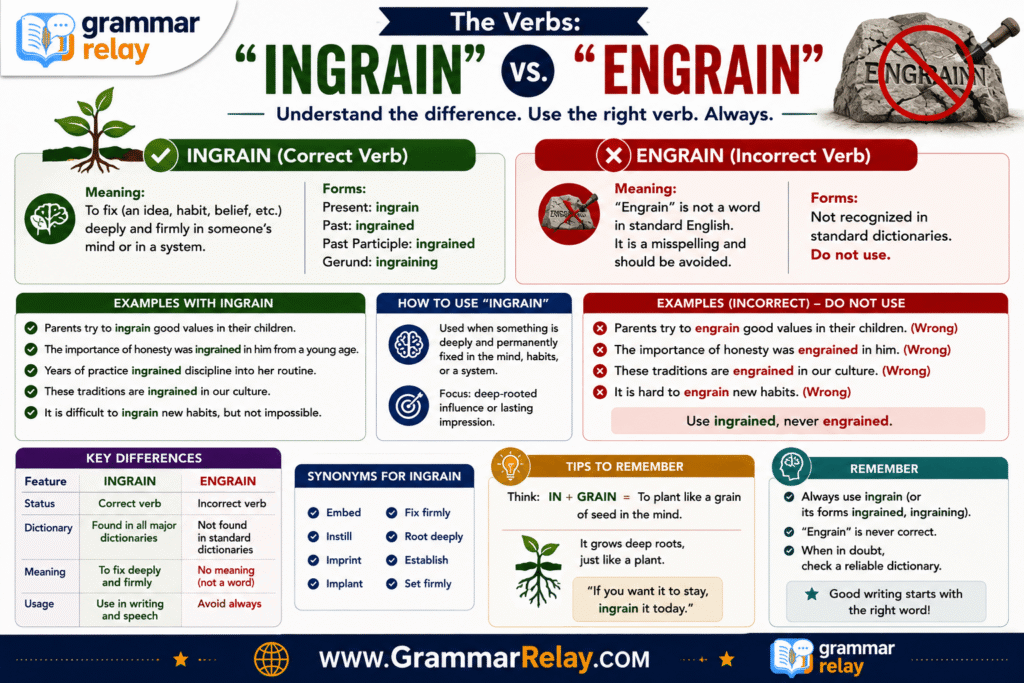
Both words also work as verbs, and the same rule applies: they mean the same thing, and “ingrain” is far more common.
- Ingrain (verb): to fix or establish deeply. “Daily practice ingrained the routine into his muscle memory.”
- Engrain (verb): identical meaning. “The training was designed to engrain safety habits from day one.”
You’ll almost always see the adjective form (“ingrained”) rather than the verb, but knowing both helps you spot the pattern. Whether you’re deciding between engrained vs ingrained as an adjective or a verb, the same guidance applies across the board: default to the “in-” spelling.
You might be interested in Behaviour vs Behavior
Common Mix-Ups and How to Avoid Them
A surprising number of people search for engraved or ingrained, mixing up “engrained” with “engraved.” These are completely unrelated words. “Engraved” refers to cutting or carving a design into a hard surface, like a name engraved on a trophy. “Ingrained” refers to something becoming deeply fixed, usually in a habit, belief, or material like fabric.
Here’s a simple way to keep them straight:
- Engraved involves a tool, like a chisel or laser, and a hard surface.
- Ingrained involves time and repetition, and it’s usually about habits, beliefs, or stains.
- If you can picture a knife or engraving tool, you probably mean “engraved.”
- If you’re talking about something that built up gradually, you mean “ingrained.”
Quick Reference Table
| Word | Status Today | Best Use Case |
|---|---|---|
| Ingrained | Standard, most common | Any modern writing |
| Engrained | Accepted, but rare | Older texts, occasional stylistic choice |
| Engraved | Different word entirely | Physical carving or etching |
Frequently Asked Questions
Is “engrained” a real word?
Yes. It’s a recognized variant spelling of “ingrained” with the exact same meaning, though it’s far less common in modern writing.
Do dictionaries list both spellings?
Most major dictionaries, including Merriam-Webster and Oxford, list “ingrained” as the primary entry and “engrained” as a secondary or variant spelling.
Which one do British vs. American English prefer?
Both varieties of English favor “ingrained” today, though “engrained” appears slightly more often in older British texts than in American ones.
Can I use either one in professional writing?
Technically yes, but “ingrained” is the safer, more polished choice for professional or formal writing since it’s what most readers expect.
What’s the easiest way to remember the difference?
Think of “ingrained” as the “in” version, like something worked deeply “into” a habit or material. That mental shortcut will steer you right almost every time.
Read more grammar lessons on Grammar Relay
Conclusion
When you’re torn between ingrained or engrained, go with “ingrained.” It’s the spelling dictionaries favor, the one style guides recommend, and the one modern readers expect without a second thought. “Engrained” isn’t incorrect, but it reads as dated, and using it in professional or everyday writing can make your work feel slightly out of step.
Language does shift over time, and this is one of those quiet cases where one spelling simply won out. Stick with “ingrained,” and you’ll never have to second-guess yourself again.
