


Some phrases carry their own dress code. Walk into a casual conversation wearing definition of thus far and people might raise an eyebrow. Use it in a research paper or legal brief and it fits perfectly. Understanding when to reach for this phrase and when to leave it in the wardrobe makes your writing more precise, more confident, and more credible.
This guide covers everything: the full thus far meaning, its grammatical behavior, how it compares to “so far,” how it differs from “this far,” and exactly when each version serves you best.
What “Thus Far” Actually Means (The Full Definition)

“Thus far” is an adverbial phrase meaning “up to this point” or “until now.” It marks a boundary between what has already occurred and what may still unfold. The phrase implies continuation: something is still in progress, and the statement reflects only its current status.
Breaking it down word by word:
| Element | Meaning | Function in the Phrase |
|---|---|---|
| Thus | To this extent / in this way | Sets the degree or manner |
| Far | A point reached in time or progress | Marks the limit reached so far |
| Thus far (combined) | Up to this point in time or progress | Adverbial phrase modifying the main verb |
What makes “thus far” distinctive isn’t its meaning “so far” covers the same ground, but its register. It signals formality, intellectual care, and measured authority. That’s why it appears constantly in academic writing, legal documents, and formal speeches but almost never in text messages or casual emails.
Etymology: Where “Thus Far” Came From
Both components of this phrase trace back to Old English. “Thus” comes from Old English “þus,” meaning “in this way” or “to this degree.” “Far” derives from Old English “feor,” originally meaning physically distant in space before expanding to include distance in time and progress.
As a fixed adverbial phrase, “thus far” appears in English writing from at least the 16th century. Its early uses were frequently spatial, describing literal distance covered. Over time, the phrase shifted toward temporal and progressive meanings: not how far you’ve walked but how far a process, investigation, or argument has advanced.
The formal register it carries today results directly from centuries of use in legal, religious, and scholarly texts. When you write “thus far,” you’re reaching for a phrase that courts, universities, and parliaments have used for hundreds of years. That history gives the phrase genuine gravitas that “so far” simply doesn’t carry.
The Grammar of “Thus Far”: How It Functions in Sentences
“Thus far” operates as an adverbial phrase, modifying the main verb of the sentence. It can appear at the beginning, middle, or end of a sentence and each position carries slightly different emphasis.
| Position | Comma Required? | Example | Notes |
|---|---|---|---|
| Sentence opening | Yes (after phrase) | “Thus far, the results have been encouraging.” | Most formal placement |
| Mid-sentence | Sometimes | “The project has, thus far, exceeded expectations.” | Parenthetical commas optional |
| Sentence end | No | “We haven’t encountered any problems thus far.” | Common in spoken formal English |
| After verb | No | “The investigation has thus far revealed nothing.” | Natural academic placement |
One important grammatical point: “thus far” pairs most naturally with perfect tenses. “The research has thus far confirmed three findings” uses the present perfect because the action is ongoing from the past into the present. This tense alignment reinforces the phrase’s core meaning of “up to this point.”
“Grammar is the logic of speech, even as logic is the grammar of reason.” Richard Chenevix Trench
“Thus Far” in Academic and Formal Writing: Full Usage Guide
Academic writers reach for “thus far” precisely because it does something “so far” cannot: it signals that the writer is operating in a formal intellectual register. In a research paper, the phrase functions as an internal signpost telling readers where the argument stands at any given moment.
| Context | Example Sentence | Purpose |
|---|---|---|
| Research paper | “Thus far, the literature has failed to address this gap.” | Identifying knowledge gaps |
| Legal brief | “Thus far, the plaintiff has provided no evidence of damages.” | Summarizing evidence status |
| Scientific report | “The experimental data collected thus far support the hypothesis.” | Progress update in results |
| Policy document | “Thus far, the implementation has exceeded projected outcomes.” | Program evaluation summary |
| Thesis/dissertation | “Thus far, this chapter has examined the theoretical framework.” | Internal signposting |
| Judicial opinion | “Thus far, no court has ruled on this specific question.” | Establishing legal precedent |
In legal writing specifically, “thus far” carries weight because it implies temporal precision. When a judge writes “thus far, no precedent exists,” the phrase communicates that the search was thorough and the statement reflects current legal reality up to the moment of writing.
Read more about Tear vs Tare: The Complete Guide to Two Confusing Words
“Thus Far” vs “So Far”: The Complete Comparison
The thus far vs so far debate resolves quickly once you understand that these phrases share identical meanings but inhabit completely different registers.
| Feature | Thus Far | So Far |
|---|---|---|
| Core meaning | Up to this point | Up to this point |
| Register | Formal/academic | Neutral to informal |
| Written frequency | Common in academic, legal, policy writing | Common in journalism, conversation, blogs |
| Spoken frequency | Rare outside formal speeches | Very common in everyday speech |
| Fixed idioms | None established | “So far so good” |
| Style guide preference | Academic style guides (APA, Chicago) | AP Stylebook (journalism) |
| Sounds natural in | Research papers, legal documents | Emails, conversation, news articles |
“So far vs thus far” in practice: both are grammatically correct in most sentences where either appears. The real question is whether your writing context warrants formal or neutral register. An academic paper warrants “thus far.” A project status email to your team warrants “so far.”
“Thus far or so far” in speech: “thus far” sounds unusual in everyday conversation and can read as affected. Reserve it for formal presentations, speeches, and written documents where elevated language belongs.
“Thus Far” vs “This Far”: A Confusion Competitors Miss
This distinction is genuinely important and almost universally ignored. “Thus far” and “this far” are not interchangeable and using one where the other belongs produces a sentence that feels slightly wrong to careful readers.
| Sentence | Uses | Correct? | Why |
|---|---|---|---|
| “We’ve come this far together.” | This far | Yes | Implies journey/distance covered |
| “We’ve come thus far together.” | Thus far | Technically yes but awkward | Too formal for emotional context |
| “Thus far, no solution has been found.” | Thus far | Yes | Formal progress summary |
| “This far, no solution has been found.” | This far | No | “This far” needs directional context |
| “I can’t believe we made it this far.” | This far | Yes | Colloquial distance/journey expression |
| “I can’t believe we made it thus far.” | Thus far | Awkward | Too formal for casual expression of relief |
“This far or thus far” the rule: use “this far” when you’re describing a physical or metaphorical distance traveled, especially in emotional or conversational contexts. Use “thus far” when you’re summarizing progress, evidence, or findings in a formal analytical context.
“We’ve come this far” feels emotionally resonant. “We’ve come thus far” feels like a parliamentary report. Same factual content. Completely different emotional register.
“Thus Far” vs “Hitherto”: Another Key Distinction

“Hitherto” is the closest formal synonym for “thus far” and the comparison reveals something important about register and evolution:
| Feature | Thus Far | Hitherto |
|---|---|---|
| Meaning | Up to this point | Up to this point |
| Archaic level | Moderately formal | More archaic/elevated |
| American usage | More common | Less common |
| British usage | Common | More common in formal British writing |
| Academic use | Common | Less common in modern academic writing |
| Example | “Thus far, no consensus has emerged.” | “Hitherto, no consensus had emerged.” |
“Hitherto” appears more frequently in British formal writing and in older legal texts. In contemporary American academic writing, “thus far” is the preferred elevated alternative to “so far.” If a document feels comfortable using “hitherto,” it can certainly use “thus far.” The reverse isn’t always true.
Common Verb Collocations With “Thus Far”
Certain verb patterns pair most naturally with “thus far” in formal writing. Knowing these makes your usage feel native rather than constructed:
| Verb Pattern | Example | Context |
|---|---|---|
| Has/have [thus far] + past participle | “Research has thus far confirmed three findings.” | Academic progress |
| [Thus far] has/have + past participle | “Thus far, results have exceeded projections.” | Formal update |
| Has/have thus far failed to | “The team has thus far failed to identify a cause.” | Negative progress report |
| Has/have thus far remained | “The situation has thus far remained stable.” | Status report |
| Has/have thus far revealed | “The investigation has thus far revealed little.” | Evidence summary |
| Had thus far been | “The evidence had thus far been circumstantial.” | Past perfect narrative |
Common Mistakes Writers Make With “Thus Far”
Several specific errors appear repeatedly in writing that uses “thus far”:
| Incorrect | Correct | Why |
|---|---|---|
| “Up until thus far, nothing has changed.” | “Thus far, nothing has changed.” | “Up until” is redundant with “thus far” |
| “Thus far to date, we have no results.” | “Thus far, we have no results.” | “To date” and “thus far” mean the same thing |
| “We’ve come thus far, we can’t stop now.” | “We’ve come this far, we can’t stop now.” | Emotional/distance context needs “this far” |
| “Thus far we have completed three stages” | “Thus far, we have completed three stages.” | Comma needed after opening “thus far” |
| “The project is complete thus far.” | “The project is complete.” | “Thus far” implies continuation; remove if done |
The redundancy errors are the most common. “Thus far to date” doubles up on two phrases that mean identical things. “Up until thus far” piles three temporal markers on one sentence. If you’ve written either of these, remove one of the redundant elements immediately.
You might be interested in Time Slot vs Timeslot
Synonyms and Alternatives to “Thus Far”
| Synonym/Alternative | Formality | Best Used In | Example |
|---|---|---|---|
| So far | Neutral | General writing, conversation | “So far, the results look promising.” |
| Up to this point | Neutral-formal | Reports, emails, academic | “Up to this point, no issues have arisen.” |
| To date | Formal | Business, legal, academic | “To date, three studies have confirmed this.” |
| Hitherto | Very formal/archaic | Legal, literary, British formal | “Hitherto, no evidence has emerged.” |
| As yet | Formal | Academic, reporting | “As yet, no solution has been found.” |
| At this stage | Neutral | Business, project management | “At this stage, everything is on track.” |
| Until now | Neutral | General writing | “Until now, the approach has worked.” |
| To this point | Neutral-formal | Reports, presentations | “To this point, progress has been steady.” |
When to Use “Thus Far” and When to Avoid It
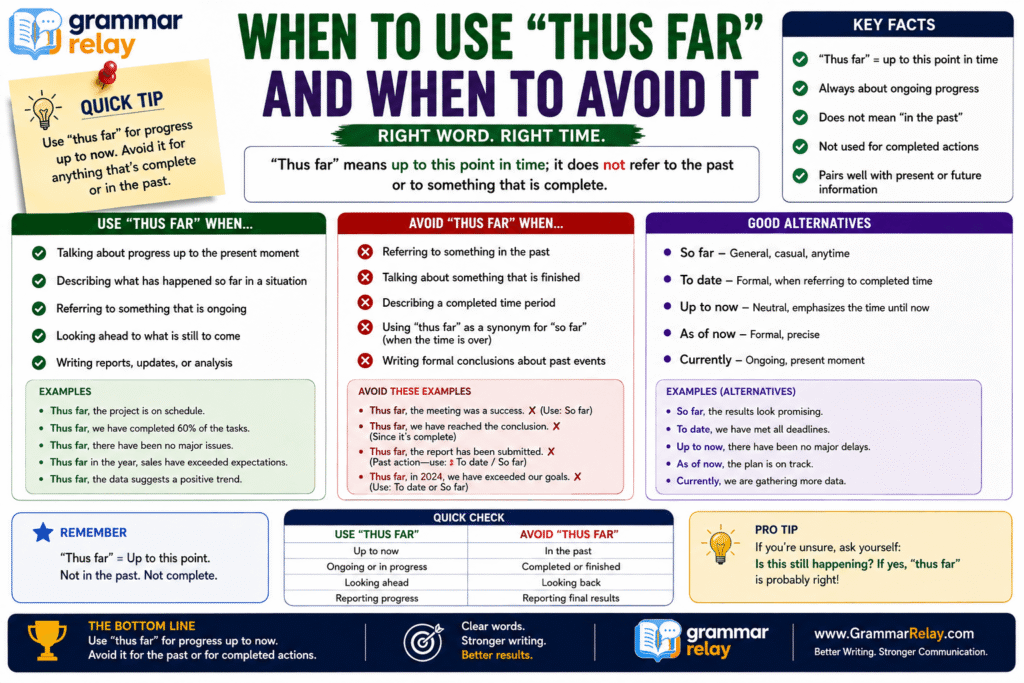
| Situation | Use “Thus Far”? | Use Instead | Why |
|---|---|---|---|
| Academic research paper | Yes | N/A | Appropriate register |
| Legal document or brief | Yes | N/A | Formal register fits |
| Casual email to a colleague | No | “So far” | Too formal for casual context |
| Text message | No | “So far” | Much too formal |
| Formal business report | Yes | N/A | Register matches |
| Blog post (general audience) | Rarely | “So far” or “up to this point” | May read as pretentious |
| Political or formal speech | Yes | N/A | Appropriate for elevated register |
| Fiction dialogue (formal character) | Yes | N/A | Character voice marker |
| Journalism | Occasionally | “So far” preferred | AP style leans informal |
Frequently Asked Questions
What does “thus far” mean?
“Thus far” means “up to this point” or “until now.” It marks the current status of something that is still in progress, implying there may be more to come. It functions as a formal adverbial phrase.
Is “thus far” grammatically correct?
Completely. “Thus far” is grammatically correct in any sentence position and has been standard in formal English writing for centuries. It appears in academic papers, legal documents, judicial opinions, and formal speeches.
What is the difference between “thus far” and “so far”?
Both mean the same thing: up to this point. The difference is register. “Thus far” is formal and suits academic, legal, and policy writing. “So far” is neutral and suits conversation, journalism, and casual professional writing.
What is the difference between “thus far” and “this far”?
These are not interchangeable. “This far” describes a physical or metaphorical distance traveled, often with emotional weight (“we’ve come this far”). “Thus far” summarizes progress, findings, or evidence in analytical contexts. Using one where the other belongs creates a subtle but noticeable register mismatch.
Can you use “thus far” at the end of a sentence?
Yes. “We haven’t encountered any obstacles thus far” is perfectly correct. No comma is needed when “thus far” appears at the sentence end. The beginning position requires a comma (“Thus far, no results have emerged.”).
Is “thus far to date” redundant?
Yes. Both “thus far” and “to date” mean “up to this point.” Using them together creates unnecessary repetition. Choose one and delete the other.
Read more grammar lessons on Grammar Relay
Conclusion
Here’s the honest bottom line on thus far meaning and usage.
The phrase means “up to this point” and carries formal register that “so far” doesn’t. It belongs in academic, legal, policy, and formal professional writing where elevated language signals intellectual rigor and precision. In casual contexts, it sounds out of place and can read as affected.
“This far” serves emotional and distance-based contexts. “Thus far” serves analytical and progress-based contexts. They aren’t competing alternatives: they’re different tools for different jobs.
And “thus far to date” or “up until thus far”? Cut one of the redundant elements every time. Clarity never suffers from removing extra words but it always suffers from adding them unnecessarily.
