


Two words. Nearly identical pronunciation. Completely different meanings. And one of them is actually two different words disguised as one. Tear vs tare sits in a uniquely confusing category of English vocabulary because the confusion isn’t simply about spelling. It involves a word that changes its entire meaning depending on how you pronounce it, a specialized technical term that most people only encounter when standing in a kitchen or reading a shipping invoice, and a Biblical reference that surprises most readers who encounter it.
This guide untangles every layer of that confusion completely.
The Immediate Answer (Because This Gets Complicated Fast)
Here’s the landscape before diving deeper:
| Word | Pronunciation | Primary Meaning | Frequency |
|---|---|---|---|
| Tear (noun) | TEER | Drop of fluid from the eye | Very common |
| Tear (verb) | TAIR | To rip or pull apart | Very common |
| Tare (noun) | TAIR | Weight of packaging; a weed; Biblical plant | Specialized |
| Tare (verb) | TAIR | To set a scale to zero | Technical/specialized |
Part of the tear vs tare is that tear (TAIR, meaning to rip) and tare (TAIR, meaning weight) sound completely identical. Context does all the heavy lifting in real conversations. In writing, spelling does it. And if you use the wrong spelling, readers notice.
The Tear Problem: One Word, Two Completely Different Words

Here’s what every competitor guide misses. “Tear” isn’t just one word with multiple meanings. It’s technically two separate English words that happen to share identical spelling. Linguists call these heteronyms: words with the same spelling but different pronunciations and meanings.
Think about that for a moment. “Tear” as in crying rhymes with “beer.” “Tear” as in ripping rhymes with “air.” Same letters. Completely different sounds. Both are different meanings. Completely different etymological origins. They just happen to occupy the same six-letter space on the page.
| Form | Pronunciation | Part of Speech | Meaning | Example |
|---|---|---|---|---|
| Tear | TEER | Noun | Drop of eye fluid | “A tear ran down her cheek.” |
| Tear | TAIR | Verb (present) | To rip or split | “Don’t tear the paper.” |
| Tore | TAIR variant | Verb (past tense) | Ripped or split | “He tore the letter open.” |
| Torn | TAIR variant | Verb (past participle) | Having been ripped | “The fabric was torn.” |
| Tear | TAIR | Noun | A rip or hole | “There’s a tear in your jacket.” |
| Teary | TEER-ee | Adjective | Filled with tears | “She felt teary during the film.” |
| Tearful | TEER-ful | Adjective | About to cry | “A tearful goodbye.” |
Understanding this heteronym distinction is the foundation for resolving every tare or tear confusion that follows.
What “Tear” (TEER) Means: The Eye-Related Word
Tear (TEER) is the saline fluid produced by the lacrimal glands located above each eyeball. Adults produce approximately 15 to 30 gallons of tears annually. The lacrimal system doesn’t just produce emotional tears: it produces three types including basal tears (constant lubrication), reflex tears (responding to irritants), and psychic tears (emotional responses).
In writing, this version of tear appears most powerfully in emotional, literary, and medical contexts:
| Expression | Meaning | Example |
|---|---|---|
| Moved to tears | So emotionally affected that you cry | “The speech moved the audience to tears.” |
| In tears | Currently crying | “She arrived at the hospital in tears.” |
| Crocodile tears | Fake or insincere crying | “His crocodile tears fooled nobody.” |
| Bring tears to one’s eyes | Cause strong emotion | “The reunion brought tears to her eyes.” |
| Fight back tears | Struggle not to cry | “He fought back tears throughout the eulogy.” |
| Burst into tears | Suddenly start crying | “The child burst into tears immediately.” |
“Tears vs tares” in a Biblical or agricultural context always refers to the plant meaning of “tares,” not this word. The confusion between tear vs tare in that specific context comes from the plural forms looking similar in print.
Read more about Time Slot vs Timeslot
What “Tear” (TAIR) Means: The Ripping Word
Tear (TAIR) as a verb means to pull apart, rip, or split something by force. It’s an irregular verb with a surprising past tense that catches non-native speakers:
| Form | Example | Notes |
|---|---|---|
| Present | “I tear the wrapper off.” | Base form |
| Third person | “She tears the paper carefully.” | Adds -s |
| Past tense | “He tore the document in half.” | Irregular past |
| Past participle | “The flag had been torn in the storm.” | With auxiliary |
| Present participle | “She was tearing through the boxes.” | -ing form |
| Noun form | “There’s a tear in the seam.” | Rip or split |
Beyond its literal meaning, tear (TAIR) powers a remarkable range of idiomatic expressions:
| Expression | Meaning | Example |
|---|---|---|
| Wear and tear | Gradual damage from normal use | “The carpet shows years of wear and tear.” |
| Tear apart | Destroy physically or emotionally | “Grief can tear a family apart.” |
| Tear down | Demolish or destroy | “They tore down the old building in 2023.” |
| Tear into | Attack aggressively | “She tore into the report immediately.” |
| Tear away | Remove forcibly or leave reluctantly | “He couldn’t tear himself away from the game.” |
| Tear up | Rip into pieces | “She tore up the letter without reading it.” |
“Tare or tear paper” and “tear or tare paper” are questions that appear frequently online and the answer is always tear. Paper tears. A tare is never something you do to paper. Paper isn’t weighed in a shipping context where you’d use the word “tare.”
What “Tare” Means: Every Definition of This Specialized Word
Tare carries three genuinely distinct meanings across different fields. Each is legitimate, current, and appears in real professional contexts. This is where tare vs tear becomes genuinely interesting rather than just a spelling question.
| Field | Definition of Tare | Practical Example |
|---|---|---|
| Weighing/Commerce | Weight of container or packaging without contents | “The tare weight of the truck is 8,000 lbs.” |
| Kitchen/Cooking | Zeroing a digital scale with container on it | “Press tare to zero the scale with the bowl.” |
| Shipping/Logistics | Deducting packaging weight from gross weight | “Net weight = gross weight minus tare.” |
| Agriculture (historical) | A weed (Lolium temulentum) growing among wheat | “Tares were a serious problem for grain farmers.” |
| Biblical | The weed mentioned in Christ’s parable | “Let both wheat and tares grow together.” |
| Chemistry/Science | Weight of a vessel used in measurements | “Record the tare mass before adding reagents.” |
Tare Weight Explained: The Most Common Modern Use

This is where most people encounter “tare” in everyday life without realizing it. When you place a bowl on a kitchen scale and press the button that resets the display to zero, you’ve just performed a tare. The scale now measures only the contents you add, not the bowl itself.
The three-way weight relationship works like this:
| Weight Type | Definition | Example (Grocery Item) |
|---|---|---|
| Gross weight | Total weight including packaging | 500g (jar + contents) |
| Tare weight | Weight of packaging only | 150g (just the jar) |
| Net weight | Weight of contents only | 350g (just the jam) |
| Formula | Net = Gross minus Tare | 500g – 150g = 350g |
In commercial trucking, tare weight carries legal significance. The United States Federal Highway Administration mandates that commercial vehicles display their tare weight because gross vehicle weight limits determine whether a truck can legally travel certain roads and bridges. The standard tare weight of a semi-trailer alone ranges from approximately 10,000 to 15,000 pounds depending on configuration.
In chemistry laboratories, recording the tare mass of a crucible or container before adding a reagent is standard experimental protocol. It ensures measurements reflect only the substance being studied, not the vessel containing it.
The Pronunciation Question That Creates the Confusion
Here’s the exact phonetic breakdown of why tear vs tare causes writing problems:
| Word/Meaning | IPA | Rhymes With | Confusion Risk |
|---|---|---|---|
| Tear (eye fluid) | /tɪər/ | Beer, fear, here | Low: distinct sound |
| Tear (rip) | /tɛər/ | Air, bare, care | HIGH: identical to tare |
| Tare (weight/weed) | /tɛər/ | Air, bare, care | HIGH: identical to tear (rip) |
When someone says “tare” out loud in conversation, you genuinely cannot distinguish it from “tear” (rip) without context. “Press the tare button” sounds exactly like “press the tear button.” Only knowing that scales have tare buttons resolves the ambiguity.
In writing, the spellings diverge clearly. Tare on a scale. Tear in fabric. The problem enters when writers are typing quickly and autocorrect changes “tare” to “tear” in technical documents, which happens constantly in shipping and logistics writing.
Etymology: Where Tear and Tare Actually Came From
Understanding origins makes the distinction intuitive rather than memorized:
| Word | Origin Language | Original Form | Original Meaning | When Entered English |
|---|---|---|---|---|
| Tear (eye) | Old English | tēar | Eye drop | Before 900 AD |
| Tear (rip) | Proto-Germanic | teraną | To pull apart | Before 900 AD |
| Tare (weight) | Arabic via French | ṭarḥa / tare | Thrown away/deducted | 15th century |
| Tare (weed) | Uncertain | taree | A type of weed | 14th century |
| Tare (Biblical) | Greek/Latin via translation | zizania | Darnel grass weed | 14th century (Wycliffe Bible) |
“Tare” (the weight term) arrived in English through medieval Arabic trade routes. The Arabic word “ṭarḥa” meant “thrown away” or “deducted” and referred to the portion of a shipment’s weight that merchants discounted because it was packaging rather than actual goods. Italian merchants adopted it as “tara,” French merchants used “tare,” and English commercial language absorbed it in the 1400s directly from the Mediterranean spice and textile trades.
Both English heteronyms called “tear,” meanwhile, trace back to Old English with roots in Proto-Germanic and Proto-Indo-European languages predating written English by millennia.
You might be interested in That’s or Thats: The Complete Guide
Tares in the Bible: The Agricultural Context
“Tears vs tares” confusion reaches its peak in Biblical discussions. The word “tares” in the Bible refers specifically to a plant, not crying. In Matthew 13:24-30, Jesus tells the Parable of the Wheat and the Tares in which an enemy sows tares (weeds) among a farmer’s wheat crop while he sleeps.
The plant identified as Biblical “tares” is Lolium temulentum, commonly called darnel or poison ryegrass. This weed is notoriously difficult to distinguish from wheat while young. Only at harvest time do the differences become apparent. The parable uses this agricultural reality as its central metaphor: the weed and the crop are virtually indistinguishable until maturity.
“Let both grow together until the harvest.” Matthew 13:30
In tears vs tares discussions in religious and agricultural contexts, “tares” always refers to this specific weed. The word “tears” (from the eye) appears nowhere in this agricultural or Biblical context.
Tear vs Tare in Specific Professional Contexts
| Professional Field | Which Word | Form Used | Example |
|---|---|---|---|
| Sports medicine | Tear (TAIR) | Noun | “The athlete sustained an ACL tear.” |
| Shipping/logistics | Tare | Noun | “The tare weight must be documented.” |
| Food manufacturing | Tare | Noun/verb | “Tare the container before filling.” |
| Chemistry lab | Tare | Noun/verb | “Record the tare mass of the crucible.” |
| Emotional writing | Tear (TEER) | Noun | “Tears of joy marked the reunion.” |
| Biblical scholarship | Tare | Noun | “The tares represent evil in the parable.” |
| Agriculture | Tare | Noun | “Tares reduce grain harvest quality.” |
In sports medicine, tear (TAIR) appears constantly as a clinical noun. An ACL tear, a rotator cuff tear, a retinal tear, a meniscal tear: these injuries affect millions of people annually. The American Academy of Orthopaedic Surgeons reports approximately 200,000 ACL tears occur in the United States each year. All use tear (TAIR) not tare.
Common Mistakes Writers Make With Tear and Tare
| Incorrect | Correct | Context | Why |
|---|---|---|---|
| “She wiped a tare from her eye.” | “She wiped a tear from her eye.” | Emotional writing | “Tear” = eye fluid, not “tare” |
| “The tear weight of the pallet is 200kg.” | “The tare weight of the pallet is 200kg.” | Logistics | “Tare” = packaging weight |
| “Press tear to reset the scale.” | “Press tare to reset the scale.” | Kitchen/lab | The scale function is “tare” |
| “He tared his jacket on the fence.” | “He tore his jacket on the fence.” | Everyday | “Tear” (past: tore) = ripped |
| “The crop was infested with tears.” | “The crop was infested with tares.” | Agriculture | “Tares” = weeds, not crying |
Autocorrect causes the most professional damage here. Technical writers creating shipping documentation frequently type “tare weight” and find autocorrect has changed it to “tear weight.” The resulting document appears unprofessional and occasionally creates genuine ambiguity in weight specifications.
Memory Tricks That Make Tear vs Tare Permanent
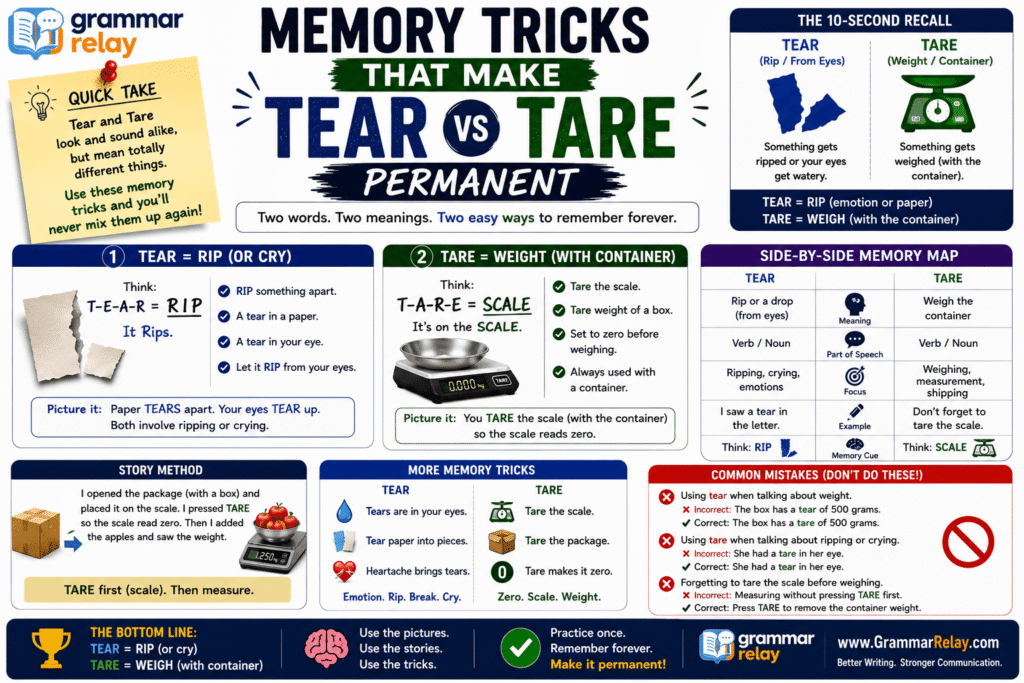
Three anchors that genuinely work:
The scale button anchor: If you press it on a kitchen scale or laboratory balance, it’s tare. If something rips or an eye produces it, it’s tear. These two contexts never overlap.
The pronunciation split: If your word sounds like “beer,” it means eye fluid (tEAR = tEER). If it sounds like “bare” and you’re talking about weight or weeds, it’s tare. If it sounds like “bare” and you’re talking about ripping, it’s tear (TAIR).
The Arabic trade route: Tare (weight) came through Arabic merchants who used the word to mean “deducted.” Think: trade routes, tare weights, commercial transactions. If your context involves commerce and weighing, reach for tare.
Synonyms for Tear and Tare
| Word | Synonyms | Formality | Best Alternative |
|---|---|---|---|
| Tear (eye) | Teardrop, lacrimation, eye fluid | Varies | “Teardrop” for poetry; “lacrimation” for medical |
| Tear (rip, verb) | Rip, split, shred, lacerate, sever | Varies | “Rip” (casual), “lacerate” (medical) |
| Tear (rip, noun) | Rip, split, gash, hole, breach | Varies | “Rip” (casual), “gash” (larger tear) |
| Tare (weight) | Container weight, packaging weight, net weight deduction | Technical | “Container weight” for non-technical audiences |
| Tare (weed) | Darnel, ryegrass, Lolium temulentum | Technical | “Weed” (casual), “darnel” (botanical) |
Frequently Asked Questions
What is the main difference between tear and tare?
“Tear” is either a drop of eye fluid (TEER) or the act/result of ripping something (TAIR). “Tare” is a specialized term meaning the weight of packaging or a container, a weed that grows among crops, or the act of zeroing a scale. They’re entirely different words that share similar pronunciation in some contexts.
Is “tear” one word or two different words?
Technically two. “Tear” (TEER) meaning eye fluid and “tear” (TAIR) meaning to rip are heteronyms: same spelling, different pronunciation, different meaning, different etymological origins. They developed independently in Old English and Proto-Germanic before converging on identical spelling.
What does “tare weight” mean in shipping?
Tare weight is the weight of the container, packaging, or vehicle without its contents. In shipping, it’s subtracted from gross weight to determine net weight, which represents the actual weight of goods being transported. Commercial vehicles in the US must display their tare weight because federal road weight limits apply.
What does the “tare” button on a kitchen scale do?
Pressing tare resets the scale display to zero while accounting for whatever is currently on the scale. Place an empty bowl, press tare, then add ingredients: the scale measures only what you add, not the bowl’s weight. This is the most common everyday encounter with the word “tare.”
What are “tares” in the Bible?
In Matthew 13:24-30, tares refer to Lolium temulentum (darnel or poison ryegrass), a weed nearly indistinguishable from wheat while growing. Jesus uses the agricultural reality of tares growing among wheat as a metaphor in his parable about allowing good and evil to coexist until judgment.
Can “tear” and “tare” ever be used interchangeably?
Never. They have completely different meanings in every context. “Tare” never means a rip or an eye drop. “Tear” never means packaging weight or a weed. Context makes the correct choice obvious in virtually every situation you’ll encounter.
Read more grammar lessons on Grammar Relay
Conclusion
Here’s the clean summary of everything covered.
Tear covers two separate heteronyms: eye fluid (TEER) and ripping action or result (TAIR). Both are extremely common English words appearing across emotional, physical, medical, and everyday contexts.
Tare handles commercial weight, kitchen scale zeroing, agricultural weeds, and Biblical references. It’s specialized but appears in genuinely important professional and technical contexts where using “tear” by mistake creates real problems.
The confusion between tare vs tear that matters most in writing is the overlap between tear (TAIR, to rip) and tare (TAIR, weight): they sound identical. Context resolves the ambiguity instantly in virtually every real-world situation. And now you know which spelling to reach for before your fingers touch the keyboard.
