


Some phrases carry more weight than their word count suggests. Deem fit is exactly that kind of phrase. Two short words. Enormous authority packed inside them.
You’ve probably spotted it in contracts, court rulings, HR policies, or government notices. Maybe you’ve wondered what it actually means or whether you’re using it correctly. Either way, this guide covers the full picture: definition, grammar, legal power, regional differences, common mistakes, and real examples across every major context.
The Straight Answer: What “Deem Fit” Actually Means
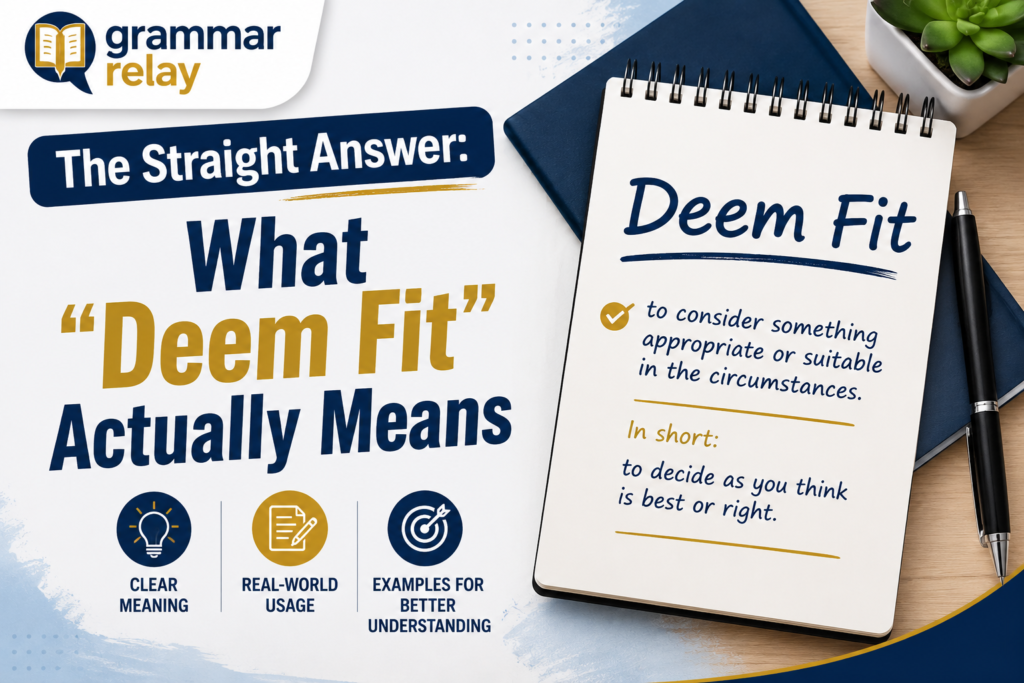
At its core, deem fit meaning comes down to one idea: to judge something appropriate based on your authority or discretion.
“Deem” means to regard, consider, or officially judge something to be true. “Fit” here means suitable, proper, or appropriate for the situation. Together they create something neither word carries alone: the sense that someone with recognized authority has made a considered judgment call.
| Element | Meaning |
|---|---|
| Deem | To regard, consider, or officially judge |
| Fit | Appropriate, suitable, or proper |
| Deem fit | To judge something appropriate based on authority or discretion |
The meaning of deem fit isn’t about physical fitness. It has nothing to do with health or exercise. That’s a surprisingly common misreading and one worth clearing up immediately.
“Language is the law of thought.” — Ernest Fenollosa
Etymology: Where “Deem Fit” Actually Came From
The word “deem” descends from Old English “dēman,” meaning to judge or pronounce a verdict. Interestingly, it shares its root with the word “doom,” which in its original Old English form meant judgment or decree rather than catastrophe.
“Fit” entered English from Middle English around the 15th century carrying the meaning of suitable, proper, or becoming. Early usage appeared in ecclesiastical writing where clergy described actions as “fit” for religious observance.
By the 17th century, English common law had adopted the combined phrase “deem fit” as a standard mechanism for granting judicial and administrative discretion. It gave courts, magistrates, and officials a standardized formula for preserving flexibility within legal frameworks.
The phrase survived centuries of language simplification precisely because it does something no simpler substitute replicates perfectly: it signals authorized judgment, not just personal preference.
The Grammar Behind “Deem Fit” (How It Actually Works)
Understanding deem fit grammatically prevents the most common writing errors.
“Deem” functions as a transitive verb requiring an object. “Fit” operates as a predicate adjective describing that object. The structure almost always follows a subject of authority making a judgment about an action or situation.
Tense Variations and What They Signal
| Tense | Form | Example |
|---|---|---|
| Present | deem fit | “The board may deem fit to suspend operations.” |
| Past | deemed fit | “The judge deemed fit to dismiss the case.” |
| Present perfect | has/have deemed fit | “The committee has deemed fit to proceed.” |
| Passive | deemed fit | “The action was deemed fit by the authority.” |
| Infinitive | to deem fit | “She has full authority to deem fit any corrective response.” |
One structural note worth remembering: the phrase almost always requires “it” as a grammatical object when followed by a clause. “She deemed it fit to leave” is correct. “She deemed fit to leave” drops the required object and reads as incomplete in formal writing.
“Deem Fit” vs “Deemed Fit”: The Difference That Trips Writers Up
This distinction matters more than most writers realize. Getting it wrong changes the entire meaning of a sentence.
Deem fit (present tense) describes ongoing authority or a hypothetical future decision. It signals that someone has the power to make a judgment but hasn’t necessarily made it yet.
Deemed fit (past tense) describes a specific decision already made. The judgment happened. It’s done.
Compare these two sentences directly:
- “The committee may deem fit to revisit the policy.” (Future possibility, authority exists)
- “The committee deemed fit to revise the policy last March.” (Decision already made)
In legal documents, this distinction carries real consequences. A contract clause using “deem fit” grants ongoing discretion. A court ruling using “deemed fit” records a specific historical judgment.
Read more about Shown vs Showed: The Complete Grammar Guide (With Real Examples)
“Deem Fit” in Legal Language: Where the Phrase Carries Real Power
This is where deem fit earns its place in the language. Legal drafters favor it precisely because it preserves judicial and regulatory discretion without specifying exactly what action must be taken.
Why Legal Drafters Choose This Phrase
When a statute says a court “may take such action as it deems fit,” it grants the judge flexibility to respond proportionately to circumstances the legislature couldn’t predict in advance. It’s a deliberate design choice, not lazy writing.
Real-World Legal Usage by Jurisdiction
| Jurisdiction | Context | Example Usage |
|---|---|---|
| US Federal Court | Judicial discretion | “The court may impose such sanctions as it deems fit.” |
| UK Statute | Legislative authority | “The Secretary of State may take such steps as deemed fit.” |
| Australian Law | Regulatory power | “The authority may act as it deems fit and proper.” |
| Nigerian Law | Administrative discretion | “The Minister shall take such action as he deems fit.” |
| Contract Law | Party discretion | “Either party may terminate as they deem fit with notice.” |
“Deem Fit and Proper”: Why Regulators Add Two Words
As deemed fit meaning sometimes expands into “deemed fit and proper” in financial regulation and licensing law. The addition of “and proper” raises the standard. It’s not enough for an action to seem appropriate. It must also meet an ethical or professional threshold.
Financial regulators worldwide use “fit and proper” tests to assess whether individuals qualify to hold positions of trust in banks, investment firms, and insurance companies. The UK Financial Conduct Authority, the Australian Prudential Regulation Authority, and the US Federal Reserve all run versions of this assessment.
“Deem Fit” in Business and Corporate Writing
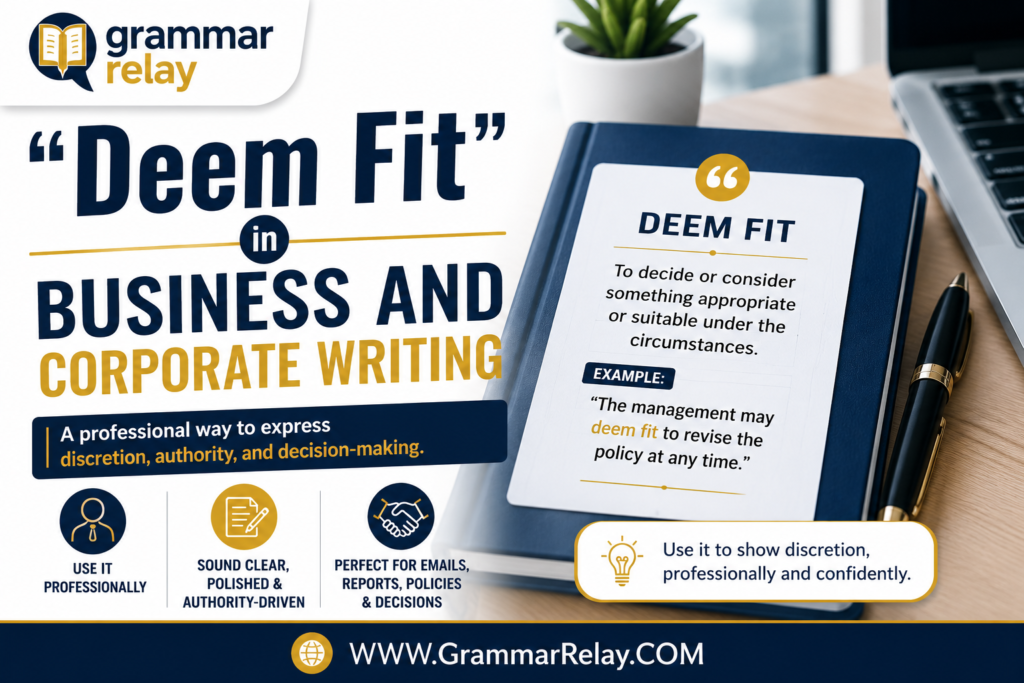
Outside courtrooms, deem fit appears constantly in corporate governance documents. It gives boards, executives, and managers documented authority to exercise judgment without needing to specify every possible scenario in advance.
| Document Type | Example |
|---|---|
| Board resolution | “The directors may take such action as they deem fit.” |
| HR policy | “Management reserves the right to apply disciplinary measures as deemed fit.” |
| Employment contract | “The company may assign duties as it deems fit.” |
| Procurement clause | “The committee will select vendors as deemed fit following evaluation.” |
Deems fit meaning in a corporate HR context specifically means the company retains discretion over how it responds to situations not explicitly covered in writing. It’s a deliberate flexibility clause. Smart legal drafters include it. Smart employees notice it.
“Deem Fit” vs Similar Phrases: Critical Distinctions
Not all authority phrases work the same way. Here’s how deem fit compares to its closest alternatives:
| Phrase | Formality | Best Used In | Key Difference |
|---|---|---|---|
| Deem fit | Very high | Legal, formal, corporate | Implies recognized authority |
| See fit | Medium-high | Professional, semi-formal | More personal judgment |
| Think fit | Medium-high | British formal writing | Regional preference |
| Find appropriate | Medium | Academic, business | Less authority implied |
| Consider suitable | Medium | General professional | Neutral, no authority signal |
| Decide to | Low-medium | Everyday writing | No formality or authority |
“Deem Fit” vs “See Fit”
As you deem fit meaning and “as you see fit” mean essentially the same thing in practice but carry different registers. “Deem fit” signals institutional authority. “See fit” signals personal discretion. A judge “deems fit.” A friend “sees fit.” Context makes the difference clear.
“Deem Fit” vs “Think Fit”
British English writers encounter “think fit” as a formal alternative. Parliament’s legislative drafting conventions historically used “think fit” while courts leaned toward “deem fit.” Both remain acceptable in UK formal writing today though “deem fit” has gained ground globally.
You might be interested in Dreamed vs Dreamt: The Complete Grammar Guide (With Real Examples)
Common Mistakes People Make With “Deem Fit”
Even experienced writers get this phrase wrong. Here are the most frequent errors:
| Incorrect | Correct | Why |
|---|---|---|
| “I deemed as fit to leave early.” | “I deemed it fit to leave early.” | “As” is redundant; “it” is the required object |
| “She deems fit that we should go.” | “She deems it fit that we go.” | Requires “it” as grammatical object |
| “The team deem fit the new policy.” | “The team deems fit to adopt the new policy.” | Word order and verb agreement |
| “He is deemed fit physically.” | Use “medically fit” or “physically fit” instead | Avoids confusion with health/fitness |
| Using “deem fit” in casual emails | Use “decide” or “choose” instead | Phrase sounds pompous in informal contexts |
Deem it fit meaning specifically involves that small but essential word “it.” Drop it and the grammatical object disappears. The sentence becomes structurally incomplete even if the meaning stays clear to the reader.
One more error worth highlighting: dim it fit appears occasionally in writing as a phonetic spelling error. It has no grammatical meaning and should always be corrected to “deem it fit.”
How to Use “Deem Fit” Correctly in Different Types of Writing
The right context makes all the difference. Here’s a practical guide:
Legal Writing
Keep it. It belongs here. Place it after the authority figure or body making the judgment. “The arbitrator may impose such remedies as the arbitrator deems fit.”
Business and Corporate Writing
Use it in formal documents: board resolutions, contracts, governance policies, and HR frameworks. Avoid it in everyday internal emails where “decide” or “choose” reads more naturally.
Academic Writing
Acceptable in formal academic prose but use sparingly. “The ethics committee deemed fit to approve the protocol” works well. Don’t pepper it throughout casual academic discussion.
Journalism
Use it when quoting officials or describing formal decisions. “The regulator deemed fit to impose a $4.5 million fine” accurately reflects the authority behind the action.
Everyday Professional Writing
This is where as you deem fit meaning often gets misapplied. Telling a colleague to “proceed as you deem fit” in a quick Slack message sounds stiff. “Use your judgment” or “do what works best” communicates the same thing more naturally.
Real Sentences Using “Deem Fit” Across Every Industry
Here’s how the phrase appears across professional contexts:
Legal: “The court may grant such relief as it deems fit in the circumstances of the case.”
Corporate: “The board of directors shall have authority to take such actions as they deem fit to protect shareholder interests.”
Government: “The Commissioner may issue directives as deemed fit under Section 14 of the Act.”
Healthcare Regulation: “The licensing authority may revoke certification as deemed fit following an investigation.”
Academic: “The dissertation committee deemed fit to request revisions before final approval.”
“Deem Fit” in Regional English: US vs UK vs Commonwealth
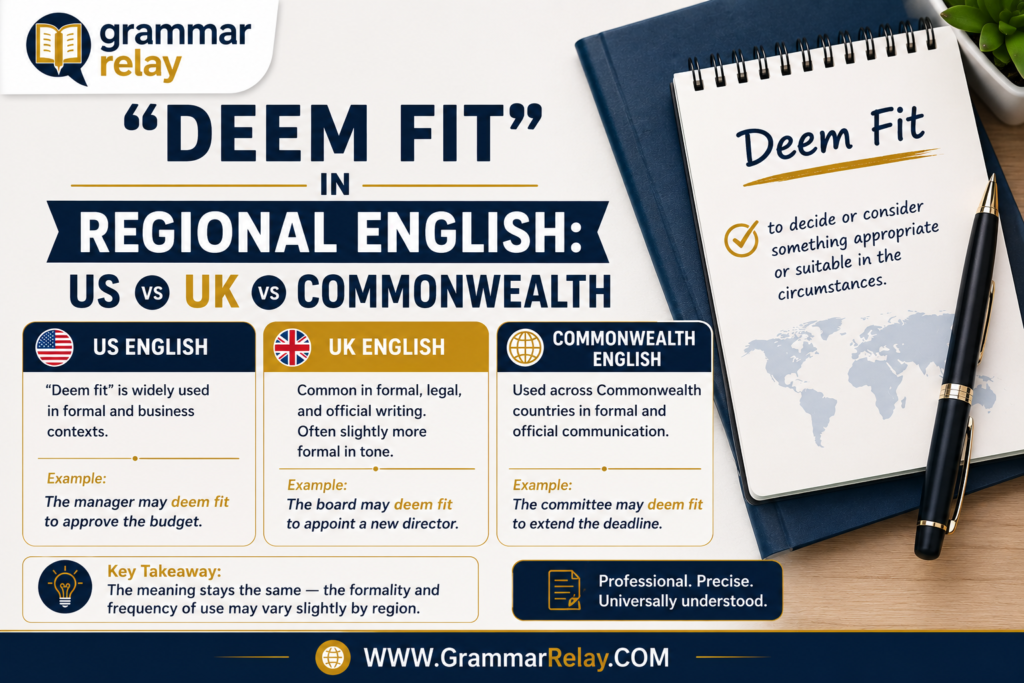
Regional preferences shape how frequently this phrase appears:
American English: Less common than in Commonwealth writing. American legal drafters often prefer “in the court’s discretion” or “as the court sees fit.” However, “deem fit” appears regularly in federal statutes and contract law.
British English: “Think fit” competes historically but “deem fit” appears in Parliamentary Acts and judicial opinions. The phrase carries full formal weight in UK legal writing.
Commonwealth English (India, Nigeria, Australia, Canada): This is where “deem fit” thrives most visibly. Indian statutory language, Nigerian court opinions, and Australian regulatory frameworks use the phrase with high frequency. South Asian and West African legal English retained strong Commonwealth drafting conventions that favor “deem fit” over simpler American alternatives.
The phrase appears in the Indian Constitution, Nigerian administrative law, Australian corporate governance codes, and Canadian regulatory frameworks, making it genuinely global in its formal reach.
Frequently Asked Questions
What does “deem fit” mean in simple terms?
It means to judge something appropriate or suitable based on your authority or position. When someone “deems fit,” they’re making an official or authoritative judgment call.
Is “deem fit” formal or can you use it casually?
It’s formal. Using it in casual conversation or informal emails sounds stiff and out of place. Stick to legal, corporate, academic, or official government contexts.
What’s the difference between “deem fit” and “see fit”?
Both mean to consider something appropriate but “deem fit” implies institutional or official authority while “see fit” suggests personal discretion. Courts deem fit. Individuals see fit.
What does “deemed fit and proper” mean in legal documents?
It raises the standard beyond simple appropriateness. An action or person must be both suitable AND meet an ethical or professional standard. Financial regulators use “fit and proper” tests to screen executives and license holders.
Is “deemed as fit” grammatically correct?
No. The “as” is redundant. The correct forms are “deemed fit” or “deemed it fit.” Adding “as” between “deemed” and “fit” creates a grammatical error even though native speakers sometimes write it this way informally.
Can “deem fit” refer to physical fitness?
No. Despite containing the word “fit,” this phrase has nothing to do with physical health or exercise. “Fit” here means suitable or proper. If someone seems medically capable of work or duty, the correct phrase is “medically fit” or “physically fit,” not “deemed fit” in isolation.
Read more grammar lessons on Grammar Relay
When to Use “Deem Fit” and When to Choose Something Simpler
Here’s the honest bottom line. Deem fit earns its place in legal documents, corporate governance frameworks, government policy, and formal institutional writing. In those contexts it does something no simple substitute replicates: it signals authorized, considered judgment with a single efficient phrase.
Outside those contexts? Reach for something simpler. “Decide,” “choose,” “consider appropriate,” or “use your judgment” all communicate the same idea without the formality weight.
The phrase isn’t pretentious when used correctly. It’s precise. And in writing, precision is exactly what separates clear communication from costly misunderstanding.
