


You’ve written it a dozen times. “I’m a Fast Learner”. It sits there in your resume, your cover letter, your interview answers, doing absolutely nothing to make you memorable. Here’s the thing: hiring managers have read that exact phrase so many times it’s practically wallpaper now. If you want to stand out, you need a different word for fast learner, one that actually sounds like you, not like everyone else’s resume template.
This guide walks through real alternatives, organized by where you’ll actually use them, so you’re not just swapping one cliché for another.
Why “Fast Learner” Feels Overused
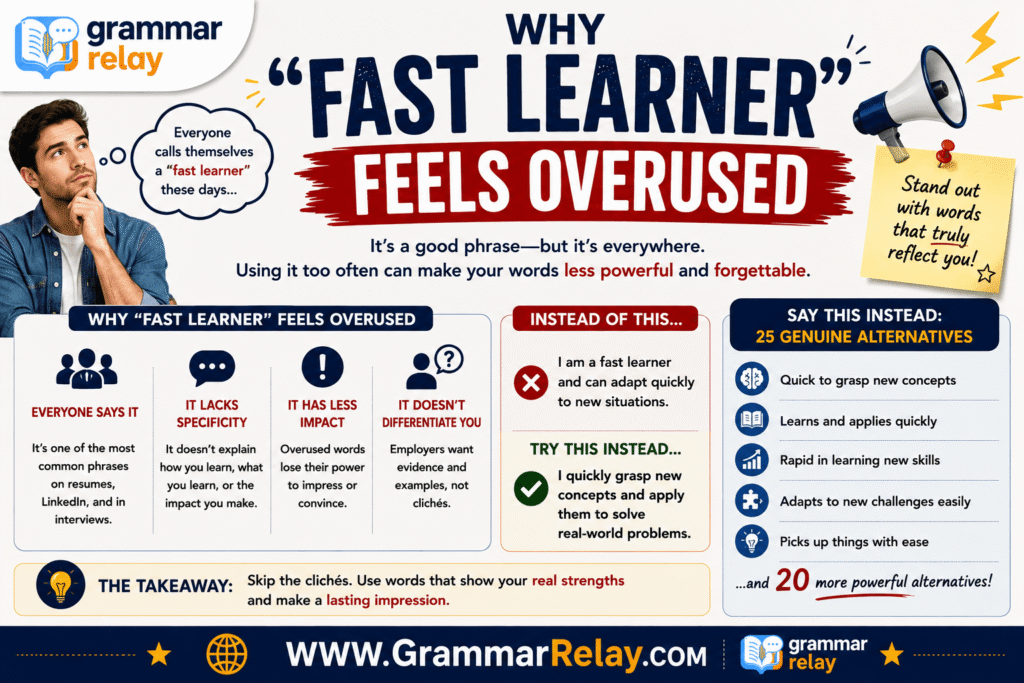
Let’s be honest about why this phrase stopped working. It shows up on nearly every entry-level resume and cover letter, which means recruiters skim right past it without registering a single thing about you. It’s become background noise, the resume equivalent of saying “I work hard” or “I’m a team player.”
The bigger issue, though, isn’t just repetition. It’s that “fast learner” describes a trait without proving it. Anyone can type those two words. Far fewer people can back them up with something concrete. That’s really the gap you need to close, and it’s why finding the right quick learner synonym matters less than you’d think, compared to what you do with it once you’ve found it.
What Employers Actually Want to Hear Instead of “Fast Learner”
Here’s a distinction worth sitting with: there’s a difference between claiming a trait and demonstrating it. “I’m a fast learner” is a claim. “I picked up our new CRM system in under a week and trained two teammates on it” is evidence. Guess which one a hiring manager remembers?
Specific alternatives paired with real examples will always outperform a generic adjective sitting alone in a sentence. Compare these two:
Weak: “I’m a quick learner and adapt well to new environments.”
Strong: “I onboarded onto a new project management platform in three days and became the go-to person for troubleshooting within a month.”
The second version doesn’t even need the phrase “quick learner” at all. It shows the trait through action, which is exactly what recruiters are trained to look for.
Strong Synonyms for Everyday and Casual Use
When you’re chatting with a coworker, writing a casual email, or just describing yourself in conversation, these phrases feel natural and unforced:
- Quick study: “She’s a quick study, picked up the whole system in a day.”
- Sharp learner: “He’s a sharp learner, catches on before you even finish explaining.”
- Picks things up fast: “Don’t worry about training him too much, he picks things up fast.”
- Adapts quickly: “New hires who adapt quickly tend to hit their stride within weeks.”
- Catches on quickly: “She catches on quickly, even with complicated software.”
None of these sound stiff or rehearsed. They’re the kind of phrases you’d actually say out loud, which is exactly why they work so well in casual settings.
Read more about Opposed vs. Apposed: What’s the Real Difference?
Professional and Resume-Ready Alternatives
For resumes and cover letters, you want language that sounds polished without tipping into corporate jargon overload. Here are five that strike that balance well:
- Rapidly acquires new skills: “Rapidly acquires new skills across unfamiliar software platforms.”
- Adapts quickly to new systems and processes: “Adapts quickly to new systems and processes with minimal onboarding time.”
- Grasps new concepts with minimal training: “Grasps new concepts with minimal training, reducing ramp-up time for new projects.”
- Efficient at mastering unfamiliar tools: “Efficient at mastering unfamiliar tools, having self-trained on three new platforms this year.”
- Thrives in fast-paced learning environments: “Thrives in fast-paced learning environments where priorities shift weekly.”
Notice how each of these pairs the trait with a specific detail. That’s the formula worth stealing: don’t just state the skill, attach a number, a timeframe, or a tool to it.
Alternatives That Work Well in Interviews
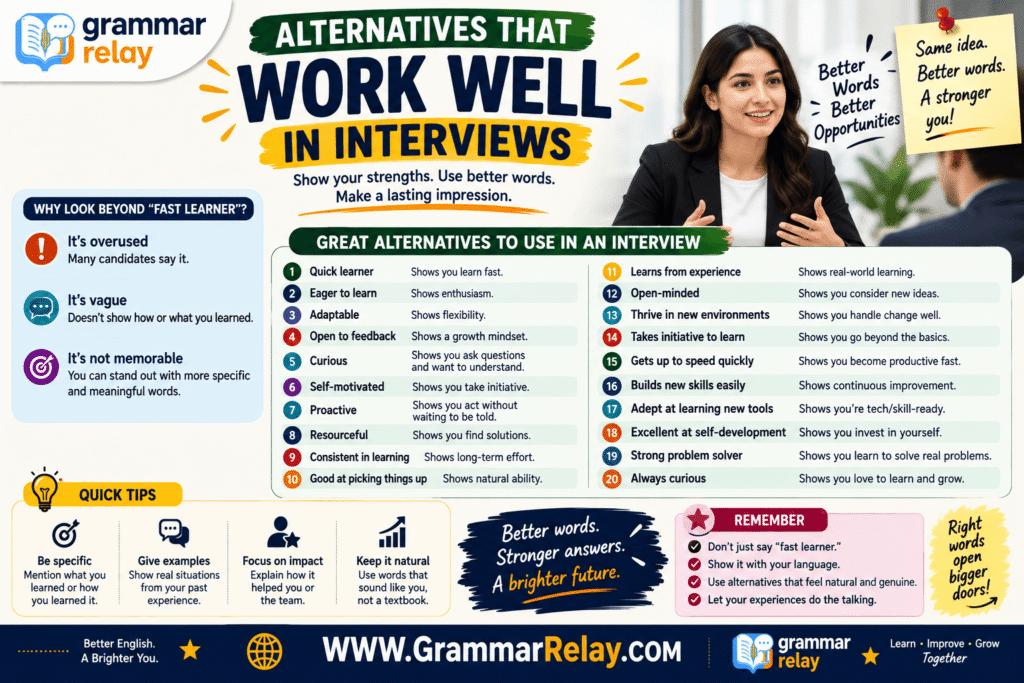
Interviews work differently than written text. You’re speaking out loud, and phrases that read fine on paper can sound stilted when spoken. That’s why interview answers benefit from weaving the trait into a story rather than announcing it upfront.
Try structuring your answer using the STAR method (Situation, Task, Action, Result) and let the “fast learner” quality show up naturally within the story, rather than as a standalone label. For example, instead of opening with “I’m a fast learner,” you might say:
“When I joined my last team, I had zero experience with our reporting software. Within two weeks, I’d not only learned it but built a new template the whole team still uses.”
A few solid interview-friendly phrases to weave in:
- “I ramped up quickly on…”
- “I got up to speed fast with…”
- “I picked up the workflow within days…”
- “I self-taught myself the platform in…”
These feel conversational, which matters a lot when you’re speaking rather than writing.
Alternatives for Academic and Technical Settings
If you’re writing a CV, research bio, or applying for a technical role, casual phrases like “picks things up fast” will feel out of place. Academic and technical contexts call for more precise, formal language:
- Quickly assimilates complex information
- Demonstrates strong conceptual retention
- Rapid comprehension of technical material
- Efficient knowledge acquisition
These phrases fit naturally into research summaries, technical resumes, or academic cover letters, where a slightly more formal register signals credibility. Using overly casual phrasing in these contexts can actually undercut how seriously your application gets taken, so match your tone to your audience.
Alternatives for Leadership and Senior-Level Roles
For leadership or senior positions, phrasing should emphasize judgment and application, not just raw speed. Decision-makers at that level care less about how fast you absorb information and more about what you do with it.
- Quickly builds cross-functional expertise
- Rapidly develops strategic understanding of new markets
- Adapts leadership approach based on new information
These alternatives signal maturity and strategic thinking, which matters more at senior levels than simply being quick on the uptake.
You might be interested in All Is Good: What It Means and How to Use It Correctly
One-Word and Short-Phrase Options
Sometimes you need something tight, especially for a LinkedIn headline or a skills section with limited space. These single-word options pack a punch:
- Adaptable
- Perceptive
- Astute
- Resourceful
- Versatile
A word of caution, though: single words work well in tight spaces, but they need supporting context elsewhere in your resume or profile. A word like “astute” alone won’t do much heavy lifting. Paired with an accomplishment further down the page, though, it reinforces the impression you’re building.
How to Prove You’re a Fast Learner (Not Just Claim It)
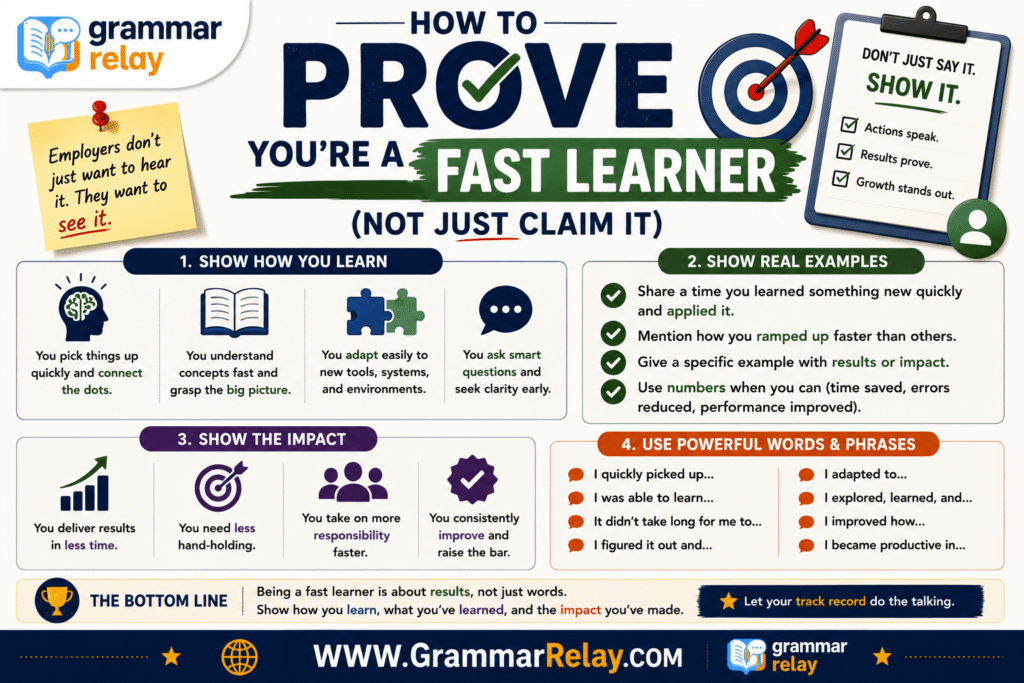
This is really the heart of the whole exercise. The “show, don’t tell” principle applies directly here. Anyone can type the word “adaptable.” Fewer people can point to a specific moment that proves it.
Here’s a simple formula that works across resumes, cover letters, and interviews:
Skill + Timeframe + Result
For example:
“Learned Salesforce (skill) within two weeks (timeframe) and increased lead-tracking accuracy by 30% (result).”
That single sentence does more work than five different quick learner synonym options stacked together ever could.
Quick Reference Table
| Context | Best Alternative | Example Use |
|---|---|---|
| Resume | Rapidly acquires new skills | Bullet point under Skills section |
| Interview | Adapts quickly to new systems | Spoken answer with an example |
| Academic | Rapid comprehension of technical material | CV or research bio |
| Casual | Picks things up fast | Conversation or cover letter intro |
Common Mistakes to Avoid
A few missteps show up again and again when people search for another way to say quick learner:
- Stacking synonyms. Using three different phrases in one paragraph sounds forced rather than confident.
- Mismatched tone. Academic phrasing in a casual cover letter (or vice versa) can feel jarring to the reader.
- No supporting evidence. Swapping “fast learner” for a fancier synonym without backing it up solves nothing. The core problem was never the wording; it was the lack of proof.
Frequently Asked Questions
What’s a stronger way to say “fast learner” on a resume?
Try phrases like “rapidly acquires new skills” or “adapts quickly to new systems,” paired with a specific example or measurable result for maximum impact.
Should I avoid saying “fast learner” in interviews?
You don’t need to avoid it entirely, but weaving the trait into a story using the STAR method will land far better than stating it as a flat claim.
Is “quick study” more professional than “fast learner”?
“Quick study” tends to read as slightly more polished and versatile, fitting well in both casual and semi-formal contexts.
What’s a good one-word alternative for LinkedIn?
Words like “adaptable,” “resourceful,” or “versatile” work well in tight spaces like headlines, as long as they’re backed up elsewhere in your profile.
How do I prove I’m a fast learner instead of just saying it?
Use the formula: skill, timeframe, and result. For example, naming a specific tool you learned, how quickly you learned it, and the outcome that followed.
Read more grammar lessons on Grammar Relay
Conclusion
At the end of the day, the exact word for quick learner you choose matters less than what surrounds it. Whether you go with “rapidly acquires new skills” on a resume or “picks things up fast” in casual conversation, the phrase only works if it’s followed by something specific: a project, a tool, a timeframe, a result. That’s what separates a forgettable line from one that actually sticks with the person reading it.
