


Picture a dentist’s note describing how two teeth meet, or a biology textbook explaining how cell walls line up against each other. Chances are, you’ll spot the word “apposed” in there, and your brain might automatically read it as “opposed.” That one-letter swap changes everything, and it’s a mix-up that trips up even careful writers. If you want to get more information about this title “Opposed vs. Apposed” must read this article, till the end!
Here’s the deal: “opposed” means against or in disagreement, while “apposed” means placed side by side or in contact. These aren’t two spellings of the same word. They’re two completely different words that just happen to look like cousins. Let’s sort out exactly where each one belongs.
What Does “Opposed” Mean
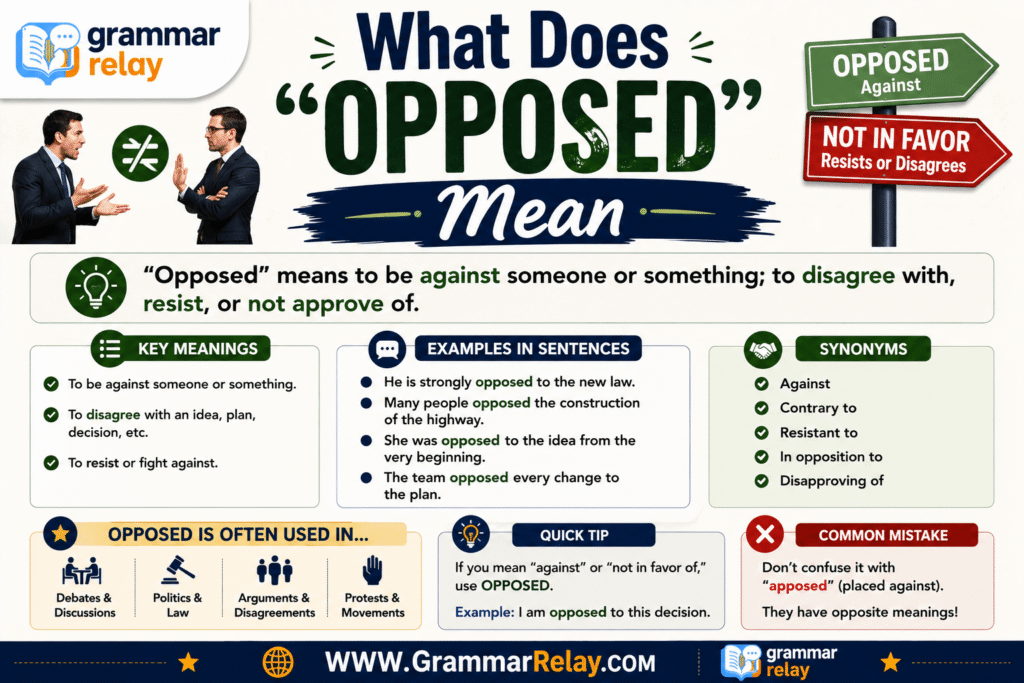
“Opposed” is the word you already know, even if you’ve never stopped to think about its structure. It describes being against something, whether that’s an idea, a decision, a person, or a physical direction.
You’ll see it constantly in everyday language:
- “She’s opposed to the new policy.”
- “The two teams stood on opposed sides of the field.”
- “He voted against the bill because he was firmly opposed to it.”
Grammatically, “opposed” functions as an adjective and as the past tense or past participle of the verb “oppose.” It shows up everywhere: politics, debates, personal opinions, sports, and casual conversation. If you’ve ever argued a point in a group chat, you’ve used the concept of “opposed” even without saying the word outright.
What Does “Apposed” Mean
Now here’s where things get interesting. “Apposed” isn’t a typo, and it isn’t slang. It’s a real word with a specific, narrower job: describing something placed directly next to or in contact with something else.
Unlike “opposed,” which you’ll hear in casual speech daily, “apposed” mostly lives in technical corners of the English language. Think anatomy, dentistry, and biology. A dentist might describe how the upper and lower teeth are “apposed” when the jaw closes. A biologist might describe cell membranes as “apposed” when they sit directly against one another.
Example sentences:
- “The two bone fragments were apposed during surgery to encourage proper healing.”
- “In the diagram, the cell walls are shown apposed to one another.”
- “The dentist checked whether the molars were properly apposed.”
Notice something? None of these sentences involve conflict or disagreement. That’s the whole point. “Apposed” describes closeness and contact, not opposition.
Why These Words Get Mixed Up Apposed vs Opposed
So why does everyone confuse apposed vs opposed? A few reasons stack up here, and honestly, they make a lot of sense once you see them laid out.
First, there’s the obvious visual overlap. Swap one letter, and “opposed” becomes “apposed” (or vice versa). Your eyes can easily skim right past that difference, especially when reading quickly.
Second, both words trace back to Latin roots involving position and placement, which we’ll dig into shortly. That shared ancestry means the words aren’t just visually similar, they’re historically related too, which adds another layer of confusion.
Third, and maybe most practically: “apposed” is rare. Most people go their whole lives without needing it outside a science class or medical setting. Because it’s uncommon, spell-checkers and autocorrect tools often “helpfully” swap it out for “opposed” without you noticing. If you’ve ever typed “apposed” in a document and watched it silently change, you already know this problem firsthand.
Read more about All Is Good: What It Means and How to Use It Correctly
Where the Words Come From

The Latin Roots: “Ob-” vs. “Ad-“
Both “oppose” and “appose” descend from the same Latin verb, ponere, meaning “to place” or “to put.” The difference lies entirely in the prefix attached to it.
- Oppose comes from ob- (against) + ponere (to place), literally meaning “to place against.”
- Appose comes from ad- (toward, near) + ponere (to place), literally meaning “to place near” or “to place beside.”
That single prefix swap flips the meaning almost entirely. “Ob-” pushes the meaning toward conflict and resistance, while “ad-” pulls it toward closeness and proximity. It’s a small linguistic detail with a surprisingly big impact on how each word gets used today.
Opposed vs. Apposed: Side-by-Side Comparison
Here’s a clean breakdown so you can see the contrast at a glance:
| Feature | Opposed | Apposed |
|---|---|---|
| Core meaning | Against, in disagreement | Placed side by side |
| Part of speech | Adjective / verb form | Adjective / verb form |
| Common fields | Everyday speech, politics, debate | Anatomy, biology, dentistry |
| Frequency | Very common | Rare, specialized |
| Root prefix | ob- (against) | ad- (near) |
Real Examples in Context Opposed vs Apposed
“Opposed” in Everyday and Political Use
- “Many voters remain opposed to raising taxes.”
- “As apposed to what critics claimed” would actually be a mistake here; the correct phrase is as opposed to, meaning “in contrast to.” This is one of the most common places people accidentally swap the two words.
- “The committee members were opposed on nearly every major decision.”
“Apposed” in Scientific and Anatomical Use
- “The surgeon carefully apposed the skin edges before suturing.”
- “Under the microscope, the two membranes appeared closely apposed.”
- “Proper appliance placement requires the teeth to be correctly apposed.”
That third bullet in the “opposed” section deserves extra attention, because “as apposed to” is a genuinely common typing mistake. The correct phrase is always “as opposed to,” meaning “instead of” or “in contrast with.” If you’ve ever typed “as apposed to” without thinking twice, you’re in good company, but it’s worth correcting since it changes the phrase into something that doesn’t quite make sense.
Is “Apposed” a Real, Commonly Used Word?
Yes, but with a big asterisk: it’s a specialist term, not everyday vocabulary. You won’t hear it in casual conversation, and you’re unlikely to need it unless you’re working in a medical, dental, or scientific field.
Here’s where you’re most likely to run into it:
- Medical and dental literature, describing how tissues, bones, or teeth align.
- Biology textbooks, especially in cellular or anatomical descriptions.
- Technical or academic writing where precision about physical positioning matters.
Outside those contexts, using “apposed” can actually confuse your reader. If you’re writing for a general audience, phrases like “placed next to” or “positioned against” communicate the same idea more clearly, without making readers wonder if you meant “opposed” instead.
Common Mistakes to Avoid Apposed vs Opposed
A few patterns show up again and again when writers mix up apposed or opposed:
- Autocorrect swaps. Word processors often “fix” apposed into opposed automatically, especially in non-technical documents.
- Casual overuse of “apposed.” Using it outside scientific writing can come across as either a typo or an odd word choice.
- The “as apposed to” typo. As mentioned earlier, this should almost always be “as opposed to.”
- Confusing apposing vs opposing in verb form. “Apposing” describes placing things together, while “opposing” describes standing against something, whether that’s a team, an argument, or an idea.
You might be interested in Ingrained vs Engrained: Which One Should You Actually Use?
How to Remember the Difference
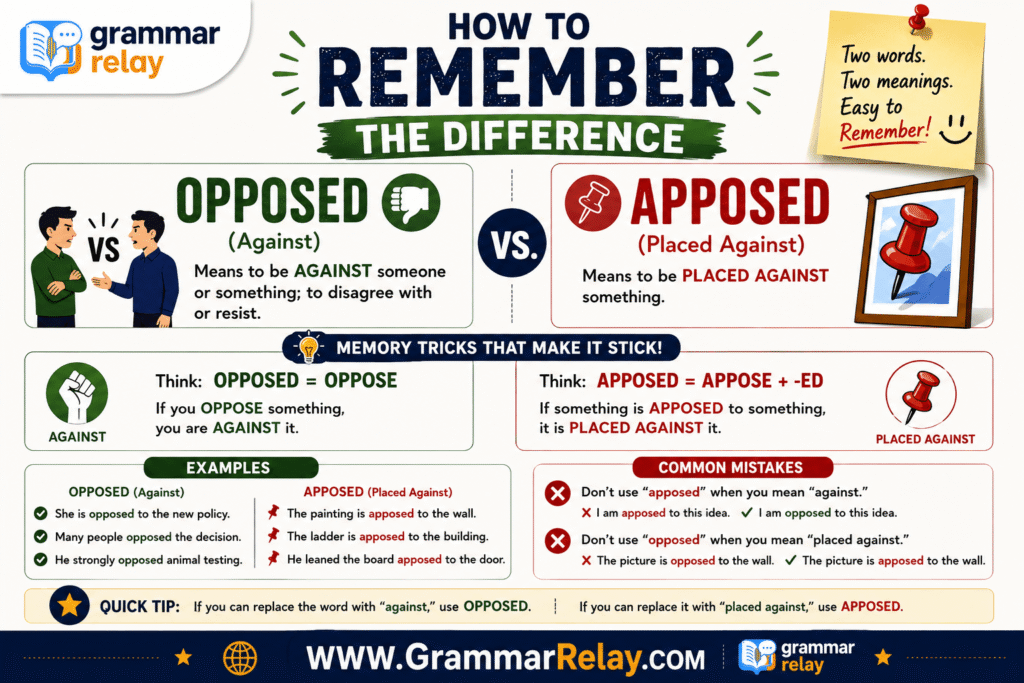
Here’s a memory trick that sticks: think about the words each one resembles.
- “Apposed” starts like “adjacent.” Both signal closeness.
- “Opposed” starts like “opposite.” Both signal conflict.
Need a quick verification test? Try substituting a simpler word into your sentence:
- If “against” fits naturally, you want opposed.
- If “next to” fits naturally, you want apposed.
Run that quick swap test any time you’re unsure, and you’ll rarely get it wrong.
Quick Reference Table Apposed vs Opposed
| Word | Meaning | Common Field |
|---|---|---|
| Opposed | Against, in disagreement | Everyday language, politics, debate |
| Apposed | Placed side by side | Anatomy, biology, technical writing |
Frequently Asked Questions
What does “apposed” mean?
“Apposed” means placed directly next to or in contact with something else. It’s most often used in anatomy, biology, and dental contexts.
What does “opposed” mean?
“Opposed” means against or in disagreement with something. It’s an everyday word used in conversation, debate, and politics.
Why do people confuse “apposed” and “opposed”?
The two words look nearly identical, share a Latin root, and “apposed” is rare enough that autocorrect frequently swaps it for the more familiar “opposed.”
Is “apposed” a typo for “opposed”?
Not necessarily. While it’s often mistyped or auto-corrected by accident, “apposed” is a legitimate word with its own distinct meaning in technical writing.
When would I actually need to use “apposed”?
You’d typically use it in medical, dental, or biological writing when describing two structures placed directly against or beside one another.
Read more grammar lessons on Grammar Relay
Conclusion
When you’re weighing opposed vs apposed, remember they’re not two spellings of one word. They’re entirely separate words with entirely separate jobs. “Opposed” belongs in nearly every conversation you’ll ever have, while “apposed” stays mostly confined to scientific and medical writing.
Next time autocorrect tries to “fix” apposed into opposed, or you catch yourself typing “as apposed to” out of habit, you’ll know exactly why that swap matters and how to correct it with confidence.
