

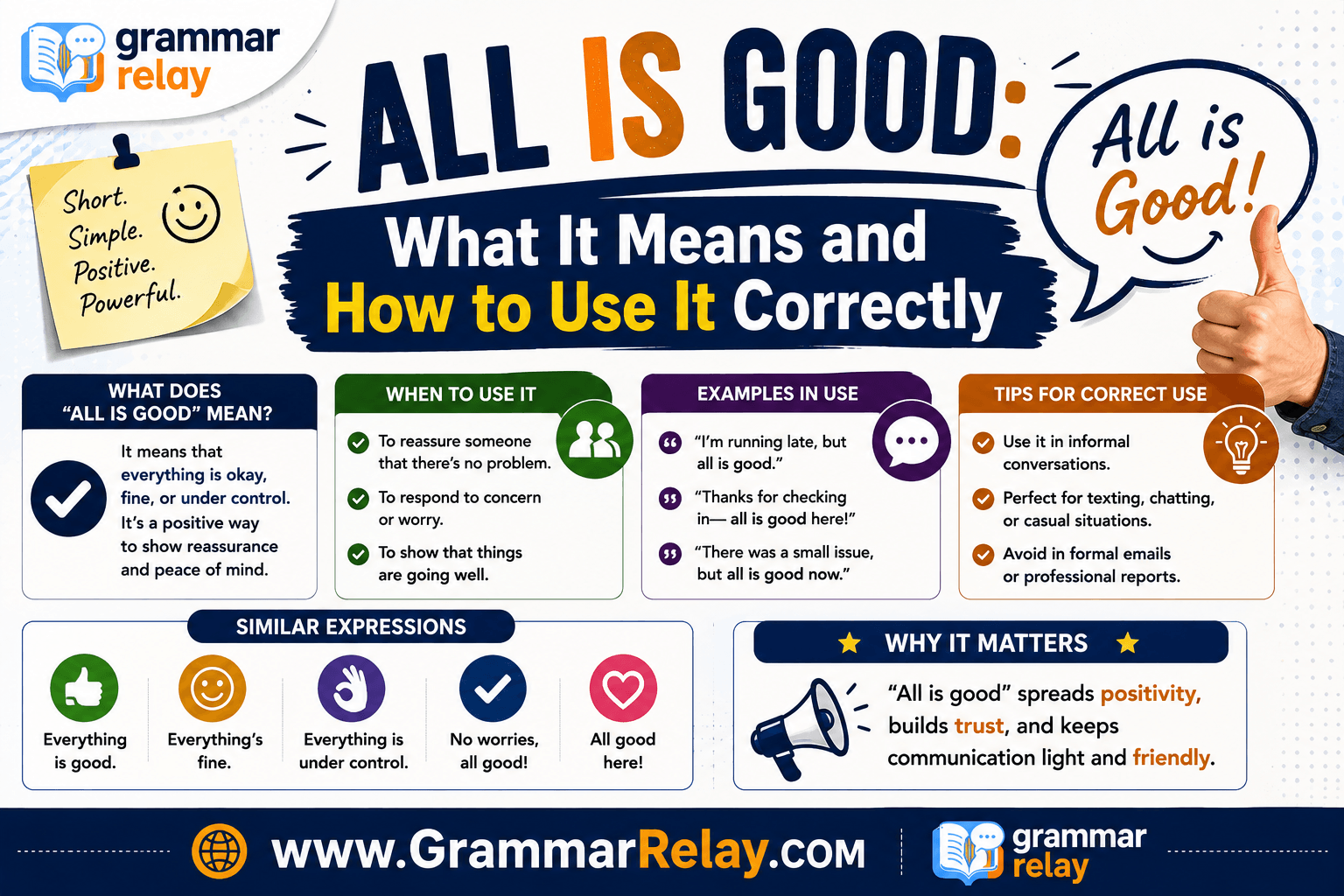
You text a friend after a rough week, and they ask how things are going. You type back “all is good” without a second thought. But then a nagging voice in your head asks: shouldn’t that be “all is well”? Is one of these actually wrong?
Here’s the quick answer: “all is good” is casual and widely accepted, while “all is well” is the more traditionally correct phrase for formal writing. Neither one is a mistake. They just serve different moods and different rooms. Let’s break down why, and when to reach for each.
What Does “All Is Good” Mean
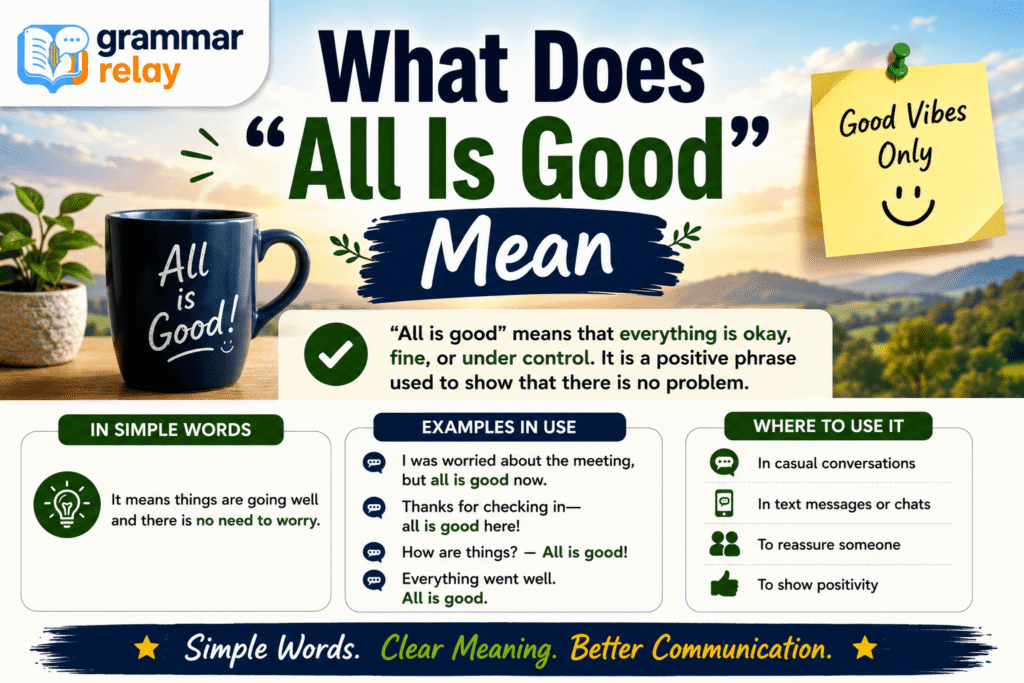
At its core, all is good means everything is fine, nothing’s wrong, and there’s no cause for concern. It’s a phrase you reach for when someone checks in on you, when you’re wrapping up a conversation on a positive note, or when you just want to signal that a situation has resolved itself without drama.
The all is good meaning leans casual and warm. It doesn’t carry the formality of a status report. Instead, it sounds like something you’d say to a friend, a coworker you’re close with, or a family member checking in after a stressful day.
You’ll also run into the shortened version, all good, which strips out “is” entirely and leans even more casual. Think of it as the text-message cousin of the full phrase. “All good” shows up constantly in texting, group chats, and quick replies where speed matters more than polish.
The Grammar Question: Is “All Is Good” Correct?
This is where things get interesting, and honestly, where most people get tripped up.
“Well” vs. “Good”: The Real Rule
Grammar teachers love to drill this one in: “well” is an adverb, and “good” is an adjective. Adverbs describe actions (how something is done), while adjectives describe nouns or states of being. That’s why you’d say “she sings well” (describing the action of singing) rather than “she sings good.”
By that logic, “all is well meaning” everything is in a satisfactory state, uses “well” correctly because it’s describing a state, not an action. So far, so good (pun intended).
Why “All Is Good” Still Works
Here’s the twist: “is” is a linking verb, not an action verb. Linking verbs connect a subject to a description of that subject, and they pair naturally with adjectives, not adverbs. Think of sentences like “the soup smells good” or “she looks happy.” You wouldn’t say “the soup smells well,” because that would describe the soup’s ability to smell things, which makes no sense.
Since “is” functions the same way, “all is good” isn’t breaking any real grammar rule. The subject (“all”) is being described by the adjective (“good”) through the linking verb (“is”). It’s grammatically sound, even if some traditionalists still prefer “well” out of habit.
So, when people debate all is good or all is well, they’re not actually debating right versus wrong. They’re debating formal versus casual, traditional versus modern.
“All Is Good” vs. “All Is Well”

Let’s put these two side by side, because context really does change which one fits better.
“All is well” tends to show up in:
- Formal writing and literature
- News reports and official statements
- Older or more traditional speech patterns
- Situations where you want a slightly more polished, composed tone
Read more about Ingrained vs Engrained: Which One Should You Actually Use?
“All is good” tends to show up in:
- Texting and casual conversation
- Social media captions and comments
- Quick check-ins between friends
- Everyday spoken English, especially in American English
Neither phrase is “better” in an absolute sense. If you’re writing a cover letter, “all is well” will read more professionally. If you’re texting your best friend, “all is good” (or just “all good”) fits the vibe far better.
Where “All Is Good” Came From
Language shifts based on how people actually talk, not just how grammar books say they should talk. Over the last several decades, casual American English has increasingly favored adjective-based expressions over adverb-based ones, especially in spoken language. Phrases like “I’m good,” “that’s good,” and “all is good” reflect this broader trend.
This shift didn’t happen randomly. Linking-verb constructions with “good” became so common in everyday speech that they eventually earned a permanent place in casual writing too. Dictionaries and usage guides now widely accept “good” following linking verbs, which is part of why “all is good” doesn’t raise many eyebrows anymore, even among people who know the “well vs. good” rule.
How People Actually Use “All Is Good”
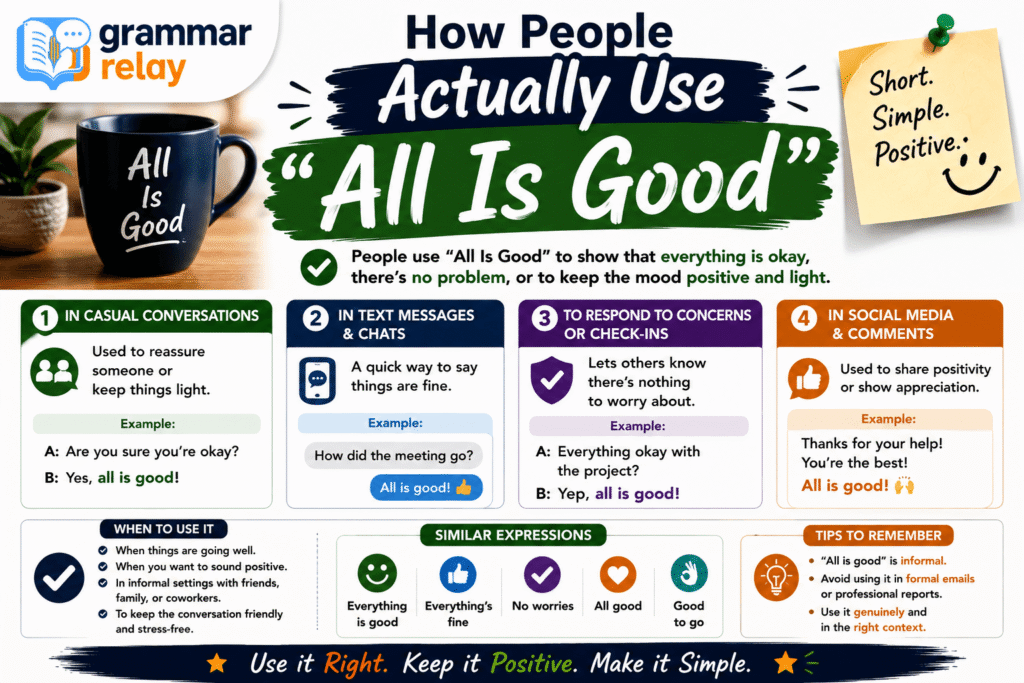
In Everyday Conversation
You’ll hear this phrase constantly in casual chats. Someone asks “how’d the appointment go?” and you reply, “all is good, nothing to worry about.” It’s short, reassuring, and doesn’t require further explanation.
In Texting and Casual Writing
Here, “all good” often wins out over the full phrase simply because it’s faster to type. A text that says “hey, sorry I missed your call” might get the reply “all good, talk later!” It’s efficient and friendly without sounding stiff.
In Professional or Formal Writing
This is where “all is well” usually takes over. A formal email update might read, “I’m pleased to report that all is well with the project timeline,” rather than the more casual “all is good with the timeline.” The stakes and tone shift, and so does the word choice.
You might be interested in City, Town and Village
Common Mistakes People Make
A few recurring mix-ups are worth flagging:
- Assuming “all is good” is flat-out incorrect. It’s not. It’s grammatically valid, just casual in tone.
- Using “all is good” in formal writing where “all is well” fits better. This can make professional writing sound too relaxed for the setting.
- Confusing the phrase with unrelated expressions, like “all’s fair” (from “all’s fair in love and war”) or “all good” used as a standalone interjection rather than a full sentence.
- Overusing filler phrases in formal writing when a more specific update would serve the reader better. Saying “all is good” in a business report, for example, tells your reader almost nothing useful compared to a specific status update.
Real Examples in Context
Here’s how the phrase looks in natural, everyday use:
- “How was the flight?” “All is good, we landed a bit early actually.”
- After a minor car scare: “Everyone okay?” “Yeah, all is good, just a flat tire.”
- A quick text reply: “No worries, all good on my end!”
- In a more reflective tone: “After a rocky start to the year, all is good now.”
- A parent checking in: “Just wanted to make sure all is good after your surgery.”
Interestingly, similar sentiments show up across languages too. If you’re curious how the phrase translates, all is well in Tagalog is often rendered as “maayos naman ang lahat” or simply “ayos naman,” both of which carry that same reassuring, everything’s-fine tone.
Alternative Ways to Say It
If you want variety beyond, try these:
- Everything’s fine
- No worries
- We’re good
- Nothing to report
- All’s well that ends well (a slightly different idiom, but related in spirit)
- Smooth sailing
Each carries a slightly different flavor, so pick based on how formal or casual the moment calls for.
Quick Reference Table
| Phrase | Grammar Status | Best Use |
|---|---|---|
| All is good | Casual, grammatically valid | Everyday speech, texting |
| All is well | Traditionally preferred | Formal writing, literature |
| All good | Very casual, shortened | Texts, quick replies |
Frequently Asked Questions
Is “all is good” grammatically correct?
Yes. Since “is” acts as a linking verb, pairing it with the adjective “good” follows standard grammar rules, even though “well” is often considered more traditional.
Should I use “all is good” in an email?
For casual, internal messages, sure. For formal or client-facing emails, “all is well” tends to read more professionally.
What’s the difference between “all is good” and “all is well”?
They mean the same thing. The difference lies in tone and formality, not meaning.
Is “all is good” more common in American or British English?
It’s used in both, but American English tends to favor casual adjective-based phrases like this one slightly more often in everyday speech.
What’s a more formal way to say “all is good”?
“All is well” is the go-to formal alternative, along with options like “everything is in order” or “the situation is under control.”
Read more grammar lessons on Grammar Relay
Conclusion
So, all is well or all is good? Honestly, you can’t go wrong with either. “All is well” leans formal and a touch old-fashioned in the best way, while “all is good” feels relaxed and modern. Neither phrase is a grammar crime. Context is really the only thing deciding which one belongs in your sentence.
Next time you’re checking in with someone, or someone’s checking in with you, trust your instincts. If you’re writing a business email, reach for “well.” If you’re texting a friend, “good” (or just “all good”) will do just fine.
