


There’s a phrase sitting at the bottom of thousands of professional emails right now. It’s polite. It’s inoffensive. “I look forward to working with you.”
Said genuinely in the right moment, this phrase works perfectly. Said robotically at the end of every professional introduction, it becomes verbal wallpaper. The goal of this guide isn’t to help you find 50 flashier ways to say the same hollow thing. It’s to help you communicate genuine enthusiasm in a way that actually lands, whether you’re closing a cover letter, starting a new role, or welcoming a new client.
Why “I Look Forward to Working With You” Gets Overused
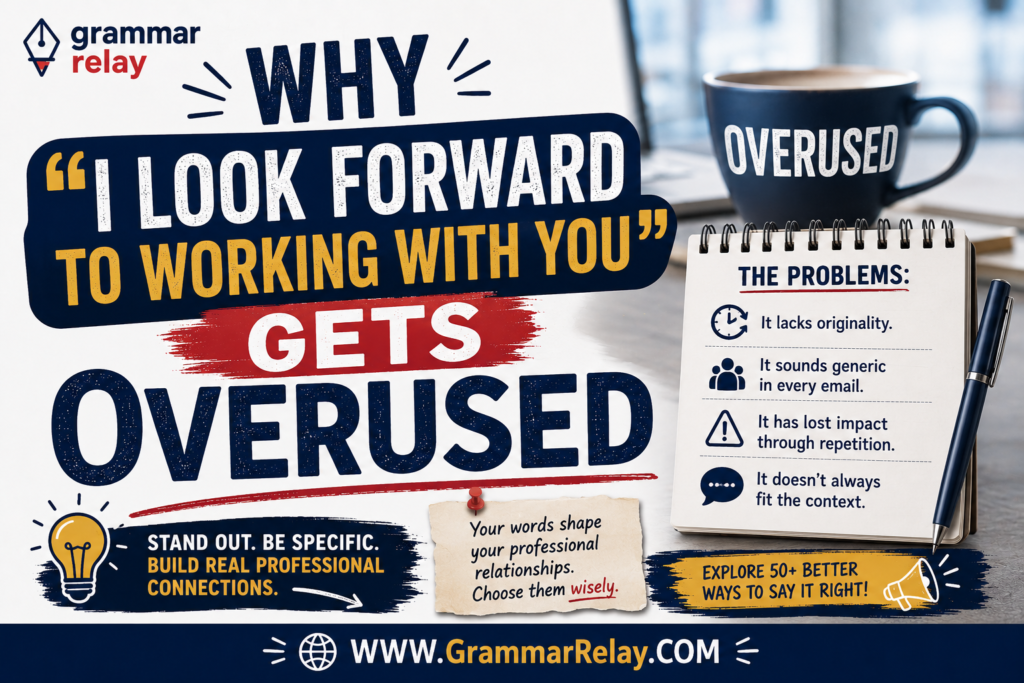
Professional communication has a comfort food problem. When writers feel uncertain about tone, they reach for familiar phrases that feel safe. “I look forward to working with you” is the most popular item on that menu.
The problem isn’t the phrase itself. The problem is frequency. When hiring managers read 200 cover letters and 190 of them end with this exact sentence, the phrase stops communicating anything. It becomes a signal that the writer ran out of things to say.
Research from Boomerang analyzing over 300,000 emails found that specific, personalized closings generated significantly higher response rates than generic sign-offs. The lesson is straightforward: specificity outperforms eloquence every single time.
“The single biggest problem in communication is the illusion that it has taken place.” — George Bernard Shaw
Having five versatile alternatives memorized across different formality levels serves you far better than a list of fifty phrases you’ll never use.
What “I Look Forward to Working With You” Actually Means (And When It’s Right)
At its core, this phrase functions as a social contract. It signals willingness, openness, and positive intent toward a new professional relationship. Done well, it sets a collaborative tone before work even begins.
| Situation | Is the Phrase Appropriate? | Best Tone |
|---|---|---|
| Starting a new job | Yes | Warm and genuine |
| Welcoming a new team member | Yes | Encouraging and inclusive |
| Beginning a client relationship | Yes | Professional and confident |
| Closing a job application | Yes | Formal and aspirational |
| After a single brief meeting | Sometimes | Keep it light |
| Ending every email habitually | No | Becomes meaningless filler |
Three situations genuinely call for this phrase: starting a new job, beginning a client relationship, and welcoming a new colleague. Outside those contexts, ask yourself whether the phrase adds something real or just fills the closing line.
Is “I Look Forward to Working With You” Grammatically Correct?
Yes but with an important caveat worth understanding.
“I look forward to working with you” is grammatically correct because “look forward to” requires a gerund (the “-ing” form of a verb) as its object. The phrase “I’m looking forward to work with you“ is incorrect because “to” here is part of the phrasal verb “look forward to,” not an infinitive marker.
This trips up non-native English speakers constantly. The rule is simple: after “look forward to,” always use the gerund form.
| Form | Correct? | Formality | Example |
|---|---|---|---|
| I look forward to working with you | Yes | Formal | Email sign-offs, letters |
| I’m looking forward to working with you | Yes | Semi-formal | Emails, messages |
| I look forward to work with you | No | N/A | Always incorrect |
| I’m looking forward to work with you | No | N/A | Always incorrect |
| I looked forward to working with you | Yes | Past tense | Reflection after collaboration |
“I look forward to” (present simple) reads as more formal and is preferred in written business correspondence. “I’m looking forward to” (present continuous) sounds warmer and more immediate, making it better suited to conversational emails and messages. Both are correct. The choice depends on tone.
The phrase “looking forward in working with you“ also appears occasionally and it’s grammatically incorrect. The correct preposition is always “to,” never “in.”
Read more about In the Street or On the Street: The Complete Guide
Formal Alternatives to “I Look Forward to Working With You”
For cover letters, client onboarding emails, executive communications, and formal business correspondence, these alternatives carry the right weight without sounding stiff.
| Alternative | Best Used When | Example In Context |
|---|---|---|
| “I anticipate a productive and rewarding collaboration.” | Client or executive onboarding | Email to new client after contract signing |
| “I welcome the opportunity to contribute to your team’s objectives.” | Job acceptance letter | Formal response to offer letter |
| “I am eager to bring my expertise to this partnership.” | New business relationship | Introduction email to key stakeholder |
| “I look forward to contributing meaningfully to our shared goals.” | New role or project | First email to new manager |
| “I am committed to making this collaboration as productive as possible.” | Client or partner relationship | Proposal follow-up |
| “I look forward to the opportunity to demonstrate what we can achieve together.” | Post-interview follow-up | High-stakes professional context |
A look forward to working with you email in a formal context should place the closing phrase in the final paragraph after expressing specific enthusiasm about the role or project. Leading with something specific then closing with a formal alternative makes the sign-off feel earned rather than automatic.
Semi-Formal Alternatives: Professional but Human
Most workplace communication lands somewhere between stiff formality and casual friendliness. These alternatives work beautifully in that middle ground: professional enough to respect the relationship, warm enough to feel genuine.
| Alternative | Best Used When | Example In Context |
|---|---|---|
| “Really looking forward to what we’ll build together.” | Project kickoff | Opening of a project launch email |
| “Glad to be on board and looking forward to getting to know everyone.” | New team member introduction | Group introduction message |
| “Looking forward to collaborating and learning from everyone here.” | Joining an experienced team | Onboarding message |
| “Thrilled about this opportunity and eager to hit the ground running.” | Competitive new role | Follow-up after accepting an offer |
| “Excited to be part of the team and see what we accomplish together.” | Team introduction | First-day email to department |
“We are looking forward to working with you” works particularly well in client-facing contexts where the communication represents a team or organization rather than an individual. It signals collective commitment rather than personal enthusiasm alone.
Similarly, “we look forward to working with you” (without the contraction) reads as slightly more formal and suits official business communications like proposals, contracts, and formal partnership announcements.
Casual Alternatives for Informal Workplaces and Platforms
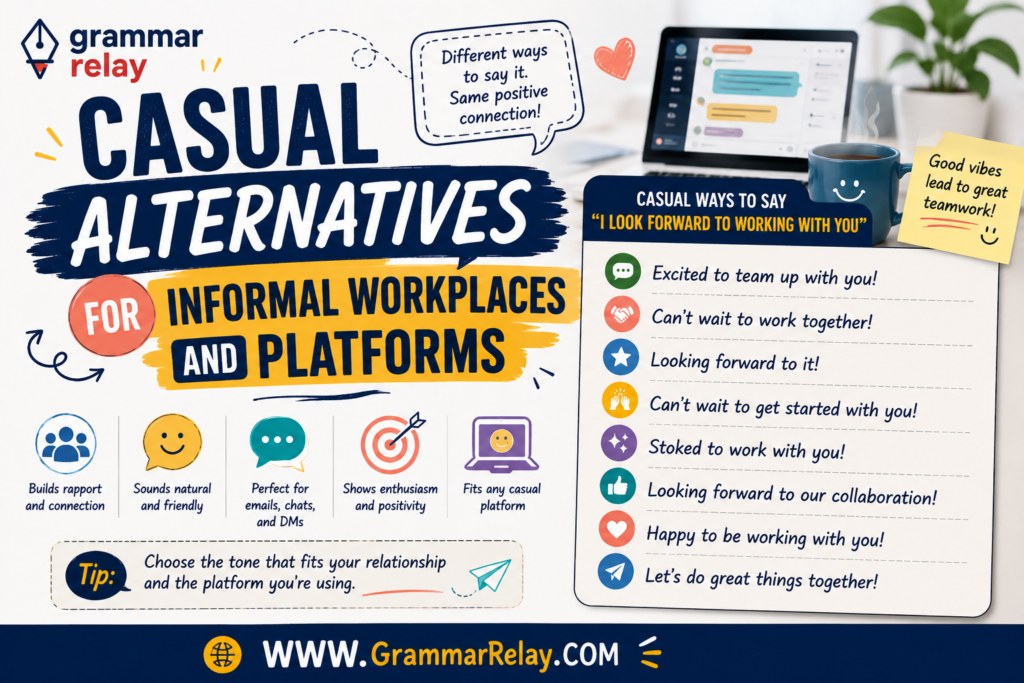
Startup culture, creative industries, and informal team environments call for something that sounds like a real person wrote it. These phrases deliver that without crossing into unprofessional territory.
| Alternative | Best Used When | Example In Context |
|---|---|---|
| “Stoked to be working with you on this.” | Creative project kickoff | Slack message to new collaborator |
| “Really glad we’re finally doing this together.” | Long-awaited collaboration | Message to existing contact |
| “This is going to be a great one. Can’t wait to get started.” | Exciting new project | Casual project intro message |
| “Happy to be on the same team. Let’s make it count.” | New team formation | Team announcement message |
| “Looking forward to the ride.” | Long-term collaboration | Partnership announcement |
“Excited to work with you” sits comfortably in this casual-professional zone. It’s enthusiastic without being overwrought and short enough to feel natural in a Slack message or Teams chat without requiring formal punctuation or structure.
Alternatives for Specific Professional Scenarios
Different situations call for different levels of enthusiasm and different types of specificity.
| Scenario | Best Alternative | Why It Works |
|---|---|---|
| Post-interview thank you | “I look forward to the possibility of contributing to your team.” | Expresses hope without presumption |
| Job offer acceptance | “I’m genuinely excited to begin and will hit the ground running on day one.” | Shows enthusiasm and readiness |
| Welcoming new hire | “We’re thrilled to have you and can’t wait to see what you bring to the team.” | Warm, inclusive, and specific |
| New client email | “I’m committed to making this partnership as valuable as possible for your business.” | Outcome-focused and confident |
| Post-networking follow-up | “I’d love to explore how we might work together in the future.” | Open without pressure |
| Cover letter closing | “I welcome the opportunity to discuss how my experience aligns with your team’s vision.” | Confident and forward-looking |
The post-interview context deserves special attention. “I look forward to working with you” in a thank-you note can sound presumptuous if you don’t yet have the job. “I look forward to the possibility of contributing” strikes a more appropriate note: enthusiastic but not assumptive.
You might be interested in How to Spell “Of Course”: Complete Guide to Correct Usage, Meaning, and Common Mistakes
How to Make Any Version of This Phrase Sound Genuine
Here’s the single most valuable lesson in this entire guide: specificity is what separates a genuine expression of enthusiasm from a hollow filler phrase.
| Generic Version | Personalized Version | What Changed |
|---|---|---|
| “I look forward to working with you.” | “I look forward to working with you on the Q3 product launch.” | Added specific project context |
| “I’m excited to join the team.” | “I’m excited to join the team, especially given the expansion into Southeast Asia.” | Referenced something real |
| “Looking forward to our collaboration.” | “Looking forward to learning from your team’s experience in enterprise SaaS.” | Shows genuine research and interest |
| “Can’t wait to get started.” | “Can’t wait to get started on the rebrand. The brief is exactly the kind of challenge I love.” | Grounded in real context |
A looking forward to working with you email that references a specific project, a conversation point from the interview, or something specific about the company or team always outperforms a generic version of the same phrase. The reader feels seen and the writer looks attentive.
Another way to say looking forward to working with you that almost always works: tie it to a shared outcome. “I look forward to seeing what we can build together” focuses on results rather than the relationship itself, which often resonates more strongly in goal-oriented professional environments.
Phrases to Avoid (And Why They Backfire)
Not all enthusiasm reads as professional. Some phrases cross into territory that undermines the very credibility they’re trying to establish.
| Phrase to Avoid | Why It Backfires | Better Alternative |
|---|---|---|
| “I’m over the moon to be joining!” | Excessively casual for most professional contexts | “I’m genuinely excited about this opportunity.” |
| “I can’t wait to synergize our skills!” | Corporate jargon that signals inauthenticity | “I look forward to combining our strengths.” |
| “I’m pumped to make magic happen!” | Too informal for professional first impressions | “I’m eager to see what we build together.” |
| “I’m thrilled beyond words!” | Hyperbole undermines credibility | “I’m genuinely excited to get started.” |
| “Looking forward to an amazing journey together!” | Vague and clichéd | “Looking forward to making meaningful progress together.” |
The rule of thumb: if the phrase would look out of place in a Fortune 500 annual report AND out of place in a text message to a friend, it’s probably in the wrong register for professional use.
“I Look Forward to Working With You” Across Communication Channels
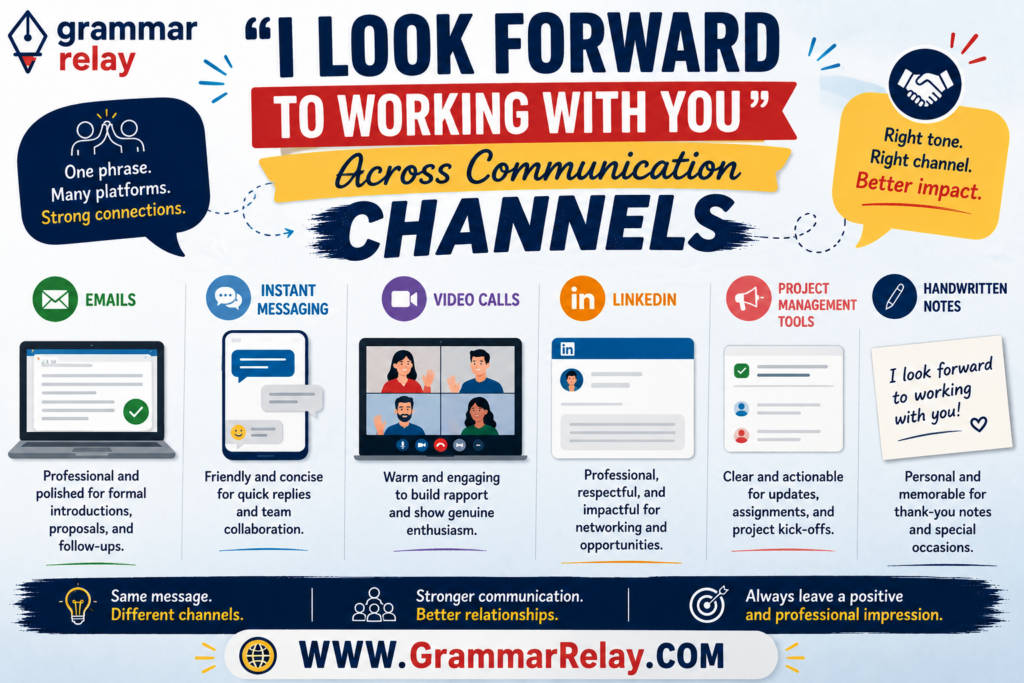
Platform context shapes phrasing more than most writers realize. The right phrase in a cover letter sounds wrong in a Slack message and vice versa.
| Channel | Recommended Style | Length | Example |
|---|---|---|---|
| Formal email | Full phrase with formal alternatives | 1 sentence | “I look forward to a productive collaboration.” |
| LinkedIn message | Shorter, warmer, specific | Half sentence | “Looking forward to connecting more on this.” |
| Cover letter | Confident and aspirational | 1-2 sentences | “I welcome the opportunity to discuss my contribution.” |
| Slack/Teams | Casual and brief | 5-8 words | “Excited to be working with you all!” |
| Video call closing | Verbal, warm, natural | 1 short sentence | “Really looking forward to working together.” |
| Handwritten note | Personal and gracious | 1-2 sentences | “I truly look forward to what we’ll accomplish.” |
A looking forward to working with you synonym that works across almost every channel: “I’m excited to collaborate.” Four words. Clear. Warm. Professional enough for email and natural enough for Slack. When in doubt, this phrase covers the bases.
International and Cross-Cultural Considerations
Enthusiasm doesn’t translate uniformly across cultures. What reads as genuine warmth in an American email can read as excessive or insincere in a German or British context.
| Culture/Region | Preferred Tone | Recommended Phrasing |
|---|---|---|
| United States | Warm, enthusiastic | “I’m excited to work with you and your team.” |
| United Kingdom | Reserved, understated | “I look forward to working with you.” |
| Germany/Nordics | Direct, task-focused | “I look forward to a productive collaboration.” |
| Japan | Formal, respectful | “I am honored to have this opportunity to work together.” |
| Middle East | Relationship-focused | “I look forward to building a strong working relationship with you.” |
| Australia | Casual, direct | “Looking forward to working with you on this.” |
“We look forward to working with you” in cross-cultural B2B communication generally lands better than overly enthusiastic alternatives because it signals institutional commitment rather than individual excitement, which reads more credibly across conservative professional cultures.
Frequently Asked Questions
Is “I look forward to working with you” grammatically correct?
Yes. “Look forward to” requires a gerund (the “-ing” form) so “working” is correct. “I look forward to work with you” is grammatically incorrect.
What’s the difference between “I look forward to” and “I’m looking forward to”?
“I look forward to” (present simple) is more formal and suits written correspondence. “I’m looking forward to” (present continuous) sounds warmer and more immediate, better suited to conversational emails and messages. Both are grammatically correct.
How do you respond when someone says “I look forward to working with you”?
Common responses include: “Likewise, I’m excited to get started,” “The feeling is mutual,” or “Looking forward to it as well.” Match their tone and formality level.
Can you end an email with just “Looking forward to working with you”?
Yes. Dropping “I” at the start is acceptable in email sign-offs and reads as slightly more natural in conversational professional contexts.
What’s a more specific way to say “I look forward to working with you” in a cover letter?
Try: “I welcome the opportunity to discuss how my background in [specific area] aligns with your team’s goals for [specific project or objective].” This version shows you’ve actually read the job description.
Read more grammar lessons on Grammar Relay
Conclusion
Here’s the honest truth about looking forward to working with you and all its alternatives: the version that works best isn’t the most creative one or the most formal one. It’s the most genuine one.
Specificity makes any version of this phrase better. Matching the phrase to the channel, the relationship, and the context makes it land. And choosing a phrase that actually reflects how you feel makes it believable.
Whether you write “I look forward to working with you” in a formal email, “excited to work with you” in a Slack message, or something more personalized that references the actual project you’re about to tackle together, the goal is the same: make the reader believe you mean it.
