

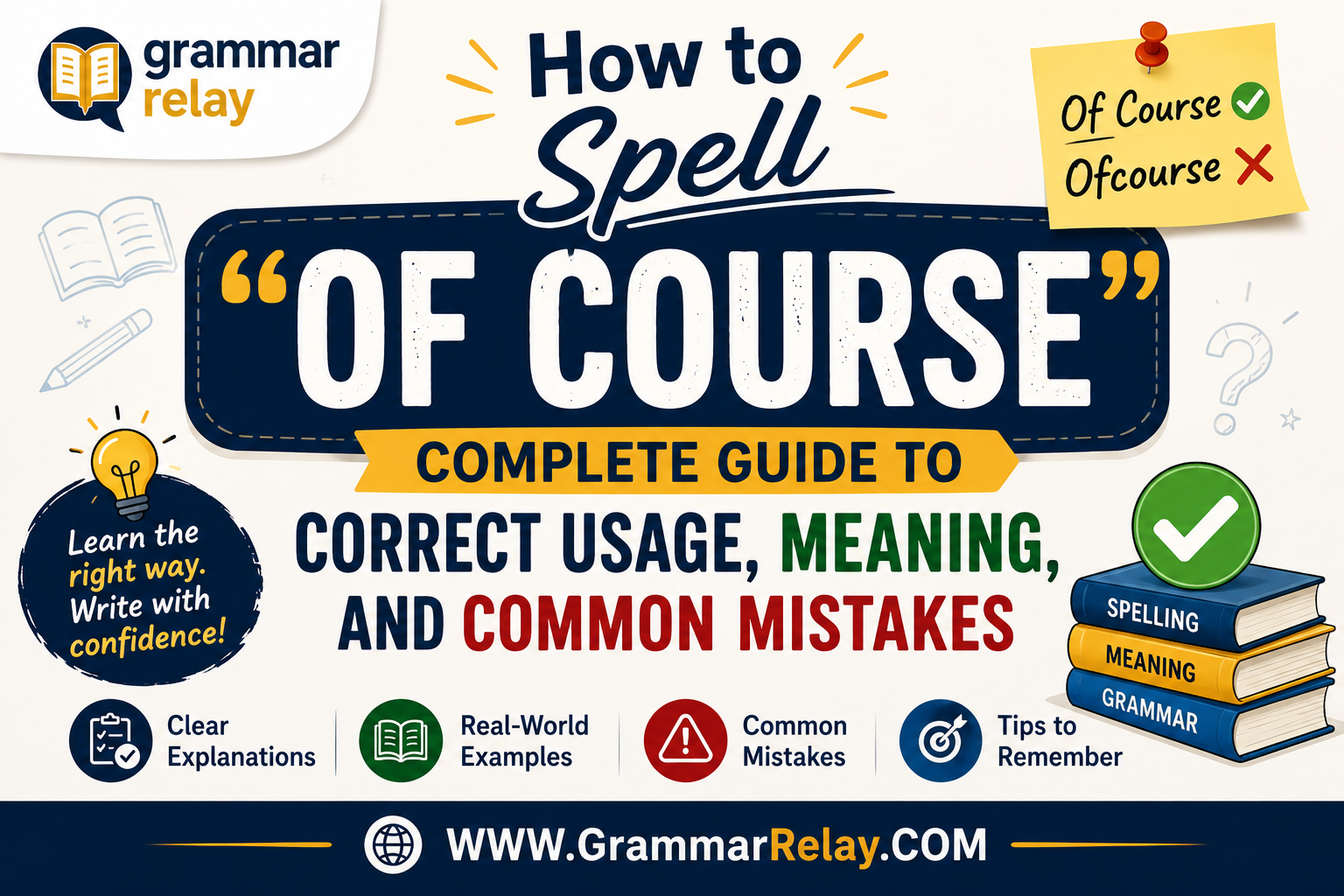
Here’s a spelling mistake that slides past autocorrect, survives proofreading, and shows up in professional emails sent to clients every single day. Ofcourse. One word. No space. And completely wrong in every context, register, and variety of English that exists.
The correct spelling of of course is two words: of course. Always. Without exception. But knowing that rule is just the starting point. Understanding why the error happens, what the phrase actually means across different contexts, and when it can accidentally sound condescending makes you a genuinely stronger writer.
This guide covers all of it.
The Direct Answer: How Do You Spell “Of Course”?
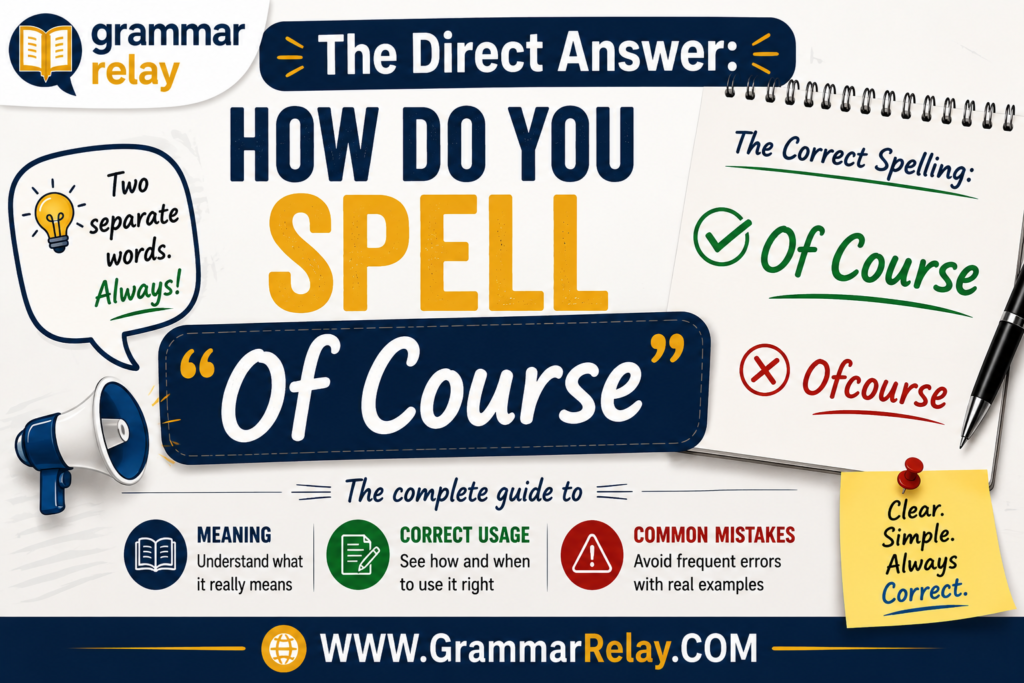
Two words. A space between them. Every time.
Ofcourse spelling questions have one answer and it doesn’t change based on context, tone, or how fast you’re typing. The merged version doesn’t exist in any dictionary, style guide, or recognized variety of English.
| Spelling | Correct? | Meaning | Use It? |
|---|---|---|---|
| Of course | Yes | Certainly, naturally, as expected | Always |
| Ofcourse | No | Nothing (not a word) | Never |
| Off course | Yes | Deviating from intended path | Only for direction/deviation |
| Offcourse | No | Nothing (not a word) | Never |
Ofcourse or of course? Always the two-word version. And afcourse or ofcourse? Neither. The only correct form is “of course” with a space and the standard spelling.
What “Of Course” Actually Means: Every Definition and Function
Ofcourse meaning questions often reveal that people understand the phrase intuitively but can’t articulate its precise function. That’s worth fixing because “of course” does six distinct things depending on context.
| Function | Example | Tone |
|---|---|---|
| Expressing certainty | “Of course she got the promotion.” | Confident/neutral |
| Polite agreement | “Of course, we can reschedule the meeting.” | Formal/courteous |
| Natural expectation | “Of course it was sold out by noon.” | Matter-of-fact |
| Sarcasm/irony | “Of course the WiFi dies right now.” | Informal/wry |
| Softening disagreement | “Of course, there’s another perspective worth considering.” | Diplomatic |
| Standalone response | “Can you help?” “Of course!” | Casual/emphatic |
Ofcourse means the same thing as “of course” in the minds of people who write it that way but the spelling remains wrong regardless of what the writer intends. Meaning and correct spelling are separate issues and both matter.
Read more about Input vs Imput: The Definitive Guide to Spelling, Meaning, and Usage
The Etymology of “Of Course”: Why It’s Always Two Words
The of course spelling question becomes permanently settled once you understand where the phrase came from.
“Of” descends from Old English “of” meaning away from or out of. “Course” comes from Old French “cours” meaning a run, path, or flow, itself derived from Latin “cursus.” The two words carried entirely separate etymological origins and separate meanings before combining into a phrase.
The original literal meaning was straightforward: proceeding along the natural path or expected route. Think of it as a navigational phrase. By the 14th century it appeared in English literature with this physical directional sense. By the 17th century it had evolved into the figurative everyday expression of certainty and agreement that English speakers use today.
| Period | Form | Meaning | Notes |
|---|---|---|---|
| 14th century | Of course (literal) | Along the natural path | Navigation and physical direction |
| 15th-16th century | Of course (figurative) | As things naturally proceed | Extended metaphorical use |
| 17th century | Of course (conversational) | Naturally, as expected | Everyday usage solidifies |
| 18th-19th century | Of course (emphatic) | Certainly, absolutely | Modern affirmative function |
| Present day | Of course (all functions) | Multiple meanings by context | Standard phrase in all registers |
Two separate word origins, separated by centuries of linguistic evolution, don’t merge into one word. That’s why ofcourse spelling is always wrong: the phrase never had the structural basis to become a compound word in the first place.
Why “Ofcourse” Feels Right (The Psychology Behind the Misspelling)
Understanding why ofcourse feels natural is more useful than simply being told it’s wrong. Several converging factors drive this specific error.
Phonetic Blending
In natural speech at normal conversational speed, “of course” sounds like a single unit. The “f” at the end of “of” blends directly into the “c” at the start of “course” with no audible pause. Your ears hear one word so your fingers type one word.
The Compound Word Assumption
English does merge words. Frequently. Your brain knows this and applies the pattern:
| Legitimate Compound | Original Words | Why They Merged |
|---|---|---|
| Therefore | There + fore | Grammatical function word, not a phrase |
| Moreover | More + over | Adverbial conjunction, single semantic unit |
| Nevertheless | Never + the + less | Fixed adverbial phrase compressed over centuries |
| Meanwhile | Mean + while | Temporal adverb with fused meaning |
| Of course | Of + course | Prepositional phrase: NEVER merged |
The difference? Words like “therefore” and “moreover” became conjunctions and adverbs, grammatical function words with unified single meanings. “Of course” remains a prepositional phrase, two words functioning together without merging into a new grammatical category.
Autocorrect and Platform Gaps
Some messaging platforms and autocorrect systems accept ofcourse without flagging it. Others treat it as a potential proper noun or name. Never rely on autocorrect to catch this error. It’s inconsistent and unreliable for this specific mistake.
“Off Course” vs “Of Course”: Two Completely Different Phrases
This distinction matters far more than competitors suggest. Writing “off course” when you mean “of course” doesn’t just look wrong: it changes the meaning of your sentence entirely.
| Phrase | Meaning | Example | Context |
|---|---|---|---|
| Of course | Certainly, naturally | “Of course I’ll attend the meeting.” | Agreement/certainty |
| Off course | Away from intended path | “The ship went off course in the storm.” | Navigation/deviation |
| Of course (figurative) | As expected | “Of course it worked out in the end.” | Conversational |
| Off course (figurative) | Going in wrong direction | “The project is off course and needs review.” | Professional/planning |
“Off course” belongs in sailing reports, aviation incident reviews, and project status updates where something has deviated from its intended path. “Of course” belongs everywhere else. Confusing them produces sentences that say the opposite of what you mean.
Grammar Deep Dive: How “Of Course” Functions in Every Sentence Position
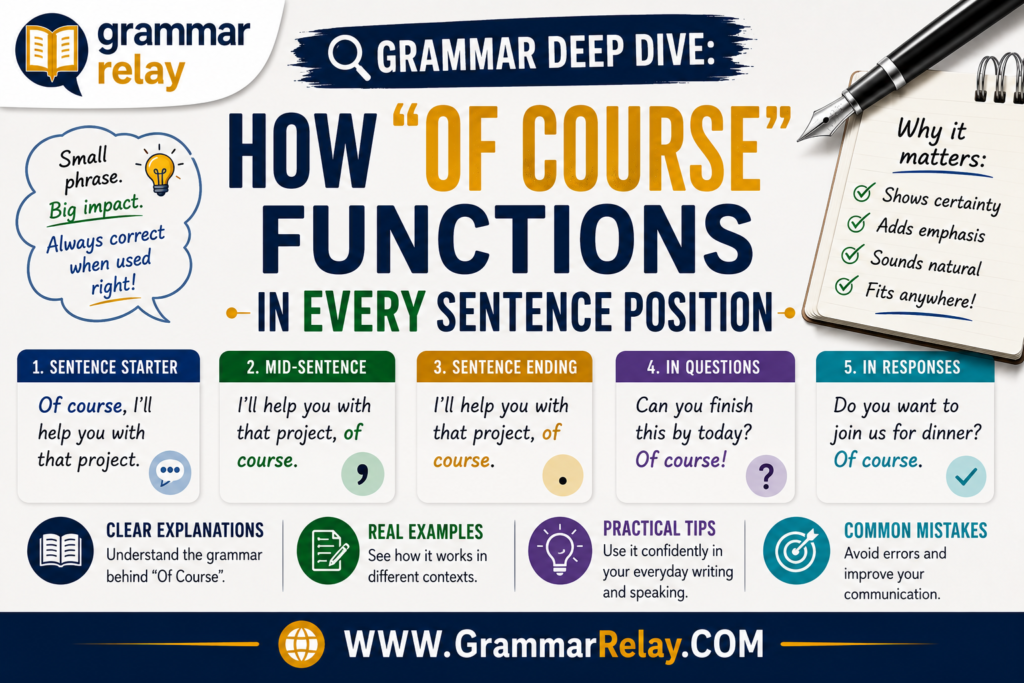
Of course spelling is just the first layer. Knowing where to put commas around the phrase separates competent writers from genuinely polished ones.
| Position | Punctuation Rule | Example |
|---|---|---|
| Sentence opener | Followed by comma | “Of course, you’re welcome to join us.” |
| Mid-sentence parenthetical | Surrounded by commas | “This is, of course, the best available option.” |
| End of sentence | Preceded by comma | “You can come with us, of course.” |
| Standalone response | No comma needed | “Are you coming?” “Of course!” |
| Before a clause (casual) | Comma optional | “Of course I knew this would happen.” |
The comma rules aren’t arbitrary. When “of course” functions as a parenthetical comment inserted into a sentence, commas signal to the reader that it’s an aside rather than a grammatical component of the main clause. Drop the commas and the sentence still makes sense but it reads as less precise.
“Of Course” in Formal vs Informal Writing: Knowing When It Fits
Of course works across registers but not equally in every context.
| Writing Context | Is “Of Course” Appropriate? | Notes |
|---|---|---|
| Business email | Yes | Polite and professional |
| Academic paper | Use sparingly | Can sound presumptuous |
| Legal documents | Rarely | Replace with “necessarily” or “certainly” |
| Casual texting | Yes | Natural and common |
| Journalism | Context-dependent | Fine in quotes, careful in editorial |
| Customer service | Yes | Warm and accommodating |
| Public speaking | Yes | Conversational and engaging |
In academic writing specifically, “of course” can imply that something is obvious when your reader might not find it obvious at all. This risks alienating readers who don’t share your assumed baseline knowledge. Use sparingly and consider “certainly” or “as expected” as alternatives.
When “Of Course” Sounds Condescending (A Warning Nobody Covers)
This is the most practically important section in this entire guide and it’s completely absent from every competitor article.
“Of course” carries a built-in implication: this thing is obvious and natural. In the right context that’s reassuring and warm. In the wrong context it signals that you think the other person should already know something they clearly don’t. That reads as dismissive and patronizing.
“The single biggest problem in communication is the illusion that it has taken place.” — George Bernard Shaw
| Condescending Use | Why It’s Problematic | Better Alternative |
|---|---|---|
| “Of course you wouldn’t understand that.” | Implies inferiority directly | “This concept can be tricky to navigate…” |
| “Of course I already knew that.” | Dismisses the speaker entirely | “Yes, I was aware of that as well.” |
| “Of course that approach is wrong.” | Belittles the error | “Actually, the more effective approach is…” |
| “Of course it failed.” | Implies obvious foreknowledge | “In hindsight, there were warning signs.” |
The fix is simple: before using “of course” in any response to someone’s question or mistake, ask whether your phrasing implies they should have known better. If it does, reach for a different phrase.
You might be interested in To or Too Many: Which Is Correct and How to Never Mix Them Up Again
Synonyms and Alternatives to “Of Course” (For Every Context)
| Synonym | Formality | Best Used When | Example |
|---|---|---|---|
| Certainly | High | Formal agreement | “Certainly, I’ll send that right over.” |
| Absolutely | Medium-high | Emphatic agreement | “Absolutely, we can make that work.” |
| Naturally | Medium | Expected outcomes | “Naturally, she excelled in the role.” |
| Indeed | High | Formal affirmation | “Indeed, that’s the correct interpretation.” |
| Sure | Low | Casual agreement | “Sure, I’ll grab coffee too.” |
| By all means | High | Formal permission | “By all means, proceed with the plan.” |
| Without question | High | Strong affirmation | “Without question, this is the right call.” |
| Needless to say | Medium | Expected situations | “Needless to say, the event was a success.” |
Ofcourse means the same thing as all these synonyms in practical use but none of the synonyms carry spelling confusion. When you’re writing quickly and want to avoid the ofcourse error entirely, “certainly” or “absolutely” remove the problem at the source.
Common Mistakes Writers Make With “Of Course”
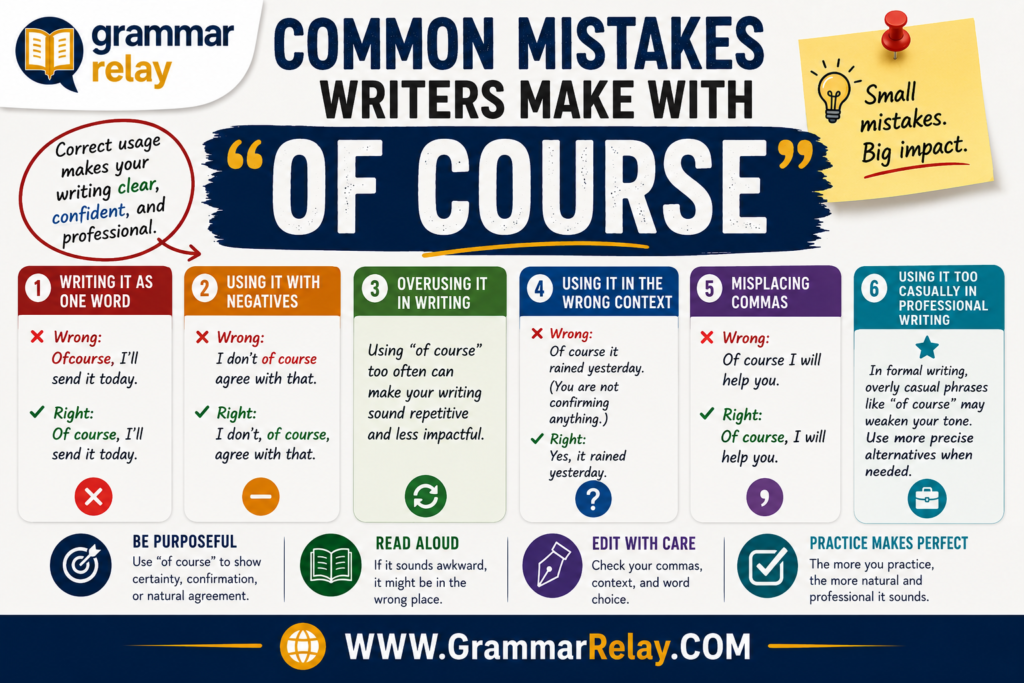
| Incorrect | Correct | Why |
|---|---|---|
| “Ofcourse I’ll help.” | “Of course I’ll help.” | Always two separate words |
| “The ship went of course.” | “The ship went off course.” | Navigation uses “off course” |
| “This is of course the best option.” | “This is, of course, the best option.” | Parenthetical needs commas |
| “Of course, of course, we’ll consider it.” | “We’ll certainly consider it.” | Overuse weakens the phrase |
| “Off course you can join us.” | “Of course you can join us.” | Wrong phrase entirely |
Overuse deserves special mention. Writers who reach for “of course” repeatedly within a single document drain it of meaning. By the third or fourth appearance it reads as filler rather than genuine affirmation. Rotate through synonyms and reserve “of course” for moments where its particular warmth or emphasis actually adds something.
Memory Tricks That Make the Correct Spelling Stick
Three anchors that work immediately:
The “therefore” comparison: “Therefore” is one word because it’s a grammatical conjunction with a unified meaning. “Of course” is a prepositional phrase. English doesn’t merge prepositional phrases into single words. This comparison alone resolves the compound word assumption permanently.
The space bar reminder: Type “of” and then pause for half a second. The space is already there before your brain reaches for “course.” Slow the typing slightly on this phrase and the correct form writes itself.
The “off course” anchor: Ask whether your sentence has anything to do with direction, navigation, or deviation from a path. If not, you need “of” not “off” and you need two words not one.
Frequently Asked Questions
Is “ofcourse” ever correct in English?
No. Ofcourse has no dictionary entry, no recognized usage, and no correct context in any variety of English. The correct of course spelling is always two words with a space between them.
Why is “of course” always two words?
Because it’s a prepositional phrase built from two words with separate etymological origins. “Of” and “course” came from different historical language roots and never underwent the grammatical transformation that would justify merging them into a compound word.
What is the difference between “of course” and “off course”?
“Of course” expresses certainty, agreement, or natural expectation. “Off course” describes deviation from an intended path. They’re different phrases with entirely different meanings and cannot substitute for each other.
Do you always need a comma after “of course”?
When “of course” opens a sentence or functions as a parenthetical, commas are standard. When it appears before a clause in casual writing, the comma is optional. As a standalone response, no comma is needed.
When does “of course” sound condescending?
When it implies the listener should already know something they’re asking about or when it dismisses someone’s error as obvious. In those situations, substitute “certainly,” “naturally,” or simply reframe the sentence to avoid implying superiority.
Why doesn’t autocorrect catch “ofcourse”?
Some systems treat it as a potential proper noun or unrecognized word rather than a clear error. Autocorrect reliability for this specific mistake varies significantly across platforms and devices.
Read more grammar lessons on Grammar Relay
Conclusion
Two words. A space. Every single time.
Ofcourse carries no meaning, no dictionary backing, and no situational correctness. The ofcourse spelling error persists because the phrase sounds like one word in speech and because English does merge words in other cases but “of course” isn’t one of those cases and never has been.
Knowing the correct of course spelling is straightforward. Using the phrase skillfully, with proper comma placement, appropriate register, and awareness of when it risks sounding condescending, is what separates writers who merely know the rule from writers who actually apply it well.
