

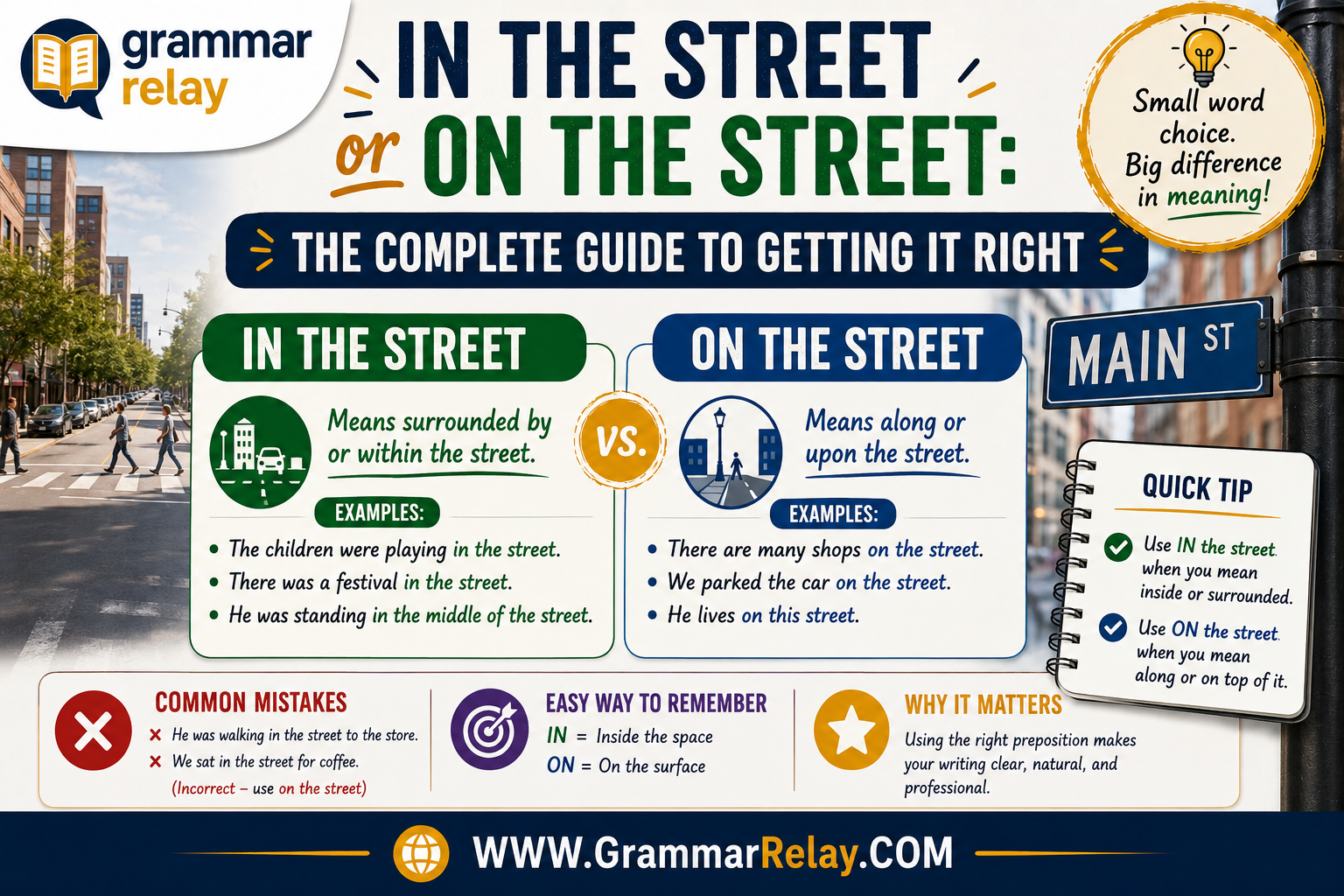
Two tiny prepositions. One major source of confusion. And the answer isn’t as simple as most grammar guides suggest. If you want to get more information about “In or On the street” must read this article till the end!
The both phrases appear in published books, respected newspapers, and everyday conversation. Both sound natural depending on where you grew up. And both can be correct depending on exactly what you mean and who you’re writing for.
This guide cuts through the ambiguity completely. You’ll understand the grammatical logic, the regional differences, the idiomatic exceptions, and the specific contexts where one preposition is clearly better than the other.
The Quick Answer (With the Nuance You Actually Need)
Here’s the core distinction in plain terms. It dominates American English across almost every situation. It is more natural in British English when describing physical presence inside the road or traffic area. However, both varieties share several fixed idioms that override regional preferences entirely.
| Phrase | Primary Meaning | Dominant In | Example |
|---|---|---|---|
| On the street | Located along or beside a street | American English | “She lives on Maple Street.” |
| In the street | Physically inside the road/traffic area | British English | “A child ran in the street.” |
| On the street (idiomatic) | Homeless or without shelter | Both varieties | “He ended up on the street.” |
| In the street (idiomatic) | Among ordinary people/public space | Both varieties | “Anger in the street was palpable.” |
The question doesn’t have one universal answer. It has several correct answers depending on meaning, region, and context.
What “On the Route” Means: Every Usage That Matters

It does considerably more work than simply describing a location. In American English especially, it covers six distinct meanings that writers encounter regularly.
| Usage | Example | Context |
|---|---|---|
| Location/address | “The café is on Fifth Street.” | Navigation/geography |
| Homelessness | “Thousands end up each winter.” | Social issues |
| Public opinion | “We asked people on the street for their views.” | Journalism/vox pop |
| Wall Street reference | “The Street reacted badly to the Fed’s announcement.” | Finance |
| Released from jail | “He’s been for two weeks now.” | Informal American |
| Product release | “The new model hits next month.” | Marketing/retail |
The financial usage deserves special mention. Capital S refers specifically to Wall and the broader financial industry in American usage. When Bloomberg or the Wall Journal write reaction,” they’re referencing institutional financial opinion, not a physical road.
What “In the road” Means: Every Usage That Matters
It carries its own distinct set of meanings and they differ meaningfully from the “on” version in ways that matter for precision.
| Usage | Example | Context |
|---|---|---|
| Physical road surface | “A car broke down”. | Traffic/safety |
| British general location | “The children were playing.” | British English |
| Public protest | “Protesters took to nationwide.” | Political/social |
| Danger/traffic exposure | “Don’t walk; use the pavement.” | Safety warning |
| Community/public life | “Life was vibrant and loud.” | Cultural/descriptive |
| Historical/literary | “Vendors cried out their wares.” | Literature/history |
The protest usage is worth examining closely. “Taking to the streets“ and “protests in the streets“ appear in both American and British English regardless of which preposition each variety prefers for general usage. This is a fixed idiomatic expression that transcends regional preference.
“Every city in America will be filled with the spirit of protest.” Cesar Chavez
Historical and literary writing favors almost universally. Victorian novels, 19th century journalism, and historical accounts consistently use to describe public activity. If you’re writing historical fiction set in London, is almost certainly the period-appropriate choice.
Read more about How to Spell “Of Course”: Complete Guide to Correct Usage, Meaning, and Common Mistakes
The Core Grammatical Difference Between “In” and “On”
Understanding at a grammatical level makes the choice intuitive rather than memorized.
“On” is a surface preposition. It describes resting on top of or traveling along a surface. You sit on a chair. You walk on a floor. A viewed as a flat surface you travel along naturally takes “on.”
“In” is a containment preposition. It describes being enclosed within or surrounded by something. You sit in a car. You walk in a tunnel. A viewed as a channel or corridor between buildings naturally takes “in.”
| Preposition | Conceptual Frame | Street Meaning | Example |
|---|---|---|---|
| On | Surface, along a line | As a surface you travel along | “Walk on the street.” |
| In | Contained, enclosed space | As a channel or enclosed area | “Playing in the street.” |
| At | Point location | As a specific address point | “Meet me at the corner of Main Street.” |
Both conceptualizations are valid. Genuinely is both a surface and a channel. This is exactly why produces legitimate disagreement: reasonable people conceptualize streets differently and their preposition choice reflects that cognitive model.
American English vs British English: Where the Real Divide Lives
The debate maps almost perfectly onto the American-British divide with Australian English generally following British patterns.
| Phrase | American English | British English | Australian English |
|---|---|---|---|
| Child playing in/on the road | “Playing on the street” | “Playing in the street” | “Playing in the street” |
| Homeless person | “Living on the street” | “Living on the street” | “Living on the street” |
| Public protest | “Taking to the streets” | “Taking to the streets” | “Taking to the streets” |
| Address location | “On Oak Street” | “In Oak Street” or “On Oak Street” | “On Oak Street” |
| Car accident location | “On the street” | “In the street” | “In the street” |
Notice that homelessness and protest idioms remain consistent across all three varieties. These fixed expressions have standardized through global media exposure regardless of local preposition preferences.
Canadian English leans American on this question, defaulting for most contexts while acknowledging British in specific physical road scenarios.
“In the Street” vs “On the Street” in Specific Activities
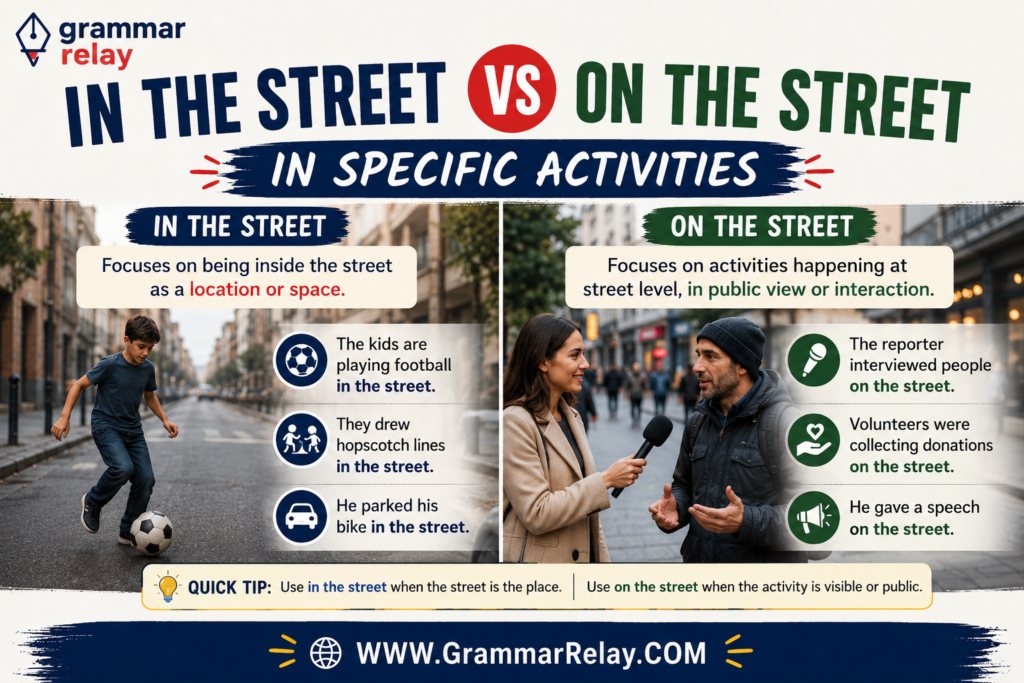
Some phrases produce meaning differences significant enough to change what a sentence actually communicates.
| Activity | “In the Street” Meaning | “On the Street” Meaning |
|---|---|---|
| Living | Literal physical road (unusual/extreme) | Homeless, without permanent shelter |
| Playing | Inside the road/traffic area | Near/beside the road (American) |
| Walking | Inside the traffic lane (danger implied) | Along the road or sidewalk area |
| Dancing | Inside the physical road | Along or near the road |
| Standing | Inside the traffic lane | Along the sidewalk or road edge |
| Sleeping | On the road surface (extreme/literal) | Rough sleeping, homelessness |
Represents the most consequential meaning difference. It reads as a literal physical impossibility in most contexts: nobody actually lives inside a road surface. It is a recognized idiom for homelessness understood universally in English.
The questions from Spanish-speaking learners reflect this exact confusion: “hay” being Spanish for “there is/are” signals these are translation-context questions where the learner wants to know which preposition to use when describing something existing.The answer follows the same logic: use “on” for general American English presence and “in” for British English physical road presence.
The Third Option Nobody Explains
“At” handles related locations differently from both “in” and “on.” Where “in” and “on” describe general presence, “at” pinpoints a specific location.
| Phrase | Meaning | Example |
|---|---|---|
| At the corner of the street | At a specific junction point | “Turn left at the corner of the street.” |
| At street level | On the ground floor facing the street | “The shop sits at street level.” |
| At the end of the street | At the terminal point of a road | “The park is at the end of the street.” |
| At the intersection | At a specific crossing point | “Meet me at the intersection.” |
It is a particularly useful fixed phrase in architecture, retail, and urban planning. It specifically means accessible from or visible at the ground floor facing opposed to being elevated or underground.
Some Example Sentences Showing: How to use these in a specific context
The definite article “the” matters more than most people realize. Dropping it changes both the register and the meaning.
| Phrase | Register | When Used | Example |
|---|---|---|---|
| On the street | Standard conversational | Everyday speech and writing | “She lives on the street.” |
| On-street | Technical/official | Urban planning, parking regulations | “On-street parking available.” |
| In the street | Standard conversational | Everyday speech especially British | “Cars parked in the street.” |
| In-street | Technical/compound adjective | Official documents, British signage | “In-street charging points installed.” |
This is without the article appears primarily in urban planning documents, local government regulations, and infrastructure signage. This technical usage operates independently of the general conversational preference.
Idiomatic Expressions Using: Where Prepositions Get Complicated
English has built an entire vocabulary around based idioms and the prepositions don’t always follow the rules you’d expect.
| Idiom | Meaning | Preposition | Example |
|---|---|---|---|
| On easy street | Living comfortably without financial worry | On | “After the sale, they were on easy street.” |
| On the street | Homeless | On | “Budget cuts left families on the street.” |
| In the streets | Public disorder or widespread protest | In | “Riots erupted in the streets overnight.” |
| The man on the street | Average person, ordinary public opinion | On | “We asked the man on the street for views.” |
| Streets ahead | Far superior (British idiom) | N/A | “Their product is streets ahead of the competition.” |
| Hit the streets | Launch publicly or become available | The | “The album hits the streets next Friday.” |
The singular versus plural distinction here carries real meaning. Typically signals widespread public activity, protest, or disorder across multiple locations. It describes a specific, contained location. “Protests in the streets” suggests a city-wide or national phenomenon.
This distinction matters in journalism, political writing, and social commentary where scale and scope are meaningful.
You might be interested in Input vs Imput: The Definitive Guide to Spelling, Meaning, and Usage
Common Mistakes Writers Make With Prepositions
| Incorrect (Context) | Correct | Why |
|---|---|---|
| “She lives in Fifth Avenue.” (American) | “She lives on Fifth Avenue.” | American addresses always use “on” |
| “The protest moved on the street.” (physical entry) | “The protest moved into the street.” | Physical road entry uses “into” |
| “He’s been living in the street for months.” | “He’s been living on the street for months.” | Homelessness idiom uses “on” |
| “Meet me at the street outside.” | “Meet me on the street outside.” | General location uses “on” |
| “Riots broke out on the streets.” (widespread) | “Riots broke out in the streets.” | Widespread disorder uses “in the streets” |
The last error is subtle but important. “On the streets” with “riots” or “protests” reads oddly to most native speakers. The standard expression for widespread public disorder is “in the streets” regardless of American or British preference. This is one case where the idiom overrides the regional rule.
Quick Practice:
Test yourself with these five sentences:
- “The accident happened _____outside our building.”
- “After losing his job, he found himself _____within months.”
- “The new phone goes _____next Tuesday.”
- “Protesters flooded _____of the capital.”
- “Turn right at the corner and the bakery is _____ on your left.”
Answers: in/on (both work, region-dependent), on, into/to, into/in, on
The tricky one is sentence four. “Flooded into the streets” uses “into” because flooding implies movement into a space. “Flooded in the streets” implies they were already there. Both appear in journalism but “into the streets” describes the movement more precisely.
Memory Tricks That Settle the Question Permanently

Three shortcuts that genuinely work:
The American address rule: If you’re writing an American English address, always use “on.” No exceptions. “on Fifth Avenue,” “on Broadway.” This covers the most common American usage automatically.
The physical danger test: If someone is literally inside the traffic lane in danger, British English uses.” Signals physical danger inside the road.
The homelessness anchor: Regardless of whether you write American or British English, homelessness. This fixed idiom doesn’t vary by region.
Frequently Asked Questions
Is it in American English?
American English strongly prefers for almost every context including addresses, general location, and most idiomatic uses. It appears in American English primarily when emphasizing physical presence inside the traffic lane.
Is it in British English?
British English uses for physical road presence and general everyday situations. However, it appears in British English for addresses and the homelessness idiom. Both forms appear in British writing depending on the specific meaning intended.
What does “living” mean?
It means being homeless or without permanent shelter. This is a fixed idiom in both American and British English. Would read as literally living inside a road, which is physically impossible and not an accepted idiomatic expression.
What does “in the streets” (plural) mean?
The plural “in the streets” typically describes widespread public activity, protest, or disorder across a city or region. “Protests erupted in the streets” suggests a broad, multi-location phenomenon rather than a single contained event.
Is it “on Oak” or “in Oak” for an address?
American English uses without exception. British English accepts both but it appears in older British usage while modern British English has largely shifted toward “on” for named streets.
What does “at level” mean?
It means accessible from or located at ground floor height facing as opposed to elevated or underground. This is a fixed phrase used in architecture, retail, and urban planning contexts.
Read more grammar lessons on Grammar Relay
Conclusion
American English defaults to virtually every use. British and Australian English favor for physical road presence and everyday situations. Fixed idioms including homelessness, protest, and product launches follow their own rules that apply across both varieties.
Understanding the question at this depth means you’ll choose the right preposition not by memorizing a single rule but by understanding what each preposition communicates. “In” treats it as a channel or enclosed space. Both conceptualizations are valid. Both prepositions are useful. And now you know exactly when to reach for each one.
