


Someone on your team just lost their mother. Your long-term client emails to say he won’t be available his wife passed away. A colleague you’ve worked alongside for three years just experienced the worst week of her life.
And you’re staring at a blank screen wondering what on earth to say.
Sorry for your loss comes to mind immediately. It’s safe. It’s recognized. But somewhere between the thousandth time it’s been said and the thousandth time it’s been received, it stopped feeling like comfort and started feeling like a formality.
The truth is, knowing how to say sorry for your loss professionally in a way that feels genuinely human rather than corporate and hollow is one of the most undervalued communication skills in any workplace. This guide covers everything: what to say, what to avoid, and exactly how to say it across every professional relationship and situation.
Why “Sorry for Your Loss” Falls Short, Especially Professionally
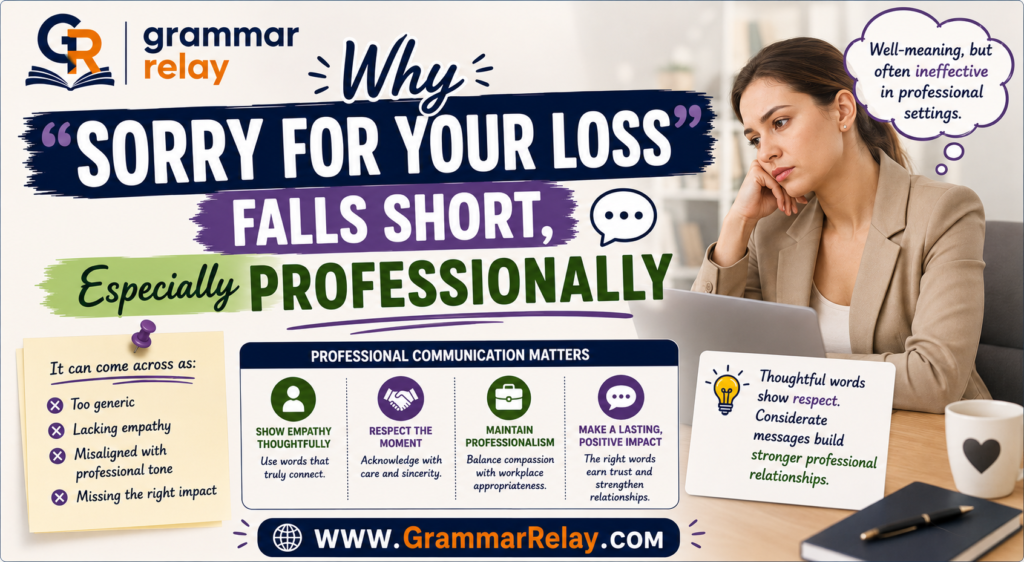
The phrase isn’t wrong. It’s just been drained of meaning through overuse.
When someone receives “sorry for your loss” in a professional email, their brain processes it the same way it processes “best regards” as a signal that the message is ending, not as a genuine expression of human care. That’s a problem when someone is standing in the middle of real, raw grief.
Professional settings add another layer of complexity. There’s pressure to be warm enough to feel human but restrained enough to respect boundaries. That tension paralyzes most people into reaching for the safest phrase available. Which is, of course, “sorry for your loss.”
Here’s the thing grief doesn’t respond to safe. It responds to genuine.
What to Consider Before Writing a Professional Condolence Message
Before typing a single word, pause and run through these four considerations:
- The relationship: Are you a close colleague, a manager, a client contact, or a near-stranger in the same building?
- The loss: Losing a parent at 85 lands differently than losing a spouse at 42 or a child at any age
- The medium: Email, handwritten card, in-person, text, or workplace announcement each require different approaches
- Cultural and religious context: What comforts one person may feel inappropriate to another
One rule applies regardless of every other variable: personalize, even minimally. A single specific detail their name, one genuine quality you observed, one shared memory, transforms a template into a message.
Professional Ways to Say “Sorry for Your Loss” (For Emails & Formal Messages)
These are your go-to phrases when you need another way to say sorry for your loss in professional written communication:
| Phrase | Formality | Best Used For |
|---|---|---|
| Please accept my deepest condolences | Formal | First response emails, formal cards |
| My sincere sympathies are with you | Formal | Colleagues, clients, senior leaders |
| I was deeply saddened to hear of your loss | Semi-formal | Colleagues you know reasonably well |
| Thinking of you during this difficult time | Semi-formal | Most professional relationships |
| My heart goes out to you and your family | Semi-formal | Warmer professional relationships |
| Words feel inadequate, please know I’m thinking of you | Semi-formal | When the loss is particularly devastating |
| Please know you have my full support | Semi-formal | Direct reports, close colleagues |
| Wishing you comfort and peace in the days ahead | Formal | General professional use |
| Your loss is felt deeply by all of us | Semi-formal | Team messages, group acknowledgments |
| I’m so sorry for the pain you’re experiencing | Warm-professional | Colleagues you know personally |
These give you genuine different ways to say sorry for your loss without crossing professional boundaries or sounding scripted.
Read more about 40+ Synonyms for “With That Being Said”
What to Say to a Colleague Who Lost a Loved One
Colleagues occupy a unique space. You know them sometimes well but the professional context still shapes what’s appropriate.
For a close colleague:
“I’m so deeply sorry about your dad. He sounded like an extraordinary man from everything you’ve shared. Please take all the time you need, we’ve got everything covered here. I’m just a call away if you need anything at all.”
For a colleague you know professionally but not personally:
“I was so sorry to hear about your loss. Please accept my sincere condolences. Thinking of you during this time.”
The key difference? Specificity signals closeness. Use it when you have it. Don’t manufacture it when you don’t.
What to avoid entirely: mentioning deadlines, coverage, or when they plan to return. That conversation belongs to a completely different message sent at a completely different time.
What to Say to an Employee Who Suffered a Loss
This relationship carries extra weight. As a manager, your words carry authority which means they carry more impact, for better or worse.
Lead with humanity. Always. Logistics come later.
Immediate condolence email from manager:
“I just heard about the passing of your [mother/husband/etc.] and I’m truly heartbroken for you. Please don’t think about work for a single moment right now. Our full bereavement policy is in place and your team is completely covered. Take whatever time you need. I’ll reach out gently in a week or so only when you’re ready.”
Follow-up after returning from bereavement leave:
“Welcome back and please know there’s absolutely no pressure to be ‘back to normal.’ We’re here to support you however you need, at whatever pace works. Just say the word.”
The most important phrase in both messages? “Whatever time you need.” It removes the pressure that grief doesn’t need.
What to Say to a Boss or Senior Leader Who Experienced a Loss
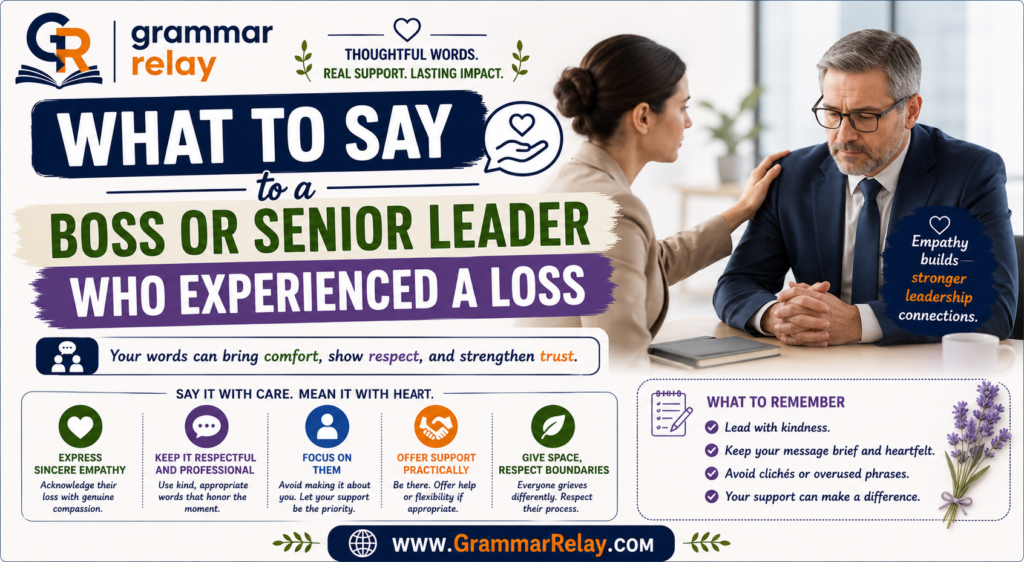
This feels harder than it is. The instinct is to overthink it to worry about overstepping or seeming presumptuous. Don’t.
Keep it sincere, brief, and dignified.
To a direct manager:
“I was so sorry to hear about your loss. Please accept my deepest condolences. Thinking of you and your family during this time.”
To a senior executive you don’t know personally:
“Please accept my sincere sympathies on the passing of your [relationship]. Wishing you and your family comfort and peace.”
That’s it. Short is respectful here. Brevity signals emotional intelligence you understand they don’t need to manage your feelings on top of their own.
What to Say to a Client or Business Contact Who Lost Someone
When a client shares a loss, they’re trusting you with something deeply personal. Honor that.
To a long-term client:
“I was deeply saddened to hear about the passing of your [relationship]. Please know that our entire team is thinking of you. There is absolutely nothing work-related that can’t wait. Please take all the time you need, and please accept my sincerest condolences.”
To a newer business contact:
“Please accept my sincere condolences on your loss. Thinking of you during this difficult time.”
If you find out weeks later, acknowledge it anyway. “I only just heard about your loss and I wanted to reach out, even belatedly, to say how sorry I am.” Late is better than never. Always.
How to Say Sorry for Your Loss Professionally in Specific Situations
In a Sympathy Email, Subject Lines That Work
The subject line determines whether a grieving person opens your email. These work:
- “Thinking of You”
- “My Deepest Condolences”
- “With Sincere Sympathy”
- “Sending You Strength”
Avoid: “Re: Your Loss” or anything that sounds like a ticket number.
In a Handwritten Sympathy Card
Handwritten still outperforms digital in 2025 full stop. A 2022 study from the Greeting card Association confirmed that handwritten sympathy cards are perceived as significantly more meaningful than digital messages across all age groups.
Keep it to three to five sentences. Don’t start with “I” it centers you instead of them. Try:
“Your [mother/father/etc.] clearly meant the world to you and so many others. Please know you’re in my thoughts during this incredibly hard time.”
In Person or on a Phone Call
Sometimes the most powerful thing you can say is the simplest. “I’m so sorry. I don’t have the right words but I want you to know I care.” Then stop talking. Silence and presence are forms of comfort most people drastically underestimate.
In a Workplace Announcement or Group Email
Template for a manager:
“I want to share that [colleague’s name] is experiencing a bereavement and will be away from [date] to [date]. Please join me in extending our warmest thoughts and support. When [he/she/they] returns, let’s make sure to give them the space and grace they need.”
Keep it dignified. Don’t share details that weren’t explicitly offered.
In a Text Message
Texting is appropriate for close colleagues or when you genuinely have no other way to reach someone quickly. Keep it human:
“Just heard and I’m so sorry. Thinking of you. No need to respond, just wanted you to know I care.”
That last sentence: “no need to respond”, removes pressure. That matters more than people realize.
You might be interested in 40+ Another Way of Saying “According To”
What NOT to Say, Phrases That Hurt More Than They Help
Knowing what to say instead of sorry for your loss also means knowing what to avoid entirely:
| What You Said | Why It Misses | Say This Instead |
|---|---|---|
| “Everything happens for a reason” | Dismissive and tone-deaf | “I’m so sorry. There are no words.” |
| “They’re in a better place” | Assumes beliefs, minimizes grief | “I can’t imagine how hard this is” |
| “I know how you feel” | Grief is deeply personal, you don’t | “I can’t imagine what you’re going through” |
| “Let me know if you need anything” | Too vague, nobody follows up | “I’ll check in with you next week” |
| “At least they lived a long life” | Comparative, minimizes the loss | “What a beautiful life they lived” |
| “Stay strong” | Pressures the grieving person | “Take all the time you need” |
| “How did they die?” | Invasive in any professional context | Don’t ask, let them share if they choose |
“The friend who can be silent with us in a moment of despair or confusion, who can stay with us in an hour of grief and bereavement, that is a friend who cares.” Henri Nouwen
Cultural and Religious Considerations
Knowing how to say sorry when someone dies across different cultural contexts matters enormously in diverse workplaces:
- Jewish traditions: “May their memory be a blessing” is deeply meaningful; “I wish you long life” is traditional
- Islamic traditions: “Inna lillahi wa inna ilayhi raji’un” (We belong to Allah and to Him we shall return) is appropriate and deeply respected
- Hindu traditions: Focus on the soul’s journey; avoid “rest in peace” as it doesn’t align with reincarnation beliefs
- East Asian cultures: Practical support and restraint are often valued over emotional expression
- Christian traditions: Prayer references, heaven, and peace resonate naturally
When you’re unsure? A simple, warm, non-denominational message, “thinking of you and your family” respects all traditions without misstep.
How to Follow Up, Because Grief Doesn’t End After the Funeral
Here’s something most people get completely wrong: the follow-up matters as much as the initial message.
Research from grief counseling organization What’s your Grief consistently shows that weeks two and three after a loss are often harder than the first week, when the shock fades, the visitors stop coming, and the reality sets in.
One week later:
“Just checking in quietly, no need to respond. Thinking of you.”
One month later:
“A month has passed and I wanted you to know I’m still thinking of you. Grief takes its own time and I’m here for all of it.”
Around difficult dates: birthdays, anniversaries, holidays:
“I know this time of year might feel especially hard this year. Thinking of you and [name] today.”
That last one is profoundly powerful. Most people completely forget to acknowledge the secondary grief that arrives with significant dates.
A Simple Framework for Writing Any Professional Condolence Message
Five steps. Every time:
- Acknowledge the loss directly: don’t soften it into invisibility
- Express genuine sympathy: one or two sincere sentences
- Add one specific personal detail: if you knew the deceased
- Offer something concrete: not “let me know if you need anything”
- Close warmly with zero expectations
Full template:
“I was so saddened to hear about the passing of your [relationship]. [Name] was [one genuine quality]. Please know that [your name/our team] is thinking of you. If there’s anything specific I can do, [concrete offer] please don’t hesitate. Take all the time you need.”
How to Say Sorry for Your Loss Professionally by Relationship
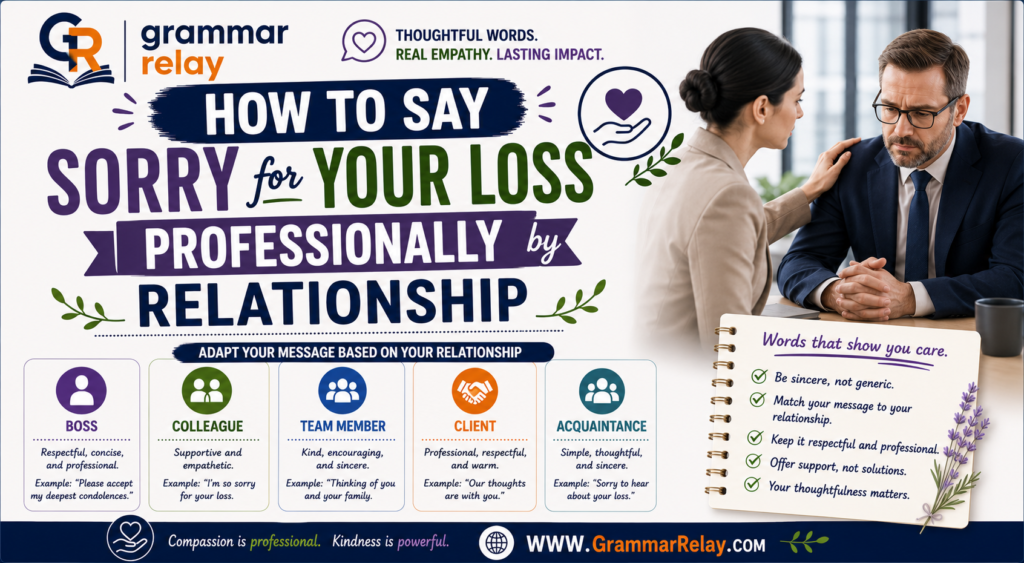
| Relationship | Best Approach | Tone |
|---|---|---|
| Close colleague | Warm, personal, specific | Personal-professional |
| Acquaintance colleague | Brief, sincere, non-intrusive | Professional |
| Direct report | Human-first, logistics second | Warm authority |
| Manager or boss | Respectful, brief, dignified | Formal-warm |
| Long-term client | Genuine, brief, no business talk | Warm-professional |
| New business contact | Brief acknowledgment only | Professional |
| Team announcement | Dignified, inclusive, clear | Formal-compassionate |
Frequently Asked Questions
Is it appropriate to send condolences via email professionally?
Absolutely, email is perfectly appropriate for professional condolences, especially when you don’t have the person’s personal contact details or when distance makes an in-person visit impossible. That said, a handwritten card alongside the email elevates the gesture significantly. For close colleagues or long-term clients, consider both.
How long should a professional condolence message be?
Shorter than you think. Three to five sentences hit the sweet spot for most professional relationships. Longer messages can unintentionally make the grieving person feel obligated to respond at length. The exception is a close colleague or direct report, there, a slightly warmer and more personal message feels appropriate and genuinely caring.
Should I mention the deceased by name in a professional message?
Yes, whenever you know it. Using someone’s name transforms a generic condolence into a human one. It signals that you see the loss as the loss of a specific, irreplaceable person, not just an abstract event. Even one sentence that includes their name makes the entire message land differently.
How do I acknowledge a loss when I find out weeks later?
Reach out anyway. A late message is infinitely better than no message at all. Simply acknowledge the delay honestly: “I only just heard and I wanted to reach out immediately, even belatedly, to say how truly sorry I am.” Most people find late acknowledgment deeply meaningful, grief doesn’t have an expiration date and neither does genuine care.
What’s the right time to bring up work after expressing condolences?
Never in the same message. Your condolence message should contain zero work content, no deadlines, no coverage updates, no return-date questions. Address those practical matters in a completely separate communication, sent later, and only after leading again with care rather than logistics. Mixing grief and work in one message signals that the work was the real priority.
How do I say sorry for your loss professionally without sounding scripted?
Add one specific, genuine detail. That single move separates a template from a real message every time. Reference something the person shared about their loved one, one quality you observed, or one memory that felt meaningful. Even “from everything you’ve shared about her over the years” transforms a standard condolence into something that actually lands. Specificity is the antidote to sounding scripted.
What do you say when someone says sorry for your loss to you?
Keep it simple and authentic. “Thank you, that genuinely means a lot” or “I appreciate you reaching out” are both gracious and easy. There’s no obligation to say more than that. Grieving people shouldn’t have to manage other people’s feelings about their loss, a brief, warm acknowledgment is more than enough.
What are the most beautiful things to say when someone dies?
The most powerful phrases are almost always the simplest ones. “I’m here for whatever you need.” “You don’t have to be okay right now.” “Their memory is going to live on in everyone who loved them.” Beauty in condolence language comes from honesty and presence, not from elaborate phrasing or poetic flourishes. Say what you genuinely mean and it will land beautifully every time.
Read more grammar lessons on Grammar Relay
Conclusion
Here’s what matters most when figuring out how to say sorry for your loss professionally: imperfect words sent with genuine care will always outperform perfect silence.
Nobody expects you to have the right words. Grief is bigger than language. But reaching out, with something real, something human, something that took you more than ten seconds, tells a grieving person that they matter. That their loss matters. That they’re not invisible in their pain.
