


Some words look wrong at first glance yet somehow keep showing up everywhere. Brite is exactly that kind of word. Autocorrect flags it instantly. Grammar teachers cross it out in red. And yet you’ll find it stamped on steel coils, printed on shampoo bottles, and splashed across storefront signs worldwide.
So what’s actually going on here? Is brite a word or just a persistent misspelling that refuses to die?
The honest answer is more nuanced than a simple yes or no. This guide covers everything: the full definition of brite, where it legitimately belongs, why “bright” remains the standard, and exactly when each spelling is the right call.
The Fast Answer: What “Brite” Actually Means
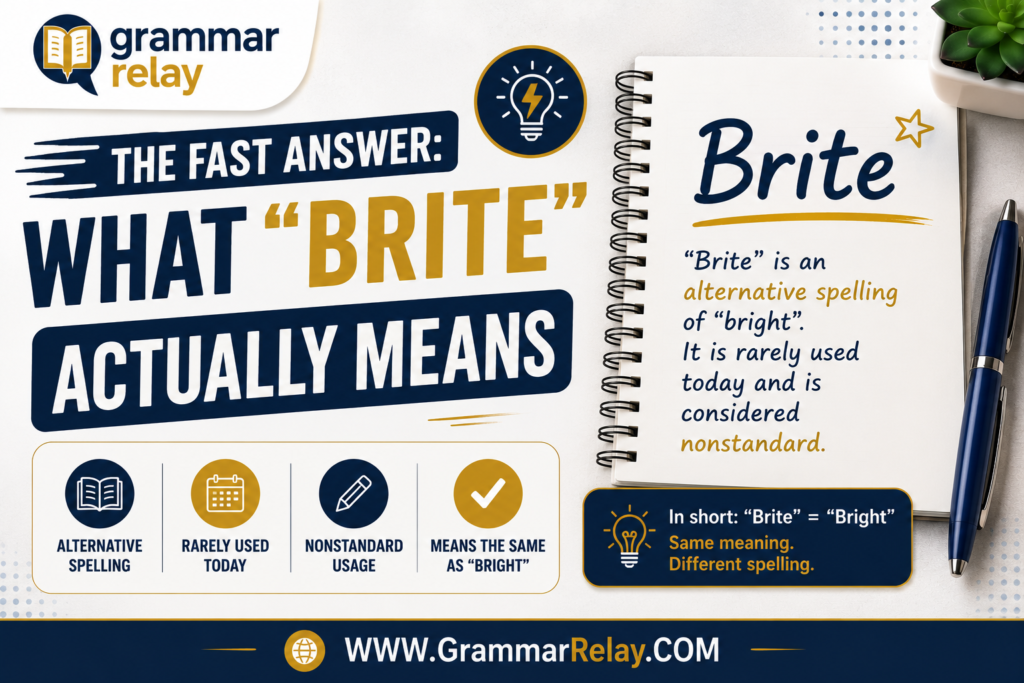
Brite is a phonetic variant of the standard English word “bright.” In most writing contexts it isn’t the correct spelling. However, it carries genuine legitimacy in industrial, packaging, and commercial branding contexts where it functions as a recognized technical or trade term.
| Word | Status | Primary Use | Formality |
|---|---|---|---|
| Bright | Standard English | All writing contexts | All levels |
| Brite | Variant/informal | Branding, trade names, industry | Informal to technical |
The brite vs bright question isn’t purely a right-versus-wrong debate. Context determines which spelling belongs on the page.
Definition of Brite: Every Meaning This Word Carries
Most articles treat “brite” as nothing more than a typo. That oversimplifies things considerably. The full definition of brite spans multiple industries and carries real meaning in each one.
Brite as an Informal Spelling of Bright
In casual writing, advertising copy, and social media, “brite” appears as a stylized phonetic alternative to “bright.” Native speakers understand it instantly because it sounds identical to the standard spelling. It doesn’t belong in formal writing but it communicates clearly in informal contexts.
Brite in Steel and Metalworking
This is where “brite” earns full technical legitimacy. Brite steel refers specifically to cold-rolled, uncoated steel with a smooth, reflective surface finish. Engineers, procurement specialists, and manufacturing professionals use this term daily. In a steel mill, nobody debates the spelling because “brite” is simply the industry standard term.
Brite Stock in Packaging and Canning
Here’s the technical definition virtually every competitor article misses. In the packaging industry, brite stock means undecorated, tin-plated steel cans carrying no printed labels. Food manufacturers purchase brite stock for private label products and apply paper labels separately. Major manufacturers including Ball Corporation and Crown Holdings use this terminology in official product documentation.
Brite in Hair Care and Beauty
Dozens of hair care lines use “brite” in product names to signal shine, luminosity, or color vibrancy. The spelling choice is deliberate. It creates brand distinctiveness while clearly communicating the product benefit.
| Industry | Meaning of Brite | Example |
|---|---|---|
| Steel/metalworking | Cold-rolled uncoated steel with shiny finish | Brite steel coil |
| Packaging/canning | Undecorated tin-plated cans without labels | Brite stock cans |
| Hair care | Product naming implying shine | Shampoo and conditioner lines |
| Branding/marketing | Phonetic spelling for commercial distinction | Store names, product lines |
| Informal writing | Casual stylized spelling | Social media, ad copy |
Read more about Deem Fit: Complete Meaning, Usage, and Real-World Examples
Definition of Bright: The Standard Word in Full Detail
Bright is the correct standard English spelling and it does considerably more work than most people realize. The word functions as an adjective, an adverb, and anchors dozens of common idioms and phrases.
Every Definition of Bright
| Definition | Part of Speech | Example Sentence |
|---|---|---|
| Emitting strong light | Adjective | “The bright sun made her squint.” |
| Intelligent, quick-witted | Adjective | “He was the brightest student in the class.” |
| Cheerful, optimistic | Adjective | “She kept a bright attitude throughout.” |
| Vivid in color | Adjective | “The walls were painted bright yellow.” |
| Shining strongly | Adverb | “The fire burned bright all night.” |
| Promising, full of potential | Adjective | “The startup has a genuinely bright future.” |
Knowing how to spell bright correctly also means understanding that this single word covers radically different meanings depending on context. A “bright child” is intelligent. “Bright room” is well-lit. A “bright outlook” signals optimism. One word carrying three distinct meanings explains why it appears so frequently across all types of writing.
Etymology: Where “Bright” Came From and How “Brite” Emerged
The history behind bright vs brite stretches back well over a thousand years and it’s genuinely fascinating.
“Bright” descends from Old English “beorht,” meaning shining, luminous, or morally illustrious. Its Proto-Germanic root “berhtaz” connects it to similar words across related Germanic languages. In Old English texts, “beorht” carried both physical and metaphorical weight: a “beorht” person was both literally radiant and figuratively virtuous.
Through centuries of phonetic evolution, “beorht” shifted through various Middle English forms before settling into the modern spelling “bright” by the 14th century. That spelling then remained stable through the standardization of print culture.
| Period | Form | Language Stage | Meaning |
|---|---|---|---|
| Before 900 AD | beorht | Old English | Shining, luminous |
| 1100s | briht | Early Middle English | Bright, clear |
| 1300s | bright | Late Middle English | Modern meaning established |
| 1800s | bright | Modern English | Standard spelling solidified |
| Early 1900s | brite | Commercial/informal | Phonetic variant enters branding |
| Present | brite | Informal/trade | Marketing and industrial use |
“Brite” emerged as a deliberate commercial spelling variant in early 20th century American advertising culture. Marketers discovered that phonetically simplified spellings attracted attention and created more memorable brand identities. “Brite” fit that strategy perfectly and it stuck.
“A word is not the same with one writer as with another.” — Julian Barnes
Pronunciation: Do “Brite” and “Bright” Sound Identical?

Yes. Completely and entirely identical.
Both words share the exact same pronunciation: BRAYT, or in International Phonetic Alphabet notation, /braɪt/. This pronunciation match is precisely why the brite or bright confusion persists so stubbornly. When you hear the word spoken aloud there’s absolutely zero difference. The distinction exists only in writing.
For ESL learners especially, “brite” feels more phonetically logical than “bright.” The silent “gh” combination in English is notoriously confusing and counterintuitive. Words like “night,” “light,” “fight,” and “right” all carry that silent consonant cluster. “Brite” eliminates the confusion by spelling the word exactly as it sounds which explains why it keeps appearing in informal writing from non-native speakers.
Is “Brite” a Real Word? What Dictionaries Actually Say
Here’s where is brite a word gets a genuinely layered answer rather than a simple yes or no.
| Dictionary | Lists “Brite”? | Classification | Notes |
|---|---|---|---|
| Merriam-Webster | Limited | Variant/informal | Not a main headword entry |
| Oxford English Dictionary | Yes (as variant) | Nonstandard spelling | Explicitly notes commercial use |
| Cambridge Dictionary | No main entry | Not standard | Recognized contextually |
| Collins Dictionary | Yes | Informal variant | Acknowledges brand usage |
| Official Scrabble Players Dictionary | Yes | Valid Scrabble word | Worth 7 points |
So is brite a word? Technically yes. The Oxford English Dictionary acknowledges it as a nonstandard variant and notes its commercial usage explicitly. The Official Scrabble Players Dictionary accepts it as a valid play worth 7 points. However, acknowledgment in a dictionary as a variant doesn’t make it appropriate for standard written English.
Bright or brite in formal writing? Always bright. Every single time.
Brite in the Steel and Metalworking Industry
This is the section that separates genuinely comprehensive coverage from surface-level treatment. In industrial contexts the bright vs brite debate simply doesn’t exist because “brite” is the established professional term.
Brite steel specifically describes cold-rolled steel processed to produce a smooth, uncoated, highly reflective surface. Automotive manufacturers, appliance makers, and precision component producers specify brite steel in engineering drawings and procurement documents as a matter of standard practice.
Brite stock in canning means plain undecorated tin-plated cans. Private label food brands purchase brite stock and apply paper labels afterward, dramatically cutting packaging costs compared to pre-printed alternatives. This is a billion-dollar segment of the food packaging industry and “brite stock” is its accepted terminology.
Writing “bright steel” or “bright stock” in an industrial context won’t cause confusion but it immediately signals unfamiliarity with industry conventions.
Brite in Branding and Marketing: Why Companies Deliberately Choose the Variant
The bright or brite question takes on an entirely different dimension in commercial contexts. Companies choose “brite” strategically and for well-documented reasons.
| Reason Companies Use “Brite” | Explanation |
|---|---|
| Visual distinctiveness | Stands apart from standard dictionary words in logos and signage |
| Trademark eligibility | Significantly easier to trademark than common dictionary entries |
| Consumer memorability | Slightly unconventional spelling aids recall |
| Contemporary feel | Reads as fresh and modern versus the traditional spelling |
| Domain availability | “Brite” web domains far more available than “bright” equivalents |
The trademark angle deserves particular attention. You generally cannot trademark a common dictionary word like “bright” in competitive product categories because it lacks the distinctiveness trademark law requires. “Brite,” however, clears that hurdle. The altered spelling creates legal distinctiveness which is why cleaning products, tech companies, and beauty brands have embraced it for over a century.
You might be interested in Shown vs Showed: The Complete Grammar Guide (With Real Examples)
Brite or Bright: When to Use Each (Complete Decision Guide)
| Context | Use Bright | Use Brite |
|---|---|---|
| Academic writing | Always | Never |
| Business emails | Always | Never |
| Legal documents | Always | Never |
| Journalism and news | Always | Never |
| Creative/literary writing | Always | Rarely |
| Brand or product names | No | Yes |
| Stylized marketing copy | Default | If brand uses it |
| Social media casual posts | Yes | Acceptable |
| Steel industry documents | No | Yes (industry term) |
| Packaging/canning industry | No | Yes (brite stock) |
The rule covering most situations: use “bright” in any formal, professional, or academic context without exception. Reserve “brite” for brand names, industrial technical documents, and stylized informal writing where the variant spelling is intentional.
Common Mistakes Writers Make With Brite and Bright
Knowing the brite vs bright distinction doesn’t automatically prevent errors. These specific mistakes appear most frequently in real writing:
| Incorrect | Correct | Why |
|---|---|---|
| “The brite sun shone overhead.” | “The bright sun shone overhead.” | Standard writing requires correct spelling |
| “She had a brite idea.” | “She had a bright idea.” | Informal or formal: both need standard spelling |
| “Brite colors filled the gallery.” | “Bright colors filled the gallery.” | Descriptive writing uses standard spelling |
| “The supplier delivered brite coils.” | Keep as “brite coils.” | Industrial term: technically correct |
| “She bought Brite cleaner because it’s brite.” | “She bought Brite cleaner because it’s bright.” | Brand spelling stays in the name only |
That last example catches writers frequently. When a brand name uses “brite,” that spelling belongs within the brand name itself. The surrounding prose still uses standard “bright.”
Synonyms for Bright
| Synonym | Meaning Captured | Best Used When |
|---|---|---|
| Luminous | Emitting or reflecting light | Describing light sources |
| Radiant | Sending out warmth or light | Emotional or visual descriptions |
| Vivid | Intensely bright color | Color descriptions specifically |
| Brilliant | Dazzling brightness or intelligence | Either light or intelligence meaning |
| Gleaming | Shiny and reflective | Surfaces and materials |
| Intelligent | Smart and quick | The “bright student” meaning |
| Cheerful | Positive and upbeat | The optimistic meaning |
None of these synonyms carry the industrial or branding implications of “brite.” They substitute for “bright” in standard writing contexts only.
Case Studies: How “Brite” vs “Bright” Plays Out in Real Situations
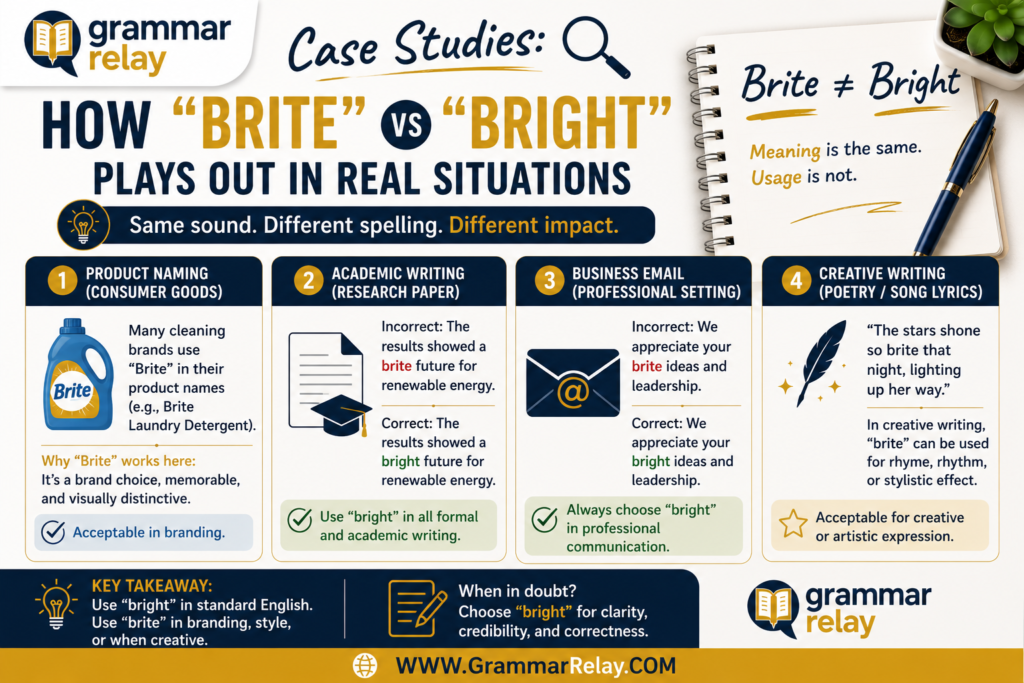
Case Study: Academic Paper Submission A psychology graduate student submits a thesis describing “brite lighting conditions” in a behavioral experiment. The reviewing committee flags the nonstandard spelling before evaluating the methodology. One four-letter word triggers a revision request that delays the submission by three weeks. Standard spelling would have prevented the entire issue.
Case Study: Steel Procurement A procurement officer at an automotive parts manufacturer writes “bright steel coils” in a purchase order sent to a steel supplier. The supplier processes the order correctly but notes internally that the standard industry terminology is “brite.” The transaction completes successfully but the document doesn’t align with industry convention.
Case Study: Brand Naming Strategy A cleaning product startup tests both “BrightClean” and “BriteClean” with focus groups. Consumer recognition scores are nearly identical since both spellings sound the same when spoken. However, “BrightClean” fails trademark registration because “bright” functions as a common descriptive term in the cleaning products category. “BriteClean” receives full trademark protection. The phonetic variant solved a legal problem the standard spelling created.
Frequently Asked Questions
What is the full definition of brite?
Brite is a phonetic variant spelling of “bright” used in informal writing, commercial branding, and specific industrial contexts. In metalworking it describes cold-rolled uncoated steel. In packaging it refers to undecorated tin-plated cans called brite stock.
Is brite a real word according to dictionaries?
The Oxford English Dictionary acknowledges it as a nonstandard variant with noted commercial use. The Official Scrabble Players Dictionary lists it as valid worth 7 points. However it remains nonstandard in formal written English.
How do you spell bright correctly?
B-R-I-G-H-T. The “gh” is silent. Knowing how to spell bright means accepting that English retains many historical spellings that don’t match modern pronunciation patterns.
What does brite mean in the steel industry?
In metalworking and steel production, brite describes cold-rolled uncoated steel with a smooth reflective surface finish. It’s a legitimate technical term used in engineering specifications and procurement documents globally.
What does brite stock mean in packaging?
Brite stock refers to plain undecorated tin-plated steel cans without printed labels. Food manufacturers use them for private label products and apply paper labels separately after purchase.
Is brite valid in Scrabble?
Yes. The Official Scrabble Players Dictionary lists brite as a valid word worth 7 points.
Why do companies use brite instead of bright in brand names?
Primarily for trademark eligibility and visual distinctiveness. Common dictionary words like “bright” are difficult to trademark in competitive product categories. The altered spelling “brite” creates the legal distinctiveness trademark law requires.
Read more grammar lessons on Grammar Relay
Conclusion
Here’s the bottom line. Bright is the correct standard English spelling and it belongs in every formal, professional, academic, and everyday writing context without exception.
Brite earns genuine legitimacy in exactly three contexts: industrial steel and packaging terminology, commercial brand names, and deliberately stylized informal writing. Outside those three areas it reads as a misspelling regardless of intent.
The brite vs bright question isn’t really about which word is right in the abstract. It’s about which word is right for your specific context and audience. Now you have everything you need to make that call confidently every time you sit down to write.
