

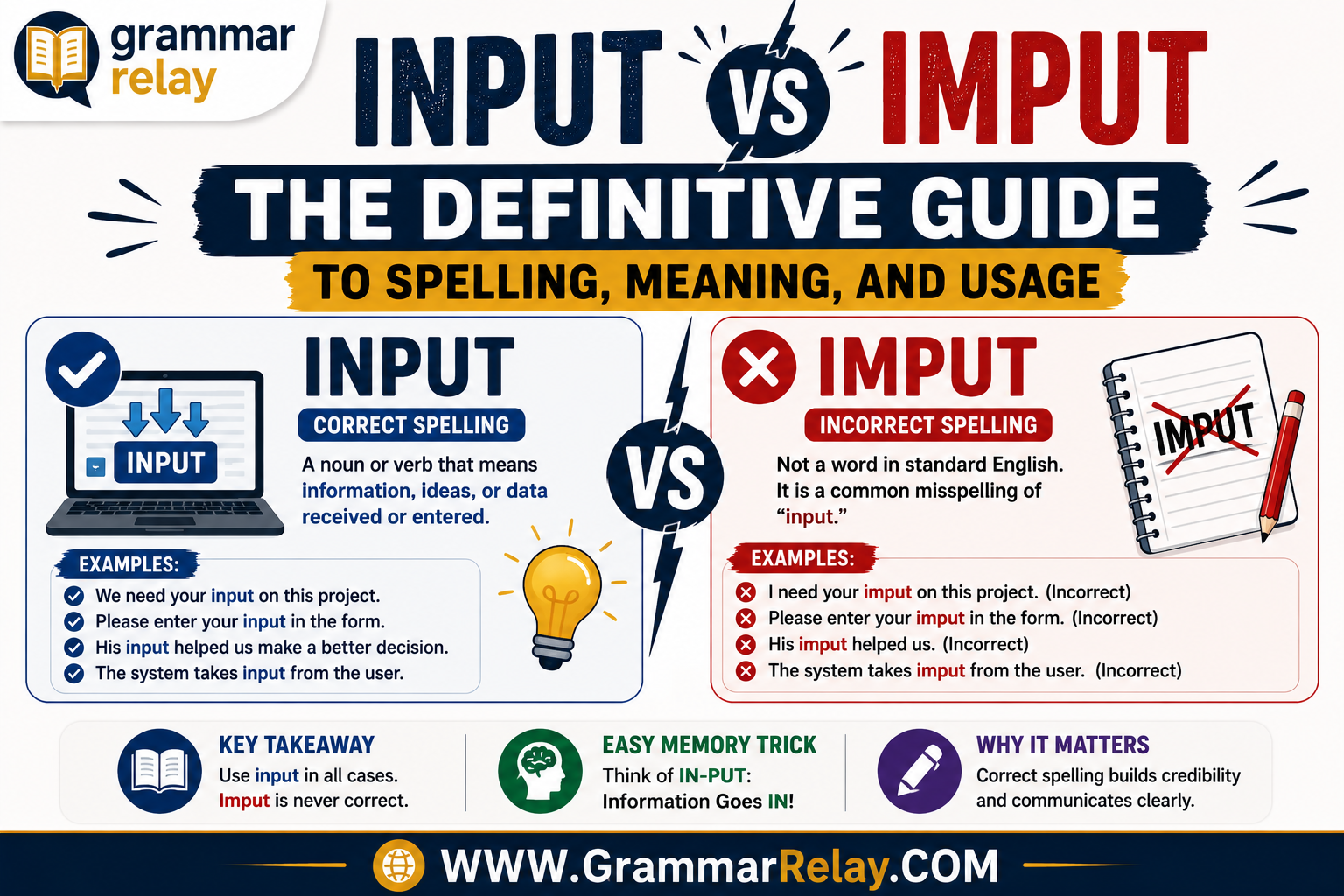
Some spelling errors are close calls. Input vs imput isn’t one of them.
“Imput” doesn’t exist in any dictionary, style guide, or recognized dialect of English. It never has. Yet it shows up constantly in professional emails, academic papers, corporate slide decks, and online forums. People type it confidently and spell-checkers sometimes miss it entirely.
So why does imput feel so natural to so many writers? And what does “input” actually mean across all the contexts where it appears? This guide covers everything: the etymology, the grammar, the psychology behind the error, and the memory tricks that make the correct spelling automatic.
The Direct Answer (Before Anything Else)
Input is correct. Imput is not a word. There are no exceptions, no dialects, and no contexts where “imput” is the right choice.
| Spelling | Correct? | Dictionary Entry? | Use It? |
|---|---|---|---|
| Input | Yes | Yes (all major dictionaries) | Always |
| Imput | No | No | Never |
That’s the input vs imput question settled in two rows. But understanding WHY “imput” is wrong and why it keeps appearing makes the correct spelling stick in a way that simple rules never do.
What “Input” Actually Means: Every Definition That Matters
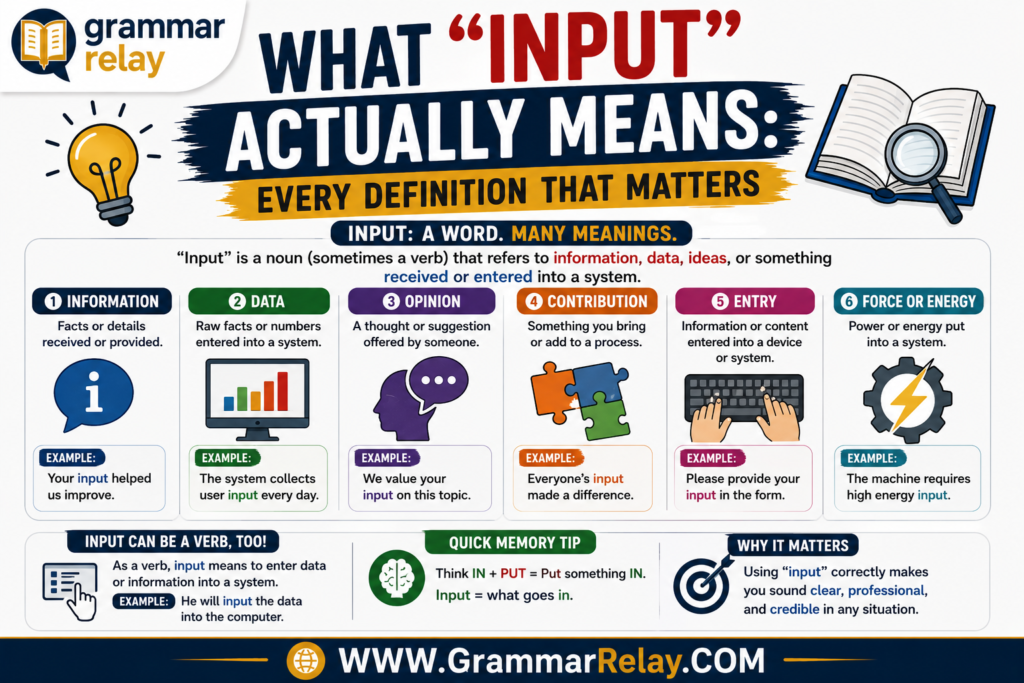
Input does considerably more work than most people realize. It functions across technology, business, education, economics, and everyday conversation, often with subtly different meanings in each domain.
| Context | Definition | Example |
|---|---|---|
| Computing | Data entered into a system | “The program requires user input to run.” |
| Business | Contribution or feedback | “We need your input before finalizing the plan.” |
| Education | Information received by a learner | “Comprehensible input drives language acquisition.” |
| Economics | Resources used in production | “Labor is a key input in manufacturing.” |
| General noun | Anything contributed to a process | “Her input shaped the entire project direction.” |
| Verb | To enter data into a system | “Please input your details into the form.” |
In technology, input describes data entering a system. Business, it means someone’s contribution or perspective. In economics, inputs are the raw resources (labor, capital, materials) that production processes consume. Education, input refers to the language or information a learner receives and processes.
Same word. Six distinct meanings. All of them valid and useful.
Read more about To or Too Many: Which Is Correct and How to Never Mix Them Up Again
Etymology: Where “Input” Came From and Why “Imput” Never Existed
The word input is a compound: “in” plus “put” from Old English “putian,” meaning to push or thrust. First recorded in English in 1753 in economic writing, it described resources entering a production process.
When computing emerged in the 1940s and 1950s, engineers borrowed “input” to describe data entering a machine. The word fit perfectly and its computing meaning quickly became its dominant association in everyday language.
Here’s why imput is etymologically impossible: the word’s structure is “in + put.” There’s no “im-” prefix anywhere in its construction. The compound word pattern it follows looks like this:
| Compound Word | Components | Meaning | Pattern |
|---|---|---|---|
| Input | In + put | To put something in | Direction + action |
| Output | Out + put | To put something out | Direction + action |
| Throughput | Through + put | What passes through a system | Direction + action |
| Turnout | Turn + out | Number who show up | Action + direction |
| Payout | Pay + out | Money distributed | Action + direction |
Every word in this family follows the same directional compound structure. “Imput” breaks the pattern entirely because “im-” isn’t the prefix in “input.” “In-” is.
Why “Imput” Feels Right to So Many People
This is the section most grammar guides skip but it’s arguably the most useful. Understanding the psychology behind imput vs input confusion makes the error much easier to avoid permanently.
The “Im-” Prefix Trap
English contains dozens of common words where “im-” is a legitimate Latin prefix meaning “into” or “not.” Your brain has seen this pattern thousands of times:
| Word With “Im-” Prefix | Actual Structure | Why It Misleads |
|---|---|---|
| Impact | Im + pact | “Im-” is a legitimate prefix here |
| Import | Im + port | “Im-” means “into” in Latin |
| Impose | Im + pose | Standard Latin prefix pattern |
| Imply | Im + ply | Follows the same “im-” pattern |
| Input | In + put | “Im-” is NOT the prefix here |
When you type “input” quickly, your brain pattern-matches it to “impact,” “import,” and “impose” and swaps “in-” for “im-” automatically. It’s not carelessness. It’s your brain applying a pattern it has learned to trust.
Phonetic Confusion
In natural speech, especially at normal conversational speed, “input” often sounds like “imput.” The “n” in “in” blends with the “p” in “put” creating an “mp” sound that your ears register as “im-put.” You hear it as “imput” so you spell it as imput.
Why Autocorrect Misses It
Imput sometimes slips past spell-checkers because it resembles a proper noun or name. Some systems flag it in red. Others don’t. Never rely on autocorrect to catch this specific error. Always do a manual check.
How “Input” Functions Grammatically: Every Role It Plays
Input is one of English’s most grammatically flexible words. It functions as a countable noun, an uncountable noun, a regular verb, an irregular verb, and an adjective. That range explains why it appears so frequently across such different contexts.
| Grammatical Form | Example | Notes |
|---|---|---|
| Countable noun | “The system accepts multiple inputs.” | Plural form: inputs |
| Uncountable noun | “Your input helped us decide.” | No article needed |
| Present verb | “She inputs the data daily.” | Third person adds -s |
| Past tense (regular) | “He inputted the figures yesterday.” | Both forms accepted |
| Past tense (irregular) | “He input the figures yesterday.” | Also widely accepted |
| Present participle | “She is inputting the records now.” | Adds -ting |
| Adjective/modifier | “Use the input field on the left.” | Modifies a noun |
The Past Tense of “Input”: A Debate Most Articles Miss
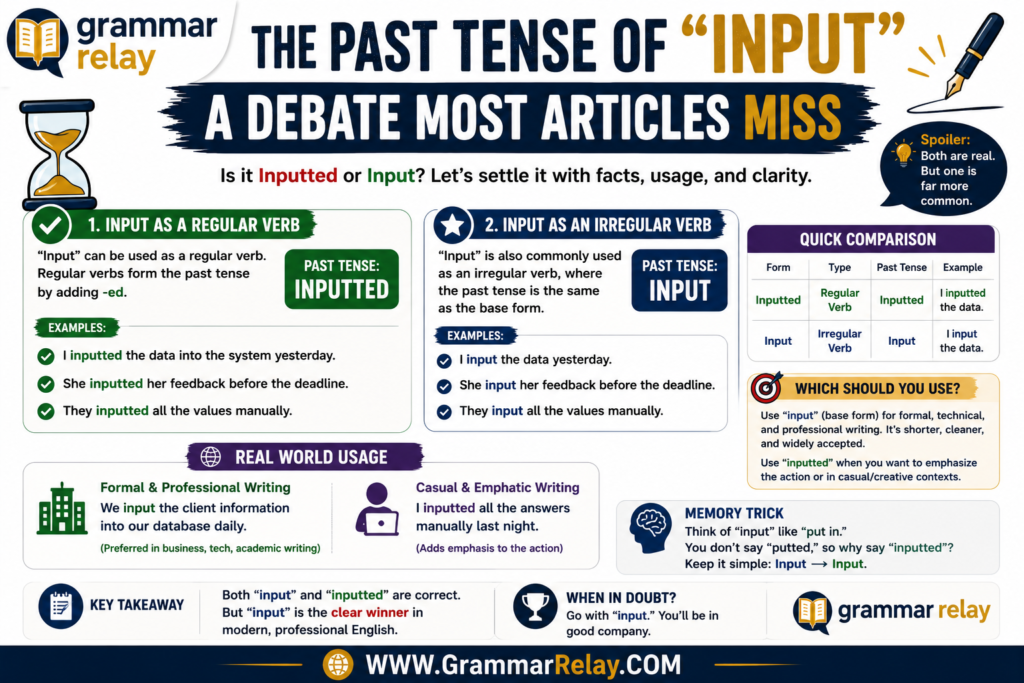
Here’s a genuine usage question that imput or input articles almost universally ignore. What’s the correct past tense of “input”?
Both “inputted” and “input” are accepted. Major style guides don’t fully agree:
| Style Guide | Preferred Past Tense | Notes |
|---|---|---|
| Chicago Manual of Style | Input (unchanged) | Treats as zero-inflection verb |
| AP Stylebook | Input or inputted | Both accepted |
| Oxford Style Guide | Inputted | Prefers regular inflection |
| Microsoft Style Guide | Input | Used in technical documentation |
| American Heritage Dictionary | Both accepted | Lists both as standard |
The practical advice: pick one form and stay consistent throughout your document. In technical writing, “input” as past tense reads more cleanly. In general writing, “inputted” signals past tense more clearly to casual readers.
Input vs Output: The Relationship Everyone Knows but Rarely Explains Fully
Understanding input or imput becomes easier when you see “input” alongside its natural counterpart. Output is what comes out. Input is what goes in. Simple enough. But the relationship runs deeper across different fields:
| Aspect | Input | Output |
|---|---|---|
| Computing | Keyboard data entered | Results displayed on screen |
| Business | Team feedback and research | Final report or decision |
| Education | Information received by learner | Knowledge demonstrated |
| Economics | Raw materials, labor, capital | Finished goods or services |
| Biology | Food and oxygen consumed | Energy produced |
Stephen Krashen’s Input Hypothesis, first published in 1982, built an entire theory of language acquisition on this relationship. Krashen argued that learners acquire language primarily by receiving “comprehensible input” (language slightly above their current level) rather than through explicit grammar instruction. The term “input” here is technical, specific, and entirely different from its computing meaning yet the core idea remains: something enters a system and something else comes out.
“Input” in Technology: The Technical Definition
In computing, input describes any data or signal entering a system for processing. The range of input types in 2025 is broader than ever:
| Input Type | Examples | What They Feed Into |
|---|---|---|
| Text input | Keyboard, voice-to-text | Word processors, search engines |
| Pointing input | Mouse, touchpad, stylus | Graphical interfaces |
| Audio input | Microphone, audio interface | Voice recognition, recording software |
| Visual input | Camera, scanner | Image recognition, document digitization |
| Data input | APIs, databases, CSV files | Business systems, analytics platforms |
| Biometric input | Fingerprint reader, facial recognition | Security systems, authentication |
Input validation deserves special mention. In software development, validating input means checking that data entering a system meets expected formats and constraints before processing it. Poor input validation is one of the most common sources of software vulnerabilities. The OWASP Top 10 consistently lists input-related security failures among the most critical web application risks.
You might be interested in Purposed vs Proposed: Complete Guide to Meaning, Grammar, and Correct Usage
“Input” in Business, Education, and Everyday Life
Input shows up across every professional and personal context:
| Context | Example Sentence | Register |
|---|---|---|
| Workplace | “The manager asked for input before finalizing the strategy.” | Professional |
| Project management | “Stakeholder input shaped every phase of the project.” | Formal |
| Education | “Comprehensible input accelerates language acquisition significantly.” | Academic |
| Creative work | “Her input transformed the initial concept entirely.” | Professional |
| Casual conversation | “Can I get your input on something?” | Informal |
| Technology | “Please input your password to continue.” | Technical |
“The quality of your output is determined by the quality of your input.” — widely attributed in business and systems thinking
In business writing especially, “input” appears in stakeholder communication, requirements gathering, and feedback collection. Asking for someone’s “input” signals respect for their perspective while keeping the request open-ended.
Common Collocations and Fixed Phrases With “Input”
Knowing how “input” collocates helps you use it naturally:
| Collocation | Example | Context |
|---|---|---|
| Seek input | “We seek input from all team members.” | Professional |
| User input | “The app relies on user input to function.” | Technology |
| Valuable input | “Your valuable input shaped our decision.” | Business/formal |
| Input field | “Fill in the input field with your email.” | Technology |
| Input data | “The system processes input data in real time.” | Computing |
| Community input | “The council gathered community input before voting.” | Government/civic |
Synonyms for “Input” (When You Need a Different Word)
| Synonym | Best Used When | Example |
|---|---|---|
| Contribution | Emphasizing active role | “Her contribution shaped the outcome.” |
| Feedback | Specifically evaluative response | “We need your feedback before launch.” |
| Data | Technical/computing contexts | “The system processes incoming data.” |
| Perspective | Emphasizing point of view | “I’d love your perspective on this.” |
| Insight | Emphasizing depth of knowledge | “Her insight proved invaluable.” |
| Entry | Data entry contexts | “Complete each entry in the form.” |
Memory Tricks That Make “Input” Stick Forever

Three anchors that genuinely work:
The “in + put” visual breakdown: You’re literally putting something IN. Break the word apart every time: IN + PUT. The “im-” version doesn’t reflect what the word actually means because nothing about “imput” signals direction inward.
The output mirror trick: If “output” looks right to you (and it should), “input” follows the identical pattern. Out + put. In + put. They’re a matched pair. You’d never write “omput” for output so don’t write “imput” for input.
The “im-” prefix test: Ask yourself whether the word uses a Latin “im-” prefix meaning “into” or “not.” Impact? Yes. Import? Yes. Input? No. The prefix is “in-” not “im-” because the second component starts with “p” not “b” or “p” in a Latin context. The word is built from English components, not Latin ones.
Frequently Asked Questions
What is the difference between input and imput?
“Input” is the correct English word for data, contribution, or information entering a system or process. “Imput” is simply a misspelling with no dictionary entry, no recognized usage, and no correct context. There’s no meaningful difference because only one of them is a real word.
Is “imput” ever correct in any context?
No. Not in American English, British English, Australian English, or any other recognized variety. Not in technical writing, academic writing, business communication, or casual conversation. “Imput” is always an error.
What is the past tense of input?
Both “input” (zero inflection) and “inputted” are accepted past tense forms. Technical writers and the Chicago Manual of Style tend to favor “input” unchanged. The Oxford Style Guide prefers “inputted.” Both are correct so choose one and stay consistent.
Can “input” be used as both a noun and a verb?
Yes. As a noun: “Your input was valuable.” As a verb: “Please input the data into the system.” Both uses are standard and appear in all major dictionaries.
What’s the difference between input and output?
Input is what enters a system, process, or conversation. Output is what comes out. In computing: keystrokes are input, displayed text is output. In business: research and feedback are input, the final decision is output.
Why does autocorrect sometimes miss “imput”?
Some spell-checkers treat “imput” as a potential proper noun or unrecognized word rather than a clear error. It doesn’t trigger the same red-underline response as obvious misspellings. Always proofread manually for this specific error in professional documents.
Read more grammar lessons on Grammar Relay
Conclusion
The input or imput question has exactly one answer. Input. Every time. In every context. Without exception.
The etymology makes it unforgettable: “in” plus “put.” You put something in. The word describes exactly what it does, which is rare and useful in English. The “im-” version breaks the compound structure, contradicts the etymology, and doesn’t appear in any reference source that matters.
Understanding input vs imput at this depth means you’ll never mistype it again and you’ll spot it immediately when others do. In professional writing, that kind of precision signals exactly the attention to detail that makes communication credible and trustworthy.
