


Here’s a mistake that autocorrect misses and spell-checkers ignore. You type “to many” and nothing flags it. The sentence looks fine. But any careful reader spots the error instantly and your credibility takes a quiet hit before you’ve made your actual point.
So which is it: to many or too many? And why does this particular confusion persist even among confident writers?
This guide answers both questions completely. You’ll walk away knowing the rule, the reasoning behind it, and a memory trick that makes the correct choice automatic every time.
The Straight Answer (No Grammar Jargon Required)
Too many is always the correct phrase when expressing excess with countable nouns. “To many” as a fixed phrase is always an error. Full stop.
However, there’s a nuance worth knowing: “to” and “many” can legitimately appear side by side in a sentence as two separate words. That’s different from the error. More on that shortly.
| Phrase | Correct? | When | Example |
|---|---|---|---|
| Too many | Yes | Expressing excess with countable nouns | “There are too many emails in my inbox.” |
| To many | No | Never correct as a unit phrase | Always an error |
| To + many (split) | Sometimes | When both words appear separately | “She spoke to many people at the event.” |
The answer to is it to many or too many is unambiguous. When you mean “an excessive number of something,” the correct spelling is always too many.
What “Too” Actually Means (The Word Doing All the Work)
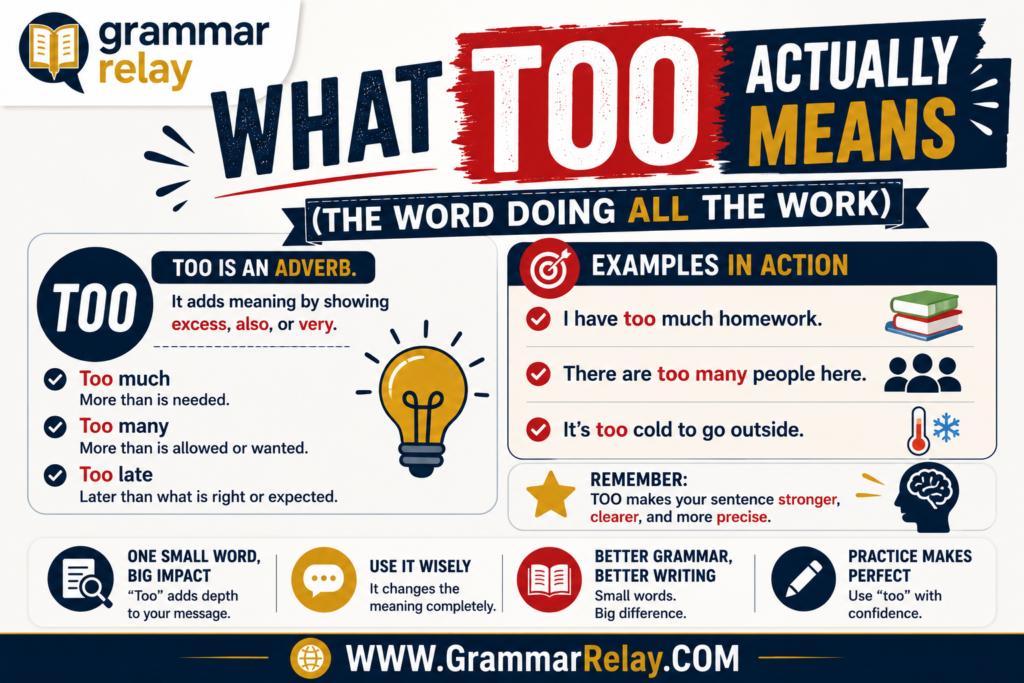
Understanding to and too starts with knowing what each word actually does in a sentence.
“Too” is a degree adverb. It signals either excess (“more than is desirable”) or addition (“also, as well”). It never points in a direction. Its never introduce a verb. It only ever describes degree or addition.
| Meaning of “Too” | Example | What It Signals |
|---|---|---|
| Excessively | “It’s too hot to work outside.” | Degree beyond acceptable limit |
| Also/as well | “I want to come too.” | Addition to something already stated |
| Intensifier | “She arrived too quickly.” | Emphasizing degree of an action |
| With “many” | “Too many cooks spoil the broth.” | Excessive quantity of countable things |
The too and to difference becomes immediately clear once you internalize this: “too” deals with degree and addition while “to” deals with direction, purpose, and verb formation. They inhabit completely separate grammatical territories.
What “To” Actually Means (And Why It Can’t Replace “Too”)
“To” works harder than almost any other word in English. It functions as a preposition, an infinitive marker, a time indicator, and more. What it never does is express quantity or excess.
| Function of “To” | Example | Grammatical Role |
|---|---|---|
| Preposition (direction) | “She walked to the store.” | Shows movement toward destination |
| Infinitive marker | “He wants to learn guitar.” | Precedes base verb |
| Time expression | “It’s quarter to three.” | Indicates time relationship |
| Ratio/range | “We won five to two.” | Shows proportion |
| Indirect object | “Give the book to her.” | Links verb to recipient |
A useful to example that clarifies things instantly: “She went to the park.” Here “to” points toward a destination. You could never swap it for “too” without breaking the sentence entirely. That fundamental incompatibility is the key insight.
Thinking about want to or want too follows the same logic. “I want to go” uses “to” as an infinitive marker. “I want to go too” uses “too” at the end meaning “also.” These are two completely different functions happening in the same sentence.
Read more about Purposed vs Proposed: Complete Guide to Meaning, Grammar, and Correct Usage
“Too Many” vs “Too Much”: A Distinction Most Articles Skip
Here’s where most grammar guides on this topic stop short. Getting too many or to many right is only half the battle. You also need to know when “too many” applies versus when “too much” is the correct choice.
The rule hinges entirely on whether your noun is countable or uncountable.
| Phrase | Used With | Example | Noun Type |
|---|---|---|---|
| Too many | Countable nouns | “Too many meetings today.” | Things you can count individually |
| Too much | Uncountable nouns | “Too much coffee is bad for you.” | Things measured in mass or volume |
| Too few | Countable nouns | “Too few volunteers showed up.” | Insufficient countable items |
| Too little | Uncountable nouns | “Too little sleep causes real problems.” | Insufficient uncountable quantity |
Too many pairs with countable nouns. Too much pairs with uncountable nouns. Getting this distinction wrong produces errors like “too many information” (incorrect) or “too much emails” (also incorrect). Both sound jarring to native ears even if the speaker clearly understood the excess they meant to describe.
How to Identify Countable vs Uncountable Nouns
The fastest test for to many or too many decisions is asking one question: can you put a specific number before this noun?
“Three emails.” Works. Emails are countable. Use too many emails. “Three information.” Doesn’t work. Information is uncountable. Use too much information.
| Countable (Use Too Many) | Uncountable (Use Too Much) | Context-Dependent |
|---|---|---|
| Emails | Information | Coffee (too many coffees / too much coffee) |
| Meetings | Traffic | Work (too many tasks / too much work) |
| Mistakes | Noise | Light (too many lights / too much light) |
| People | Advice | Experience (too many experiences / too much experience) |
| Cars | Water | Time (too many times / too much time) |
| Tasks | Stress | Space (too many spaces / too much space) |
Context-dependent nouns are the trickiest category. “Coffee” can be countable when you’re ordering individual cups (“too many coffees this morning”) or uncountable when referring to the substance (“too much coffee in this recipe”). The meaning you intend determines which quantifier you need.
“To Many”: When It’s Actually Correct (The Nuance Competitors Miss)
Here’s the distinction that separates a thorough grammar guide from a surface-level one. While “to many” as a fixed phrase is always an error, the words “to” and “many” do legitimately appear side by side in sentences. They just aren’t functioning as a unit.
| Sentence | Analysis |
|---|---|
| “She spoke to many people at the conference.” | “To” is a preposition; “many” separately modifies “people” |
| “This rule applies to many different situations.” | Preposition + adjective, completely separate grammatical functions |
| “He reached out to many colleagues last week.” | Standard preposition use; not a fixed phrase |
| “The announcement was sent to many departments.” | Two independent words appearing near each other |
In each sentence above, “to” points toward something and “many” describes quantity. Neither word affects the other. Compare that to “too many emails” where “too” directly modifies “many” to signal excess. The grammatical relationship is fundamentally different.
“Grammar is the logic of speech, even as logic is the grammar of reason.” — Richard Chenevix Trench
“Too Many” in Everyday Real-Life Contexts
Too many appears across virtually every writing context and register. Here’s how it functions across different environments:
| Context | Example Sentence | Register |
|---|---|---|
| Workplace | “We have too many unresolved tickets in the queue.” | Professional |
| Academic | “Too many variables were introduced without adequate controls.” | Formal |
| Casual | “There are way too many people here right now.” | Informal |
| Idiomatic | “Too many cooks spoil the broth.” | Proverbial |
| Journalism | “The agency cited too many compliance failures.” | Neutral/formal |
| Social media | “Too many opinions, not enough solutions.” | Informal |
The question of way too many or way to many follows the same logic as the core rule. “Way” here functions as an intensifier meaning “considerably” or “by a large margin.” So the phrase is always way too many. “Way to many” is always wrong.
Similarly, to many more or too many more resolves the same way. If you’re expressing that the quantity exceeds what’s acceptable, you need “too many more.” Example: “There are too many more variables to account for in this model.”
The Grammar Engine Behind “Too Many”
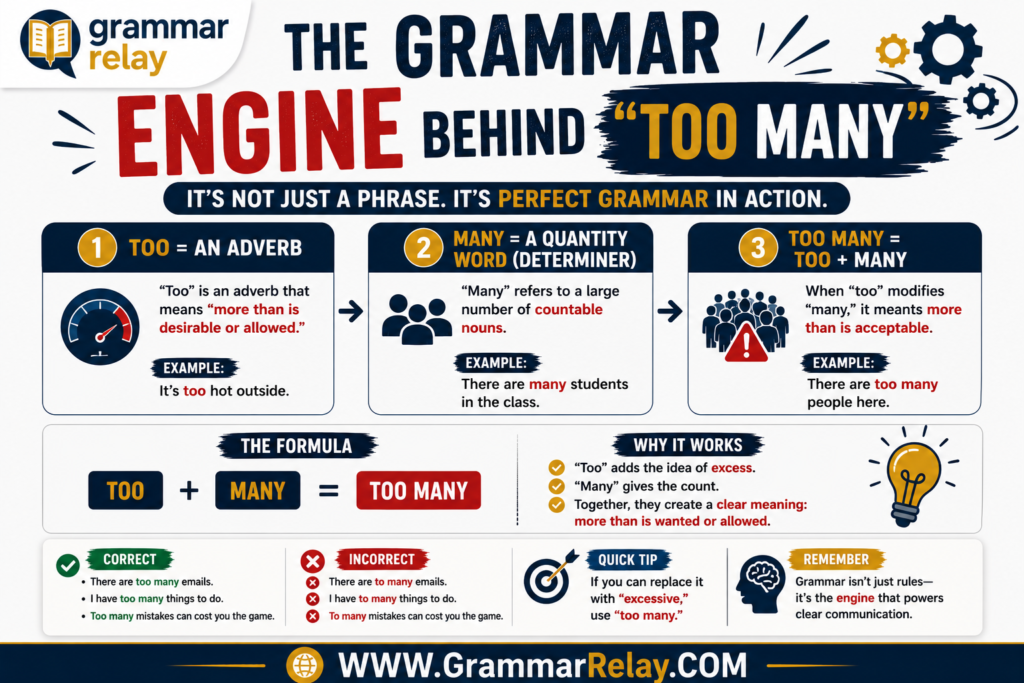
Breaking down the grammatical structure of too many reveals why it works the way it does:
| Component | Grammatical Role | Example |
|---|---|---|
| Too | Degree adverb | Modifies “many” |
| Many | Determiner/adjective | Modifies the countable noun |
| Countable plural noun | Head noun | The thing existing in excess |
| Full structure | Too + many + noun | “Too many errors in the report” |
| Implied noun | Too + many (noun implied) | “How many is too many?” |
“Too” modifies “many” by intensifying it. “Many” then modifies the countable plural noun. The chain works like this: too (adverb) → many (determiner) → [noun]. Remove “too” and you just have quantity. Add “too” and you have excess.
Interestingly, the noun can be implied and dropped in informal usage. “How many meetings is too many?” doesn’t need a second noun at the end. Native speakers understand the implied meaning. This informal pattern appears constantly in everyday conversation.
You might be interested in Definition of Brite: Meaning, Spelling, and When It’s Actually Correct
Common Mistakes Writers Make With “To” and “Too Many”
Even careful writers make these errors. Here’s what to watch for:
| Incorrect | Correct | Why |
|---|---|---|
| “There are to many options.” | “There are too many options.” | “Too” needed to express excess |
| “Too many information.” | “Too much information.” | Information is uncountable |
| “Too much emails in my inbox.” | “Too many emails in my inbox.” | Emails are countable |
| “To many people attended the event.” | “Too many people attended the event.” | Expressing excess requires “too” |
| “Way to many mistakes.” | “Way too many mistakes.” | Intensifier + degree adverb + determiner |
The to many error most commonly happens in two situations: fast typing where the double-O gets dropped and autocorrect that changes a correct “too” to “to” without flagging it. Always do a manual check for this specific word in professional documents.
“Too Many” Expressions and Idioms Worth Knowing
The phrase too many anchors several important fixed expressions in English:
| Expression | Meaning | Register |
|---|---|---|
| “Too many to count” | An enormous uncountable quantity | All levels |
| “Too many cooks spoil the broth” | Too many people involved creates problems | Informal/idiomatic |
| “One too many” | One more than is acceptable or wise | All levels |
| “Too many variables” | Excessive complexity in a situation | Academic/professional |
| “Too many times” | More frequently than is acceptable | All levels |
| “Too many to mention” | So numerous listing them isn’t practical | Formal and informal |
“One too many” deserves special attention. It appears in contexts ranging from drinking one extra glass (“he had one too many”) to making one extra mistake (“that was one too many errors”). The phrase always implies crossing a threshold from acceptable to excessive.
Memory Tricks That Make “Too Many” Stick Forever
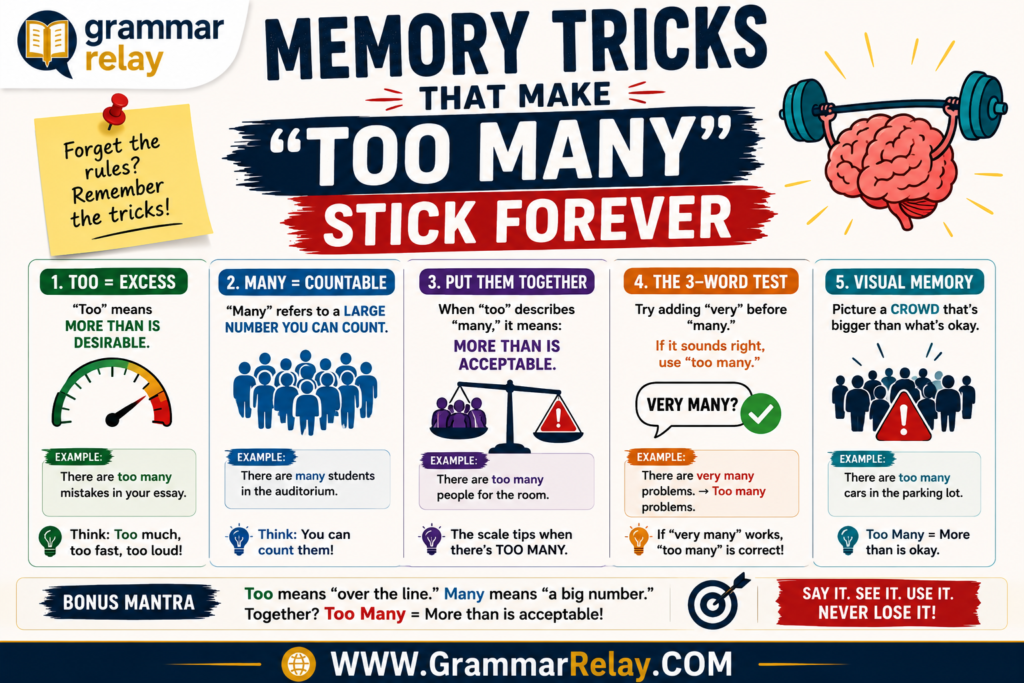
Three shortcuts that genuinely work every time:
The extra O trick: “Too” has an extra O because it means extra or excess. Two O’s signal “too much” of something. One O in “to” means you’re going somewhere or doing something. This visual anchor is the most reliable memory device for the to many or too many question.
The substitution test: Swap “too” for “excessively.” If the sentence still makes sense, “too” is correct. “There are excessively many emails” works structurally so “too many emails” is right. “She walked excessively the store” breaks completely so “to” is correct for that sentence.
The countable test: Can you put a specific number before the noun? If yes, use “too many.” If no, use “too much.” This test prevents the secondary error of pairing “too many” with uncountable nouns.
Quick Practice: “To” or “Too Many”? Test Yourself
Fill in the blank with the correct option:
- “There are _____ tasks on my plate this week.” (to many / too many)
- “She sent the report _____ many colleagues simultaneously.” (to / too)
- “The project failed because of _____ variables.” (to many / too many)
- “We have _____ much noise in this office.” (to / too)
- “He gave the document _____ many reviewers before submitting.” (to / too)
Answers: too many, to, too many, too, to
The trickiest sentence is the last one. “To many reviewers” looks like the error phrase but here “to” is a preposition pointing toward “reviewers” and “many” is a separate adjective. They aren’t working together as a unit. That’s the nuance that separates genuine understanding from surface-level rule memorization.
Frequently Asked Questions
Is “to many” ever grammatically correct?
As a fixed phrase expressing excess, never. However, “to” and “many” can appear next to each other in a sentence when “to” functions as a preposition and “many” separately modifies a noun. These two words appearing near each other isn’t the same as the error phrase “to many.”
What’s the difference between “too many” and “too much”?
“Too many” pairs with countable nouns (things you can number individually). “Too much” pairs with uncountable nouns (things measured in mass or volume). Emails are countable so you use “too many emails.” Water is uncountable so you use “too much water.”
Can “too many” appear without a noun after it?
Yes in informal usage. “How many is too many?” drops the second noun because the context makes it clear. Native speakers use this implied noun construction constantly in casual conversation.
Why do people confuse “to” and “too” so consistently?
Both words sound identical in speech. In fast or casual writing, the double-O gets dropped through habit or autocorrect interference. The confusion persists because neither word triggers a spell-check error since both are valid English words.
What’s the opposite of “too many”?
“Too few.” If “too many” signals an excessive countable quantity, “too few” signals an insufficient one. “There are too few resources” pairs with the countable noun just like “too many” does but signals deficiency rather than excess.
Is “way too many” correct?
Yes. “Way” intensifies “too many” by emphasizing the degree of excess. “Way too many” means considerably more than is acceptable. “Ways to many” is always the incorrect version.
Read more grammar lessons on Grammar Relay
Conclusion
Two words. One extra letter. Significant difference in meaning.
Too many is the correct phrase for expressing excess with countable nouns and it belongs in everything from casual texts to formal reports. “To many” as a fixed phrase is always wrong regardless of context, register, or audience.
The extra O in “too” is your permanent visual anchor. See “too” before “many” and you’re looking at excess. See “to” before “many” and you’re either looking at an error or two separate words that happen to appear near each other in a sentence.
Once that distinction clicks, to many or too many stops being a question you have to think about. It becomes automatic and that’s exactly where good grammar lives.
