


You’ve probably seen both these words tossed around in news headlines or formal writing, and if you’ve ever paused mid-sentence wondering which one fits, you’re definitely not alone. They look similar, they sound similar when you’re skimming quickly, and that one extra letter makes all the difference in the world. Let’s clear this up for good.
Quick Answer
Imminent means something is about to happen very soon, usually within a short timeframe. Eminent describes a person or thing that’s highly respected, distinguished, or notable in their field. One word is about timing, the other is about status.
Here’s a simple side-by-side example: “The storm is imminent” tells you bad weather is coming fast. “She’s an eminent scientist” tells you she’s earned serious respect in her profession. Different words, different jobs entirely.
What Does Imminent Mean?
Definition and Core Meaning
Imminent describes something that’s about to occur, often within moments, hours, or days. It carries a sense of urgency, like the event is hovering right on the edge of happening. Think of it as the word you reach for when something feels close enough to touch.
Common Contexts
You’ll spot “imminent” most often in a handful of specific situations. Weather warnings love this word, as in “imminent flooding” or “an imminent storm system.” Emergency situations rely on it heavily too, since first responders and news anchors need a word that conveys real urgency without overstatement.
Business and legal writing use it constantly as well. A company might warn employees of an “imminent merger,” while a lawyer might describe an “imminent court ruling.” Political reporting follows the same pattern, often referencing an “imminent decision” from a government body or an “imminent ceasefire” during ongoing negotiations.
Example Sentences
- “Forecasters warned residents that the hurricane’s landfall was imminent.”
- “With the deadline just hours away, an imminent decision from the board seemed inevitable.”
- “Doctors said the patient’s recovery was imminent after weeks of treatment.”
What Does Eminent Mean?
Definition and Core Meaning
Eminent describes someone or something widely recognized for excellence, authority, or distinction within a particular field. Unlike imminent, this word has nothing to do with timing. It’s entirely about reputation and standing.
Read more about Smelled vs Smelt: The Real Difference
Common Contexts
This word shows up constantly in academic and professional circles. Academia uses it to describe respected professors and researchers, as in “an eminent historian” or “an eminent physicist.” Medicine follows suit, with phrases like “an eminent cardiologist” appearing in hospital bios and medical journals.
Law and politics lean on this word too, often to describe judges, attorneys, or public figures who’ve built a strong reputation over time. You might read about an “eminent jurist” sitting on a high court, or an “eminent diplomat” negotiating a major treaty.
Example Sentences
- “The university invited an eminent professor to deliver the keynote address.”
- “He’s regarded as one of the most eminent surgeons in the country.”
- “Her work earned her recognition as an eminent voice in environmental science.”
Imminent vs Eminent: Key Differences Explained
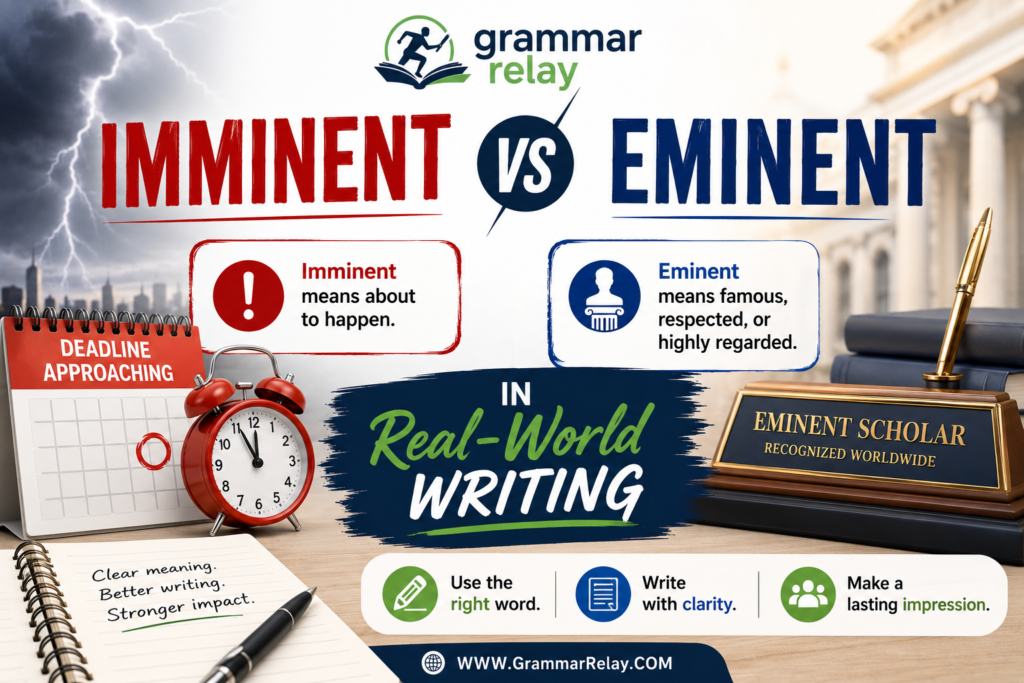
Here’s the cleanest way to separate these two: imminent is about when something happens, eminent is about who someone is. One deals with time pressure, the other deals with prestige.
If you’re describing an event, a deadline, a storm, or anything that’s about to occur, reach for “imminent.” If you’re describing a person’s reputation, expertise, or standing in their field, reach for “eminent.” It really comes down to asking yourself one question: am I talking about timing or about status?
Comparison Table
| Feature | Imminent | Eminent |
|---|---|---|
| Core meaning | About to happen soon | Highly respected or distinguished |
| Part of speech | Adjective | Adjective |
| Typical subject | Events, deadlines, dangers | People, achievements, reputations |
| Common fields | Weather, emergencies, law, business | Academia, medicine, law, politics |
| Example | “An imminent storm” | “An eminent scholar” |
A Quick Note on “Immanent” (The Third Lookalike)

There’s actually a third word that occasionally trips people up because of its similar spelling: immanent. This one means something that exists or operates within something else, often used in philosophical or theological writing to describe a quality inherent to a thing rather than imposed from outside it. For example, “Some philosophers argue that morality is immanent to human nature rather than externally imposed.”
This word is far less common in everyday writing, but if you ever see it, don’t confuse it with either imminent or eminent. It’s a completely separate concept tied to inherent qualities, not timing or reputation.
How to Remember the Difference
A solid memory trick can save you from second-guessing yourself every time. For imminent, think of the word “immediate.” Both start with the same letters and both relate to something happening fast. If a deadline is imminent, it’s basically immediate.
For eminent, think of the word “elite.” Both words relate to standing out, being respected, or sitting at the top of a field. An eminent doctor is an elite doctor in terms of reputation. Once these two associations click, you’ll rarely mix them up again.
Common Mistakes
A few patterns show up again and again in writing, even among experienced writers:
- Using “eminent” to describe danger or urgency. A sentence like “The eminent threat of flooding” is incorrect, since urgency calls for “imminent” instead.
- Using “imminent” to describe a respected person. Saying “He’s an imminent professor” doesn’t work, since reputation calls for “eminent.”
- Mixing up “immanent” with either word due to spelling similarity. This happens less often, but it’s worth double-checking in academic or philosophical writing where “immanent” might legitimately appear.
You might be interested in Calfs or Calves: The Correct Plural of Calf
Pronunciation Differences
Spoken language adds another layer of confusion here, since both words sound fairly close when said quickly. Imminent is pronounced “IM-uh-nuhnt,” with the stress on the first syllable. Eminent is pronounced “EM-uh-nuhnt,” also stressed on the first syllable, but starting with an “eh” sound rather than an “ih” sound.
If you say them slowly side by side, the difference becomes clearer. The “im” sound in imminent is short and sharp, while the “em” sound in eminent is slightly more open. Practicing both out loud a few times tends to lock in the distinction far faster than just reading definitions.
Imminent vs Eminent in Real-World Writing
News and Journalism
Journalists rely heavily on “imminent” when covering breaking news. Headlines like “Imminent Storm Threatens Coastal Towns” or “Imminent Vote Expected on Controversial Bill” show up constantly because urgency drives reader attention.
Academic and Professional Writing
In academic circles, “eminent” appears in author bios, conference introductions, and award announcements. A university press release might read, “The eminent researcher will present findings at next month’s symposium,” lending weight and credibility to the announcement.
Business Communication
Companies use both words depending on context. An internal memo might warn of “imminent budget cuts,” while a company newsletter might celebrate “an eminent industry leader” joining the board of directors.
Quick Reference Table
| Word | Meaning | Typical Use Case | Memory Hook |
|---|---|---|---|
| Imminent | About to happen soon | Storms, deadlines, emergencies | Sounds like “immediate” |
| Eminent | Highly respected | Scholars, doctors, leaders | Sounds like “elite” |
Frequently Asked Questions
What’s the main difference between imminent and eminent?
Imminent refers to timing, describing something about to happen soon, while eminent refers to status, describing someone or something highly respected in their field.
Can imminent and eminent ever be used interchangeably?
No, these words serve entirely different purposes and swapping them creates confusing or incorrect sentences.
What does immanent mean, and how is it different from both?
Immanent describes something inherent or existing within something else, often used in philosophical contexts, and has no connection to timing or reputation.
How can I remember the difference easily?
Link imminent to “immediate” for timing, and link eminent to “elite” for status and reputation.
Where are these words most commonly used in professional writing?
Imminent appears frequently in news, weather, legal, and business writing, while eminent shows up most in academic, medical, and political contexts describing respected individuals.
Read more grammar lessons on Grammar Relay
Conclusion
At this point, the imminent vs eminent confusion should feel a lot less intimidating. One word tracks time, warning you that something is about to happen, while the other tracks reputation, pointing toward someone or something widely respected. Keep that core distinction in mind, watch out for “immanent” lurking as the odd one out, and you’ll never second-guess yourself when these words show up in your writing again.
