

You’re writing a sentence, you pause, and you realize you don’t know if it should be “I smelled smoke” or “I smelt smoke.” Don’t worry, this happens to a lot of people, and the good news is that both versions are actually correct. The trick is knowing when to use which one.
Quick Answer
Here’s the short version: smelled is the standard past tense in American English, while smelt is the standard past tense in British English. Neither one is wrong, but each belongs to a different side of the Atlantic.
For example, an American writer would say, “I smelled fresh bread baking,” while a British writer might say, “I smelt fresh bread baking.” Same meaning, different dialect. So when you’re debating smelled or smelt, the real question isn’t which one is correct, it’s which audience you’re writing for.
Understanding the Verb “Smell”
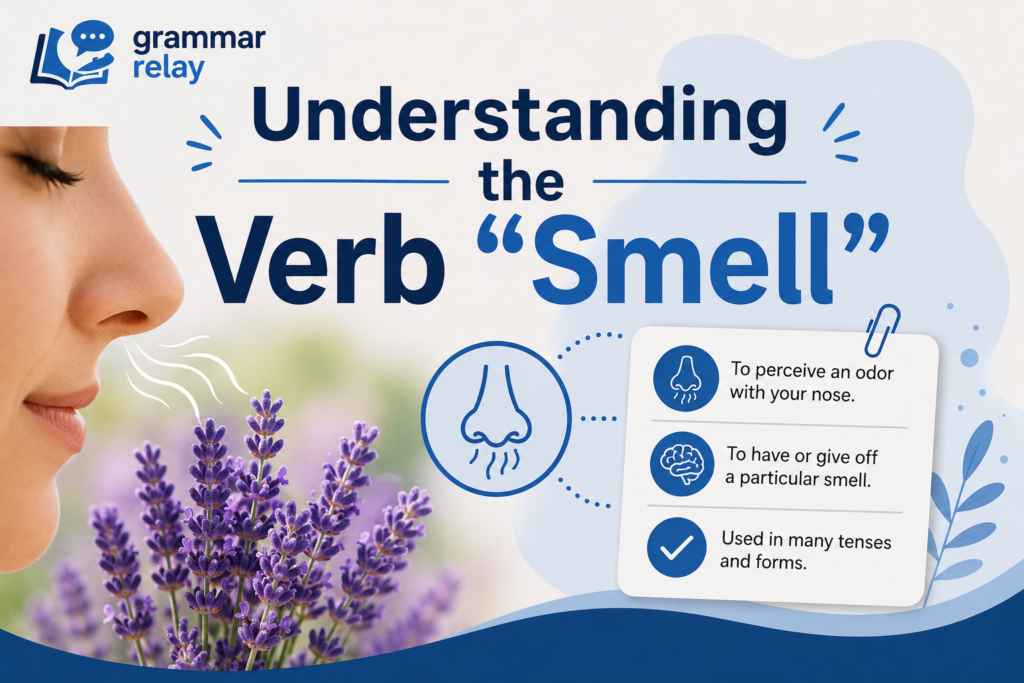
Before getting into the smelt vs smelled debate, it helps to know that “smell” actually works in two different ways depending on the sentence.
Smell as an Action Verb
When “smell” describes something you actively do, like sniffing or detecting an odor, it acts as a regular action verb. “I smelled the flowers” or “She smelled gas in the kitchen” both fall into this category. You’re performing an action with your nose, plain and simple.
Smell as a Linking Verb
But “smell” can also describe a quality, almost like the word “seems” or “appears.” In this case, it links the subject to a description rather than showing an action. “The kitchen smelled amazing” doesn’t mean the kitchen did any sniffing, it means the kitchen had a pleasant odor. This distinction matters because both smelled and smelt can fill either role, but understanding the difference helps you see why some sentences feel more natural with one form over the other.
Read more about Calfs or Calves: The Correct Plural of Calf
Smelled vs Smelt: The Core Grammar Rule
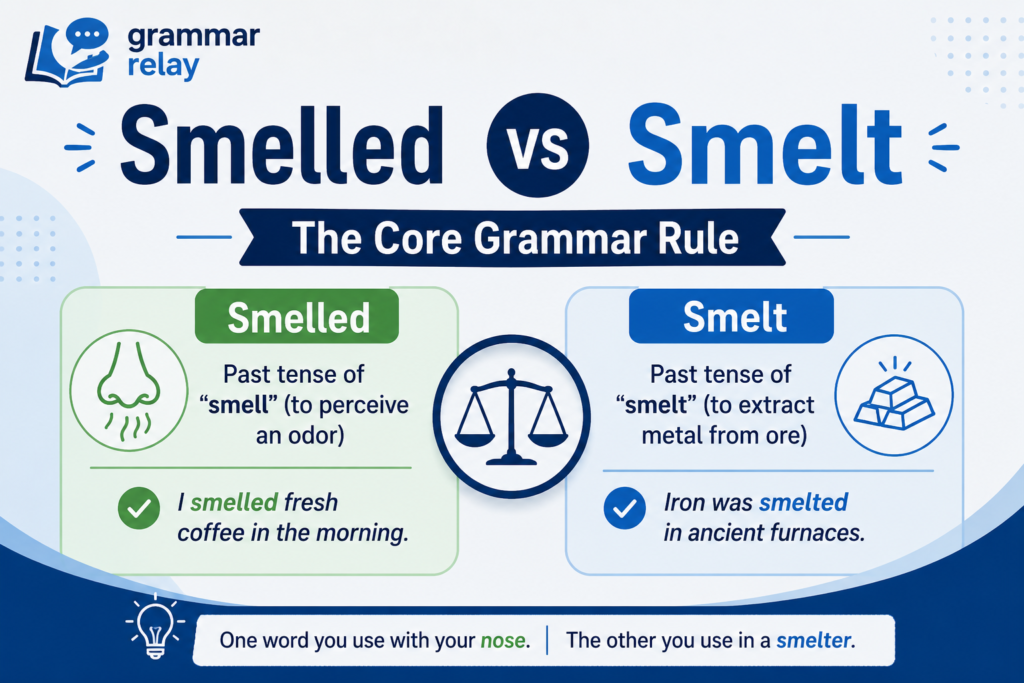
Here’s the part that surprises a lot of people: smell belongs to a small group of English verbs that have two accepted past tense forms. It’s not some random exception. Words like burn, learn, and spell follow the exact same pattern.
| Base Verb | American Past Form | British Past Form |
|---|---|---|
| smell | smelled | smelt |
| burn | burned | burnt |
| learn | learned | learnt |
| spell | spelled | spelt |
| dream | dreamed | dreamt |
Notice the pattern? In each case, the American form adds “-ed,” while the British form swaps in a “-t” ending instead. Once you spot this, smelled vs smelt stops looking like a mysterious exception and starts looking like part of a predictable family.
American English vs British English
So why does location change something as basic as a verb ending? It comes down to how English developed differently on each side of the Atlantic after British colonization spread the language to North America.
Comparison Table
| Feature | American English | British English |
|---|---|---|
| Preferred past tense | smelled | smelt |
| Usage in formal writing | Very common | Common, especially in the UK |
| Usage in casual speech | Standard | Standard |
| Recognized by dictionaries | Yes | Yes |
Both forms appear in major dictionaries, including Merriam-Webster and the Oxford English Dictionary. Neither one is considered slang or incorrect. The split is purely regional, similar to how Americans say “color” while Brits write “colour.”
Why This Matters for Writers
If you’re a blogger, student, or professional writer, your real concern shouldn’t be picking the “correct” word. It should be staying consistent. If you start an article using “smelled,” don’t suddenly switch to “smelt” halfway through. Readers notice inconsistency, and it makes writing feel sloppy even when both words are technically fine.
Smelt: The Other Meanings (Where Real Confusion Happens)
Here’s where things get genuinely tricky, and it’s the part most grammar guides skip over too quickly. The word “smelt” doesn’t just function as a past tense verb. It has two completely unrelated meanings that have nothing to do with sniffing anything at all.
Smelt as a Verb
This is the meaning covered above: the British past tense of “smell.” Example: “He smelt the rain coming before the clouds even rolled in.”
Smelt as a Process
In industrial and metallurgical contexts, “smelt” refers to the process of extracting metal from ore using heat. Steelworkers might say, “Factories smelt iron ore to produce raw steel,” and this usage has absolutely nothing to do with odors or noses. It’s been used this way in English since at least the 16th century, tied to early metalworking trades across Europe.
Smelt as a Noun
To add one more layer, “smelt” is also the name of a small, silvery fish found in cold coastal and freshwater regions, often used in fishing and cooking. You might read a recipe that says, “Pan-fried smelt makes a crispy, flavorful appetizer,” and again, this has zero connection to the verb form.
As one longtime copy editor once put it during an editing workshop, “Context is everything. Strip a sentence of its surroundings, and even native speakers can momentarily second-guess which ‘smelt’ they’re looking at.” That’s exactly why writers need to slow down and check the full sentence before assuming which meaning applies.
Which One Should You Use?
The honest answer is that it depends entirely on your audience. If you’re writing for an American publication, blog, or business, smelled is the safer, more expected choice. If you’re writing for a British or broader international audience, smelt fits naturally and won’t raise any eyebrows.
For global content, where readers come from a mix of regions, many writers default to “smelled” simply because American English tends to dominate online content and search engines. That said, this is a stylistic choice, not a strict rule.
What Style Guides Say
Major style guides don’t single out “smelled or smelt” with some special ruling. Instead, they generally follow regional conventions:
- AP Stylebook (used widely in American journalism) defaults to American spelling conventions, favoring smelled.
- Chicago Manual of Style similarly follows standard American usage, recommending smelled for U.S.-based publications.
- APA Style doesn’t specifically address this verb pair but generally aligns with American English throughout academic writing.
None of these guides claim that “smelt” is wrong. They simply reflect the regional preference of the audience they’re written for.
You might be interested in Advice vs Advise: The Complete Guide to Using Both Words Correctly
Common Mistakes
A few patterns show up again and again when writers mix up smelled and smelt:
- Switching forms mid-document. Starting with “smelled” in paragraph one and suddenly using “smelt” in paragraph four creates inconsistency that distracts readers.
- Using “smelt” as a linking verb for American audiences. While grammatically fine, it can sound oddly formal or even slightly old-fashioned to American ears.
- Confusing the metal or fish meaning with the verb. A sentence like “The factory smelt the metal yesterday” works fine, but writers sometimes accidentally apply the wrong meaning when skimming or editing quickly.
Quick Reference Table
| Word Pair | American Form | British Form |
|---|---|---|
| smell | smelled | smelt |
| burn | burned | burnt |
| learn | learned | learnt |
| spill | spilled | spilt |
| dream | dreamed | dreamt |
This table makes it easy to see that smelled vs smelt isn’t an isolated grammar headache. It’s part of a broader, predictable pattern across several common English verbs.
Frequently Asked Questions
Is smelt correct in modern English?
Yes, smelt remains fully correct, particularly in British English, and appears in all major dictionaries as a valid past tense form.
Which is more common, smelled or smelt?
Smelled is more common globally due to the dominance of American English in digital content, though smelt remains standard in the UK, Ireland, and Australia.
Can I use both in the same document?
It’s best to pick one and stay consistent throughout a single piece of writing, even though both forms are grammatically acceptable on their own.
Does smelt only refer to metal or fish?
No, smelt also works as the British past tense of “smell,” so context determines which meaning applies in any given sentence.
What’s the past tense of smell?
Both smelled and smelt are correct past tense forms, with the choice depending on regional English preference.
Read more grammar lessons on Grammar Relay
Conclusion
So, smelt or smelled? At this point, you’ve got the full picture: both are correct, and the only real decision is matching your word choice to your audience and staying consistent once you’ve made that choice. American writers should lean toward smelled, British writers toward smelt, and everyone should stay alert to the metal and fish meanings hiding behind that same word. Once you’ve got that straight, you’ll never have to pause mid-sentence wondering which version to type again.
